


A special exhibition at the Musée Condé, Château de Chantilly, France — through January 3, 2027
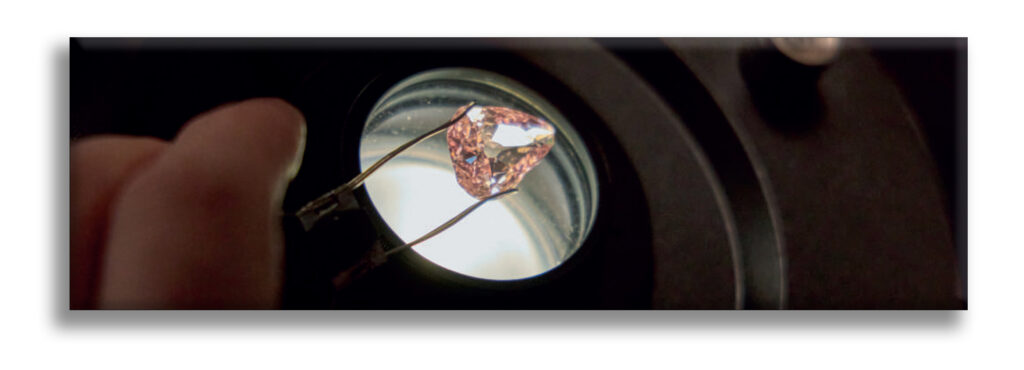
An historic pink diamond weighing 9.01 carats, stolen from a French château and recovered hidden inside an apple, would seem to have enough of a story already. But a new exhibition at the Musée Condé inside the Château de Chantilly shows there is considerably more to the Grand Condé than its celebrated disappearing act.
Presented in partnership with L’ÉCOLE, School of Jewelry Arts, supported by Van Cleef & Arpels, The Pink Diamond brings together archival research by art historian Clémence Pau and gemological examination by Dr. Emmanuel Fritsch, professor emeritus of physics at the University of Nantes, and Aurélien Delaunay and Annabelle Herreweghe, respectively director and deputy director of the Laboratoire Français de Gemmologie (LFG).
Their findings offer a closer look at the stone’s history, its cutting, and its unusual physical properties. And for those of us looking through a gemologist’s eye, there is this nagging question: With all that strain, where is the pink graining?
Strain Without Pink Graining
The English press release for the exhibition mentions that the diamond’s color results from “rarely observed physical characteristics.” Which physical characteristics? And were they observed in this diamond, or were they absent?
So we called Dr. Emmanuel Fritsch of the gemological research team for an explanation.
In many natural pink diamonds, the color is concentrated in thin, parallel bands, commonly called pink graining. These colored lamellae are associated with plastic deformation—stress that permanently distorts the diamond’s crystal structure, leaving internal strain.
The Grand Condé, however, presents a different microscopic picture. Its pink color appears evenly distributed, without the distinct pink bands one might expect.
This was a central finding of the examination of the Grand Condé published back in 2007 by Emmanuel Fritsch, Benjamin Rondeau, Thomas Hainschwang, and Marie-Hélène Quellier in Diamond & Related Materials. The authors reported: “No colored zoning or graining is observed, despite careful examination in immersion liquid.”
Yet the diamond was certainly not free of strain. Between crossed polarizers, the researchers observed strong anomalous birefringence, with interference colors, broad dark bands, and a subtle tatami pattern.
The visible spectrum of the big pink offered another important piece of evidence: a broad absorption band near 550 nanometers associated with deformation-related pink color was present, even though, again, visible pink graining when viewed in the microscope was absent.
As the researchers explained: “The disconnection of pink graining from the 550 nm band is still consistent with the pink color being related to plastic deformation.”
The recent examination confirms the homogeneous color, the characteristic absorption, and the strain features observed between crossed polarizers. The newer account also places these findings in context: nitrogen-containing type Ia pink diamonds almost always show pink graining, while type IIa pink diamonds, such as the Grand Condé—Aha!—can contain little or none.
Exactly what is happening at the atomic level to produce the pink color in this diamond remains a mystery.
A Type IIa Pink Diamond
So the Grand Condé is classified as type IIa, meaning that its infrared spectrum does not show the nitrogen absorption features used to classify type I diamonds.
In the visible range, the Grand Condé displays a group of sharper absorption features at approximately 573, 586, 594, 600, and 609 nanometers. The 2007 researchers named this group the 609 nm system.
These features add to the diamond’s scientific interest, but they should not be confused with the broad 550 nm band responsible for its pink color. The 2007 paper found that the strength of the 609 nm system did not track the intensity of the pink coloration.
An Historic Stone, with the Blemishes to Match
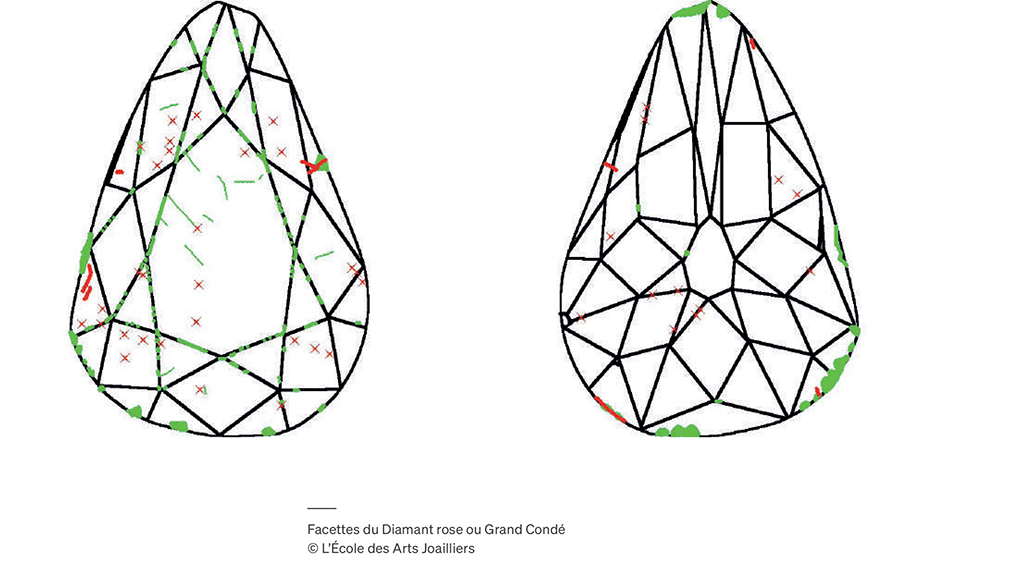
The Grand Condé is a shallow, irregular pear shape. Researchers interpret its outline and proportions as an effort to preserve as much of the original rough crystal as possible.
Its brilliant-style pavilion includes additional facets to the relatively flat crystal. A cleavage at the girdle also contributes to the asymmetrical outline.
Well, we’ve talked Carat Weight, Color, and Cut. It’s now time for Clarity. The Grand Condé’s plotting diagrams record numerous clarity characteristics: bruises, fractures, nicks, and chips—the marks of an historic diamond that has had an eventful life.
While some of surface characteristics could be removed/repaired by minor repolishing, its history is tied up in those marks. It seems highly unlikely we will ever see this historical gem placed on a diamond polishing wheel.
Revisiting the Familiar History
The Grand Condé’s traditional history reaches back to the seventeenth century.
Numerous books record an account in which Louis XIII purchased the diamond and it was subsequently given to Louis de Bourbon in 1643. The exhibition’s archival research, however, asks us to distinguish that familiar account from what can actually be documented.
No source has been found confirming that the diamond belonged to Louis II de Bourbon, Prince of Condé—the celebrated military commander known as the Grand Condé.
Its first certain appearance is in the inventory prepared after the death of his great-grandson, Louis Henri de Bourbon, in 1740.
There, the rose-colored, pendant-drop diamond was recorded in the prince’s insignia of the Order of the Golden Fleece, together with a rare green diamond and numerous yellow and white* diamonds. The insignia was later dismantled, and the pink diamond was mounted in a ring.
*White is the conventional jewelry term for diamonds in the colorless to near-colorless range, rather than diamonds with an actual white bodycolor.
The historical description does not establish their individual color grades, but we will assume that they are near-colorless. – gr
Following the sale of jewels from the estate of the last Prince of Condé in 1833, the diamond entered Queen Marie-Amélie’s collection. Intended for her grandson, Louis d’Orléans, it ultimately passed to his father, the Duke of Aumale, following Louis’s premature death in 1866.
An Indian Origin?
The Grand Condé has traditionally been associated with India’s Golconda diamond sources. However, Fritsch confirmed to the Roskin Gem News Report that no diagnostic gemological property establishes any specific origin for this stone.
We talked about a possible historical connection: if the diamond was in France during the reign of Louis XIV (1638–1715; reigned 1643–1715), Jean-Baptiste Tavernier could plausibly have brought it from India with other notable diamonds. But without documentation establishing when it arrived in France, that remains conjecture.
A Clue in the Cutting?
Looking at the Grand Condé’s pavilion diagram,
I was struck by the sunburst-like arrangement of facets surrounding its culet.
It recalls the central pavilion pattern of the French Blue,
whose sevenfold design researchers have interpreted as a reference to Louis XIV, the Sun King.
Could the resemblance offer a clue to the pink diamond’s cutting history?
That is my speculation, prompted by the diagrams.
It certainly does not establish a royal connection or a seventeenth-century date,
but it raises a question worth putting to specialists in historic diamond cutting. – gr
A Château Worth Introducing
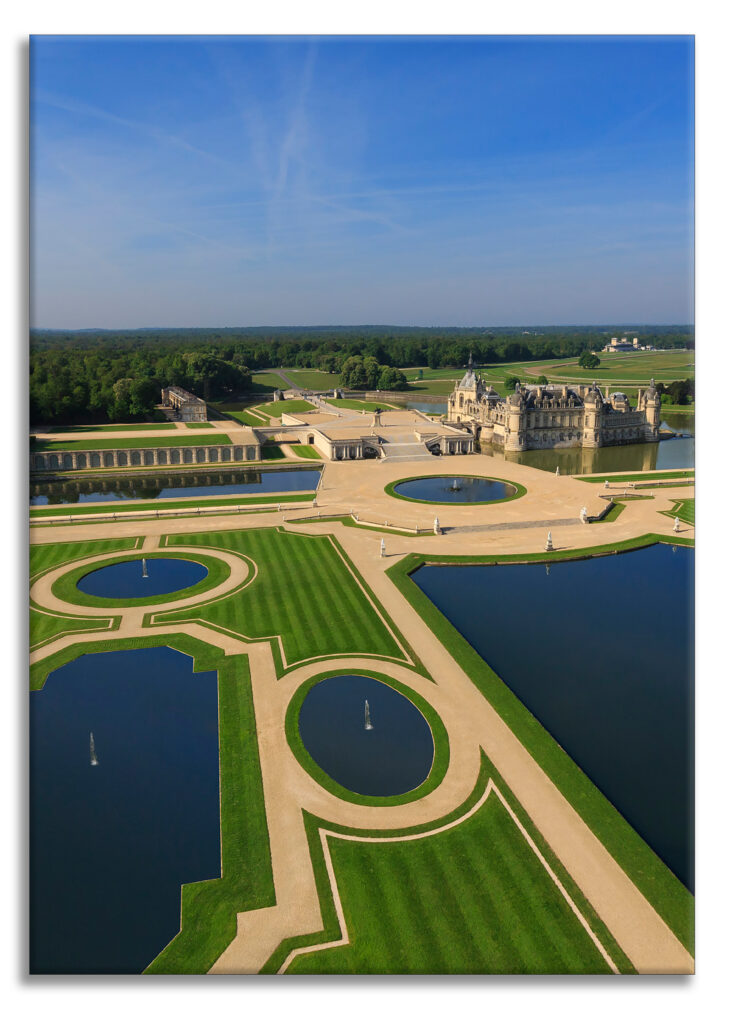
The Musée Condé occupies the enormous Château de Chantilly, north of Paris, where Henri d’Orléans, Duke of Aumale (1822–1897), assembled an extraordinary collection of paintings, manuscripts, books, and decorative arts.
A son of King Louis-Philippe, the duke gave Chantilly and its collections to the Institut de France in 1886, with conditions: the museum would open to the public after his death, its presentation would be preserved, and the collections could not be loaned.
The museum opened on April 17, 1898. Its Old Master painting collection is regarded as second only to the Louvre’s in France, including works by Raphael, Fra Angelico, Poussin, Ingres, and Delacroix.
The diamond exhibition occupies the Galerie de Psyché and Cabinet des Gemmes. The latter contains much more than gemstones, with enamels, miniatures, goldsmiths’ work, ceramics, and arms amongst its treasures.
An Apple with a Surprise Inside
On the night of October 11–12, 1926, cousins Léon-Émile Kauffer and Émile Souter crossed the château’s moat and stole the pink diamond and other objects from the Cabinet des Gemmes.
The burglary attracted international attention. For approximately two months, investigators pursued leads without recovering the diamond.
Then came the apple.

Writing for Katerina Perez, jewelry journalist Claire Roberts recounts a December 21, 1926, report in Le Petit Parisien: a hotel chambermaid bit into an apple taken from a guest’s suitcase—and discovered the stolen pink diamond.
The exhibition dossier places the discovery in a Paris hotel near the Gare de l’Est. It led to the thieves’ arrest, although many of the other stolen jewels had already been dismantled and sold.
Tap here to read Claire Roberts’s feature on Katerina Perez’ Jewellery Insights.
Returned to the museum in 1928, the Grand Condé diamond has since been displayed only on exceptional occasions. A pink elbaite tourmaline served as its usual display substitute—another identification confirmed during the recent examination.
Now visitors can see the original, alongside archival material and the results of the research.
Another Diamond, Another Corrected Story
The exhibition also revisits the history of the 14.50-carat yellow Jonquille de Chantilly.
Previously associated with the name “Penthièvre,” it is now identified as the diamond from a ceremonial dagger presented to the Duke of Aumale in 1846 by Ahmed I, Bey of Tunis. The dagger was dismantled following the 1926 theft, but the yellow diamond was recovered.
Unlike the type IIa Grand Condé, the Jonquille is type IaAB, containing nitrogen aggregates. The two stones offer visitors a useful comparison in diamond chemistry, color, cutting, and history.
Off to the Château
The Pink Diamond is on view at the Musée Condé, Château de Chantilly, through January 3, 2027. Admission is included with the château’s timed one-day ticket.
Tap here for exhibition information
Tap here to learn more about the Château de Chantilly