
It began with a dream.
Adam Neeley was attending a dinner party hosted by Salvador and Gala Dalí. After dinner, he wandered into their moonlit garden, where he encountered extraordinary flowers and creatures, all in colors that seemed almost impossible.
Rose petals drifted through the air, with Rubies sparkling inside them. A large blue butterfly appeared. A swan emerged from a bush of tuberose flowers.
The colors were unlike anything he could reproduce in traditional jewelry metals.
When Neeley woke up from this dream, he began sketching.
AN – “The next day I drew everything up in a proper sketch and said, wow, well, what am I going to make this with to get these colors?”
He had worked extensively with different colors of gold, experimenting with alloys and combinations. But the colors he imagined required something else.
His answer was titanium.
And that decision would lead to years of experimentation, considerable technical challenges, and ultimately, a collection of extraordinary jewelry.
At the 2026 AGTA Spectrum Awards, four pieces from Neeley’s Dalí’s Garden collection were entered in the competition. Two of them received a combined five recognitions, including two First Place awards, Best Use of Color, Fashion Forward, and Editors’ Choice.
But the story behind those awards began several years earlier.
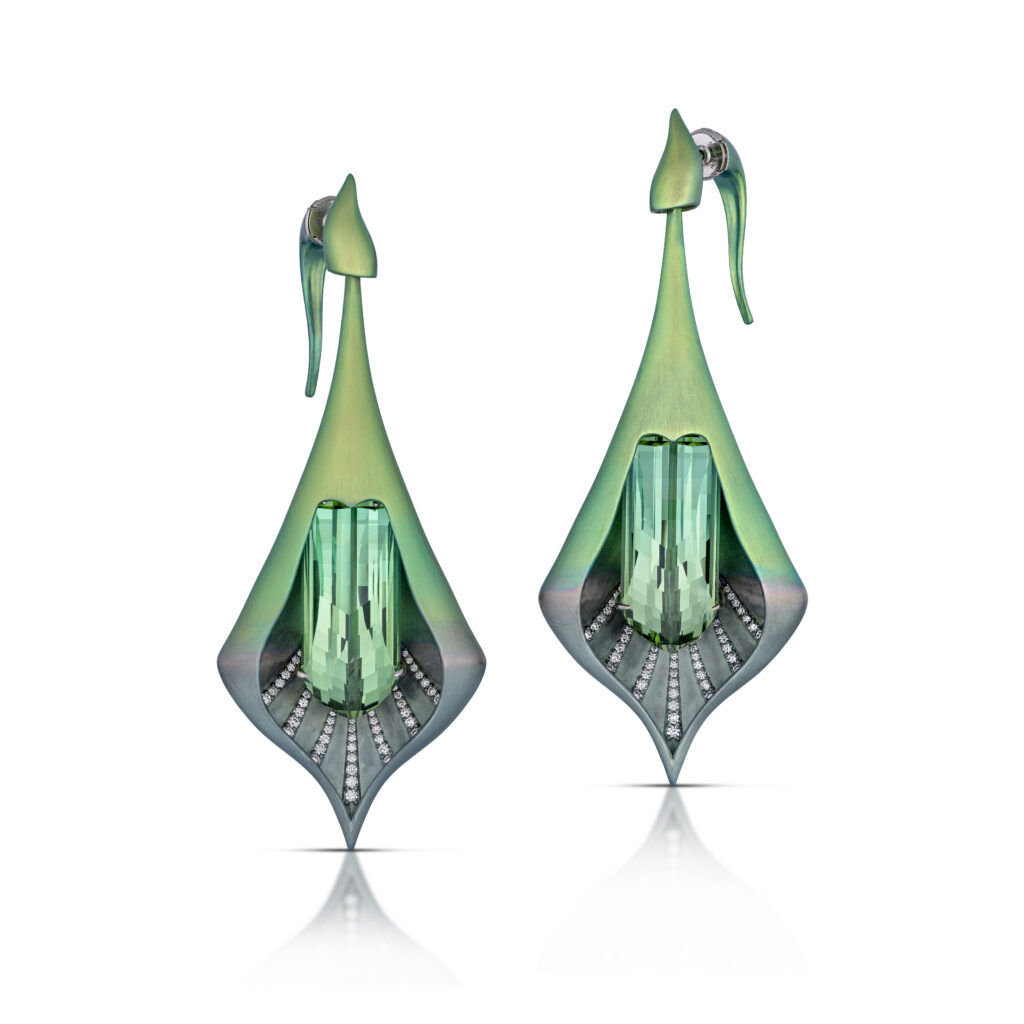
1st Place — Business/Day Wear
Best Use of Color
Editors’ Choice — Spectrum
Titanium & 18K white gold earrings
featuring green custom-cut Tourmalines (67.00 ctw.)
accented by Diamonds (1.11 ctw.)
Jeff Mason Photography
Why Titanium?
When we first spoke with Adam about titanium, our interest was gemological. How was this relatively unfamiliar jewelry metal being used to complement colored gemstones?
Neeley had already experimented with titanium in 2017 and 2018, producing a few pieces to better understand its properties and potential for color.
But it wasn’t until his dream in 2020 that he began seriously exploring what he could accomplish with it.
He recalled seeing the work of jewelry artist Wallace Chan, whose use of titanium had made a lasting impression.
AN – “Those colors were so amazing in the dream. It was like, how can I get those colors in metal?”
And titanium was the answer.
Titanium offered something that gold and platinum could not: the ability to produce a remarkable range of surface colors without applying conventional pigments or enamels.
It also offered exceptional strength at a fraction of the weight of traditional precious metals.
That combination made it possible to create jewelry on a much larger scale without making it uncomfortable to wear.
There was, however, a catch.
AN – “It’s a very difficult metal to work in. But that’s perfect for aerospace, where it’s super strong and super lightweight.”
From the Jewelry Bench to Aerospace Manufacturing
Traditional jewelry fabrication techniques don’t translate easily to titanium.
Its strength, one of its greatest advantages in finished jewelry, becomes a substantial obstacle when attempting to manipulate it.
For the intricate forms Neeley envisioned, conventional fabrication wasn’t going to be practical.
AN – “Titanium… you can fabricate with it a little bit, but I’m not aware of anyone that’s doing much more than fabricating sheets of titanium. Once the material gets much thicker, it’s really hard to manipulate, particularly with traditional jewelry equipment.”
So, Neeley turned to 3D printing.
Not through a typical jewelry casting operation, but through two companies specializing in aerospace manufacturing and medical implants.
AN – “We’re actually 3D printing with two different aerospace companies. They’re doing aerospace and they’re even doing human body implants as well.”
These companies were accustomed to producing highly engineered titanium components. But jewelry presented a different set of challenges.
Unlike conventional cast gold or platinum, the finished titanium components offer very little opportunity for substantial alteration.
Neeley explained that while titanium can be sanded, drilled, and polished, there are limits to how much the printed material can be manipulated.
That means the engineering must be completed before the final piece is manufactured.
AN – “I have to do all of my engineering ahead of time because the titanium prints are quite expensive. They’re one-offs, or very limited series. And the parts, like I said, you really cannot manipulate much.”
He creates digital models, produces wax prototypes, and then casts silver models to verify the design and construction.
Only after those steps does he commit to the titanium printing.
And there’s a very practical reason for all that preparation.
AN – “When you’re ordering sheets or scrap metal, it’s not real expensive material. But when you’re going through and doing these one-off grows that are very intricate and highly detailed, they are quite expensive.”
Mistakes can be costly.
As Adam explained, an unsuccessful print can become a very expensive object decorating his desk.
Hmmm… that sounds like the voice of experience.
AN – “Oh, yeah. Oh, yeah.”
Setting Gemstones in Titanium
For gemologists and jewelers, one of the most interesting challenges involves setting gemstones.
Titanium is strong, but that doesn’t necessarily make it a friendly material for a gemstone setter.
In fact, Neeley described the process as being considerably more demanding to set stones in titanium than to set stones in gold or platinum.
AN – “Of the four setters that I work with, only one will set in it. Everyone else has tried and said no.”
The amount of force required to move titanium during setting is substantially greater than with conventional jewelry metals.
And there isn’t much room for correction.
AN – “The amount of force that’s being used is way more than setting in gold or platinum. And then there’s also not a lot of going back. The titanium will move once or twice in one direction, and then past that it’s done.”
That creates obvious concerns when setting gemstones.
Even Diamonds, Rubies, and Sapphires can break during the process.
AN – “We already have breakage with Diamond and Sapphire, or Ruby. But it can be set in there, and we’ve kind of engineered how best to prep the models for success.”
For softer gemstones, Neeley takes another approach.
Rather than setting them directly into titanium, he creates conventional gold or platinum settings that are incorporated into the titanium structure.
AN – “For all softer colored stones, we are having to create a traditional gold or platinum setting, and then that gets incorporated into the titanium.”
It’s an important distinction.
Although titanium may dominate the visible design, the gemstone itself may actually be held in gold or platinum.
This also allows Neeley to maintain the clean lines of his designs without exposing more of the conventional setting than necessary.
During our conversation, we discussed a ring featuring a large Tanzanite set within a sculptural titanium rose.
Adam explained that the gemstone’s setting was incorporated into the design so that the precious metal remained relatively inconspicuous.
AN – “I’m not wanting to show a lot of the platinum because it’s all about the titanium and the colored stone.”
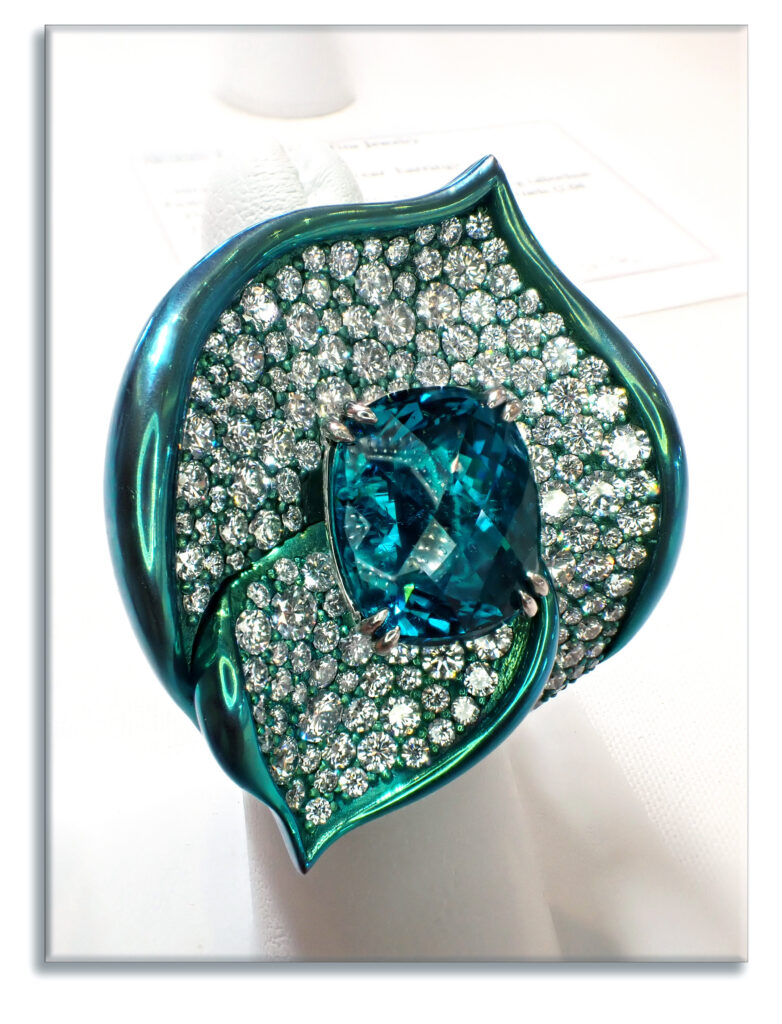
Titanium & platinum ring featuring
a 9.00 ct., indicolite Tourmaline
accented by Diamonds, 6.38 ctw.
Photo by Gary Roskin, Press Day, AGTA Spectrum Awards
Where Does the Color Come From?
One of titanium’s most remarkable characteristics is its ability to produce color through surface oxidation.
Unlike traditional colored gold alloys, titanium’s colors are not primarily the result of adding different metals to change its bulk color.
Instead, the colors arise from optical interference involving a very thin oxide layer on the metal’s surface.
The thickness of that layer determines which wavelengths of light are reinforced or diminished, producing the colors we see.
During our conversation, we asked Adam whether heat or electricity was responsible for producing the colors.
AN – “It could be both. Most people are traditionally using anodizing. Between 10 volts and about 110 volts is the key range.”
Electrical anodizing allows the jeweler to achieve relatively precise colors by controlling the voltage.
Heat coloring is less predictable, but it can produce transitions and variations that are difficult to achieve through conventional anodizing.
AN – “You can dial in a very specific color, which is great. With heat, it’s much more difficult to control an exact color. So if you’re wanting something that can be a graduation of color, an ombré, multitone, the heat is the way to go.”
For designs requiring several organically designed colors or a gradual transition between tones, Adam finds heat particularly useful.
The trade-off is control.
And once the titanium has been colored, making changes can become complicated.
Although the oxide layer can be removed and the surface recolored, repeated finishing can alter the dimensions of delicate components, including gemstone settings.
AN – “You can sand it, so you can finish it way back down and then go and try again. The issue becomes you can only do that so many times before you end up with loose stones because the prongs are getting finished down.”
Even repairs present problems.
A laser-welded area may develop a different color from the surrounding metal when anodized.
AN – “If you go through and try to laser repair a spot or a prong, that will anodize a different color. And so suddenly you could have a beautiful purple tone, and then your laser-weld area is going to come out bright green or yellow.”
For a designer whose work depends on carefully coordinated color, that’s a serious consideration.
The Gemstones Must Come First
For Neeley, titanium’s color isn’t simply decorative.
It’s part of the relationship between the gemstone and its mounting.
AN – “For myself, I use, as you probably know, a ton of colored gems. That’s my focus.”
The metal allows him to create combinations that would be difficult to achieve with traditional precious metals.
Sometimes he chooses complementary colors, allowing the titanium to contrast with the gemstone.
At other times, he uses a tone-on-tone approach, selecting a metal color related to the gemstone’s hue.
AN – “I love the fact that I can do some tone on tone with colored stones. I can do complementary colors. But I get that really vivid color that you don’t see in the traditional precious metals.”
But that requires restraint.
During our conversation, Adam described a pair of earrings featuring Burmese Rubies set against reddish-purple titanium.
The Rubies had been acquired in Tucson several years earlier.
AN – “Those Burmese Rubies, I mean, that was a Tucson find several years ago. Some of the absolute best melee Ruby I’ve ever seen, truly pigeon blood red.”
He had carefully selected the titanium color to support the Rubies rather than compete with them.
The metal could display subtle variations in hue depending on the lighting and viewing angle.
Yet the Rubies remained the visual focus.
AN – “It was really stunning to let the Rubies be the most vibrant color, that this be almost the tone on tone, but a step back from the Ruby. So the Ruby wasn’t overpowered.”
That’s an important point.
With so much color available in titanium, it would be easy for the mounting to overwhelm the gemstone.
Neeley’s challenge is to make the two work together.
Bigger Jewelry, Less Weight
Titanium offers another advantage: weight.
Its relatively low density allows Neeley to create large earrings, brooches, and other elaborate forms without the weight associated with equivalent designs in gold or platinum.
During our interview, we discussed a pair of substantial Ruby earrings.
Despite their considerable dimensions, Adam estimated that they weighed approximately 10 grams.
AN – “I think that these are probably, I’m guessing, 10 grams or so. So they’re quite a comfortable weight.”
That makes a difference in jewelry intended to be worn.
AN – “You get big, you get that lightweight, and then you get color.”
And those three qualities — scale, comfort, and color — are central to Dalí’s Garden.
But titanium isn’t necessarily a less expensive alternative to gold.
Although the raw metal is relatively inexpensive, Neeley’s manufacturing process involves costly individual 3D prints, extensive finishing, and unusually demanding gemstone setting.
AN – “I’m finding [it] more expensive by the time you add in the one-off titanium 3D prints, mixed with the prototypes, adding the labor, which here, labor time on finishing and setting is like ten times what it is in precious metal.”
For his one-of-a-kind high-jewelry creations, titanium can actually cost more to manufacture than gold.
It’s not about saving money.
It’s about achieving a result that would otherwise be difficult, or perhaps impossible.
Five Awards for Dalí’s Garden
The results of those years of experimentation were on display at the 2026 AGTA Spectrum Awards.
Four entries from Dalí’s Garden represented different interpretations of the extraordinary plants and creatures Adam imagined in his dream.
Two received five recognitions.
Trumpetta
1st Place — Business/Day Wear
Best Use of Color
Editors’ Choice — Spectrum
The Trumpetta earrings feature 67.00 carats of custom-cut mint green Tourmalines, accented by 1.11 carats of Diamonds, in titanium and 18K white gold.
The Tourmalines were custom-cut by master lapidary Stephen Avery.
Inspired by the flared form of a trumpet flower, the earrings combine sculptural green-to-white ombré anodized titanium with gemstones that reinforce the botanical theme.
The green Tourmalines provide the central color, while the surrounding titanium extends that color throughout the design.
The result demonstrates exactly what Adam described during our earlier conversation: using titanium to create a relationship between the metal and the gemstones that would be difficult to achieve in gold or platinum.
The earrings earned First Place in Business/Day Wear, along with Best Use of Color and Editors’ Choice.
The Flame Skimmer
1st Place — Men’s Wear
Fashion Forward
The Flame Skimmer brooch takes its inspiration from a dragonfly native to California.
Its long, tapering body features six different Garnets totaling 12.16 carats, expertly cut by Stephen Avery, accented with Diamonds, and set in 18K yellow gold.
The dragonfly’s wings are formed from two tones of orange and green anodized titanium.
The multicolored Garnets provide a range of warm hues, while the titanium wings create a contrasting color composition and a lightweight sculptural structure.
The brooch received First Place in Men’s Wear and the Fashion Forward recognition.
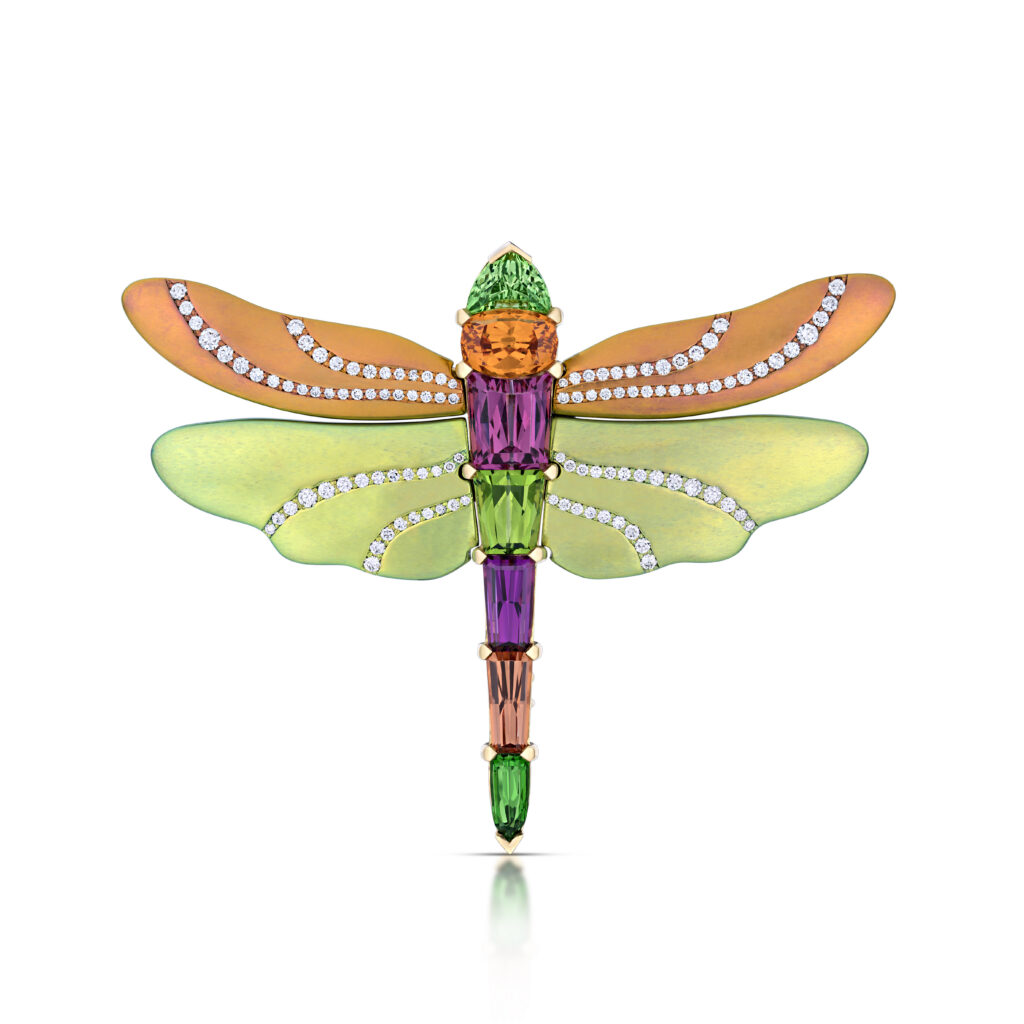
1st Place — Men’s Wear
Fashion Forward
Titanium brooch featuring a suite
of six different Garnets (12.16 ctw.) accented by Diamonds
Jeff Mason Photography
A Dream, Years in the Making
Looking back at our original conversation with Adam, what stands out isn’t simply that he chose titanium.
It’s how much work followed that decision.
He had a vision of jewelry in colors that traditional metals couldn’t reproduce.
But achieving those colors meant learning to work with an unfamiliar material, finding manufacturers capable of producing intricate components, developing new approaches to gemstone setting, and accepting that mistakes could be extraordinarily expensive.
And through it all, he remained focused on the gemstones.
The titanium provides the structure, the scale, and the extraordinary colors.
But the gemstones remain at the heart of the jewelry.
Five recognitions at the 2026 AGTA Spectrum Awards suggest that the judges appreciated what he accomplished.
For Adam Neeley, however, it began with a much simpler question.
AN – “What am I going to make this with to get these colors?”
Titanium was the answer.