The first-place winners may have taken the top honors, but there were plenty of extraordinary gemstones, carvings, and objects of art deserving of recognition at the 2026 AGTA Cutting Edge Awards.
From exceptional examples of classic gemstones to innovative faceting, phenomenal gems, and remarkable works of art, the 2nd Place, 3rd Place, and Honorable Mention recipients remind us just how much talent was on display.
And as we discovered during AGTA’s Press Day, there’s often a fascinating story behind the finished gemstone.
Along with our photographs and observations from AGTA’s Press Day, we’ve included comments from the gem artists and designers themselves, both from our personal correspondence and from the official 2026 AGTA Spectrum & Cutting Edge Awards Compendium.
All Other Cut Gemstones
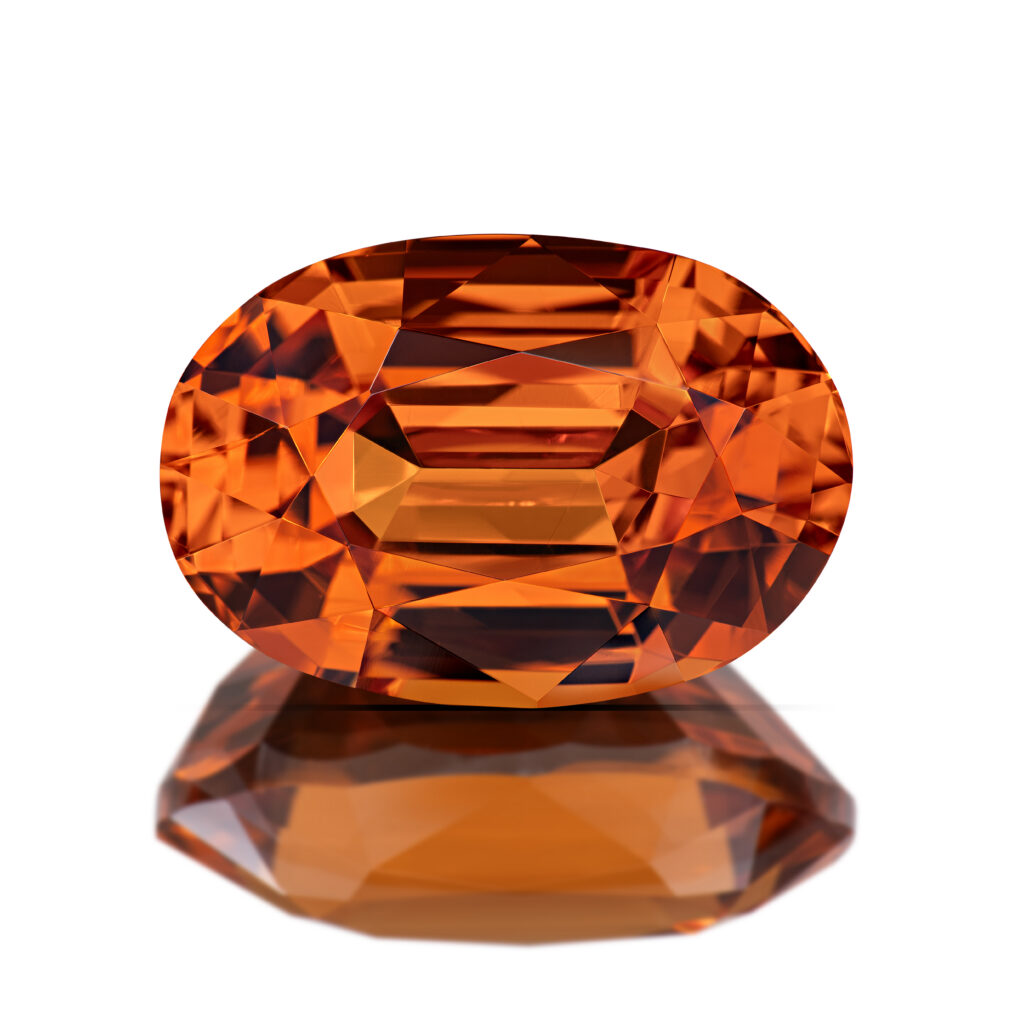
2nd Place — Rajeev Godha, Jaipur Trading Company — 20.78 ct. natural oval mandarin Garnet.
Jeff Mason Photography
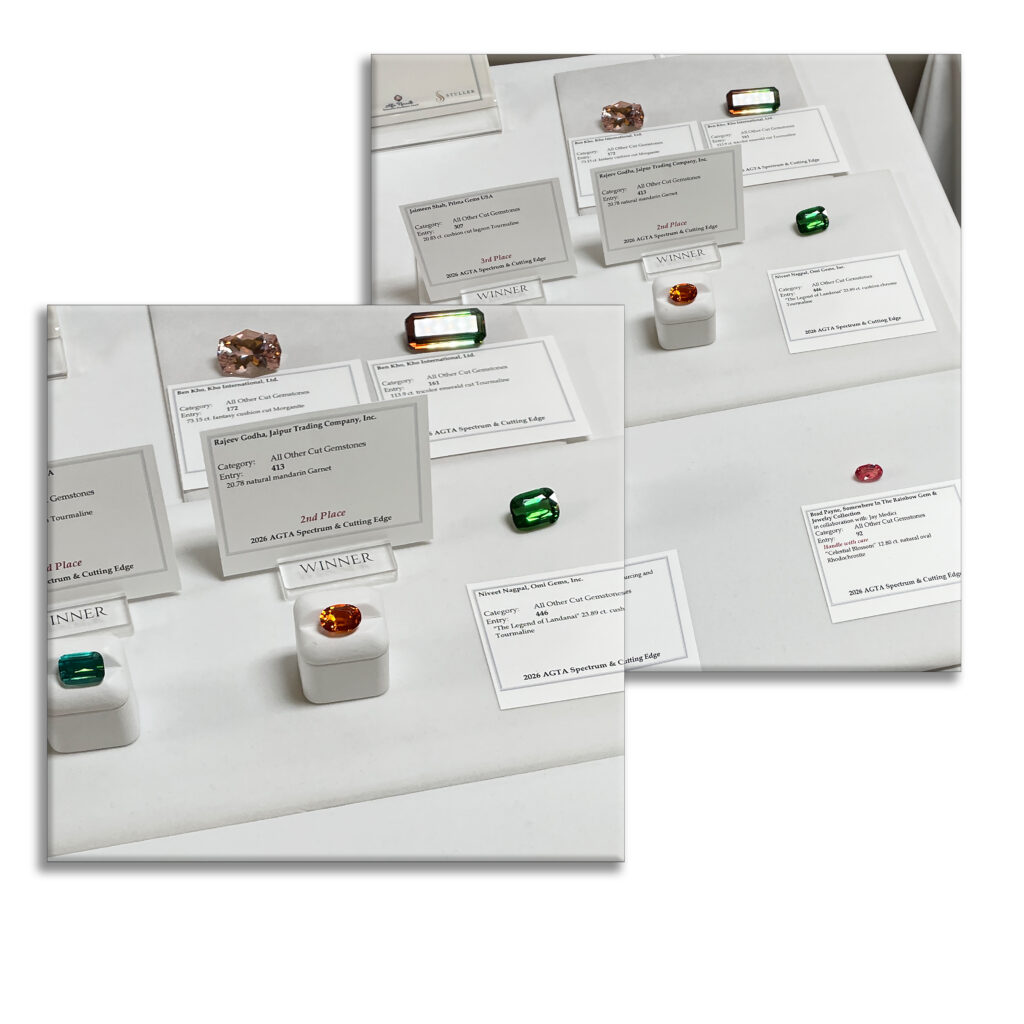
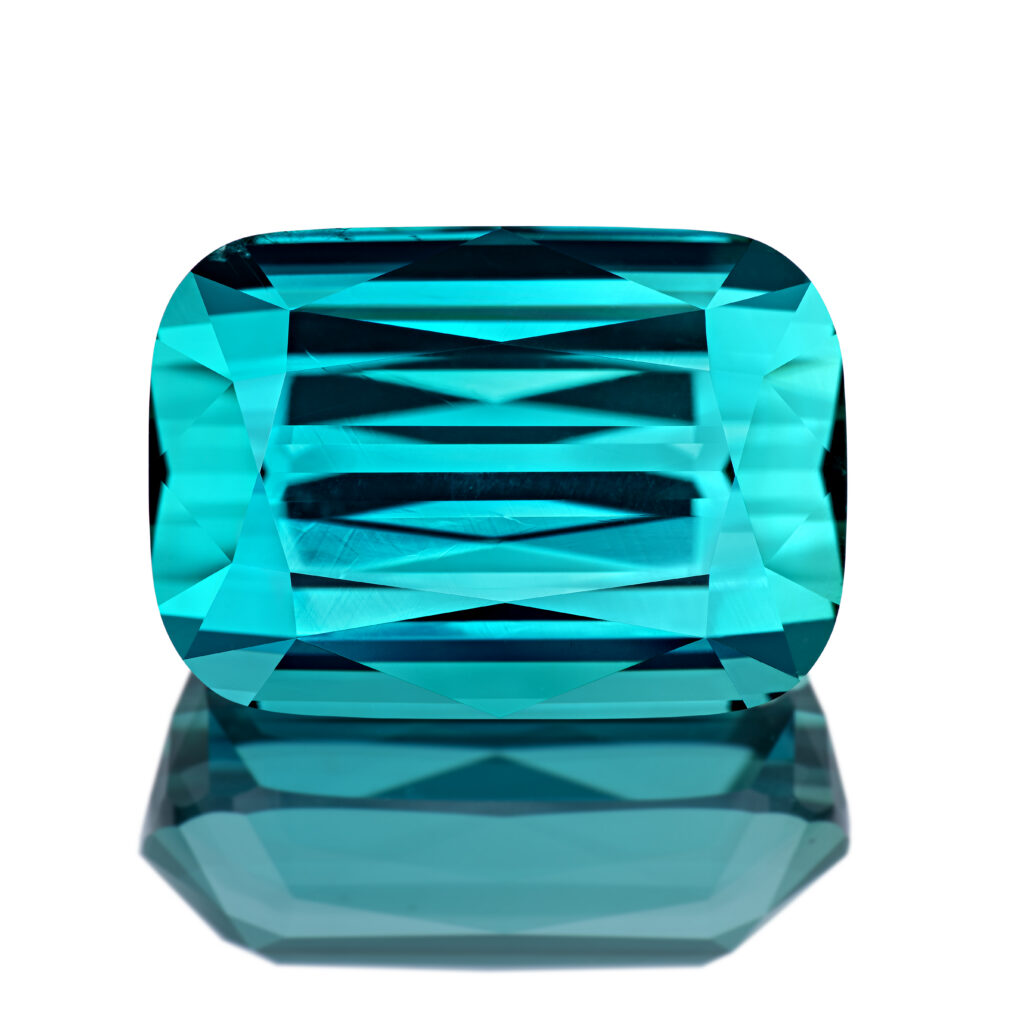
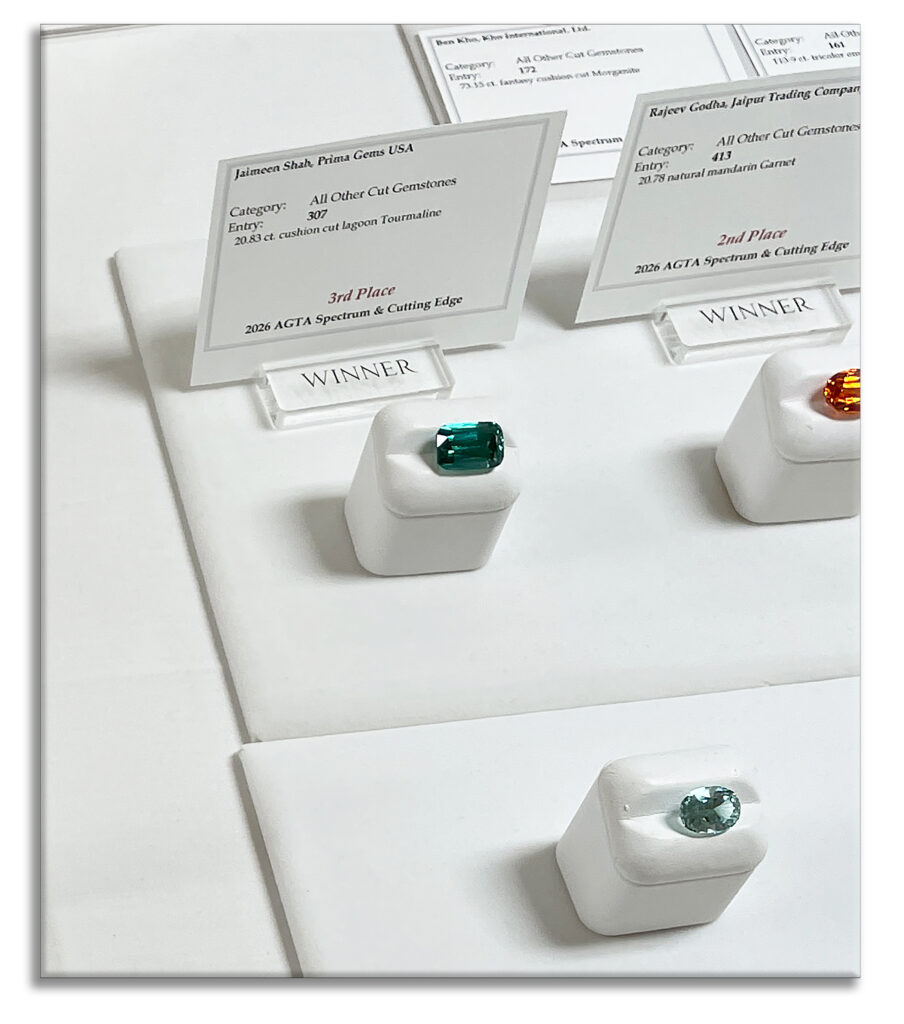
3rd Place — Jaimeen Shah, Prima Gems USA — 20.83 ct. cushion-cut lagoon Tourmaline.
Jeff Mason Photography
Big. Clean. Bright. And Beautiful!
“As for this lagoon Tourmaline, we just acquired this stone in August,” says Shah.
“There has been a major buying frenzy for this material and acquiring anything of this magnitude has become extremely difficult these days,” Shah notes.
Think Color
“We were really excited about the depth of color and open c-axis which makes the stone extremely unique. The color is a perfect lagoon color. We gave it a modified step cut that softened the brilliance and evened out the color.”
Following in Paraiba’s Footsteps?
“Our prediction is that lagoon tourmalines are going to be extremely popular these coming years. With Paraiba reaching all-time highs in popularity, it is inevitable that indicolites and lagoons will continue to grow in popularity and value as well. We hope to be able to continue to find such materials in the future, but for now we will be enjoying this one till it makes its way to a collection or a beautiful piece of jewelry.”
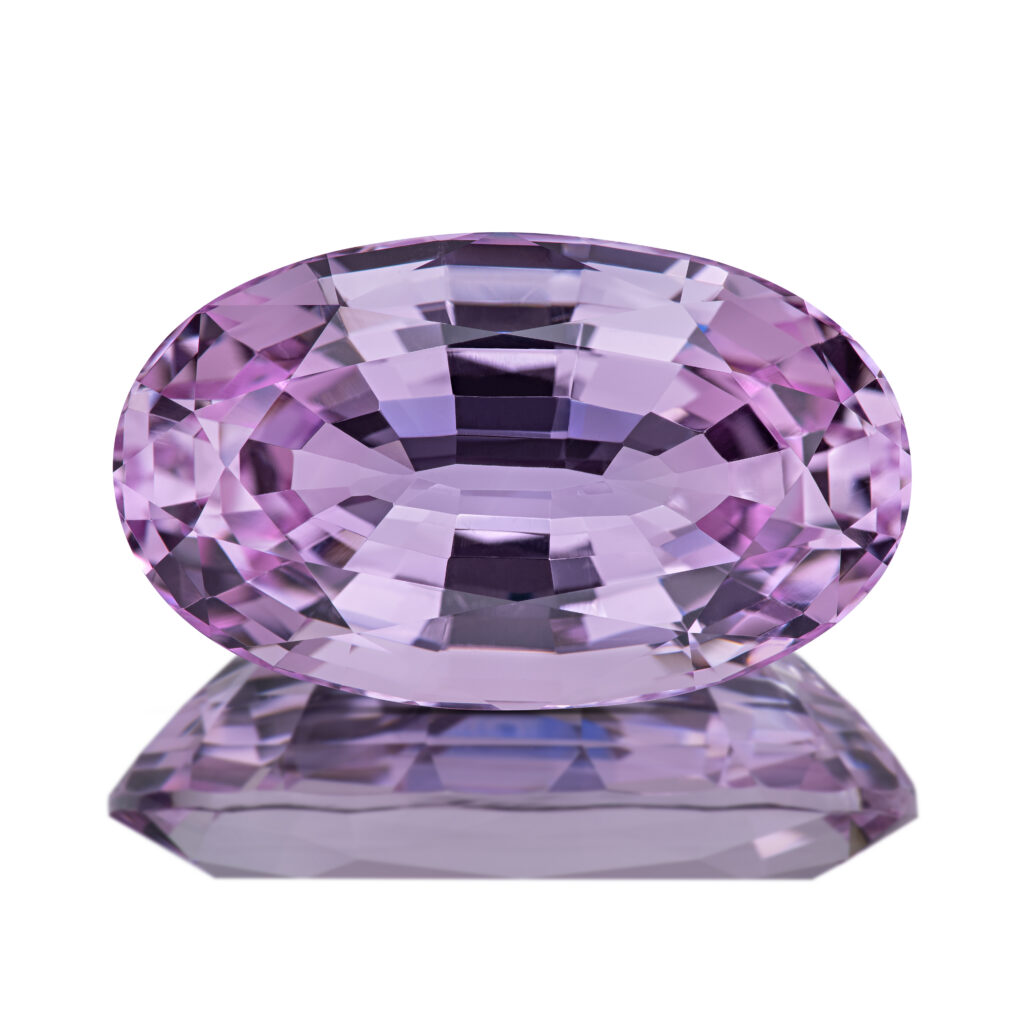
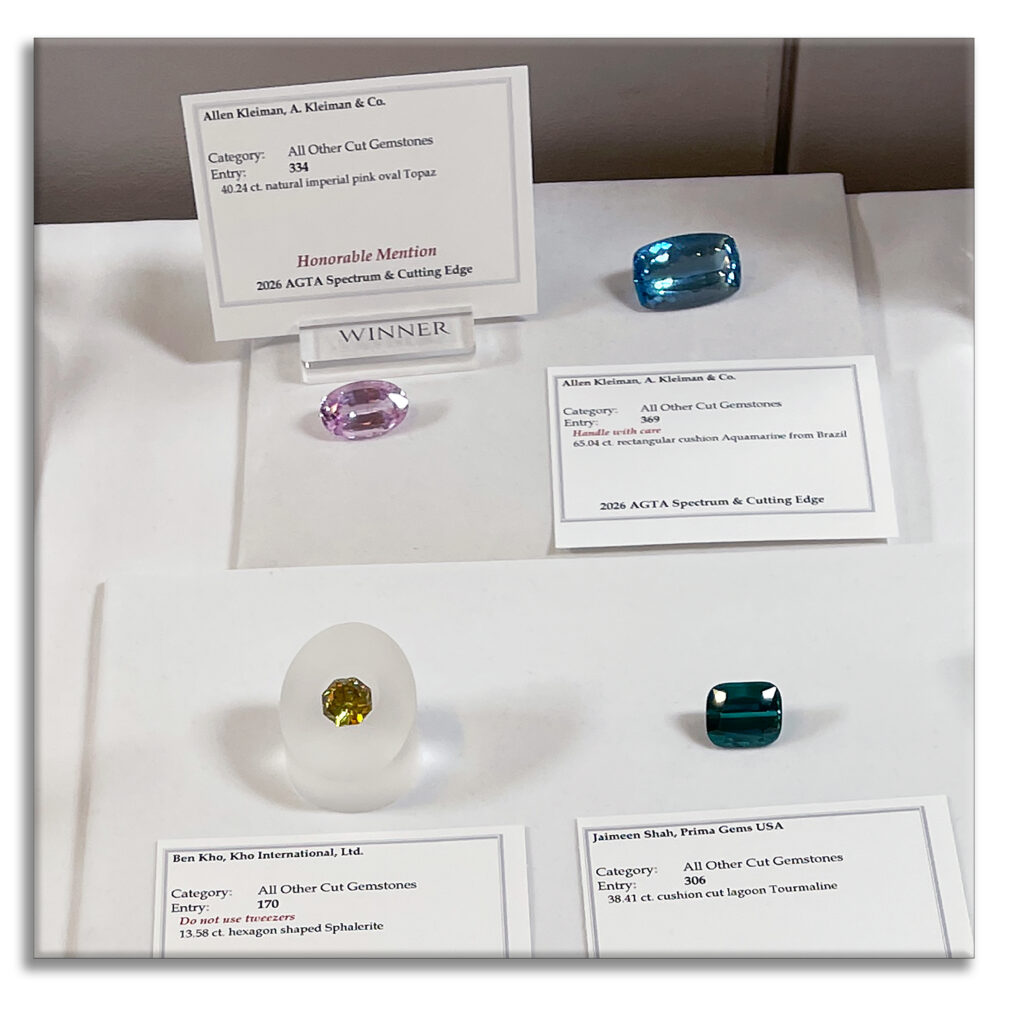
Honorable Mention — Allen Kleiman, A. Kleiman & Co. — 40.24 ct. natural imperial pink oval Topaz.
Jeff Mason Photography
When a Window Isn’t the Issue!
This 40.24-carat imperial pink Topaz had been removed from a mounting that Allen Kleiman estimated to be close to 100 years old.
Originally weighing approximately 41.50 carats, the Topaz had “a pure, sweet pink color” that Allen considered exceptionally rare, particularly in a gemstone of this size.
We would have to agree … go ahead, take another look.
So, Allen did improve the cutting, sacrificing approximately 1.26 carats in the process. But it wasn’t necessarily the weight he was concerned with.
He wanted to keep a little of the original look. He kept a little of that window.
Why?
“Sometimes you almost lose the character of the stone if you do that,” says Kleiman.
For Allen, it wasn’t about achieving perfect proportions. It was about preserving what made this particular gemstone beautiful in the first place.
Read more about Allen’s approach to cutting and recutting gemstones in our interview, The Weight of Experience — Allen Kleiman on Carats, Cutting, and the Pursuit of Beauty.
Carving
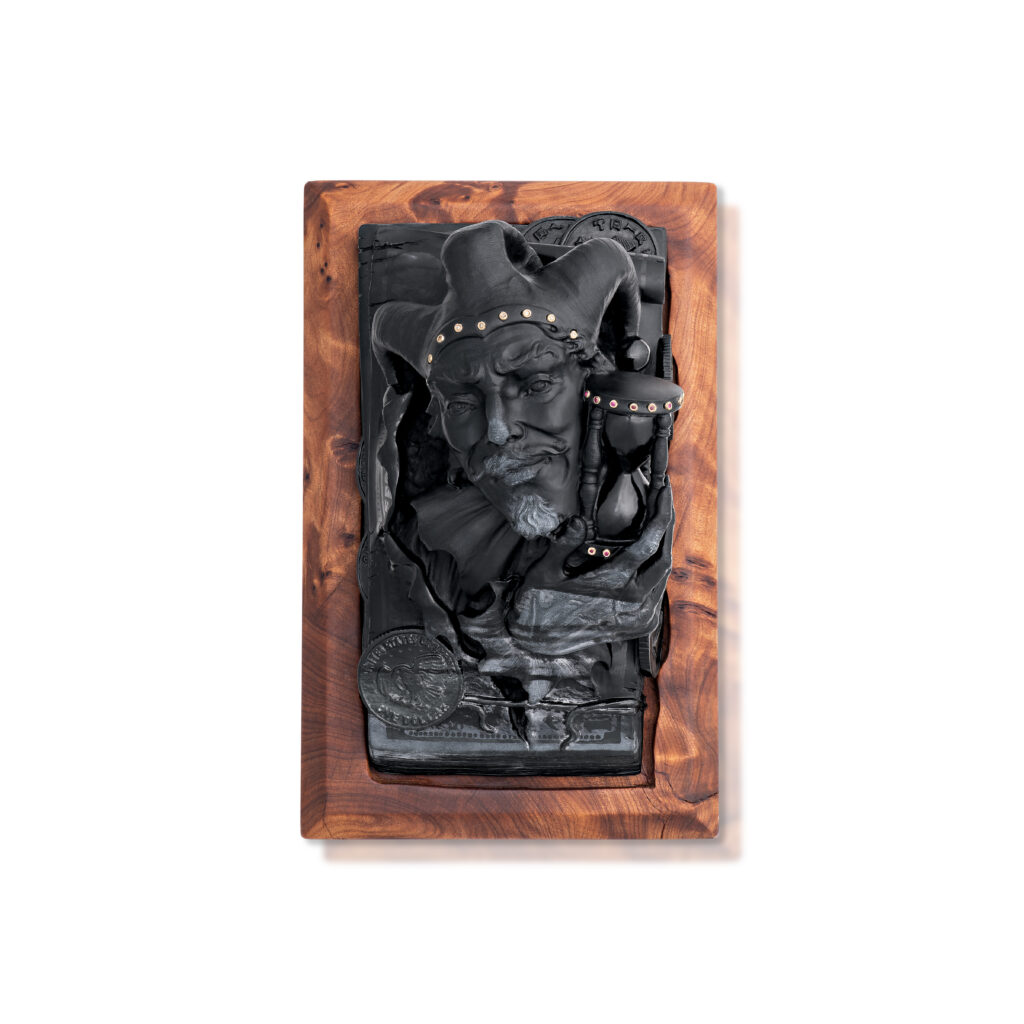
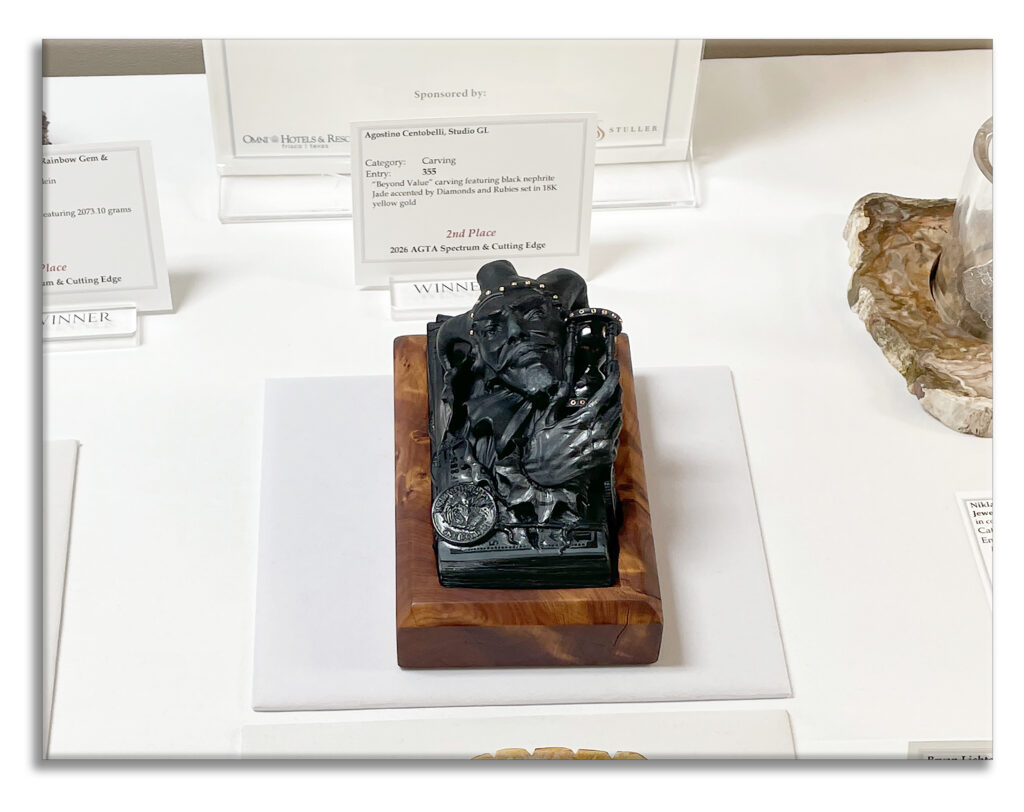
2nd Place — Agostino Centobelli, Studio GL — “Beyond Value,” a carving featuring black Nephrite Jade, accented by Diamonds and Rubies set in 18K yellow gold.
accented by Diamonds and Rubies set in 18K yellow gold
Jeff Mason Photography
Money Measures What We Own; Time Measures Who We Are
Born in Naples, Italy, Agostino Centobelli developed a passion for drawing and painting as a child. It was while attending the Academy of Fine Art in Naples that he discovered his love of sculpture. His artistic development has since taken him beyond traditional shell and coral carving, experimenting with different techniques and materials.
From Wyoming to Naples
For Beyond Value, Centobelli chose Wyoming black Nephrite Jade. Measuring 125 x 68 x 60 mm, the sculpture incorporates Diamonds purchased in Naples and cut in Antwerp, along with Mozambique Rubies cut in India.
As noted by Agostino, the Diamonds and Rubies, measuring just 0.70–0.80 mm and weighing approximately 0.003 ct. each, [yes, three tenths of a point] are set in 18K yellow gold.
The Jolly
And what is the story behind this rather unusual carving?
“From a torn block of banknotes emerges a Jolly, a figure whose very nature defies rules and every predetermined value,” Centobelli explains. “In one hand he holds an hourglass: time, the only true wealth that no one can buy, keep, or reclaim.”
The Jolly, or Joker, represents freedom and unpredictability — a playing card with no fixed role, capable of changing the course of the game.
Look closely and you’ll see references to four of the world’s major currencies — the US Dollar, the Euro, the Japanese Yen, and the Chinese Yuan. Each incorporates elements of national identity, history, or the institutions behind the currency.
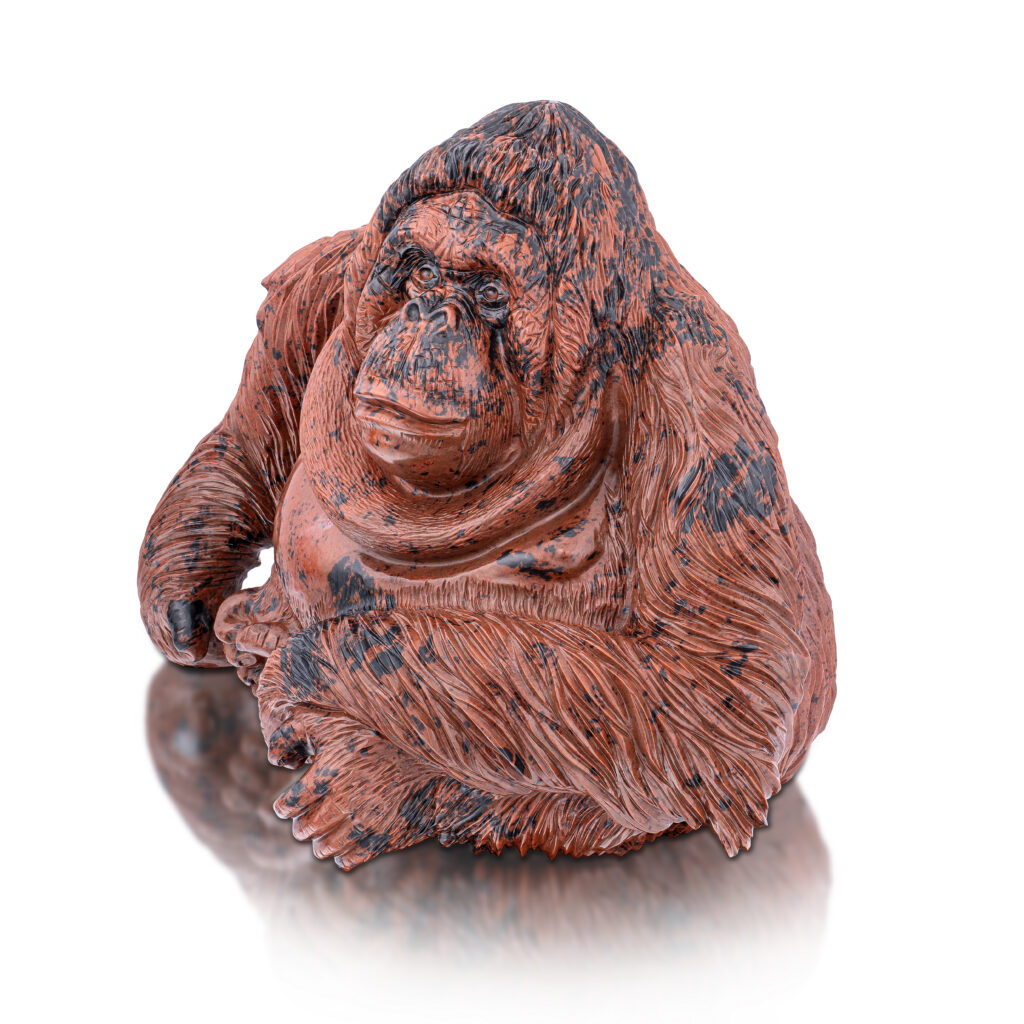
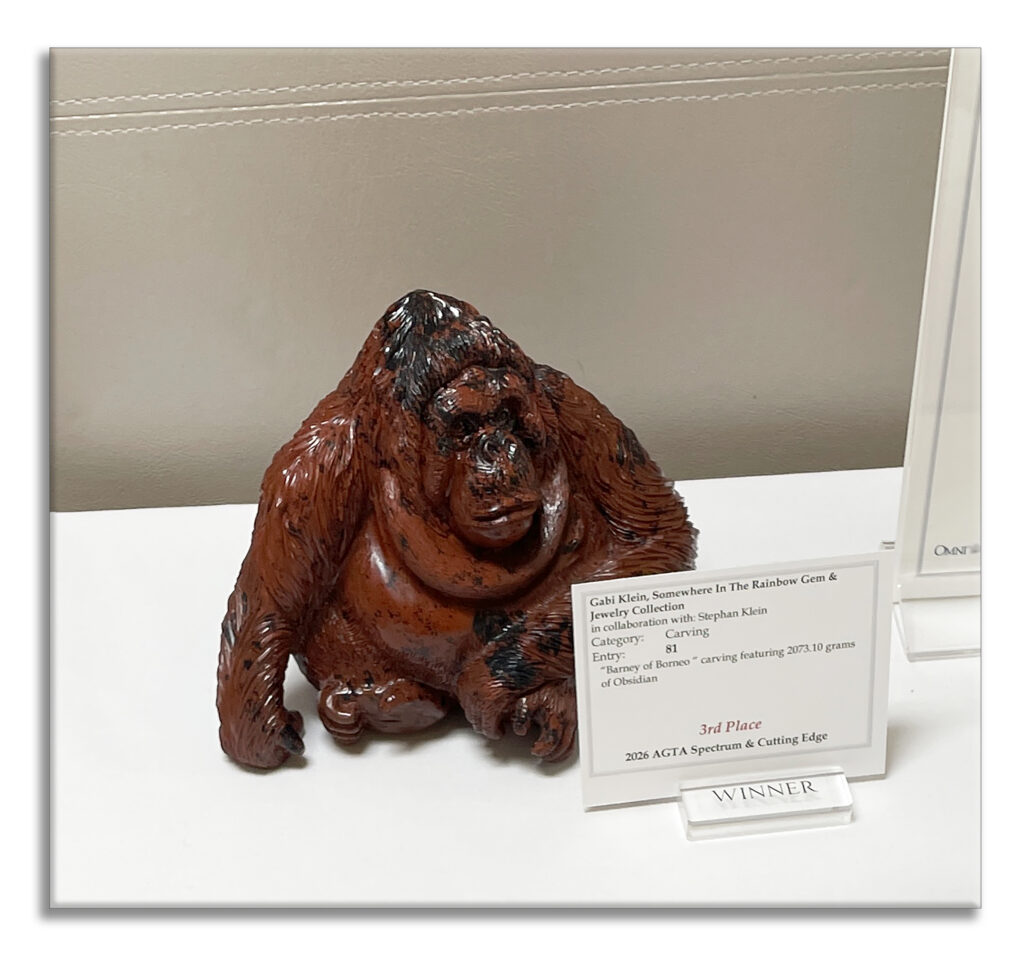
3rd Place — Gabi Klein, Somewhere In The Rainbow Gem & Jewelry Collection — in collaboration with Stefan Klein – “Barney of Borneo” carving featuring 2073.10 grams of Obsidian.
Jeff Mason Photography
Barney — Well Worth the Wait!
It was during a visit with Stefan, Gabi, and Isabelle Klein in Idar-Oberstein in 2023 that Shelly Sergent, curator of the Somewhere In The Rainbow Gem & Jewelry Collection, first met Barney.
“His eyes, his posture and his brindle like fur color were all captivating.”
But while Shelly acquired several other Klein carvings on that trip, Barney stayed behind.
“But always Barney remained in my mind.”
Three years later, Shelly returned.
“There he was in the Klein family collection, looking at me like he’d been patiently waiting for his trip to the USA and into the rainbow.”
Forty Years in the Making
Carved from a single large piece of mahogany Obsidian, Barney is particularly special to the Klein family. Stefan created and signed the carving to commemorate his 40th anniversary as a gemstone carver.
And as Shelly points out, that’s 40 years of study, skill, patience, and experience that went into creating Barney.
Take another look at the carving. The natural reddish-brown and black color patterns of the Obsidian lend themselves beautifully to the orangutan’s coloring, while the carved texture of the fur, the posture, and that wonderful facial expression give Barney quite the personality.
As Shelly tells us, “there was no way we were leaving without him this time.”
And what do Stefan and Gabi think of Barney’s latest accomplishment?
“We’re sure that Barney is very happy to win that prestigious AGTA award … and we are proud, too.”
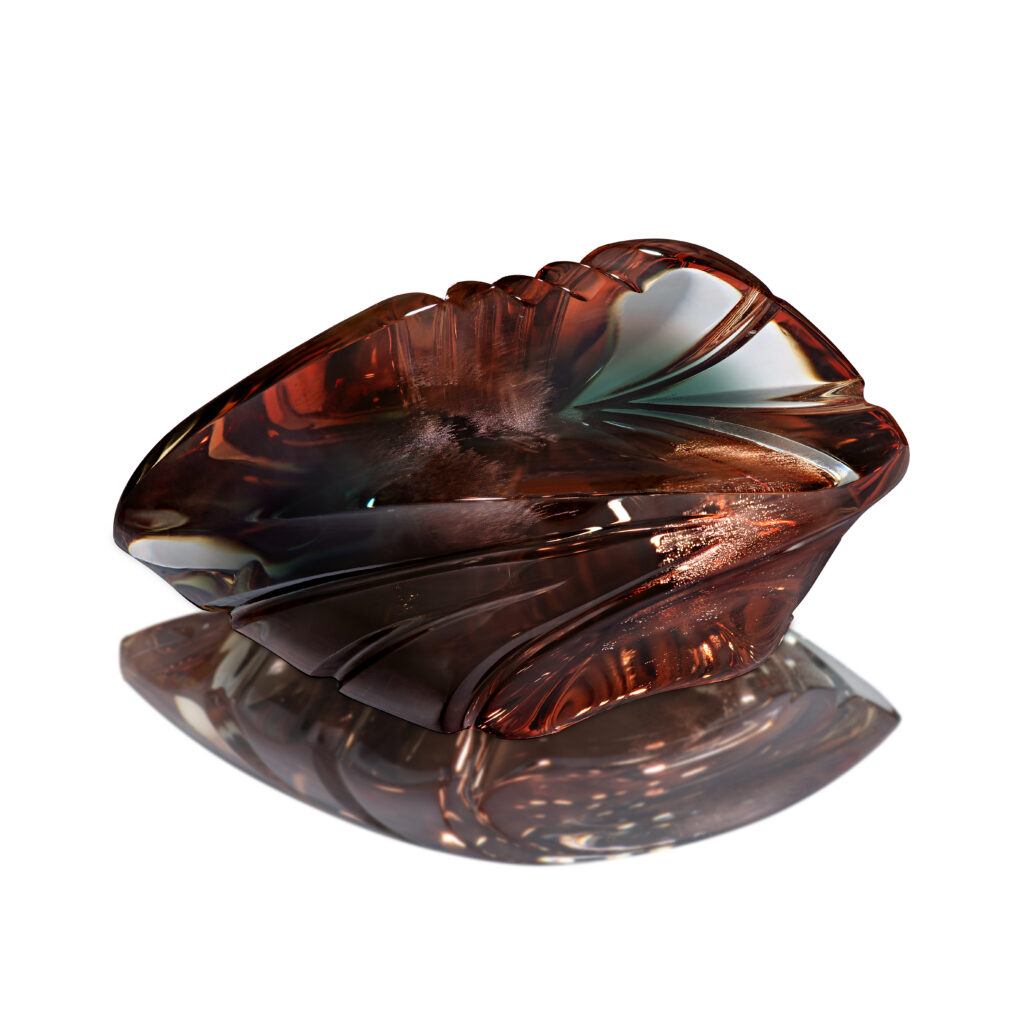
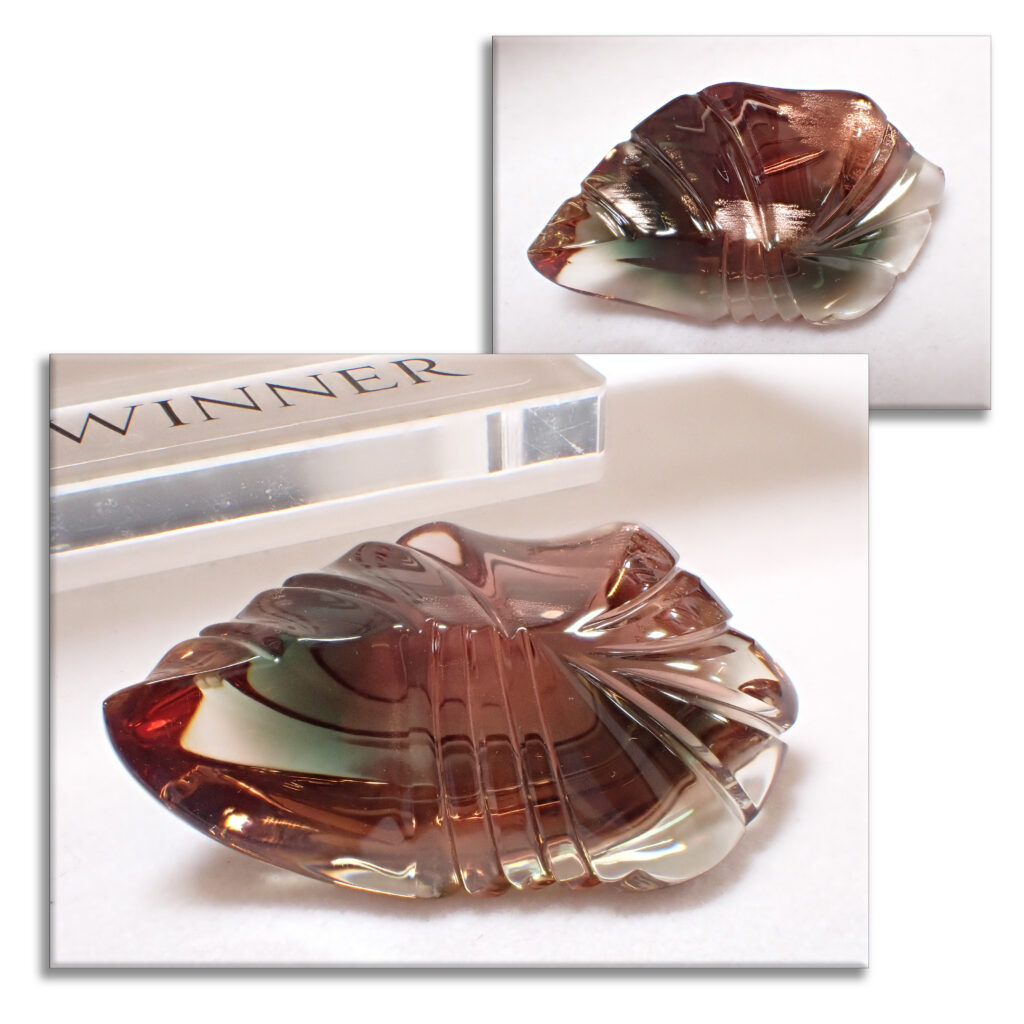
Honorable Mention — Robin Callahan, Robin Callahan Designs, LLC, in collaboration with Aaron Sangenitto (lapidary artist) — “Tula,” 77.45 ct. Sunstone carving.
Jeff Mason Photography
Photos by Gary Roskin
Classic Gemstones
2nd Place — Alan Afshin Hackman, Intercolor USA, in collaboration with David Hackman — 7.30 ct. oval Madagascar Ruby.
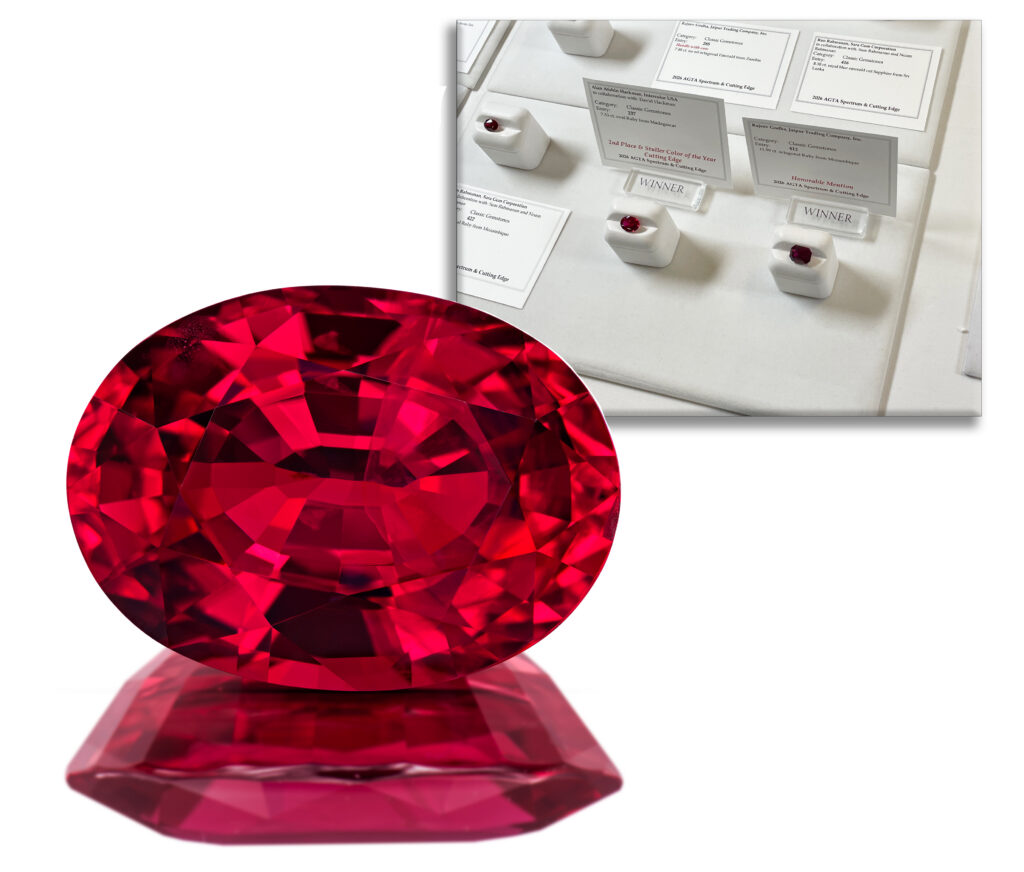
“The Crimson Flame” 7.30 ct. oval Ruby from Madagascar
Jeff Mason Photography
It’s the Color!
“Rubies from Madagascar are very high in iron and typically very dark red. The color of this magnificent ruby is a true fire engine red.” – Alan Hackman
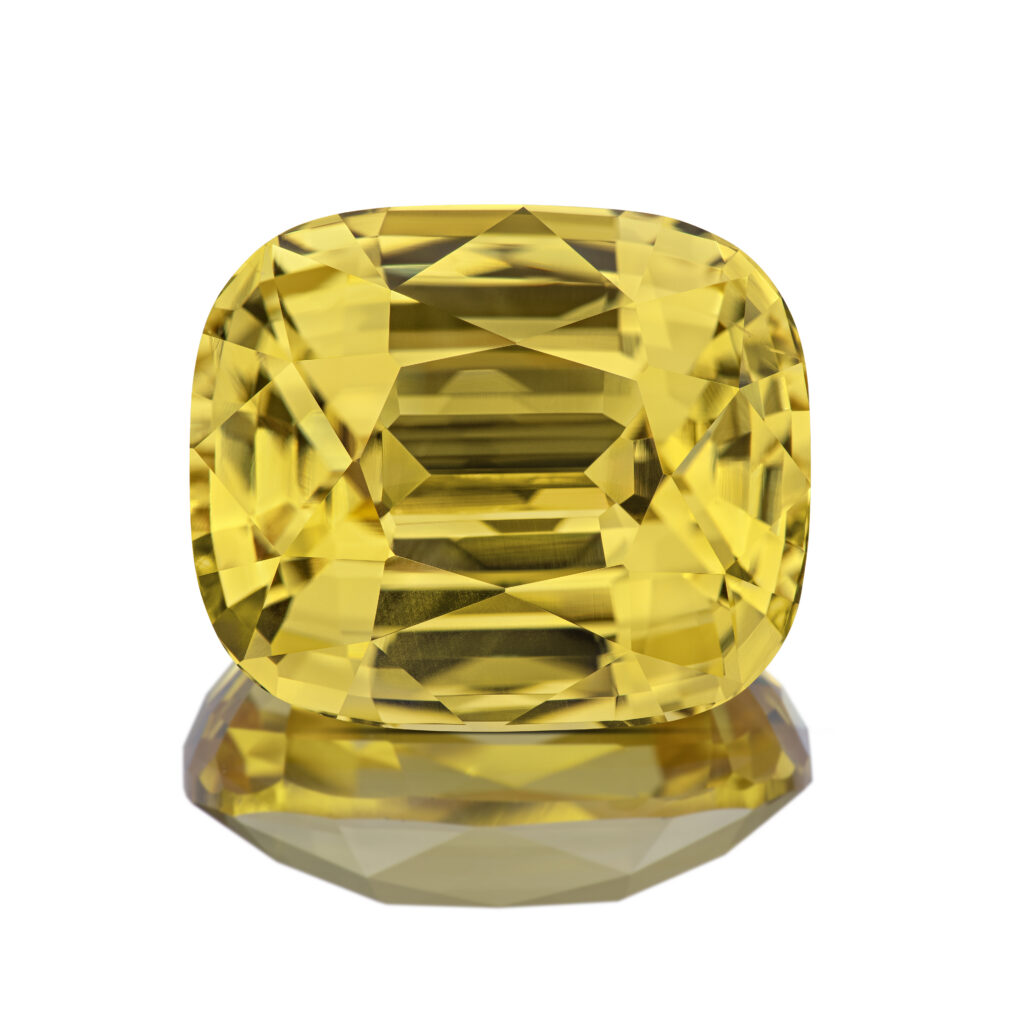
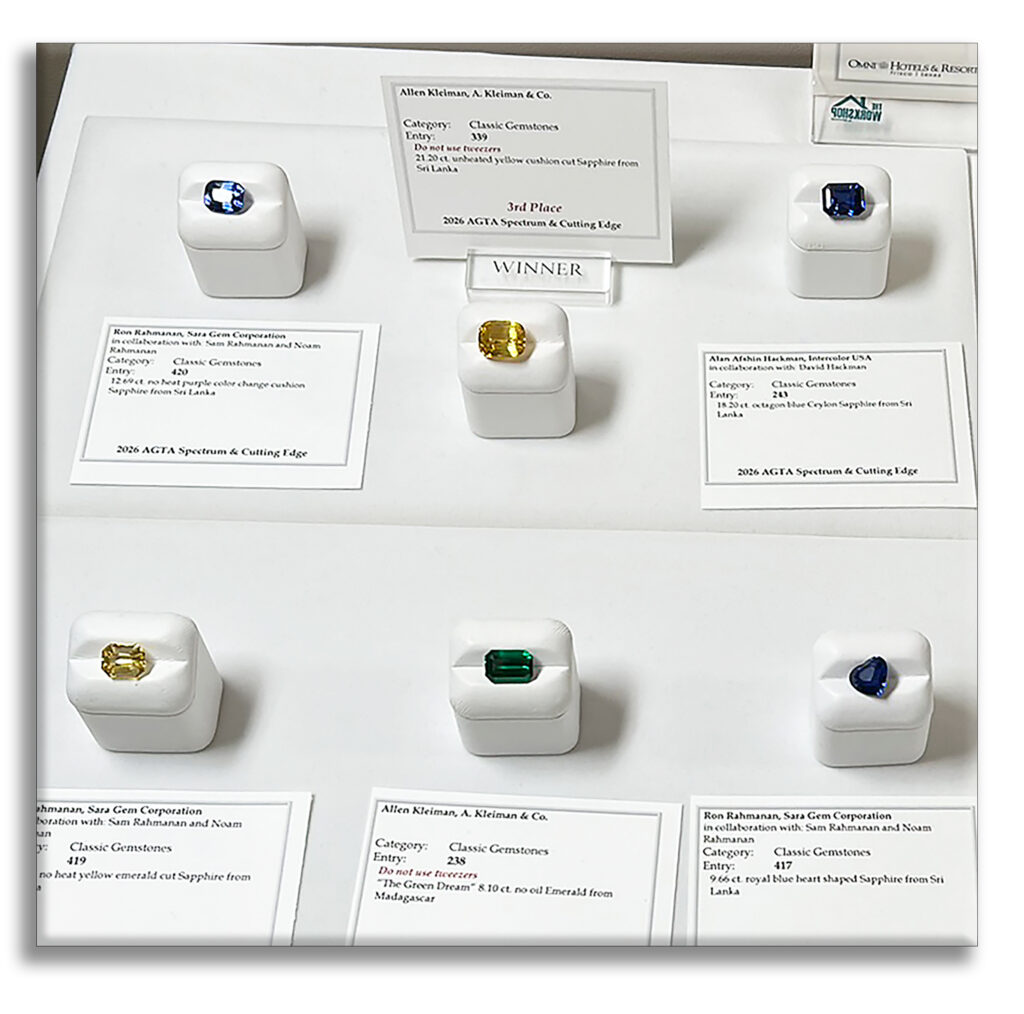
3rd Place — Allen Kleiman, A. Kleiman & Co. — 21.20 ct. unheated yellow cushion-cut Sri Lankan Sapphire.
Jeff Mason Photography
A Yellow Sapphire Worth Another Look
Allen Kleiman had owned this Sapphire for several years. The color and clarity were exceptional, but the cutting, he thought, could be improved. So back onto the cutting wheel it went.
For Allen, what makes this unheated Sri Lankan Sapphire so rare is that combination of exceptional clarity and an intense, pure yellow color.
Yes, there are plenty of attractive yellow Sapphires out there. But finding one with this combination of color, clarity, and size is another matter entirely.
Honorable Mention — Oren Nhaissi, EMCO Gem, Inc., in collaboration with Yaron Nhaissi — 8.47 ct. elongated Colombian Emerald.
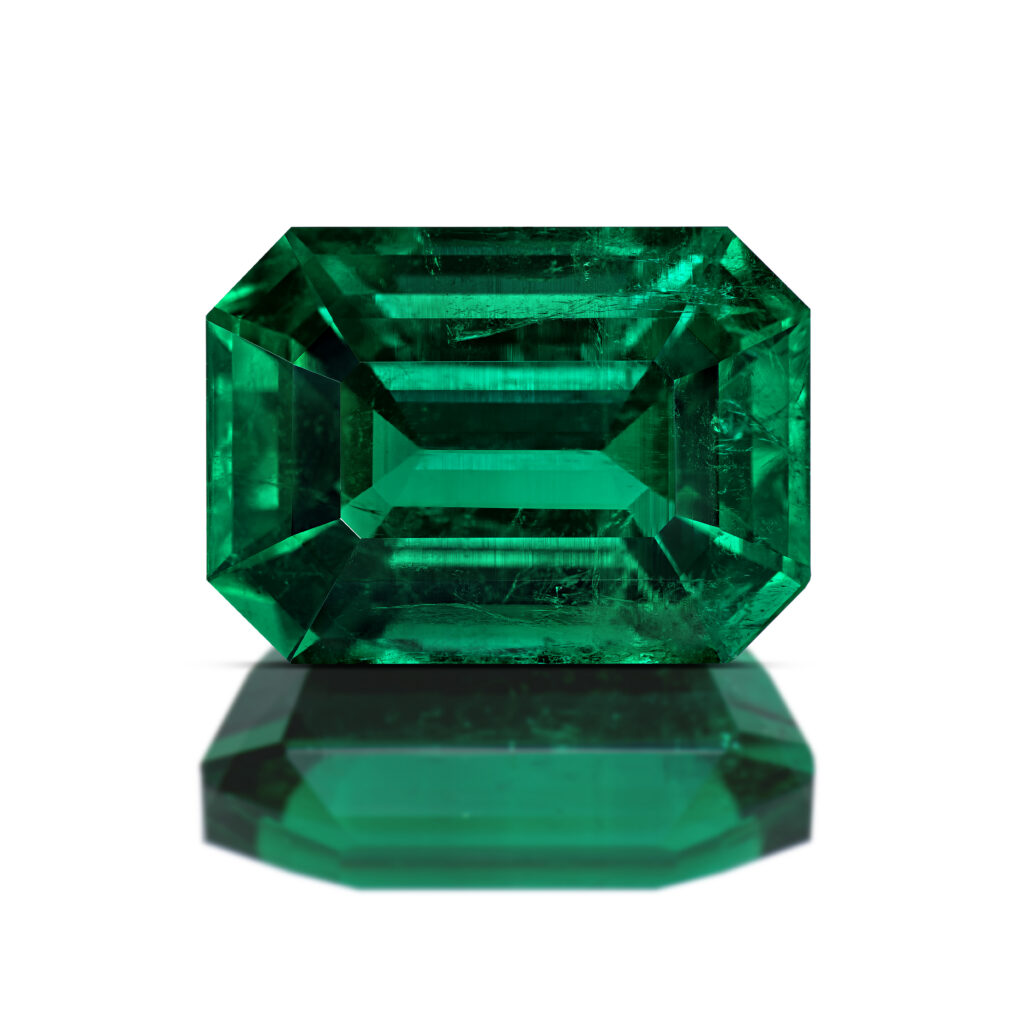
Jeff Mason Photography
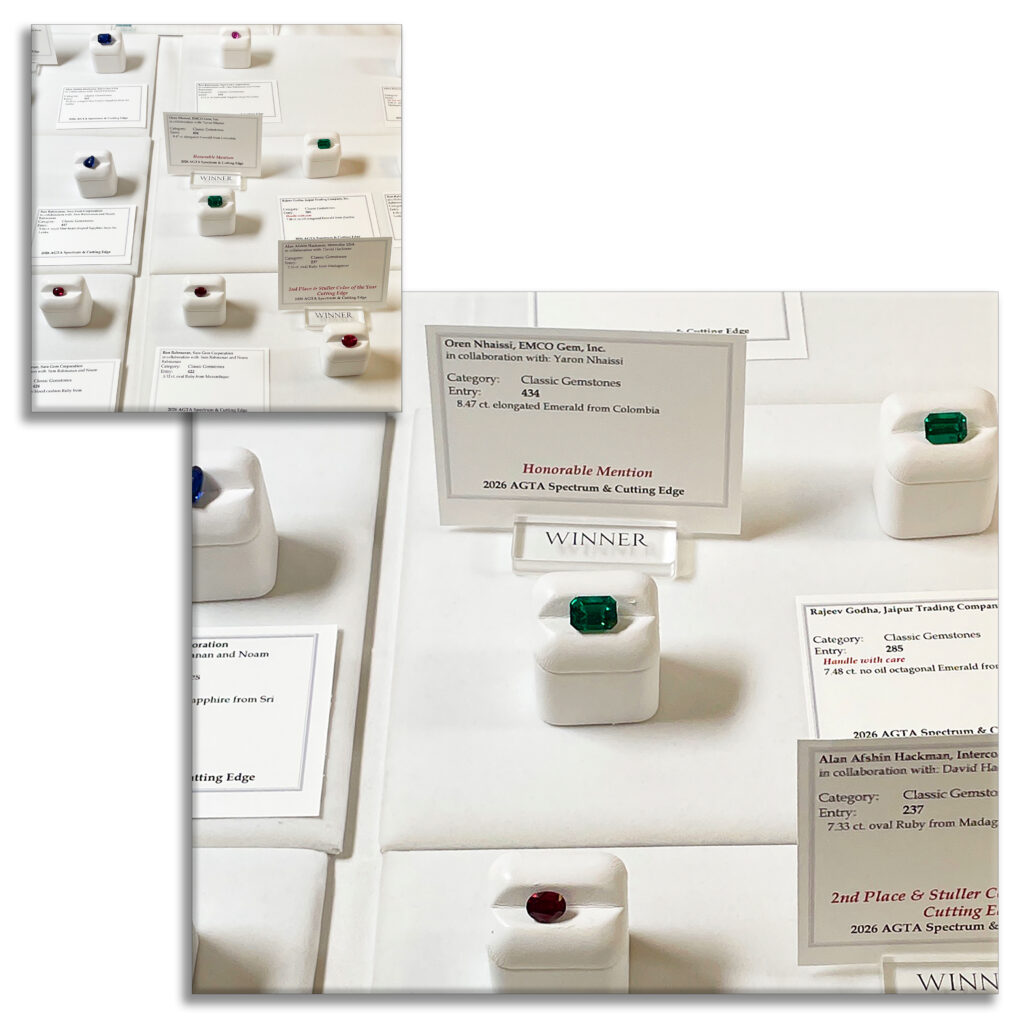
Colombian
From the Muzo mining region of Colombia, this 8.47-carat Emerald is noteworthy for its eye-clean clarity and rich, velvety green color.
As EMCO Gem explains in the Compendium, the elongated step cut and deep pavilion angles were designed to accentuate the Emerald’s depth of color while creating a “hall of mirrors” effect.
Honorable Mention — Rajeev Godha, Jaipur Trading Company, Inc. — 11.99 ct. octagonal Mozambique Ruby.
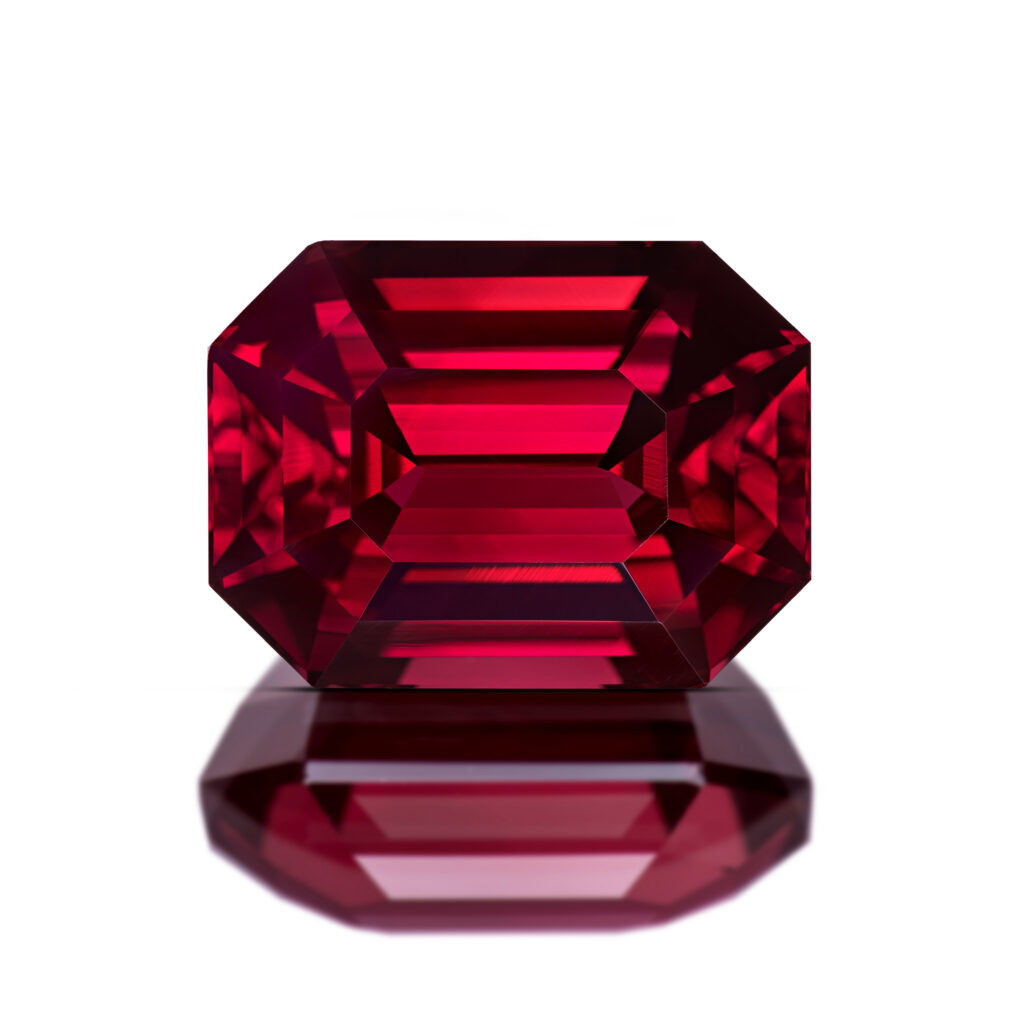
Jeff Mason Photography
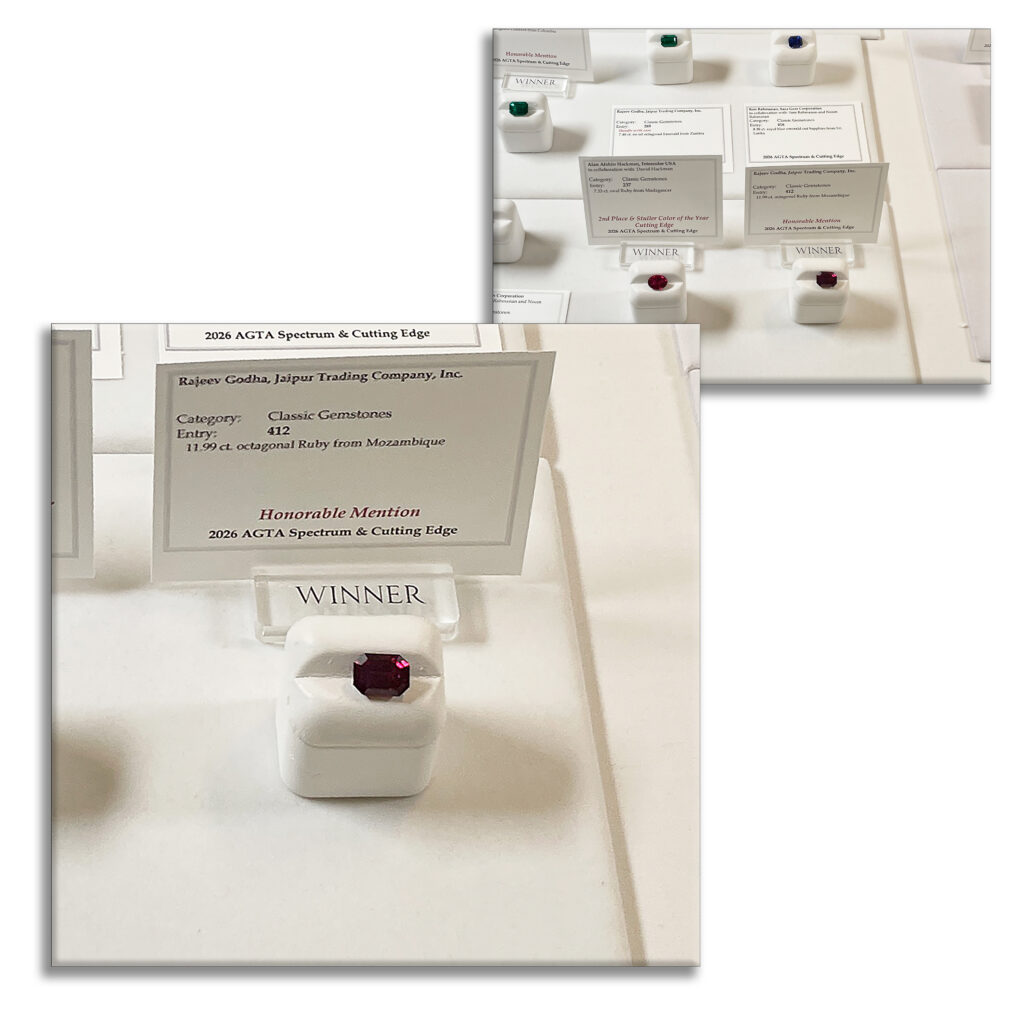
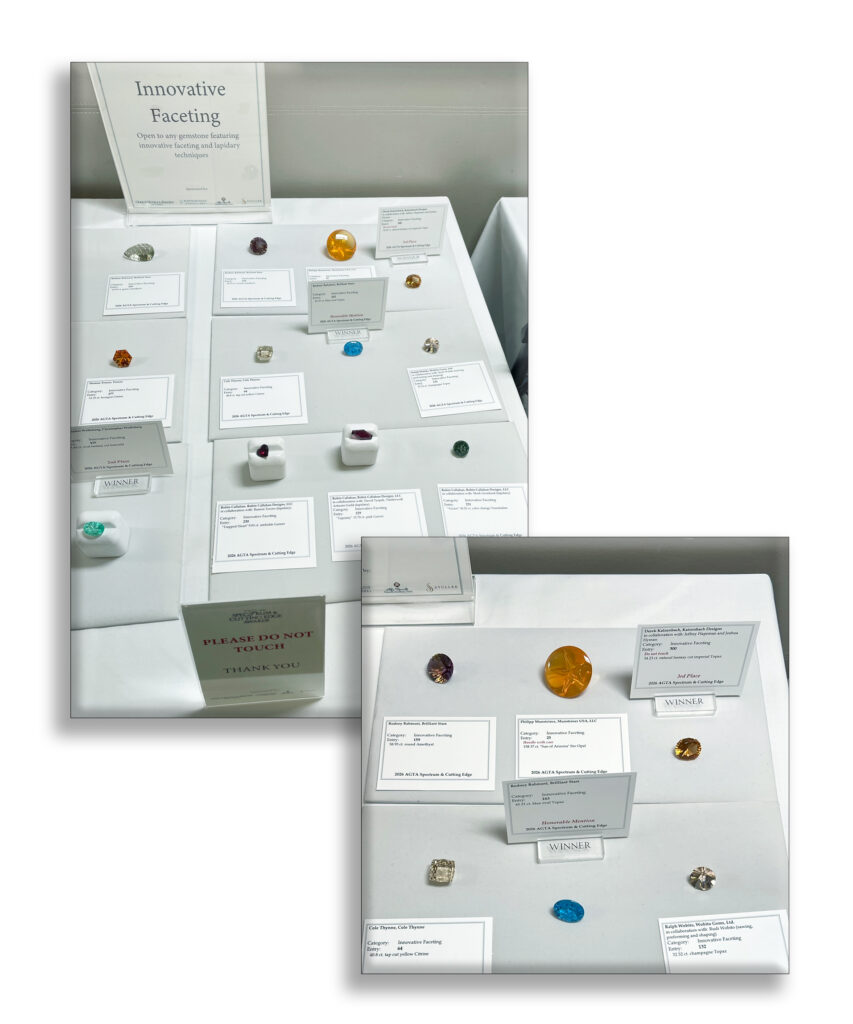
Innovative Faceting
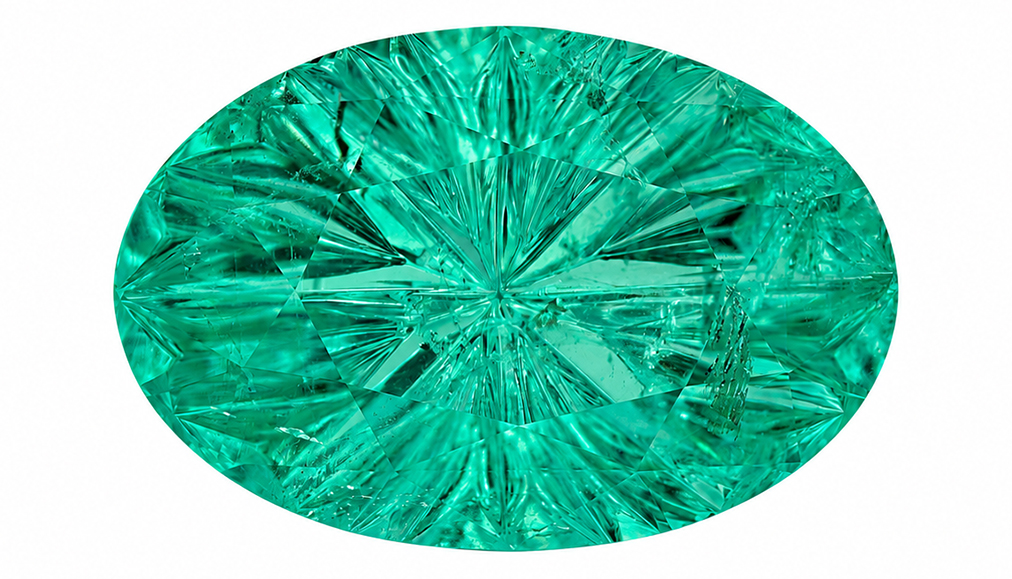
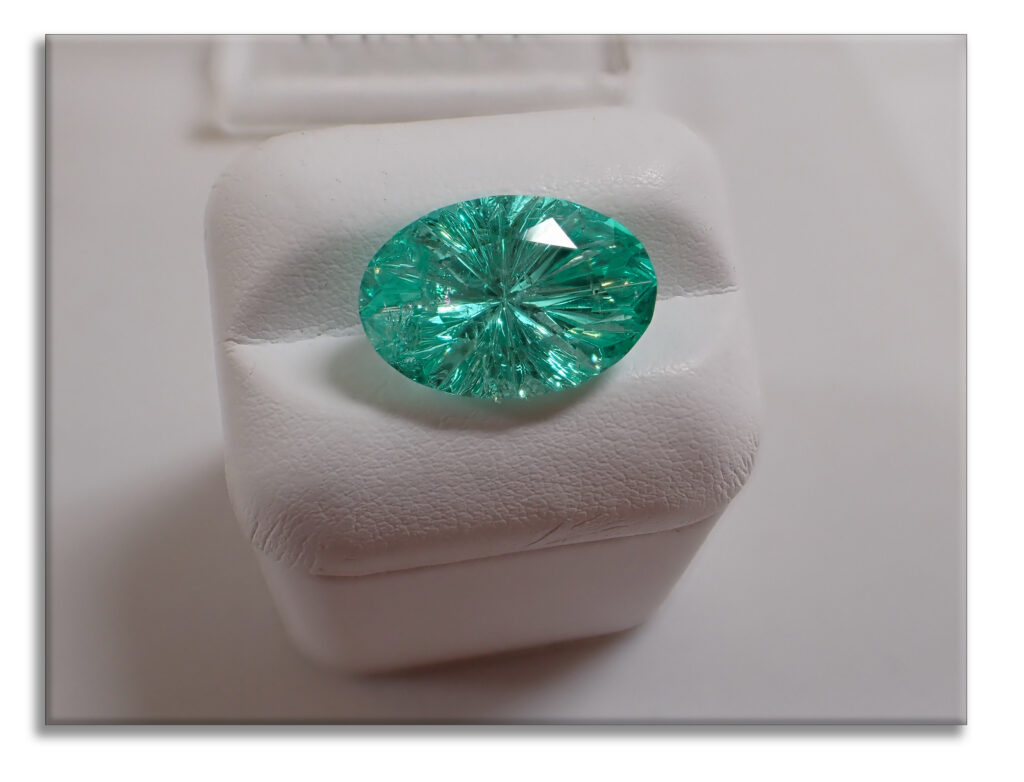
2nd Place — Christopher Wolfsberg, Christopher Wolfsberg — 11.83 ct. oval fantasy-cut Emerald.
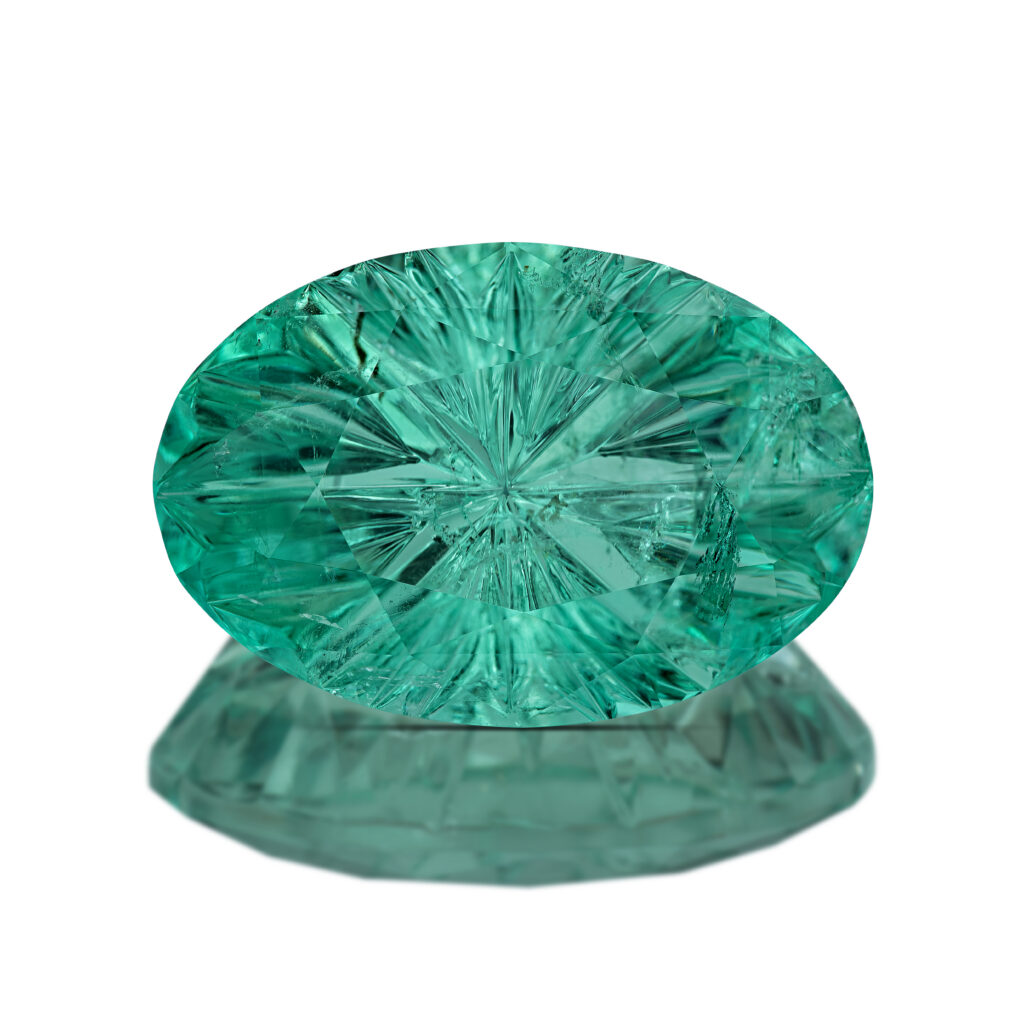
Jeff Mason Photography
3rd Place — Derek Katzenbach, Katzenbach Designs, in collaboration with Jeffrey Hapeman and Joshua Hyman — 34.23 ct. natural fantasy-cut imperial Topaz.
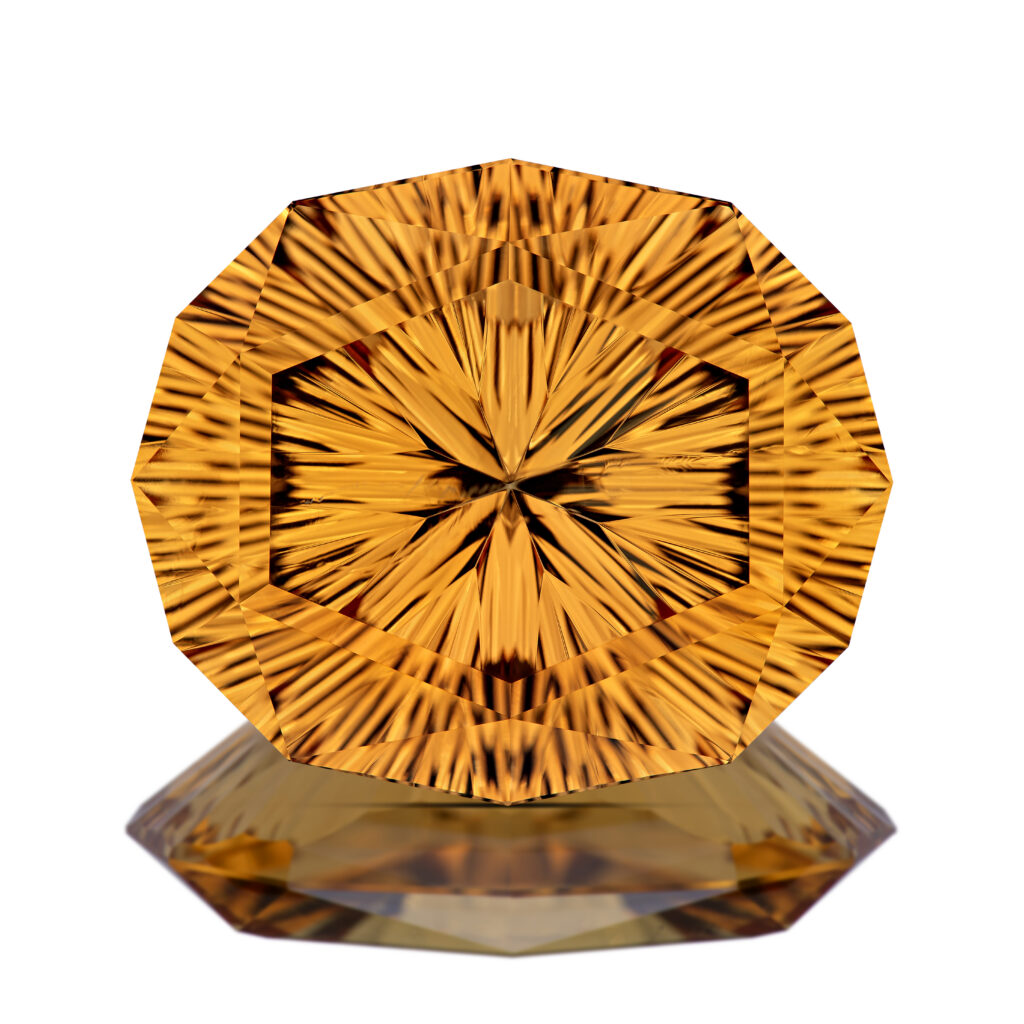
Jeff Mason Photography
When a window IS the Issue!
“This stone was recut from a badly windowed gemstone in an 1800s brooch. It had a lot of potential for a recut so I recut it into a custom stone to maximize its color and remove the window.”
We’re pretty sure they got rid of the window! Wow!
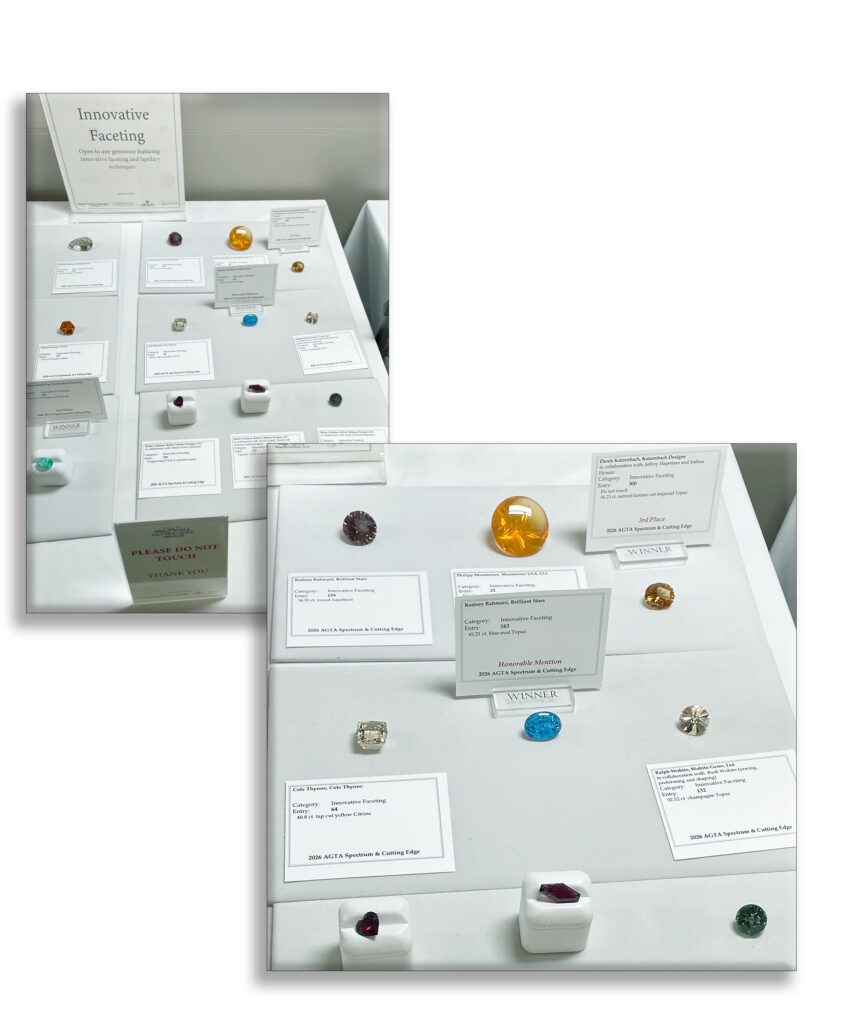
Honorable Mention — Rodney Rahmani, Brilliant Stars — 45.21 ct. blue oval Topaz.
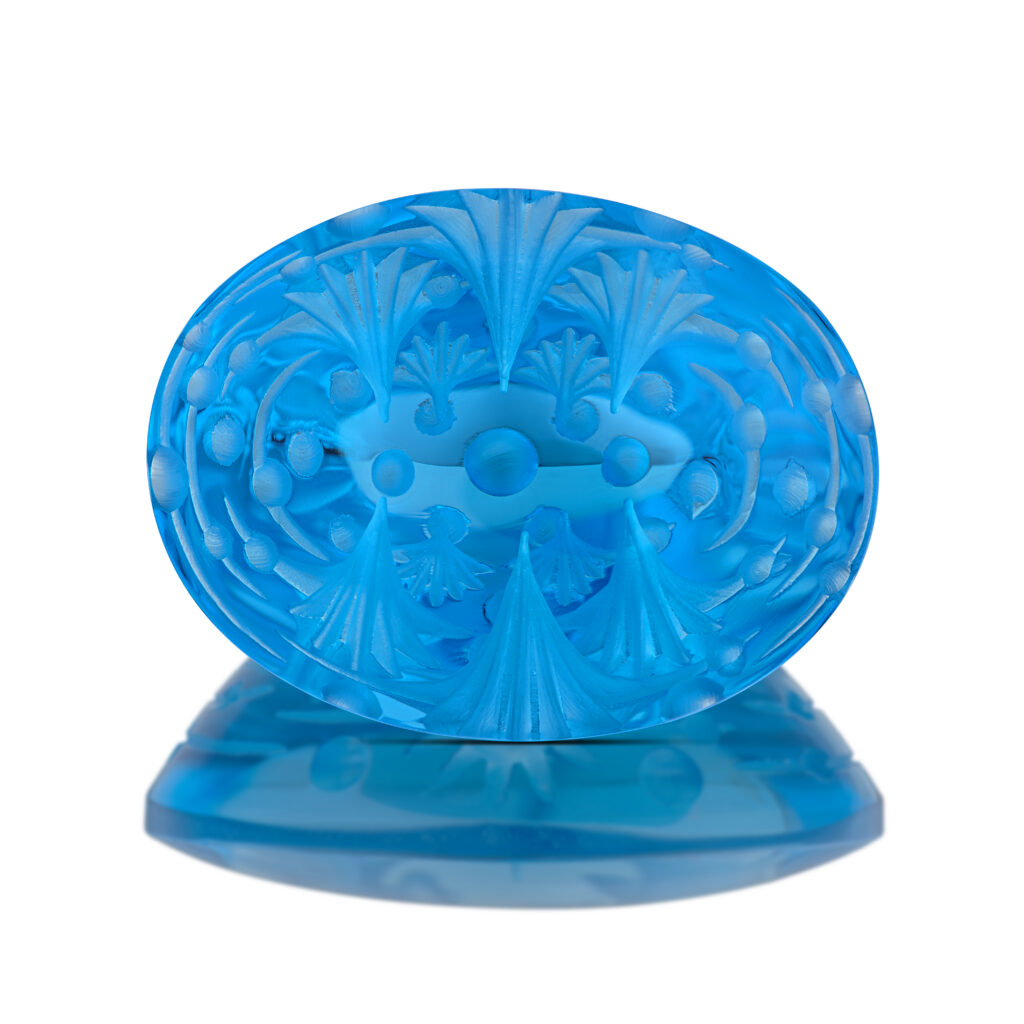
Jeff Mason Photography
North American Mined Gemstones
2nd Place — Tim Condron, Inoro Gems, in collaboration with Tourmaline King Mining Company — “King’s Cross,” 37.31 ct. California pink Tourmaline.
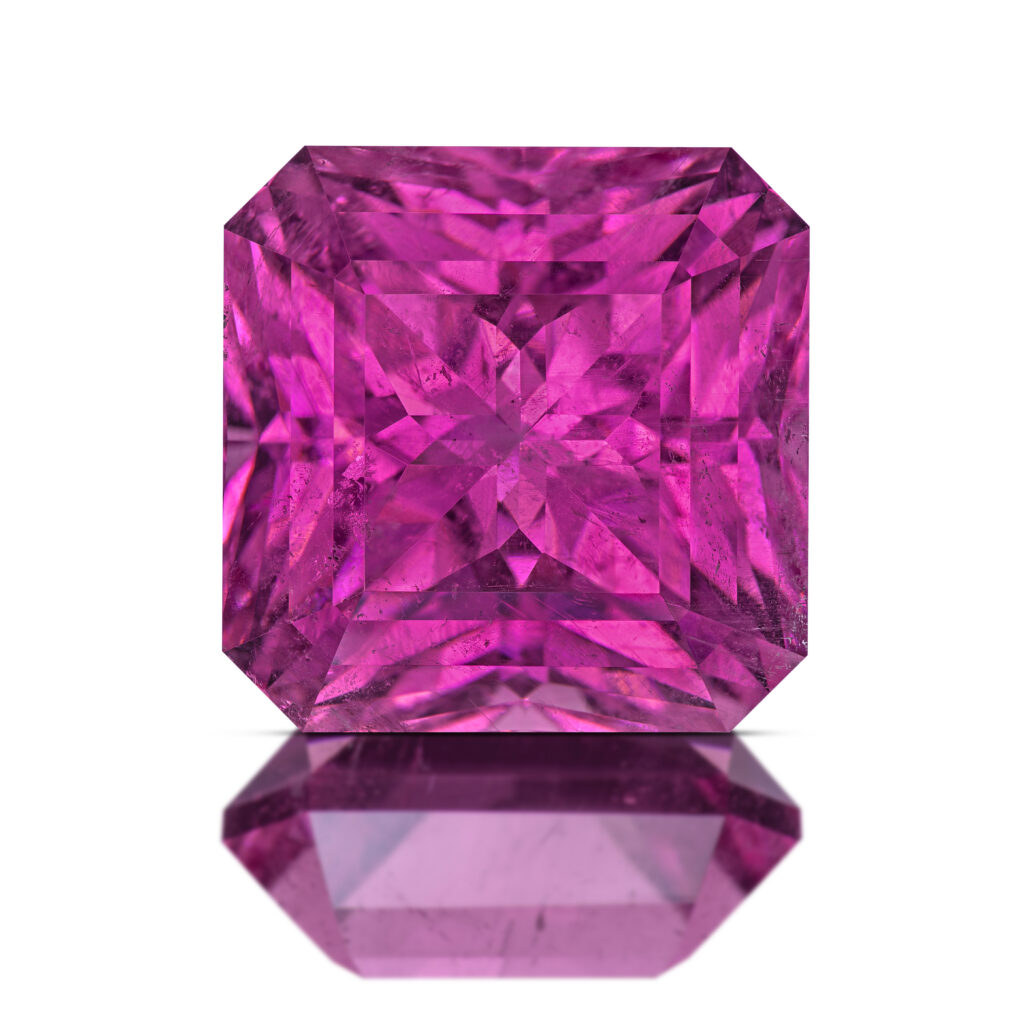
“King’s Cross” 37.31 ct. 18 mm pink Tourmaline from California
Jeff Mason Photography
I Am the King!
Mined just this past September from the latest pocket discovery at the Tourmaline King Mine on Tourmaline Queen Mountain, this California pink Tourmaline didn’t take long to become an award winner!
We caught up with Tim Condron, who told us a bit more about “King’s Cross.
“The Kings Cross was named after its location of origin and the cross fashioned into the culet of the gem,” says Condron. “The 37.31-carat tourmaline was mined in September of 2026 at the Tourmaline King Mine, Pala mining district, San Diego county, Ca. U.S.A. The Tourmaline King mine is world renowned for its intense pink to pinkish-red tourmalines. The cut was designed specifically to highlight and intensify that color, and promotes an above average scintillation for tourmaline.”
THAT is PINK!
3rd Place — Ben Kho, Kho International — 32.35 ct. pentagon-shaped New Hampshire Fluorite.
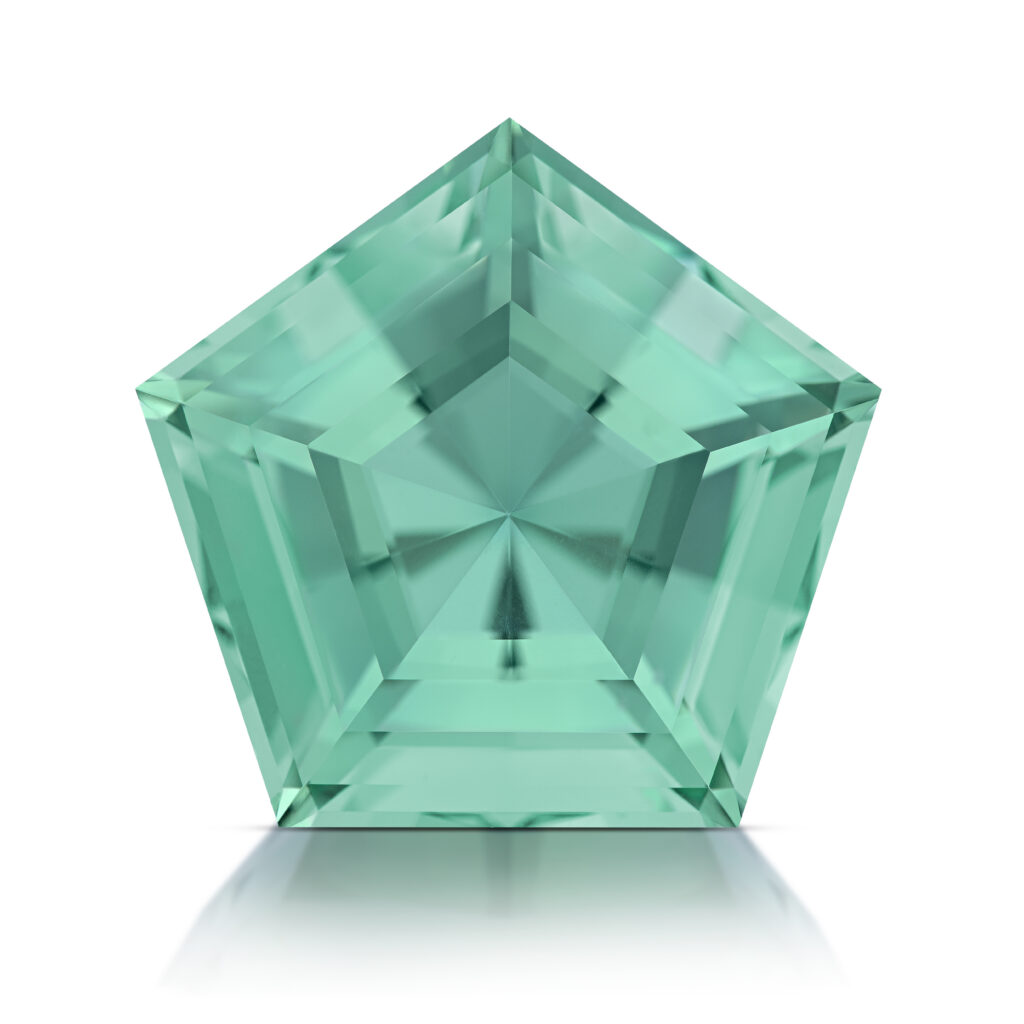
32.35 ct. pentagon shaped Fluorite from New Hampshire
Jeff Mason Photography
Honorable Mention — Jeffrey R. Hapeman, Earth’s Treasury, Inc. — 5.68 ct. mint green Montana Sapphire.
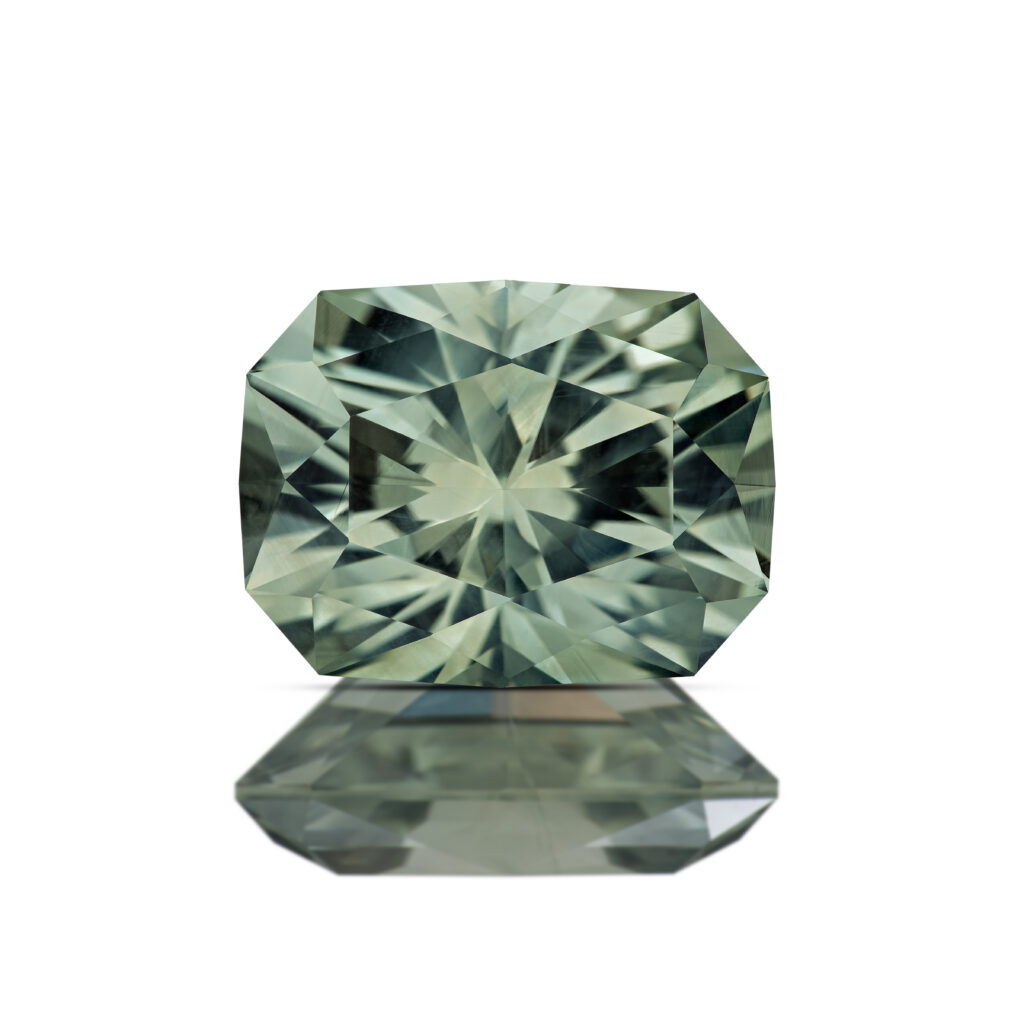
5.68 ct. mint green natural Sapphire from Montana
Jeff Mason Photography
I AM the Potentate!
As Hapeman describes his entry in the Compendium: “This 5.68-carat Mint-Green Montana Sapphire was mined by Potentate Mining at the Rock Creek deposit outside of Philipsburg, Montana. It measures 11.3 x 8.6 x 7.0 mm and is untreated in any way. It comes with a GIA report stating origin and unheated. It was faceted by Jeff Hapeman in his custom ‘Eureka’ brilliant rectangle cushion design.”
Objects of Art
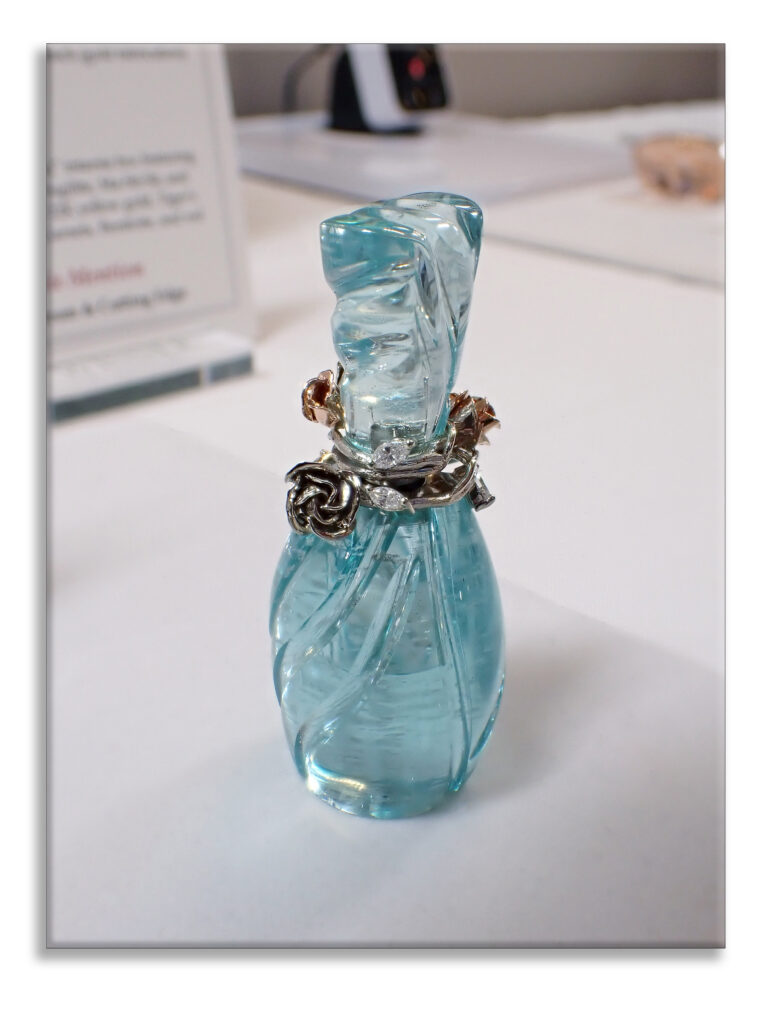
2nd Place — Ralph Wobito, Wobito Gems, in collaboration with Rudi Wobito — A 174.0 ct. carved Aquamarine bottle, decorated with 18K white and rose gold, and accented with diamonds (0.20 ctw.).
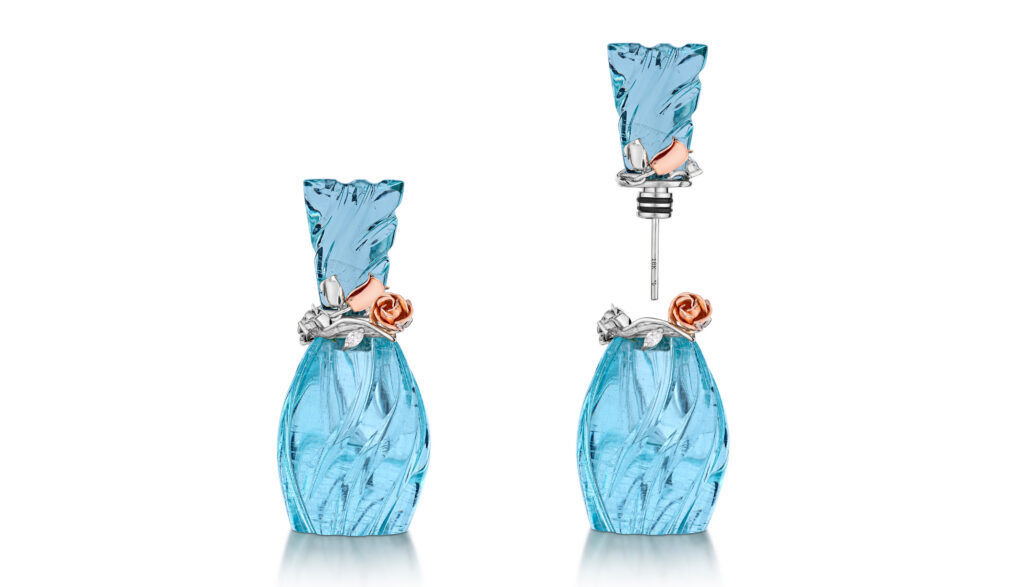
18K white & rose gold bottle featuring a 174.0 ct. Aquamarine accented by Diamonds (0.20 ctw.)
Jeff Mason Photography
“I believe this is the fourth bottle that we have won an AGTA Cutting Edge Award for,” says Rudi. “As you can guess, making these bottles is very time consuming, and also a bit risky. Sometimes, drilling and polishing the reservoir can take several days. We always do this part first because it is the riskiest part of the process. Once this is completed, we cut and polish the rest of the bottle.”
For brothers Ralph and Rudi Wobito, creating a gemstone carving is a collaborative effort, although the division of labor isn’t necessarily equal.
“With regards to this piece, I would say Ralph did at least 80% of the work,” Rudi told the Roskin Gem News Report. “We plan everything together, and I almost always do the sawing and preforming. Ralph did the main carving and polishing.”
The brothers regularly take turns cutting and polishing, depending on who’s available. But each brings different strengths to the partnership.
“Ralph is definitely better at carving. He is the artistic one. I am better with the technical part,” Rudi explained.
Their best-known creation, the Wobito Snowflake cut, illustrates that relationship particularly well. Ralph invented the cut, while Rudi figured out how to make it consistent and repeatable. But Rudi points out that their expertise extends well beyond that signature design.
“We are also known for recutting very fine and very difficult expensive stones, many of which have won awards for our clients.”
And yes, the brothers sometimes finish each other’s work. But when we asked whether they also finish each other’s sentences, Rudi laughed off the suggestion.
“I have no idea what Ralph is thinking, so we definitely don’t finish each other’s sentences.”
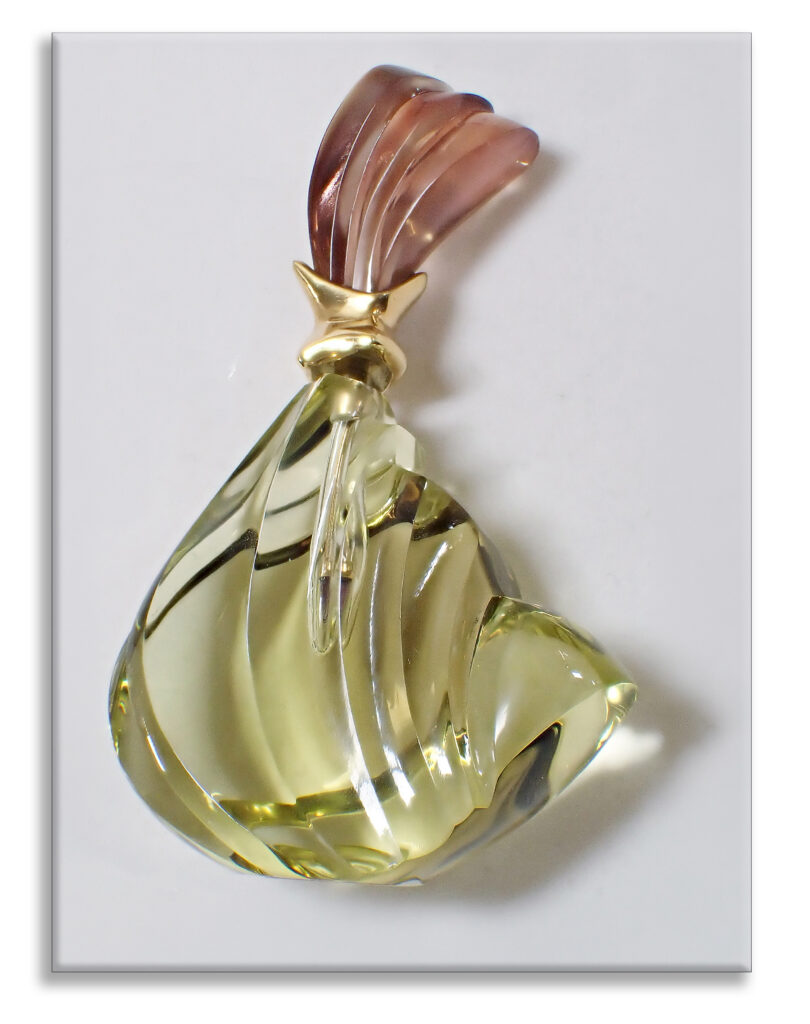
3rd Place — Philip Louer, Jr., North American Gem Carvers, LLC, in collaboration with Gil Roberts — 18K yellow gold “Genie in a Bottle,” perfume bottle featuring chartreuse Quartz, accented by a hand-carved Sunstone, with a Sugilite bullet.
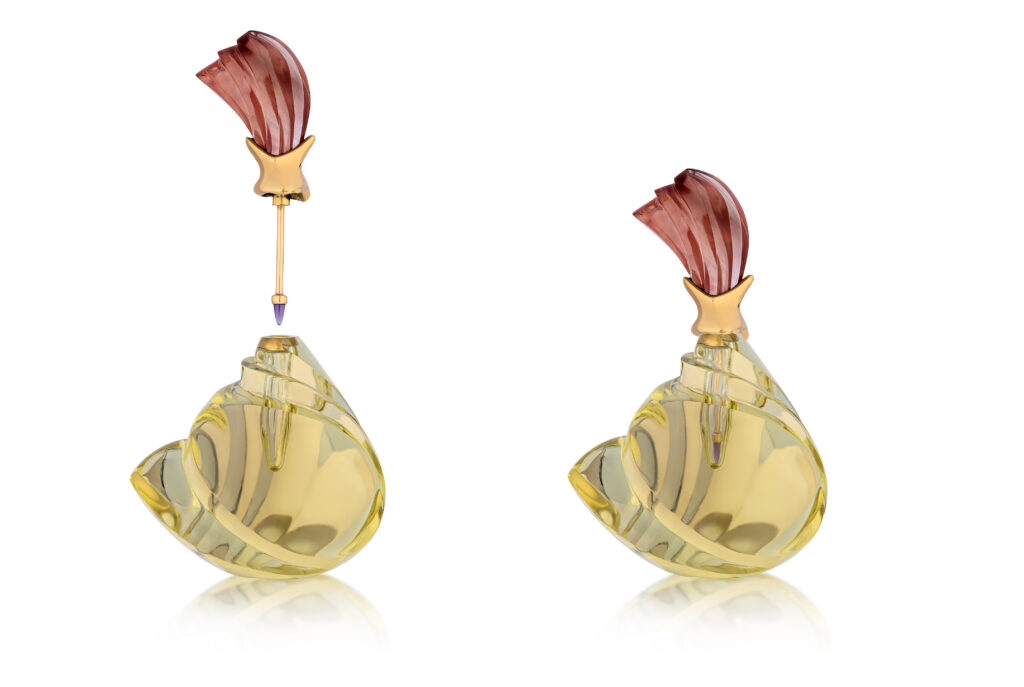
18K yellow gold “Genie in a Bottle” perfume bottle featuring chartreuse Quartz
accented by a hand-carved Sunstone and a Sugilite bullet
Jeff Mason Photography
Timeless Beauty
More than two decades after his passing, the artistry of Gil Roberts is still being recognized.
“Genie In a Bottle is a vintage carving by renowned, award-winning artist Gil Roberts,” notes Phil Louer, Jr., president of North American Gem Carvers. “The fluid design accented with fluted lines was a mainstay of Roberts’ style. A woodworker, jeweler and gem carver, Gil brought imagination and boundless skill to his art, always experimenting and expanding his styles.”
“‘Sculpting dreams into reality’ was his guiding mantra. Like a comet streaking through the sky, Roberts left the rest of us behind in January of 2003, leaving cherished memories and timeless beauty.”
And if you’re wondering where the Sugilite is, Louer explains:
“The sugilite is on the tip of the dipper, within the bottle, and one has to touch it in order to actually see it.”
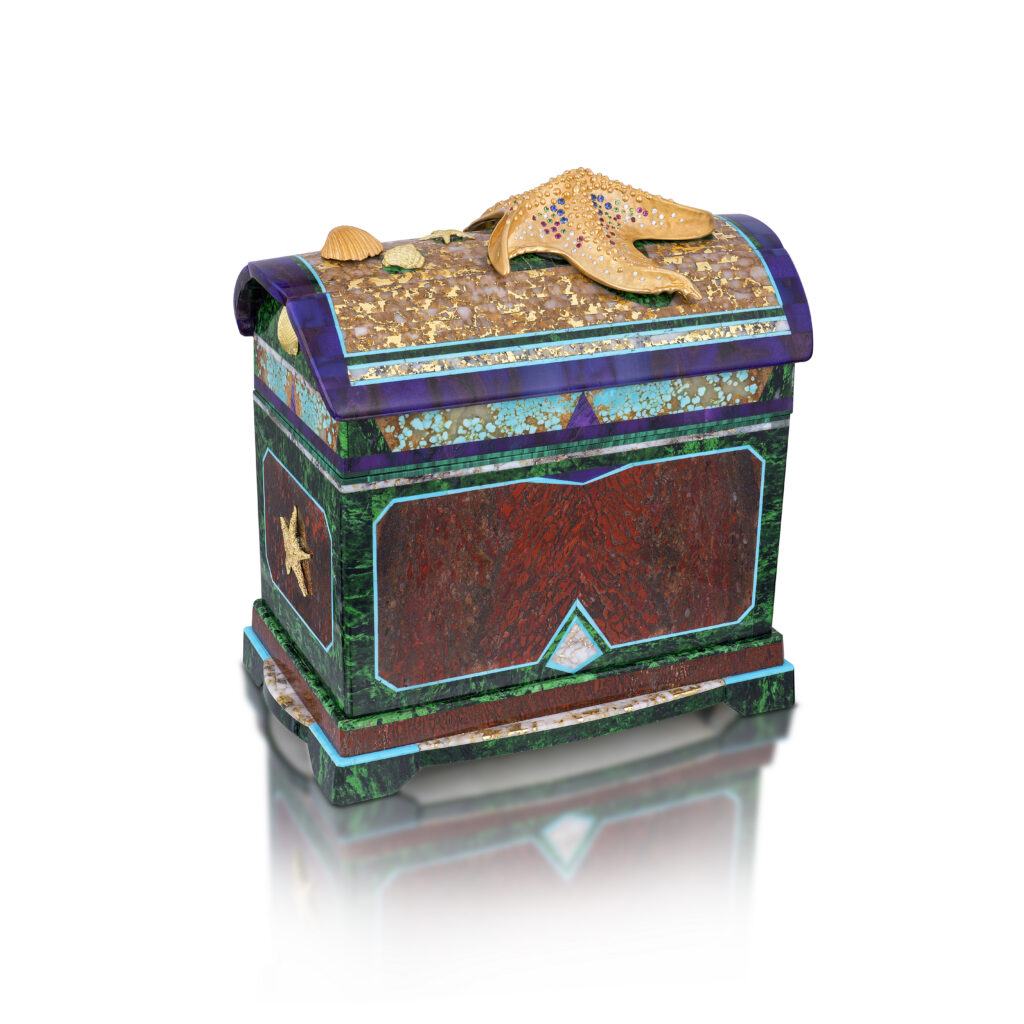
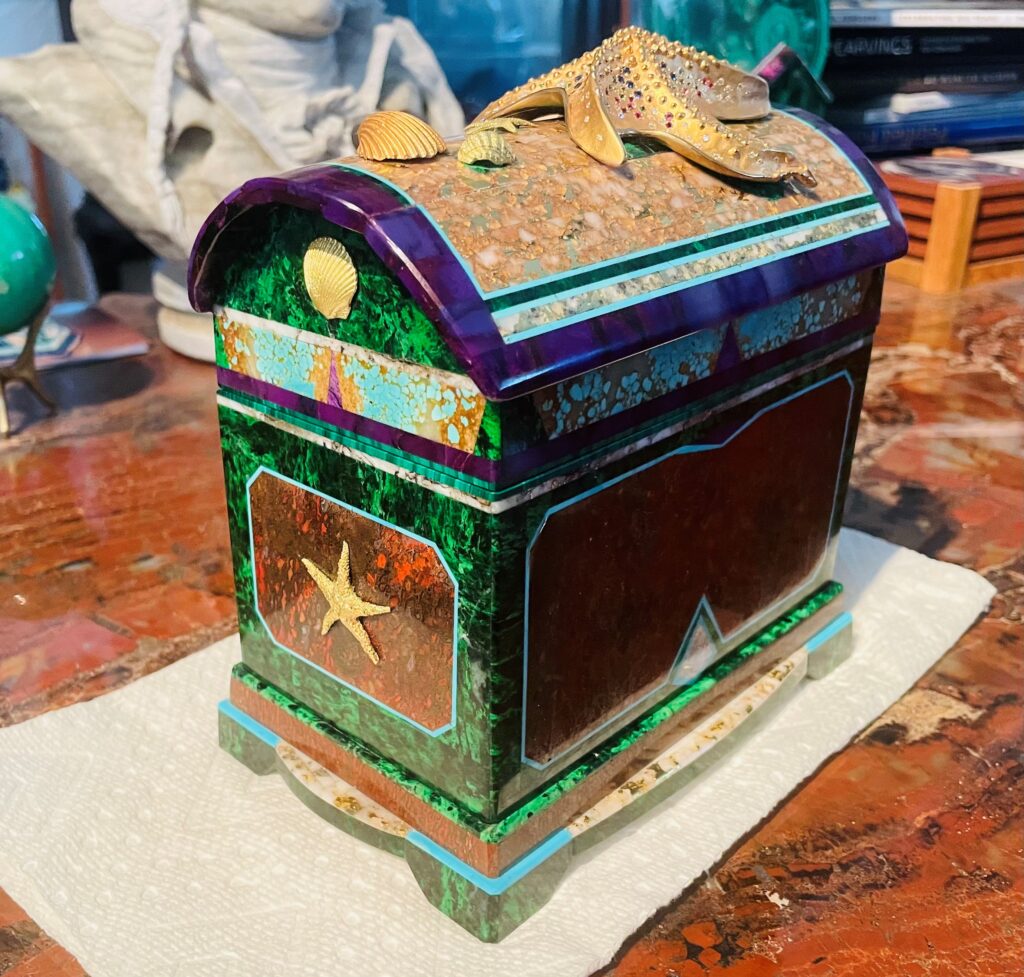
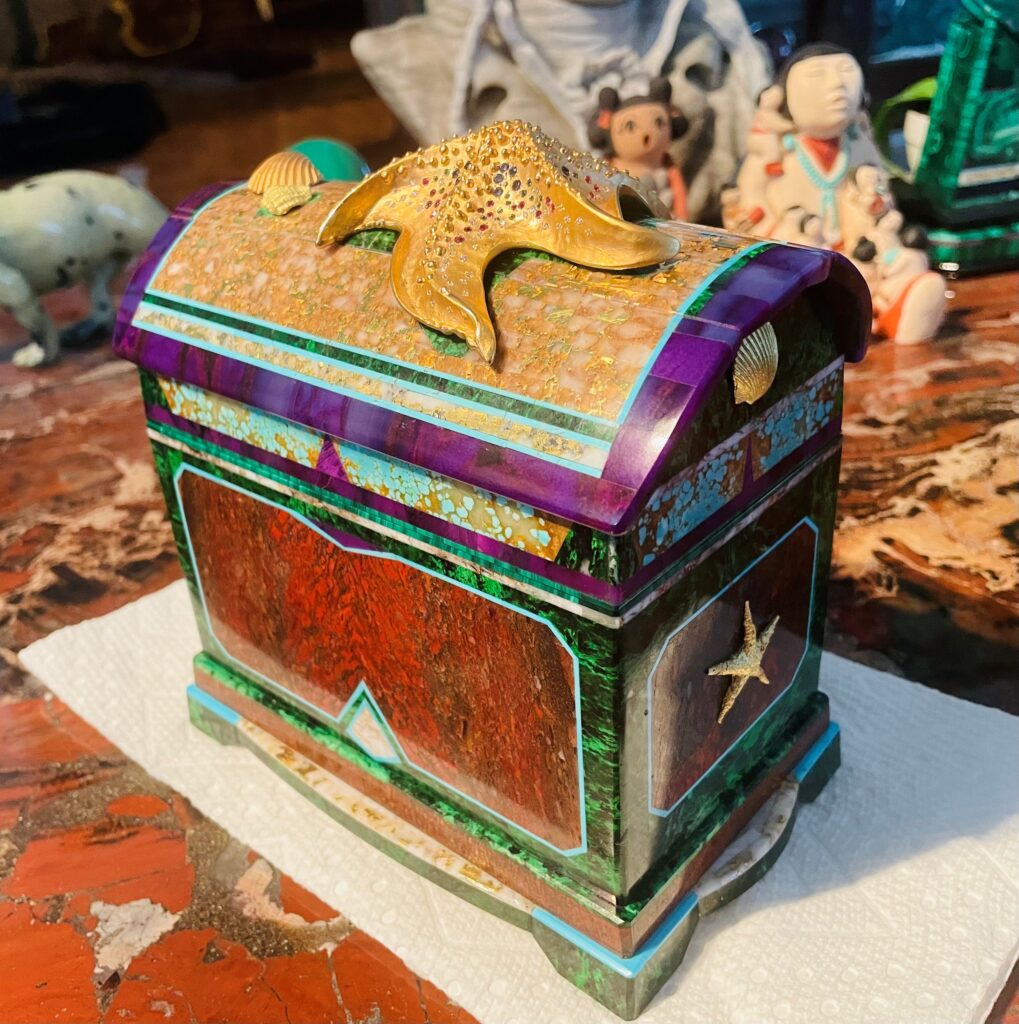
Honorable Mention — Nicolai Medvedev, Nicolai Medvedev, in collaboration with Susan Helmich (gold fabrication) — “Stella Maris (Star of the Sea),” intarsia box featuring Gold in Quartz (Australian on the top, Californian on the sides), Turquoise, Sugilite, Maw-Sit-Sit, Dinosaur Bone, accented by 22K yellow gold, Tiger’s-eye, Diamonds, Tsavorite Garnets, Benitoite, and red Beryl.
Jeff Mason Photography
Stella Maris — Capturing Slow Motion
A year in the making, Stella Maris is the third in a series of marine-inspired treasure boxes created through the collaboration of two masters of their craft, intarsia artist Nicolai Medvedev and jewelry artist Susan Helmich.
Their collaboration began in 2017, when Medvedev approached Helmich at Tucson’s GJX show, asking if she would be interested in creating the gold work for his first dome-topped box.
As it turns out, the two artists share an appreciation for life under the sea — Nicolai as a diver and Susan as a snorkeler.
Their first collaboration featured an octopus, The Collector, followed by a blue-spotted stingray, Blue Boy. Both received AGTA Cutting Edge Awards.
A Celebration of America
For this latest creation, Medvedev wanted to incorporate several American gem materials, focusing on the colors of the American flag — red, white, and blue.
Among the domestic materials are Gold in Quartz from California, Turquoise from Nevada and Arizona, Benitoite from California, Dinosaur Bone and red Beryl from Utah.
“Because the box was made in 2026, I also wanted to dedicate it as ‘Celebration USA-250 years,’” writes Medvedev.
And if you’re wondering how much gold went into creating this treasure box, Nicolai tells us approximately 10½ troy ounces, including the Gold in Quartz and the 18K gold hinge.
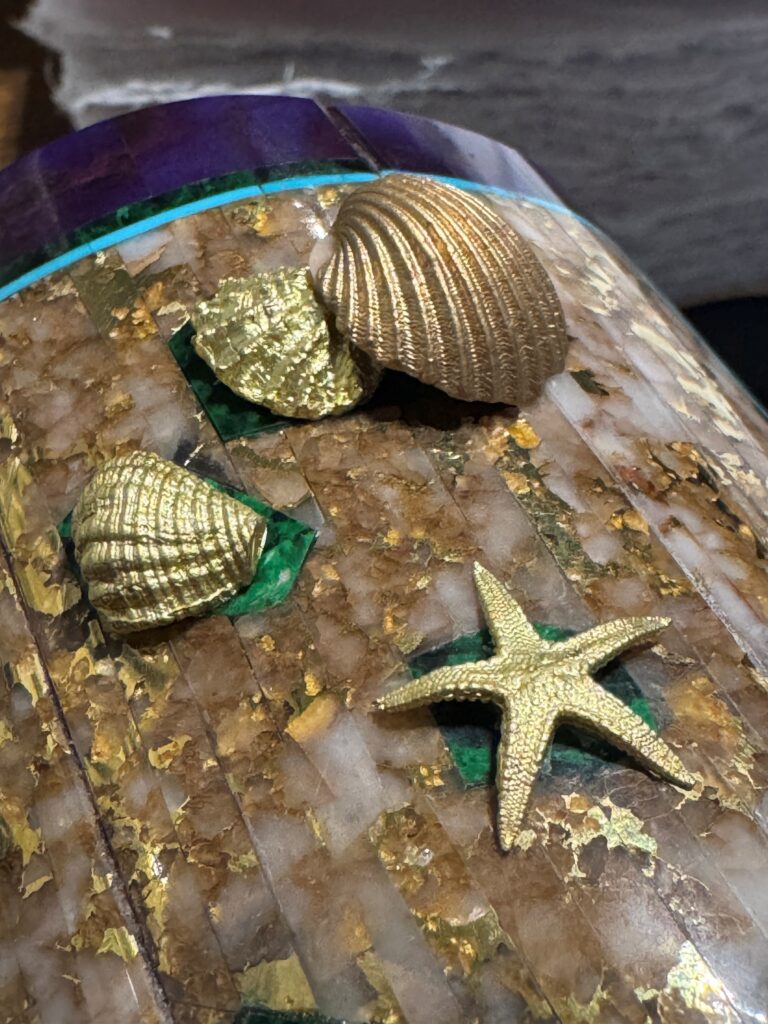
along with gold sea shells and a baby starfish.
Image courtesy of Nicolai Medvedev and Susan Helmich.
Bringing the Starfish to Life
For Helmich, creating the starfish presented an entirely different challenge from that of the octopus and stingray.
Starfish move very slowly.
“How do you show the emergence of movement in slow motion?” asks Helmich.
After studying starfish and creating approximately eight models, Susan wanted to convey something more than simply a starfish resting on top of an intarsia box.
“It’s one that is holding onto the box that wants to be there and therefore is alive.”
But there was another challenge. When Susan received the box from Nicolai, he had already created the shadows of the starfish using Maw-Sit-Sit!
Susan had to create her starfish to work with those existing shadows, while also taking into consideration the way sunlight and shadows appear beneath the surface of the water.
“So I was working backwards.”
And take a closer look at the texture of the gold starfish. Each of those little raised dots was individually placed on the wax model.
“I don’t work according to work hours. I work according to inspiration,” says Helmich.
Susan estimates that she spent at least ten months working on the piece, and that doesn’t include the research.
From the Depths of the Sea to the Stars Above
There is yet another source of inspiration behind Susan’s starfish — music.
A longtime music aficionado, Helmich was inspired by the song Stella by Starlight.
“Stars are something we look up to and we look down to,” says Helmich, referring to the stars in the sky and the stars at the bottom of the sea.
While researching starfish, Susan came across the Latin Stella Maris — Star of the Sea.
And there it was — the name Stella appearing in both her musical inspiration and the Latin name.
For Helmich, stars represent mystery, romance, light, positivity, and hopefulness.
“I’ve never heard a negative comment about a star. Have you?”
Pairs & Suites
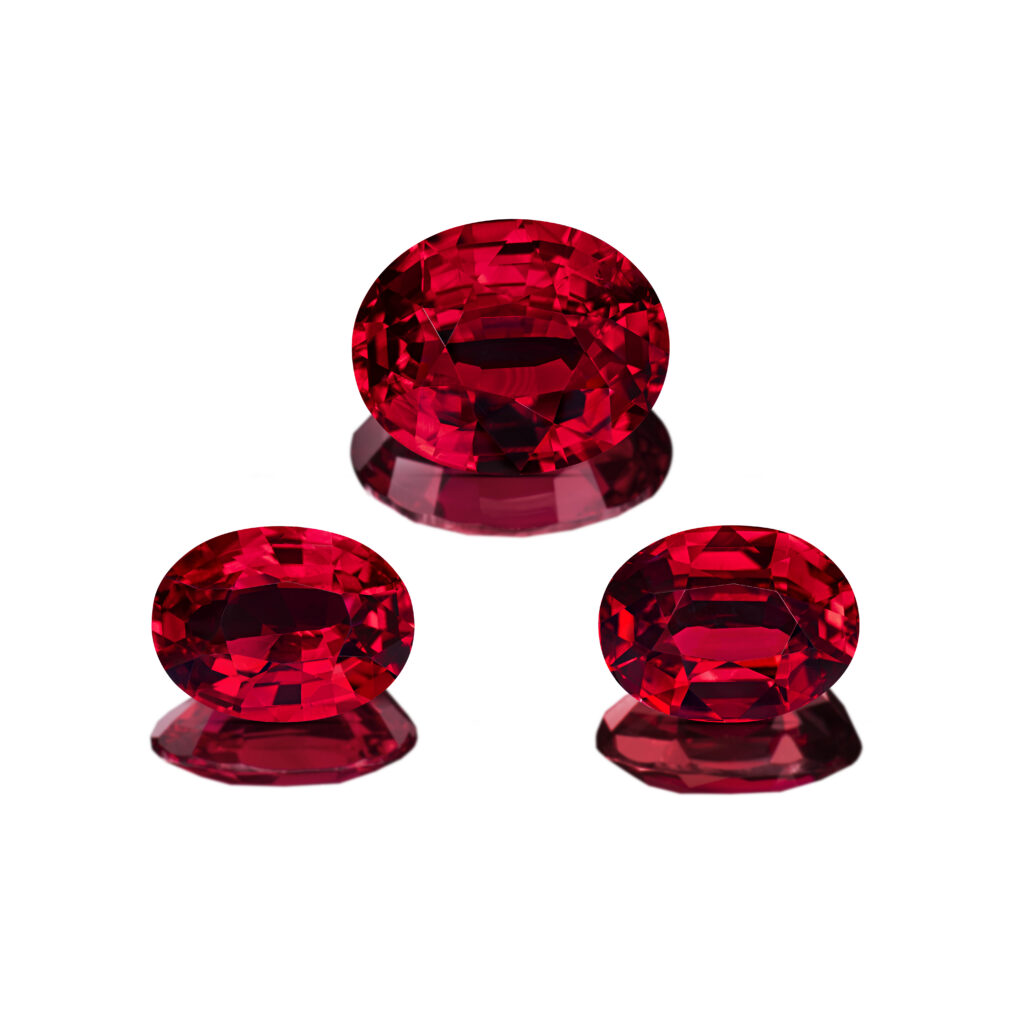
2nd Place — Allen Kleiman, A. Kleiman & Co. — Suite of three unheated oval Mozambique Rubies, 13.28 ctw.
Jeff Mason Photography
Making Gems Look Like Gems
For Allen Kleiman, putting together this suite of three unheated Mozambique Rubies involved more than simply matching color. Allen recut the Rubies to improve their appearance and create a more attractive matching suite.
“If it’s gem material, I kind of feel compelled to make them look like ‘gems’,” says Kleiman.
It’s a philosophy we explore further in our interview with Allen, The Weight of Experience — Allen Kleiman on Carats, Cutting, and the Pursuit of Beauty.
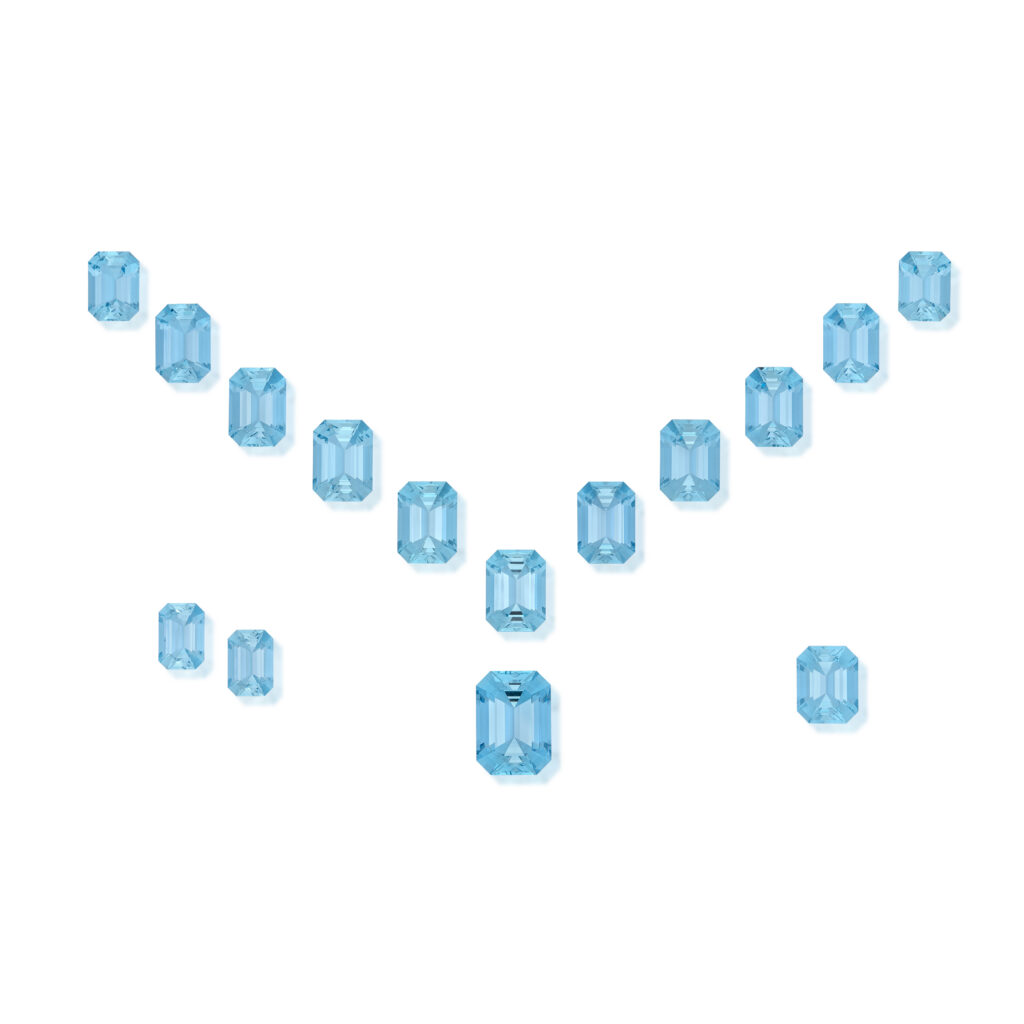
3rd Place — Mikola Kukharuk, Nomad’s — Suite of 16 emerald-cut Aquamarines, 343.15 ctw.
Jeff Mason Photography
Sixteen of a Kind!
It’s challenging enough to find/cut two large Aquamarines of matching color and quality. Now imagine finding/cutting sixteen!
“The layout of large, deep blue Aquamarine from Espírito Santo State, Brazil, is also a highlight of our collection,” says Tracy Lindwall of Nomad’s. “It is always difficult to put a suite of gems together. This one has beautifully cut large stones with that incredible color Brazilian aquamarine is known for.”
Phenomenal Gemstones
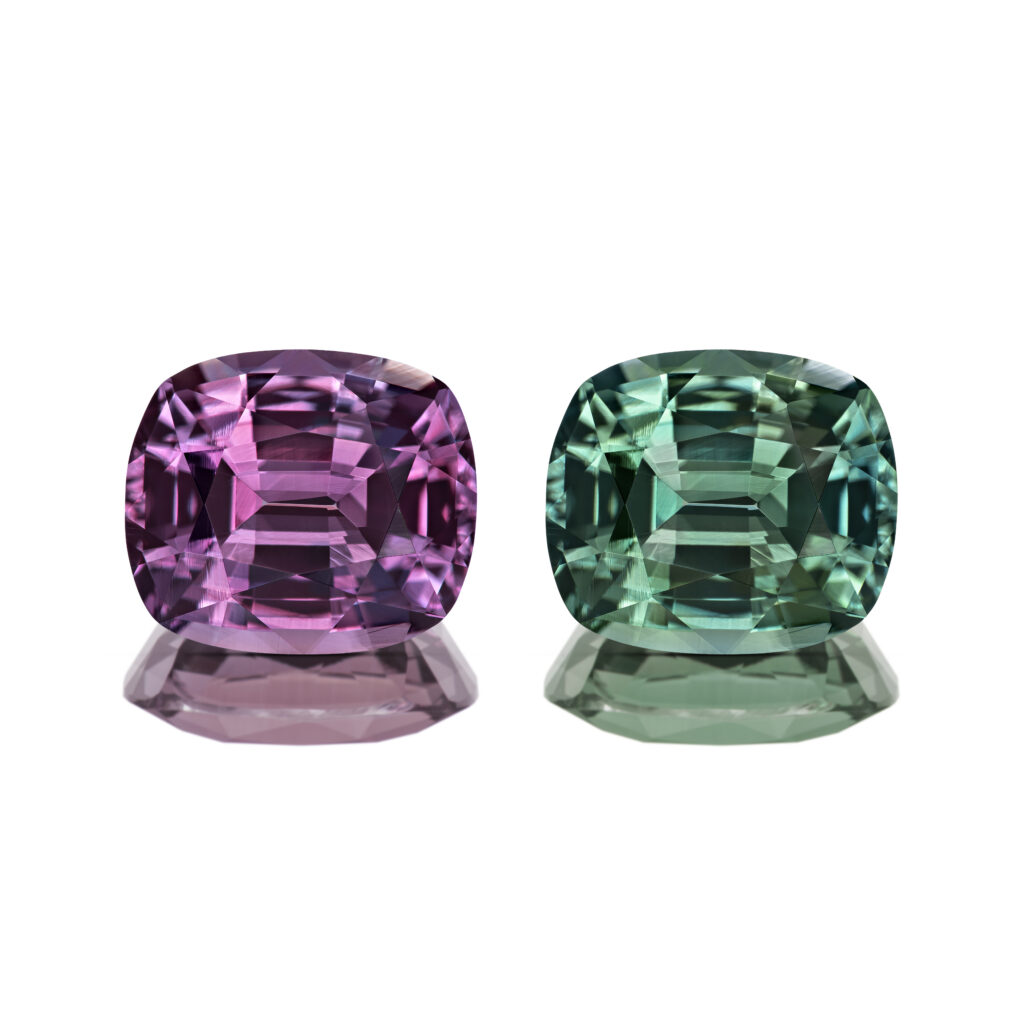
2nd Place — Allen Kleiman, A. Kleiman & Co. — 5.53 ct. cushion-cut Sri Lankan Alexandrite.
Jeff Mason Photography
When Beauty Outweighs Weight
The 5.53-carat cushion-cut Alexandrite that earned 2nd Place in Phenomenal Gemstones began its journey at approximately nine carats.
Allen purchased the gemstone in Sri Lanka. It had an inclusion that needed to be considered in any recutting decision.
The sellers believed the stone could retain approximately nine carats. Allen disagreed, estimating that a finished gemstone would weigh closer to 6.50 carats.
He purchased it with that expectation.
After the first recutting, the Alexandrite weighed approximately 6.50 carats. But Allen still wasn’t satisfied with the result.
So he cut it again.
The finished gemstone weighed 5.53 carats — nearly 3.5 carats less than its original weight.
“That’s what it was meant to be, to make a gem. And that’s what I did,” says Kleiman.
Remember Allen’s imperial pink Topaz featured earlier? In recutting that gemstone, Allen sacrificed just 3% of its original weight, deliberately retaining a little of the window to preserve the character of the stone.
Here, with the Alexandrite, he sacrificed nearly 40%!
Two very different recutting decisions, but with the same objective — bringing out the beauty of the gemstone.
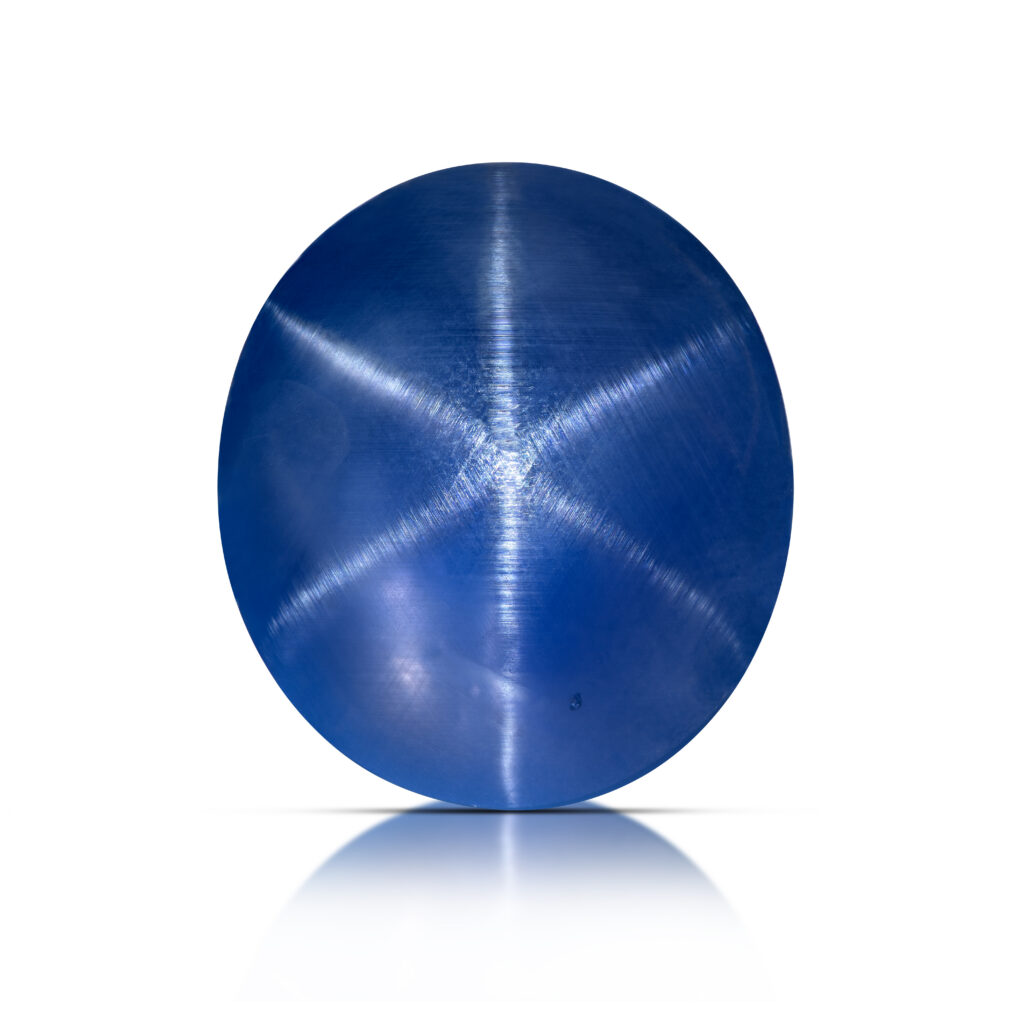
3rd Place — Allen Kleiman, A. Kleiman & Co. — 40.09 ct. unheated Sri Lankan star Sapphire.
Jeff Mason Photography
Knowing When to Leave Well Enough Alone
Unlike the Alexandrite, Allen’s 40.09-carat Sri Lankan star Sapphire required a very different approach.
This was an older gemstone that had been sold into Japan years earlier and subsequently returned to the market.
Allen acquired it and recognized that it needed relatively little attention.
He cleaned up the bottom and improved the polish, but the extraordinary sharp, straight, and unbroken six-rayed star was already there.
What impressed him was the combination of size, a sharp star, and a fine blue bodycolor without the gray component often seen in lighter-colored star Sapphires.
Allen described the color as a pure, cornflower-like blue.
Finding that combination of color, size, and quality of asterism in an unheated Sapphire of 40 carats is unusual.
No major recutting necessary here.
When it’s right, it’s right.
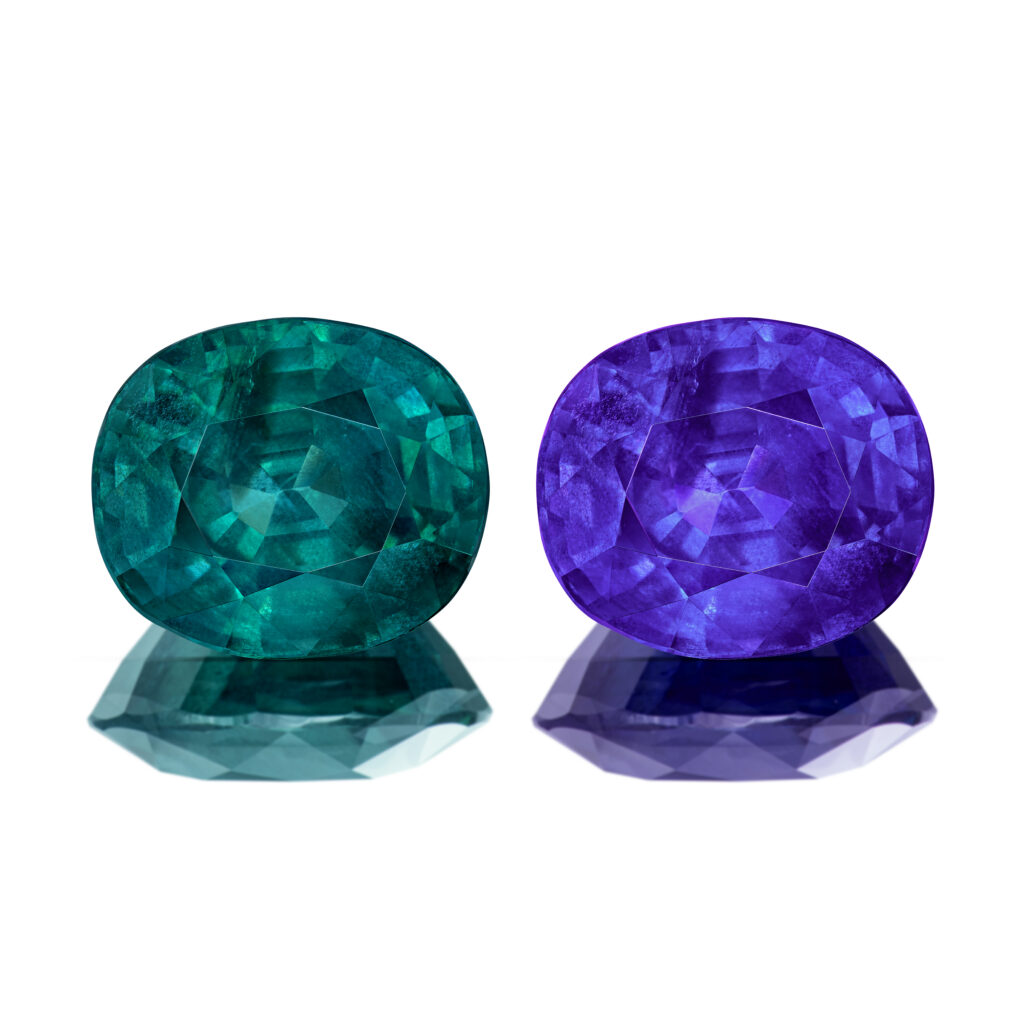
Honorable Mention — Bryan Lichtenstein, 3090 Gems — “Phenomenal Velvet,” 20.40 ct. color-change Zircon.
Jeff Mason Photography
“This gemstone was acquired prior to the Feb 2021 military coup in Myanmar (formerly Burma).”