Seven awards. Six winning entries. And several extraordinary gemstones that didn’t receive so much as an Honorable Mention.
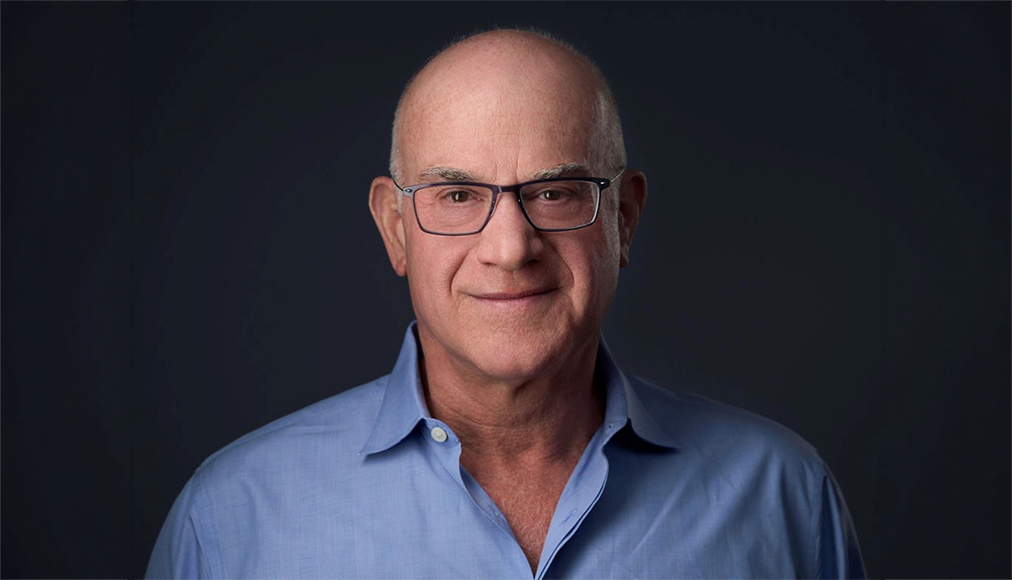
For Allen Kleiman of A. Kleiman & Co., the 2026 AGTA Cutting Edge Awards were a remarkable success. His entries, spread across four categories, earned seven recognitions, including Best of Show for a suite of 11 rainbow Moonstones.
But in our conversation with Allen, we discovered that some of the most interesting stories weren’t necessarily about the gemstones that won.
They were about the decisions that went into cutting them — how much weight to sacrifice, which imperfections to eliminate, and when another trip to the cutting wheel might do more harm than good.
And then there were the gemstones he was certain would win.
They didn’t.
Seven Awards, Six Gemstone Entries
Best of Show — The Rainbow Moonstones
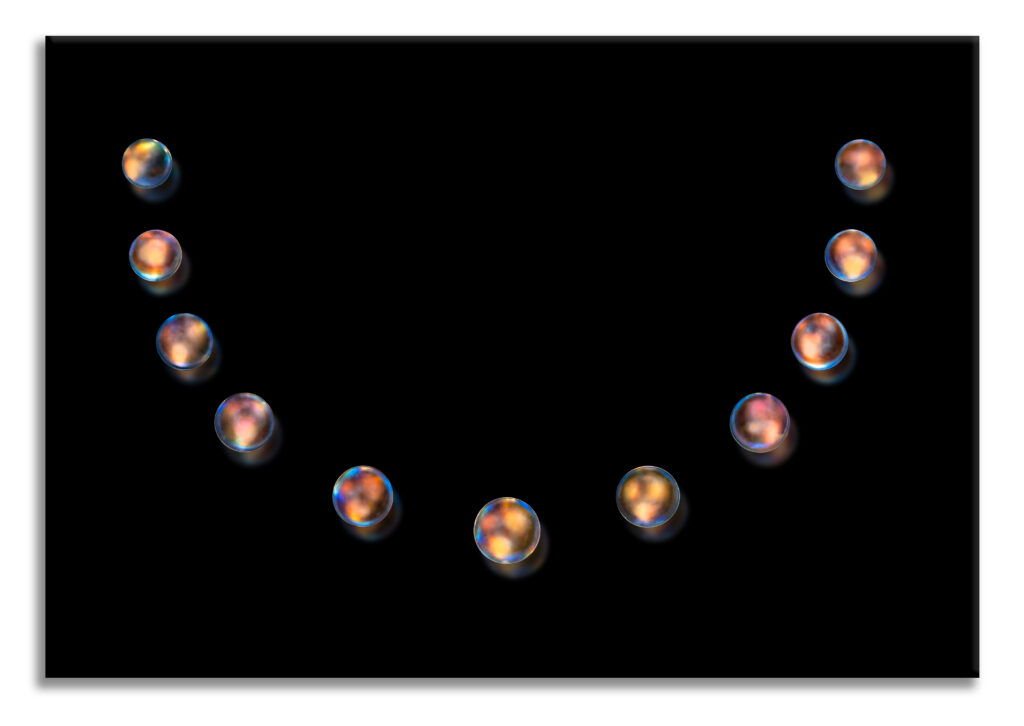
Allen’s suite of 11 rainbow round cabochon Moonstones, weighing a combined 90.12 carats, earned both Best of Show and 1st Place in Pairs & Suites.
The gemstones, from Madagascar, were selected and cut to match in shape, size, and their colorful sheens.
Allen figured they would be a crowd-pleaser. But he hadn’t necessarily expected them to take the competition’s top honors.
Still, assembling a suite of this quality required considerably more than finding 11 decent cabs.
AK – “Most of the material is included, so to get really clean stones, you have a huge weight loss.”
And after obtaining clean material, there is that other challenge: matching the colorful sheens across the entire suite.
According to Allen, production of this quality of material has declined substantially, and finding enough to assemble comparable suites is becoming increasingly difficult.
AK – “I’m thinking that these might be the last top, top gem suites for a while.”
2nd Place — The Suite of Mozambique Rubies
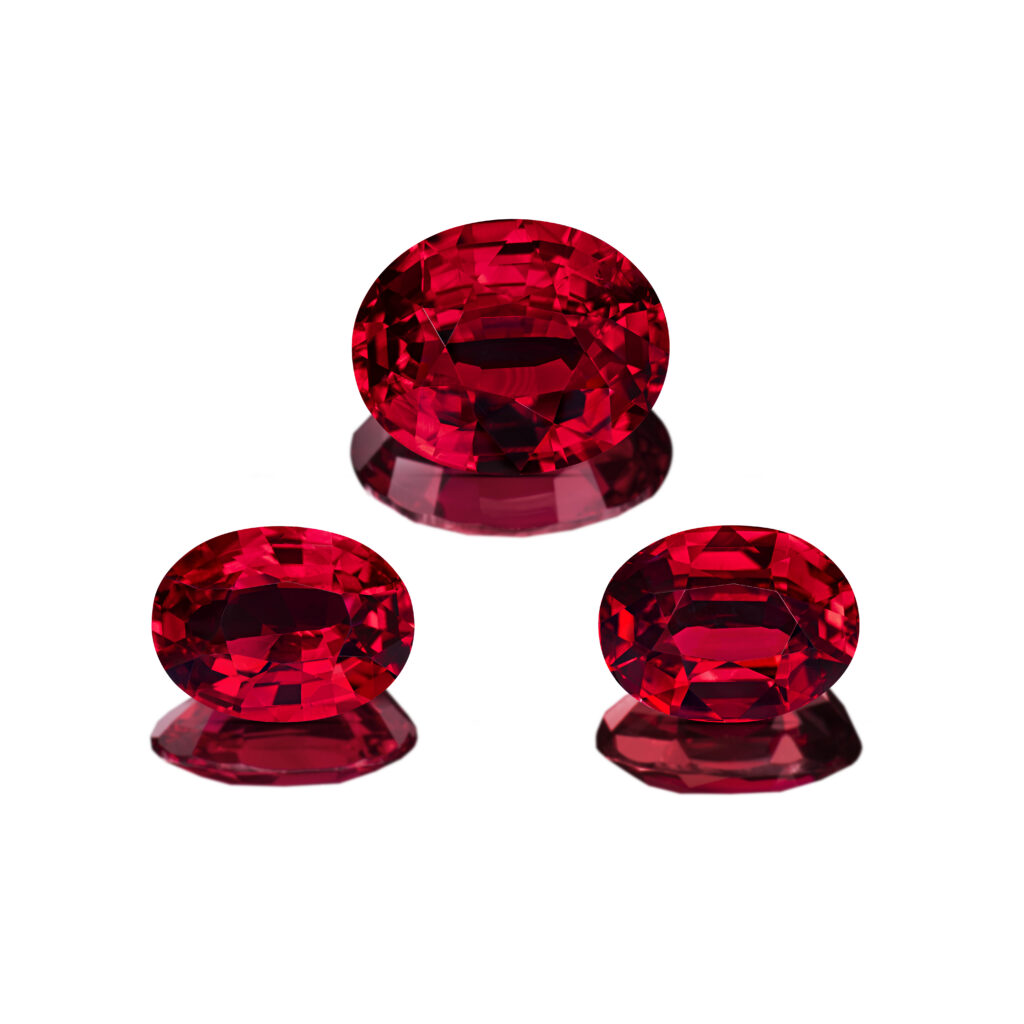
Kleiman’s suite of three unheated oval Rubies from Mozambique, weighing 13.28 ctw., received 2nd Place in Pairs & Suites, following the rainbow suite.
He had owned the material for some time before deciding to recut the gems to match and improve their beauty. For Kleiman, fine material deserves cutting that brings out its quality.
AK – “If it’s gem material, I kind of feel compelled to make them look like ‘gems’.”
Some dealers, he explained, prefer to retain more weight, even when the cutting — and the beauty — could be improved. They may believe that the additional carat weight makes the gemstone easier to sell, or that a lower price per carat will attract a buyer.
Kleiman has a different philosophy.
His clients are discerning, and he wants the cutting to reflect the quality of the material, and his expertise.
That doesn’t necessarily mean perfect facet junctions or mathematically ideal proportions. It means creating the most beautiful gemstone possible while respecting the material.
Jeff Mason Photography
3rd Place — A Yellow Sapphire Worth Another Look
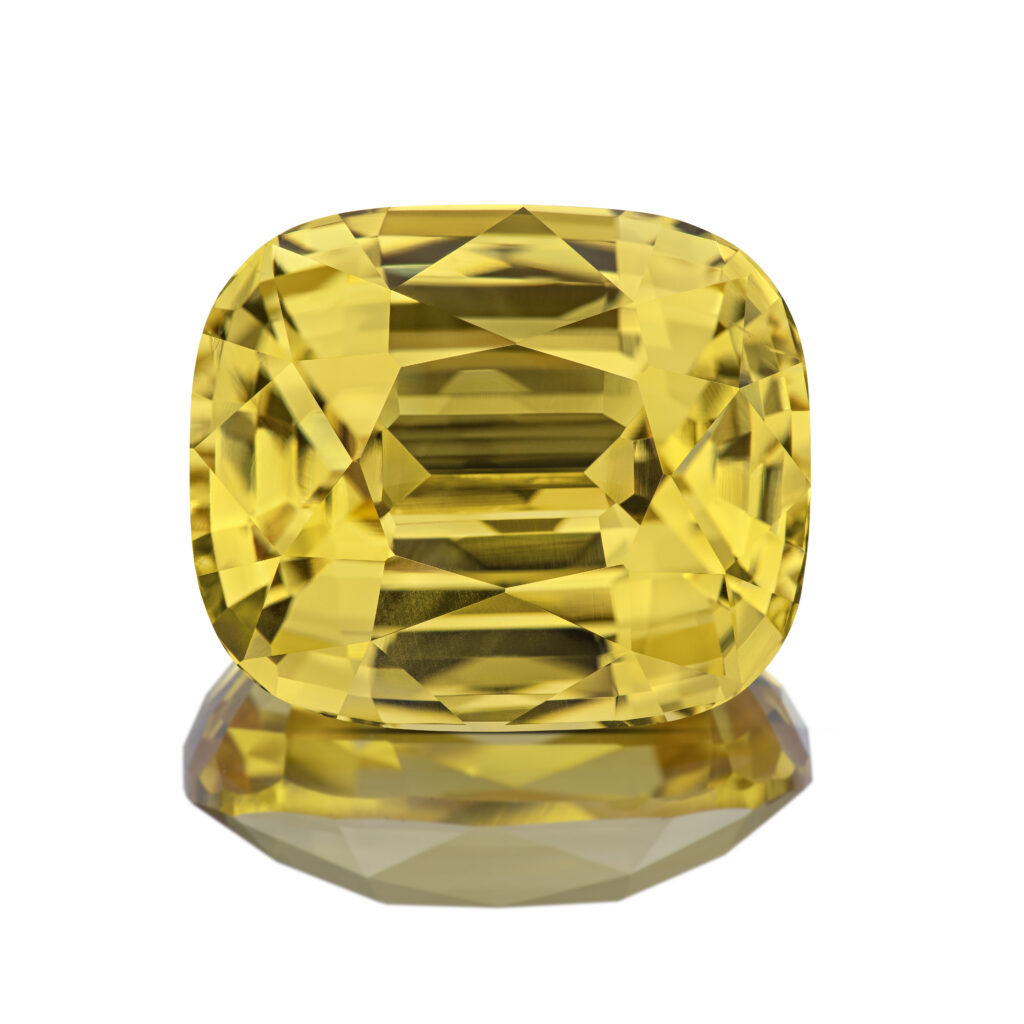
In Classic Gemstones, Kleiman’s 21.20-carat unheated yellow cushion-cut Sri Lankan Sapphire was awarded 3rd Place.
It was a gemstone he had owned for several years, actually. But despite its exceptional color and clarity, Kleiman could see that the cut needed some attention. So back onto the cutting wheel it went.
What makes this particular Sapphire interesting is Allen’s respect for its clarity and its intense, ‘pure yellow’ color.
For him, the combination of exceptional clarity and color makes this gemstone substantially rarer than an otherwise ‘attractive’ yellow Sapphire.
Jeff Mason Photography
Honorable Mention — The Imperial Pink Topaz
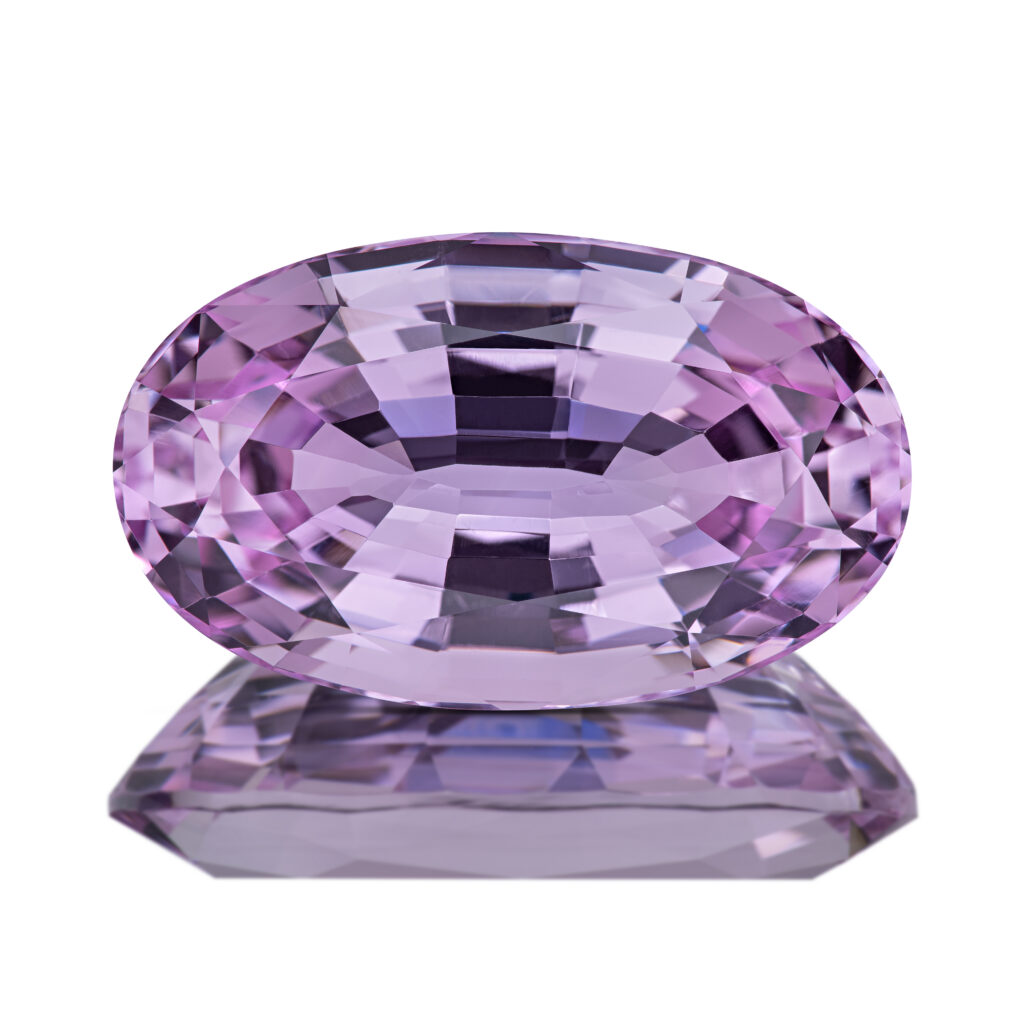
One of the more interesting stories in our conversation involved a 40.24-carat natural imperial pink oval Topaz, which received Honorable Mention in All Other Cut Gemstones.
The gemstone had been removed from a mounting that Allen estimated to be close to 100 years old.
It originally weighed approximately 41.50 carats, and although Allen recognized that the cutting could be improved, he was reluctant to sacrifice the qualities that made the gemstone special.
AK – “I thought even the shape was kind of sexy and cool.”
The color was another attraction. Rather than the more intense pink that some buyers might prefer, this Topaz displayed a pure, ‘sweet pink’ that Allen considered exceptionally rare, particularly in a gemstone of this size.
He recut the stone, improving its appearance while reducing its weight by approximately 1.26 carats.
But he deliberately stopped short of eliminating every imperfection.
There was still a slight window.
Could he have continued cutting until the window disappeared? Probably. But that would have meant sacrificing more weight and, more importantly, potentially changing the gemstone’s character.
AK – “Sometimes you almost lose the character of the stone if you do that.”
Allen described the finished gemstone as something of a hybrid — improved cutting that retained the elegance of an older style.
The decision wasn’t simply about achieving perfect proportions. It was about recognizing what made this particular gemstone beautiful in the first place.
Jeff Mason Photography
2nd Place — An Alexandrite That Lost Nearly Four Carats
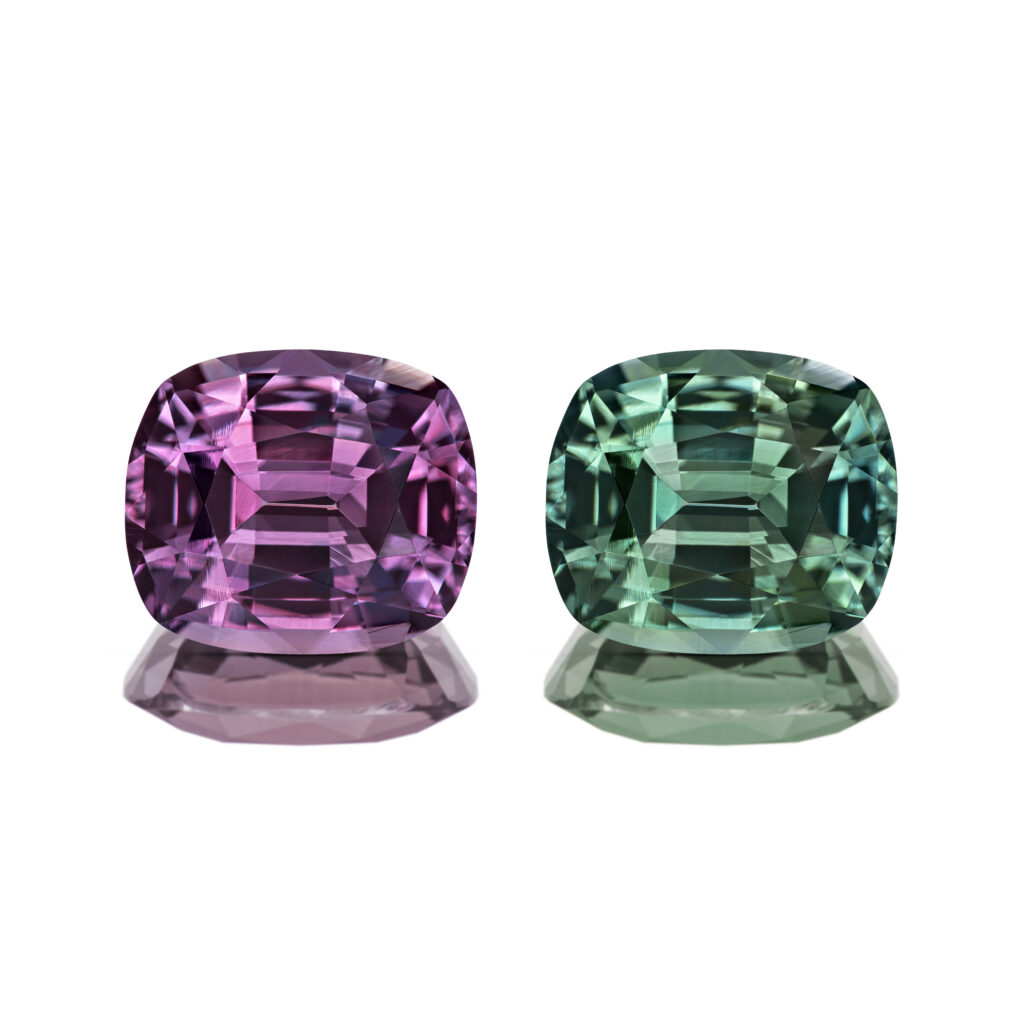
The 5.53-carat cushion-cut Alexandrite that earned 2nd Place in Phenomenal Gemstones began its journey at approximately nine carats.
Allen purchased the gemstone in Sri Lanka. It had an inclusion that needed to be considered in any recutting decision.
The sellers believed the stone could retain approximately nine carats. Allen disagreed, estimating that a finished gemstone would weigh closer to 6.50 carats.
He purchased it with that expectation.
After the first recutting, the Alexandrite weighed approximately 6.50 carats. But Allen still wasn’t satisfied with the result.
So he cut it again.
The finished gemstone weighed 5.53 carats — nearly 3.5 carats less than its original weight.
AK – “That’s what it was meant to be, to make a gem. And that’s what I did.”
It’s a striking example of Allen’s willingness to sacrifice weight when he believes the improvement in beauty justifies the loss.
Jeff Mason Photography
3rd Place — A 40-Carat Star Sapphire
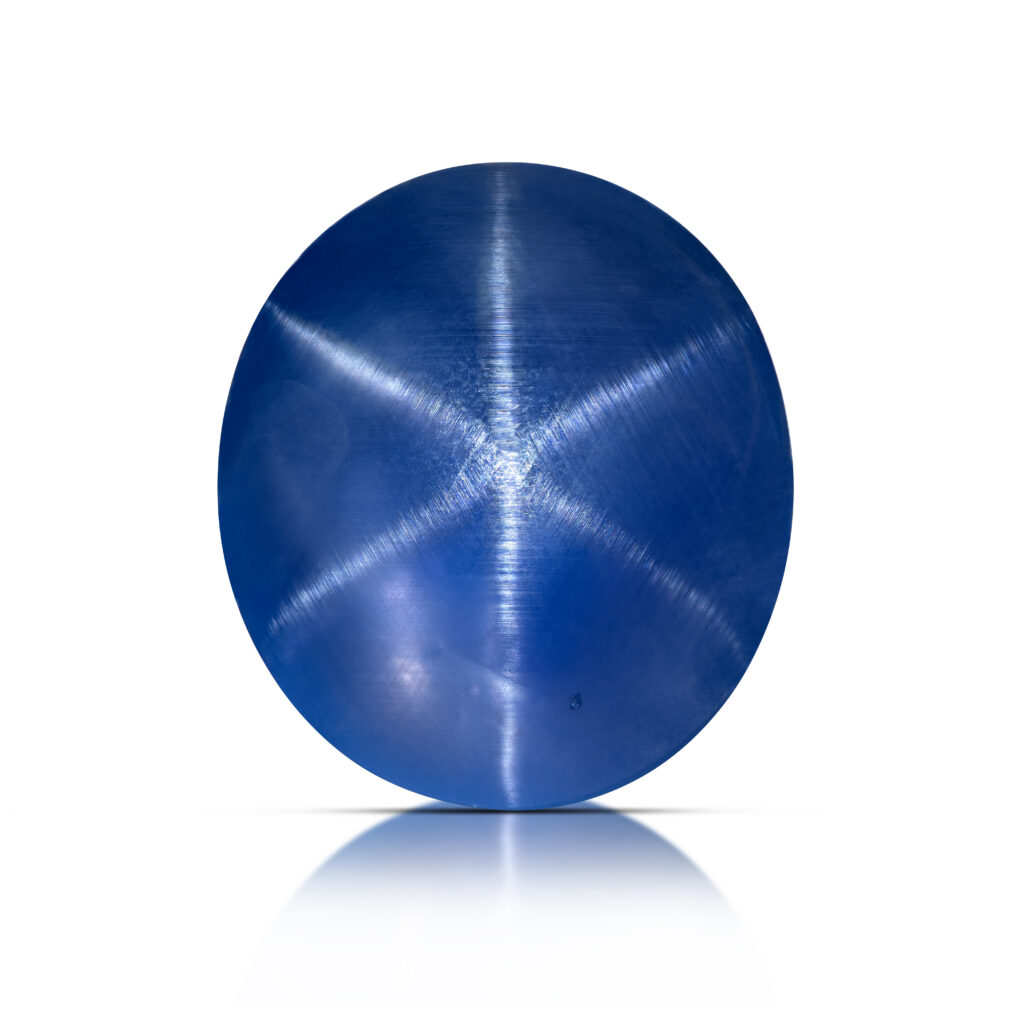
The 40.09-carat Sri Lankan star Sapphire, awarded 3rd Place in Phenomenal Gemstones, required a different approach.
This was an older gemstone that had been sold into Japan years earlier and subsequently returned to the market.
Allen acquired it and recognized that it needed relatively little attention.
He cleaned up the bottom and improved the polish, but the extraordinary sharp, straight, and unbroken six-rayed star was already there.
What impressed him was the combination of size, a sharp star, and a fine blue bodycolor without the gray component often seen in lighter-colored star Sapphires.
Allen described the color as a pure, cornflower-like blue.
Finding that combination in a gemstone of approximately 40 carats is unusual.
And unlike the Alexandrite, this was a case where relatively minor improvements were enough.
Jeff Mason Photography
And Then There Were the Ones That Didn’t Win
Among the entries that Allen submitted there were some that received no award recognition.
They too were exceptional gemstones.
And at least two were entries he had expected to do particularly well.
The Little Stack of Hearts
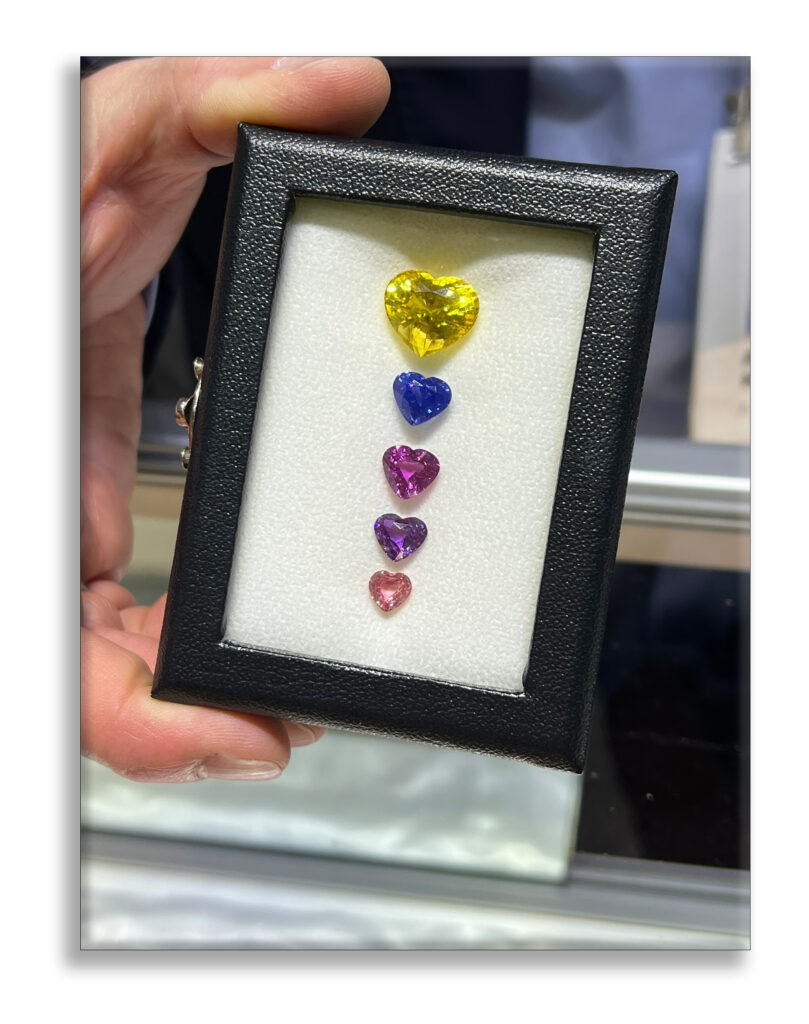
One that we saw in Tucson, and reported on here in the Roskin Report, was a suite of five heart-shaped, unheated Sapphires in yellow, blue, pink, purple, and padparadscha colors, from Sri Lanka and Madagascar.
We recognized it immediately on the Cutting Edge tables during AGTA Press Day.
Allen thought it could be a winner.
AK – “That was one that I thought would win also in Pairs & Suites.”
He acknowledged that the padparadscha wasn’t perfectly cut, but emphasized that its shape and color was excellent, and that each gemstone in the suite was exceptional.
AK – “They’re all super clean stones, and they’re all gems in their own right.”
Yet the suite received no recognition – except from us.
Of course, judging is subjective, particularly when so many exceptional gemstones are competing against one another.
Tucson, February 2026
Photo by Gary Roskin
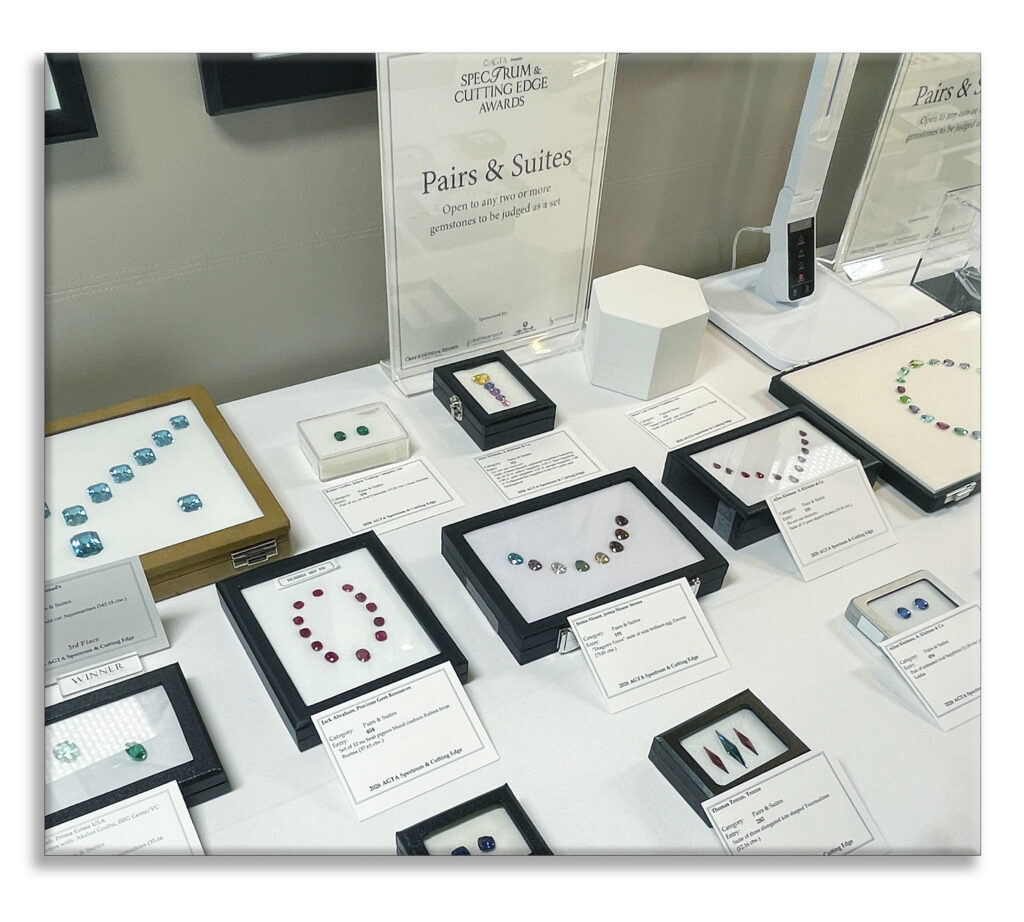
Photo by Gary Roskin
An Exceptional Emerald — And No Award
Then there was “The Green Dream,” an 8.10-carat no-oil Emerald from Madagascar.
Allen considered this too an extraordinary gemstone, the kind of material he believes is unlikely to be encountered again.
It too received no award.
Nor did his 55.46-carat yellow Sri Lankan Sapphire, “Soleil de Ceylan,” which had been recut from approximately 65 carats.
Other entries included a 65.04-carat Brazilian Aquamarine and a 9.07-carat Tanzanian Alexandrite.
The results were a reminder that an exceptional gemstone doesn’t necessarily become an award winner — even when its owner has decades of experience selecting and cutting fine material.
Knowing What It Takes
Throughout our conversation, Allen returned to the same fundamental question: How do you make the most beautiful gemstone possible without sacrificing something that makes it special?
With the rainbow Moonstones, the challenges were removing inclusions and matching 11 cabochons for their colorful sheens.
With the Alexandrite, the answer meant cutting a nine-carat gemstone down to 5.53 carats.
With the imperial pink Topaz, the opposite approach was required. Allen recognized that continuing to cut might eliminate the slight window, but it could also destroy some of the gemstone’s original character.
And with the yellow Sapphire, a few adjustments to an already exceptional gemstone were enough.
There is also the commercial reality of carat weight.
As Allen explained, a gemstone doesn’t necessarily need mathematically perfect cutting if it already displays its beauty.
AK – “If it looks perfect as a 5.01, you leave it alone.”
Knowing when to cut, how much to sacrifice, and when to stop requires more than technical skill.
It requires an understanding of the material, the market, and the qualities that make an individual gemstone worth preserving.
Sometimes that means sacrificing several carats.
Sometimes it means leaving a little window.
And sometimes it means recognizing that the gemstone is already exactly what it should be.
That’s the weight of experience.