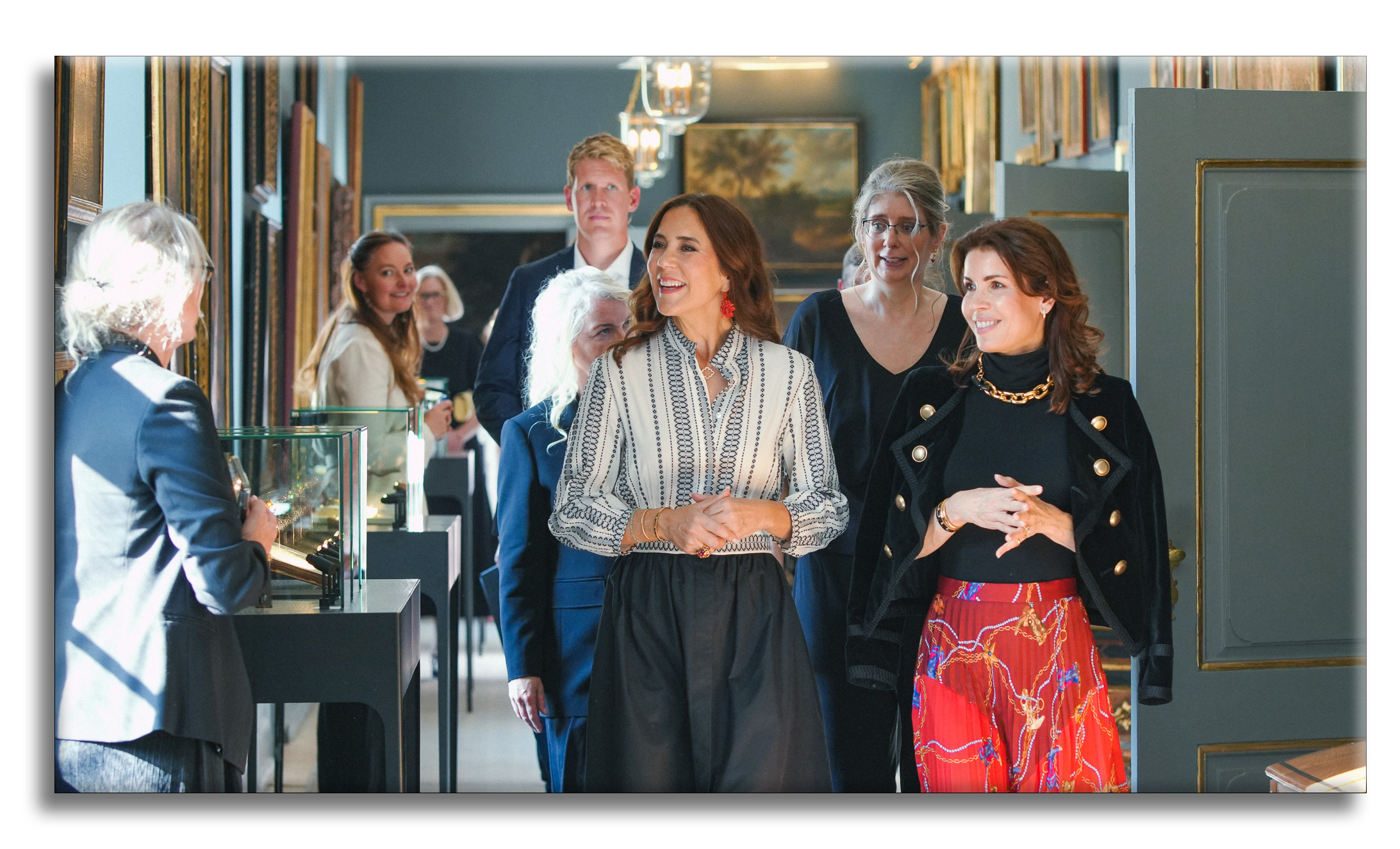
When Her Majesty Queen Mary recently visited Gavnø Castle in Denmark, she wasn’t there to admire the Danish Crown Jewels.
Instead, she came to explore an exhibition of contemporary headpieces and hair ornaments—33 one-of-a-kind creations crafted by some of Denmark’s finest goldsmiths and jewelry designers, alongside internationally recognized jewelry artists.
Conceived and curated by jewelry writer Nina Hald, To the Ball at the Castle is brought beautifully to life through the exhibition design of goldsmith Bodil Binner.
What to Wear in the Twenty-first Century
For centuries, tiaras, diadems, and crowns have symbolized royalty, ceremony, rank, and celebration.
This exhibition acknowledges that history but chooses to go in a different direction.
Rather than reproducing traditional royal jewels, the participating artists were invited to reimagine the entire category. The result is an exhibition less about status and more about storytelling—one where gold, gemstones, pearls, titanium, silver, horn, coral, and even bamboo become part of the story.
Butterflies become wearable sculptures.
Cherry blossoms become hairpins.
Birthstones become a family portrait.
A devastating fire becomes a trembling ruby.
And one artist even found inspiration… in an onion.
The craftsmanship throughout is exceptional, but what makes the exhibition even more memorable is the imagination behind each piece.
So, let’s take a look at just a few of the remarkable creations now on display at Denmark’s Gavnø Castle.
When butterflies forget they’re butterflies
“Picturesque Dream”
Among the exhibition’s international highlights is Wallace Chan’s “Picturesque Dream.”
The Hong Kong jewelry artist describes reaching a point in the creative process where he forgets that “a butterfly is a butterfly and a flower is a flower.” Only imagination remains. The result is a remarkable butterfly whose titanium wings “take on the rhythms of waves, the flames of passion, the softness of rain, and the wonders of the earth,” set with diamonds, tsavorites, rubies, sapphires, tourmaline, and his own Wallace Chan porcelain.
It is certainly not your traditional tiara—but then, we never expect “traditional” from Wallace Chan. Let’s simply call it wearable sculpture.
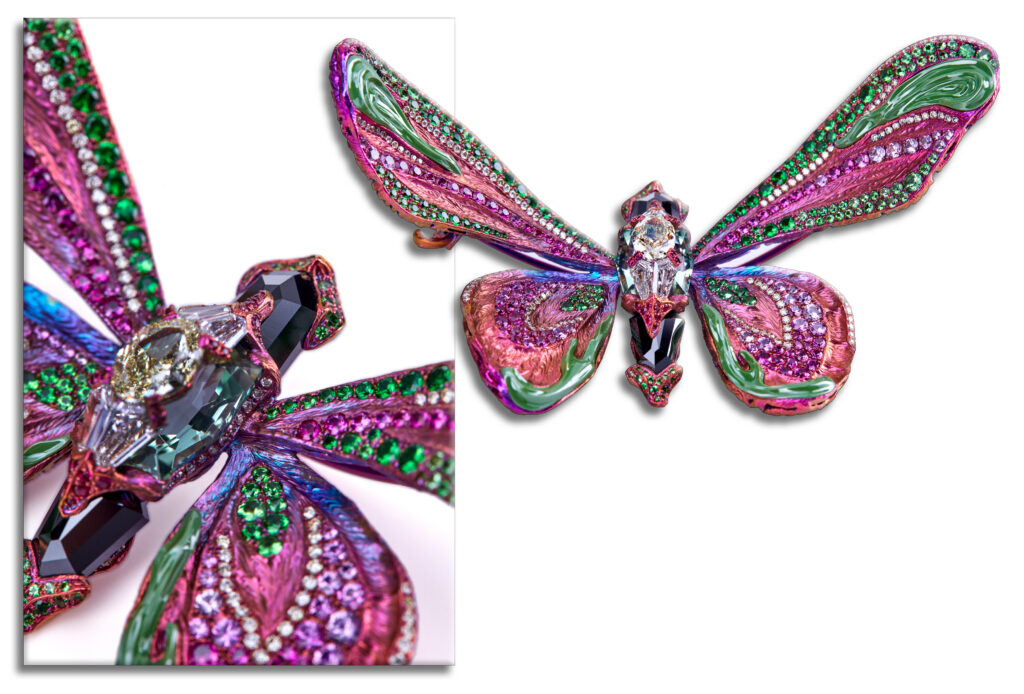
Titanium with Wallace Chan porcelain; a 1.21-carat oval diamond; four marquise-cut diamonds (0.82 ct total); two black diamonds (4.01 ct total); a 6.87-carat green tourmaline; 172 yellow diamonds (0.92 ct); 181 tsavorites (3.55 ct); 103 pink sapphires (3.07 ct); 23 rubies (0.11 ct); and 44 diamonds (0.19 ct).
History worn in gold
“Laird of the Highlands”
History appears throughout the exhibition in unexpected ways.
Goldsmith Bodil Binner looks to Scotland, combining the country’s national flower, the thistle, with the centuries-old story behind Britain’s Order of the Garter. Her creation features a magnificent custom-cut amethyst carved as a thistle and can be worn not only as a headband, but also as a garter. The thistle itself may be removed and worn separately as either a hair ornament or a brooch.
So, there are really two historical stories woven into Binner’s design.
◈ Why the Thistle?
According to Scottish tradition, the thistle became the nation’s emblem when it warned the Scots of an impending Viking attack. Legend says a barefoot Viking stepped on the prickly plant during a nighttime raid, cried out in pain, and alerted the sleeping defenders. Today, the thistle symbolizes Scotland’s resilience and national pride.
◈ Then there’s “The Order of the Garter.”
There is a phrase “Honi soit qui mal y pense,” which when translated becomes “Shame on him who thinks ill/evil of it.” Apparently, according to the legend, King Edward III uttered the words after rescuing a lady from embarrassment when her garter slipped during a court dance. According to legend, King Edward III uttered those words after rescuing a lady from embarrassment when her garter slipped during a court dance. Rather than allowing the assembled nobles to laugh, he picked up the garter, fastened it around his own leg, and declared, Honi soit qui mal y pense. This then became the motto of the Order of the Garter, Britain’s oldest and highest order of chivalry.
The motto is printed on Bodil Binner’s multifunctional creation, which can be worn as both a garter or a hairband, and the thistle motif can be used as a hair ornament or used as a brooch.
And while historians still debate whether the story is fact or legend, The Order of the Garter—and its enduring motto—remain very real.
Elsewhere, Louise Degn found inspiration in Gavnø Castle’s famous cherry avenue and in Japanese art and craftsmanship, creating elegant gold hairpins where blossoms seem to drift in the wind.
Even the castle itself quietly becomes part of the exhibition’s storytelling.
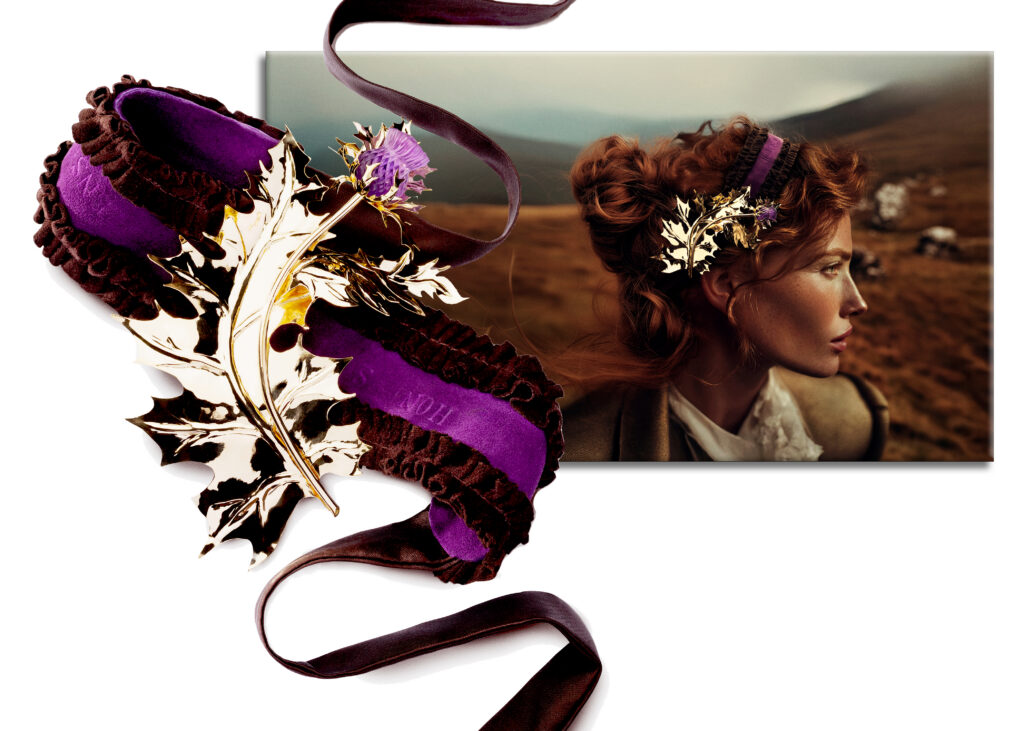
Bodil Binner, Guldsmed
foto Miklos Szabo & Ida Buss
Letting the Gemstones Lead
“Opal Royal”
Australian opals have long held a special place in goldsmith Henrik Skjønnemand’s work, so it’s no surprise they became the focal point of his contribution to the exhibition.
His goal was straightforward: create a contemporary headpiece elegant enough to be worn by a queen.
But rather than forcing the gemstones into a preconceived design, Skjønnemand let the opals take the lead.
The three Australian opals—with their softly rounded, pear-shaped outlines and flashes of iridescent color—determined the flowing curves of the gold itself. The result is a remarkably light, minimalist interpretation of a royal headpiece, where the gemstones don’t simply decorate the design—they define it.
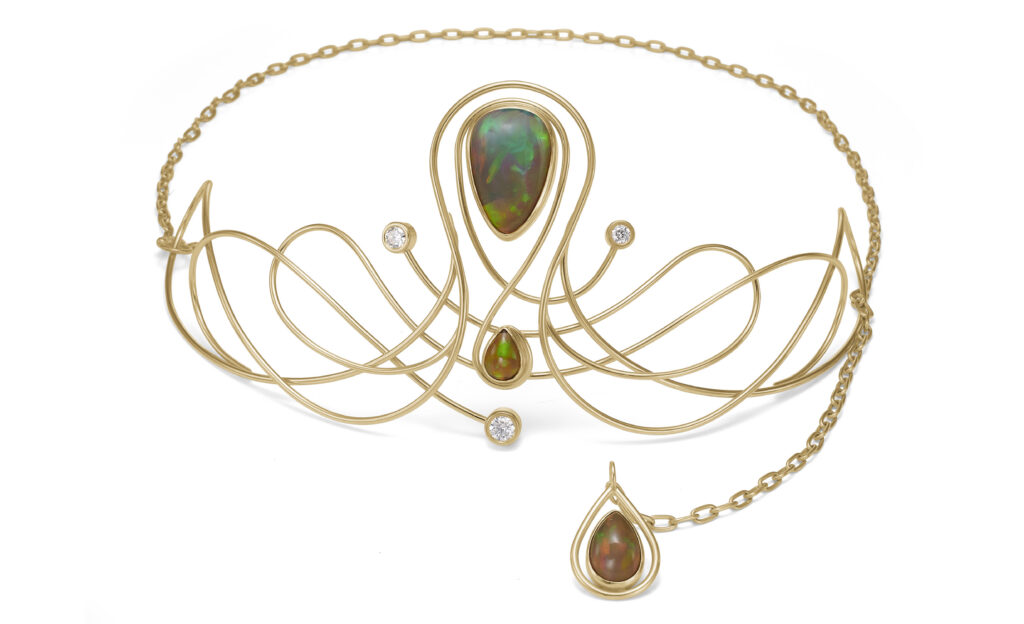
Made of 18 karat yellow gold, three Australian opals weighing 15.20 carats, 2.94 carats and 1.51 carats respectively,
and three brilliant-cut diamonds weighing 0.45 carats, 0.25 carats and 0.12 carats respectively.
Henrik Skjønnemand, Guldsmedjen i Ribe – foto Mousefoto
Pia Lütken chose an entirely different path. Birthstones
“The Royal Children’s Heart Crown”
Her Kongebørnenes Hjertekrone, “The Royal Children’s Heart Crown,” celebrates Queen Mary’s family through the birthstones of her children.
Crown Prince Christian’s October opal sits at the center of the design, flanked by Princess Isabella’s April diamonds. January red garnets represent Prince Vincent and Princess Josephine, while the gold heart in the center symbolizes Queen Mary’s love for her family.
It struck me while reading the description. This used to be called a Mother’s Ring—or a Mother’s Pin. Now, we have a Mother’s Tiara. Every mother deserves a tiara.
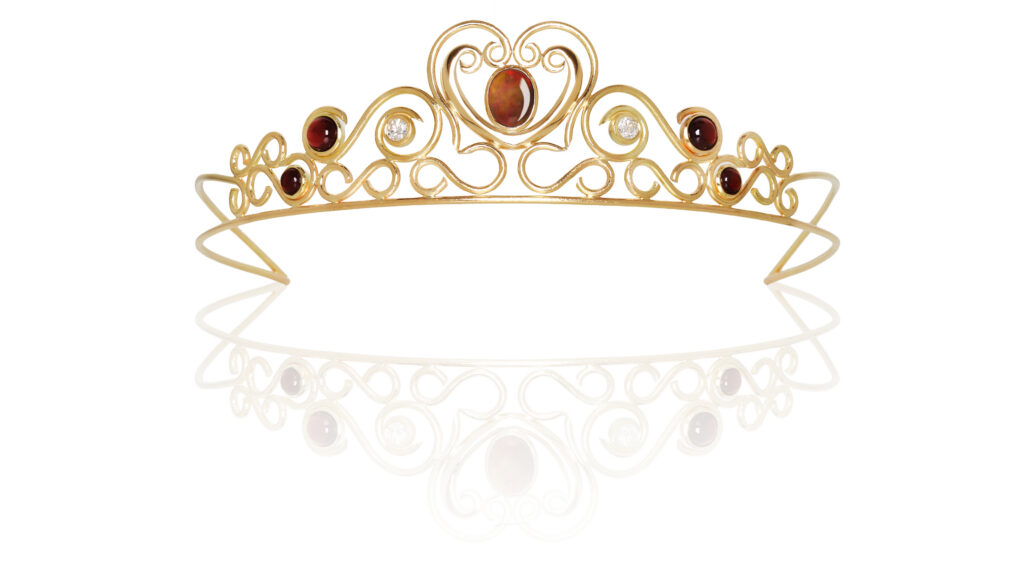
Made of 14 karat gold with a 3 carat opal, two diamonds (total 1 carat) and four cabochon-cut garnets (6-8 mm in diameter).
Photographer: Størup Studio
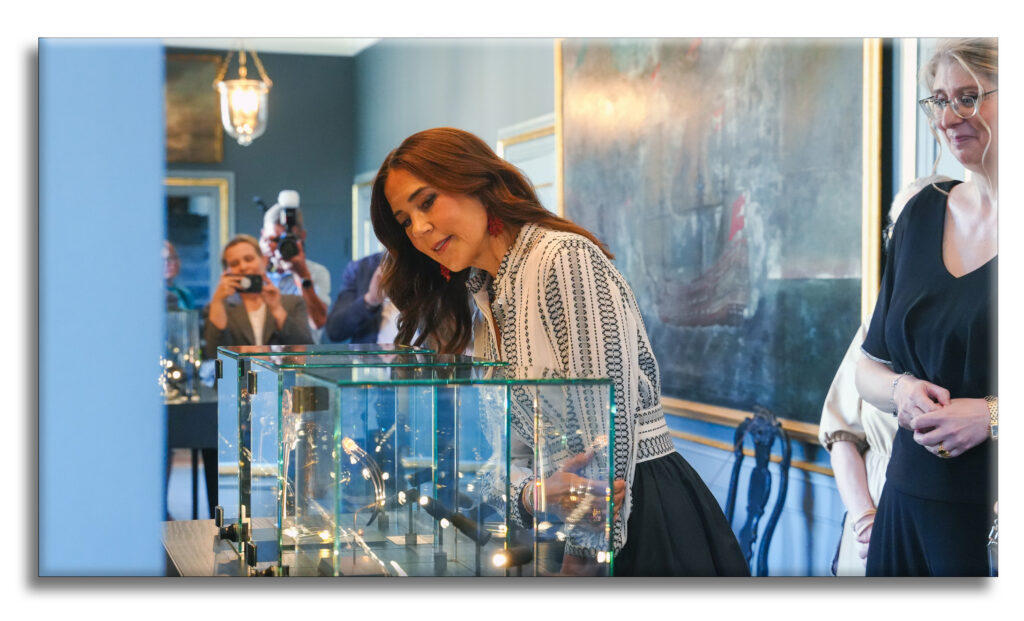
– Photographer Kasper Søgaard Alstrup, Ritzau.
Inspiration Can Come from Anywhere
“Notre Regret”
One of the exhibition’s greatest pleasures is discovering where each artist found inspiration.
For Maria Guldbrandsen, it was the ballet character Columbine.
For Malene Helweg-Larsen, it was pearls woven through the hair in historic portraits at Gavnø Castle.
But for Felix Bresler, it was tragedy.
Four years and four days after the fire at Notre-Dame Cathedral in Paris, another historic landmark was lost when Copenhagen’s Stock Exchange burned on April 16, 2024. Both events deeply affected Bresler, who is also a trained conservator.
His dramatic hairpin serves as a memorial to both fires. A ruby, representing the first spark of the blaze, and a sculpted flame are mounted en tremblant so they quiver with the wearer’s slightest movement, preserving the memory of a fleeting moment in history. In that sense, the piece continues the long tradition of commemorative jewelry.
Fun Fact: During Queen Mary’s tour of the exhibition, curator Nina Hald wanted to demonstrate the movement of the en tremblant ruby. There was only one problem—it needed a little vibration.
So she turned to Her Majesty and said, “We need to jump up and down.”
They did.
The ruby trembled, the demonstration worked perfectly, and for one delightful moment, a queen became part of the exhibition.
Yes it did – Watch the video here. “It took an unexpected turn: Queen Mary jumped in high heels”
[ *There will be a few commercials before the video plays: Dronning Mary hoppede i høje hæle. Video: Hanne Juul Foto: Hanne Juul ]
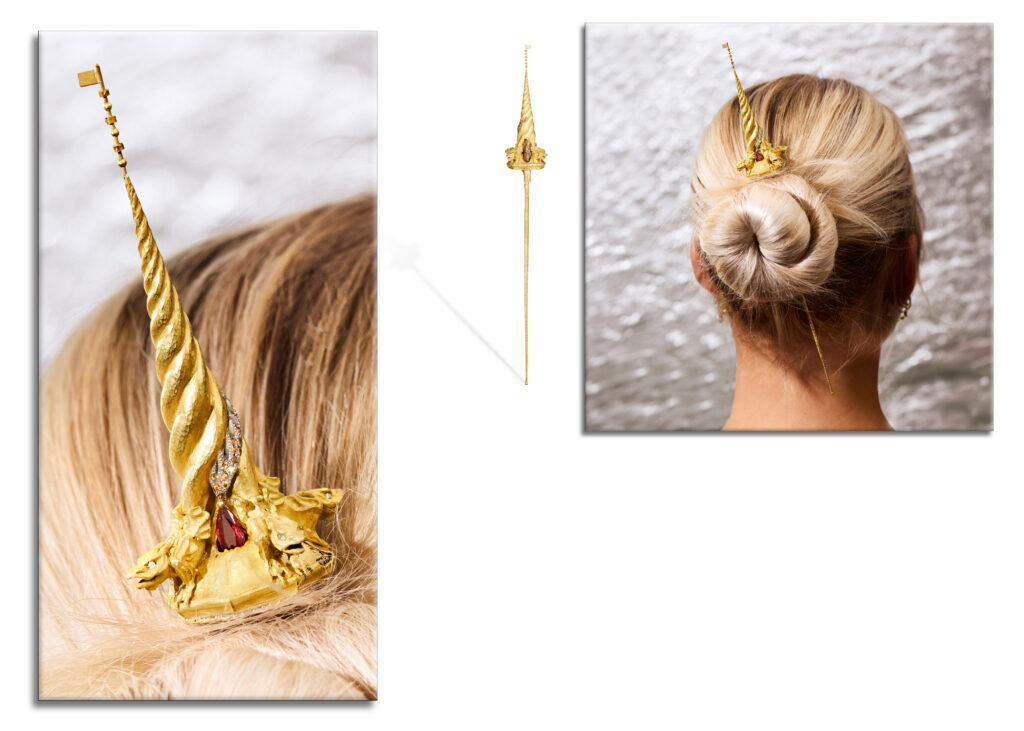
Made of 18 karat gold with a teardrop-cut 0.89 carat ruby and a total of 138 brilliant-cut diamonds, spinels and rubies.
Photographer: Dennis L Photo
Model: Iris Eik
Then there is Anette Sjøgren Hendriksen
“Onion & Buns”
Her inspiration?
An onion.
Fascinated by its layered structure ever since her student days in London, Hendriksen transformed the humble onion into an elegant contemporary hair ornament. Looking back through the history of head and hair ornaments, she felt there weren’t enough beautiful “cages” designed to hold a hair bun securely in place. Yep, probably not a lot of bun covers.
So she designed one. Of course.
But how do you embellish an onion?
Hendriksen paired the onion’s organic form with another longtime fascination—the organic form of rough gems and minerals, a classic source of inspiration for goldsmiths. You’ll find rough emerald, spinel, and rhodochrosite crystals throughout the design.
Sometimes inspiration comes from the most unexpected places.
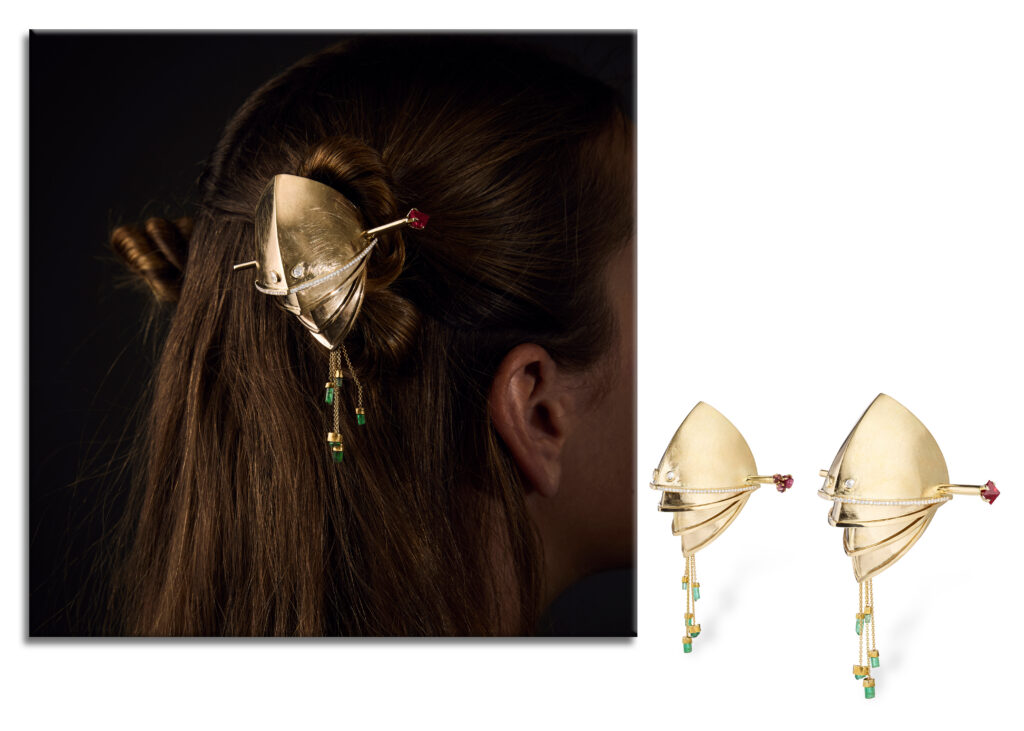
14- and 22-karat gold, 118 brilliant-cut diamonds (1.18 ct total), four pear-shaped diamonds (0.32 ctw.),
one rough red rhodochrosite, three rough spinels, and ten rough emeralds.
Photographer: Dennis L Foto
Model: Paloma Sjøgren Henriksen
Malene Helweg-Larsen
“Pearl Bloom”
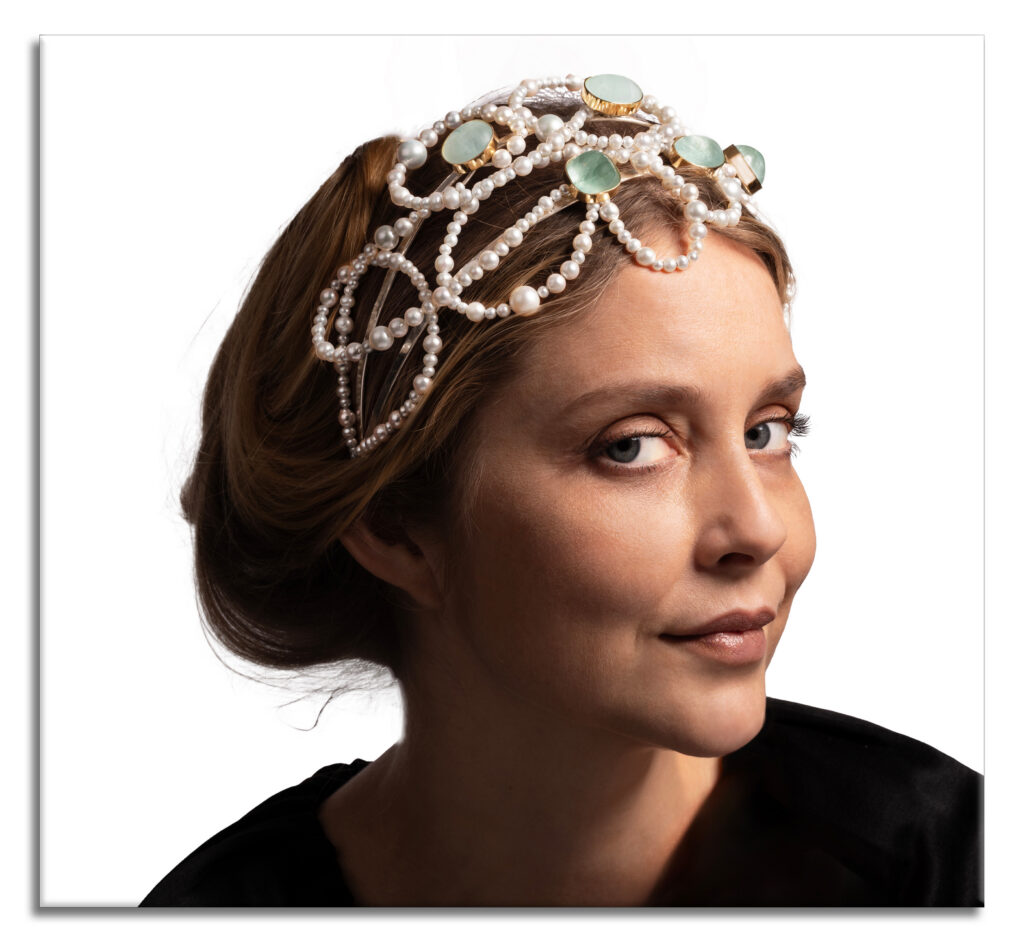
Guldsmed Malene Helweg-Larsen
– model C D Helweg-Larsen
18-karat gold, silver, cultured pearls (4–10.5 mm), and five aquamarines totaling 129.3 carats.
– foto Andreas Vrontos
With Pearl Bloom, goldsmith Malene Helweg-Larsen combines inspiration from the historic portraits at Gavnø Castle—where women are depicted wearing pearl necklaces woven into their hair—with the organic sensibility of British artist Chris Ofili’s 1997 painting Blossom.
The headpiece transforms the flowing movement of cultured pearls into a modern sculptural form. Their varying sizes, the glow of the aquamarines, and the balance between silver and gold create an expression that is both poetic and timeless.
Maria Guldbrandsen
“Columbine”
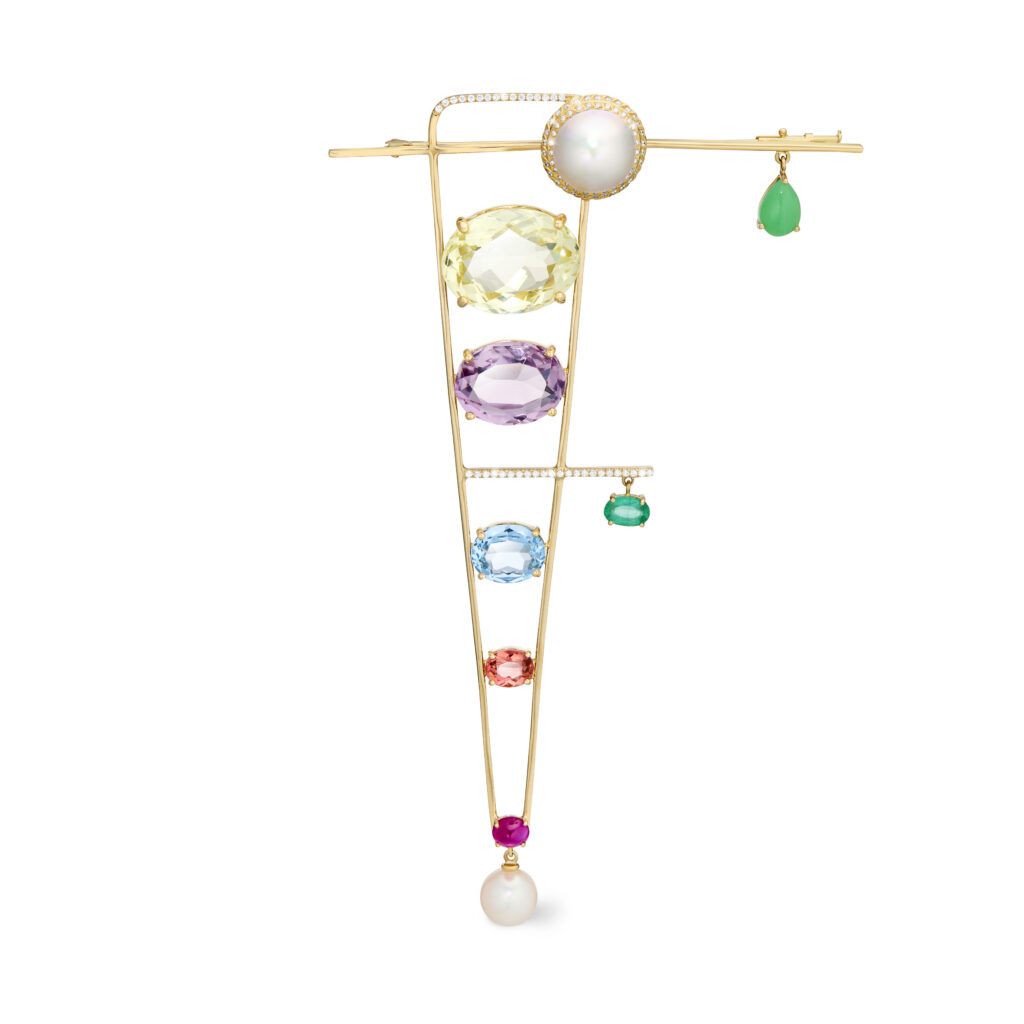
Columbine
Maria Guldbrandsen, Guldbrandsen Juveler
14-karat gold with mabé and cultured pearls, chrysoprase, emerald,
lemon quartz, amethyst, aquamarine, pink tourmaline, ruby,
and 0.24 carats of brilliant-cut diamonds.
– foto Dennis L Foto
With her pure heart, the ballet character Columbine dreams of her true love, Harlequin, whose colorful costume is reflected in this brooch.
The brightly colored diamond-shaped pattern of Harlequin’s costume is recreated in gold and gemstones of varying sizes and colors—colors that only the world of gemology can provide.
Soft cultured pearls introduce Columbine’s feminine qualities into the design.
Just as gemstones may be harmonized through subtle tonal relationships or dramatic contrasts, transparent and opaque gemstones can also be combined to striking effect.
Gold lines weave through the composition, giving the large brooch a surprisingly light and playful character.
Cherry Blossoms on Chopsticks?
“Sticks’n’Cherry Chopsticks”
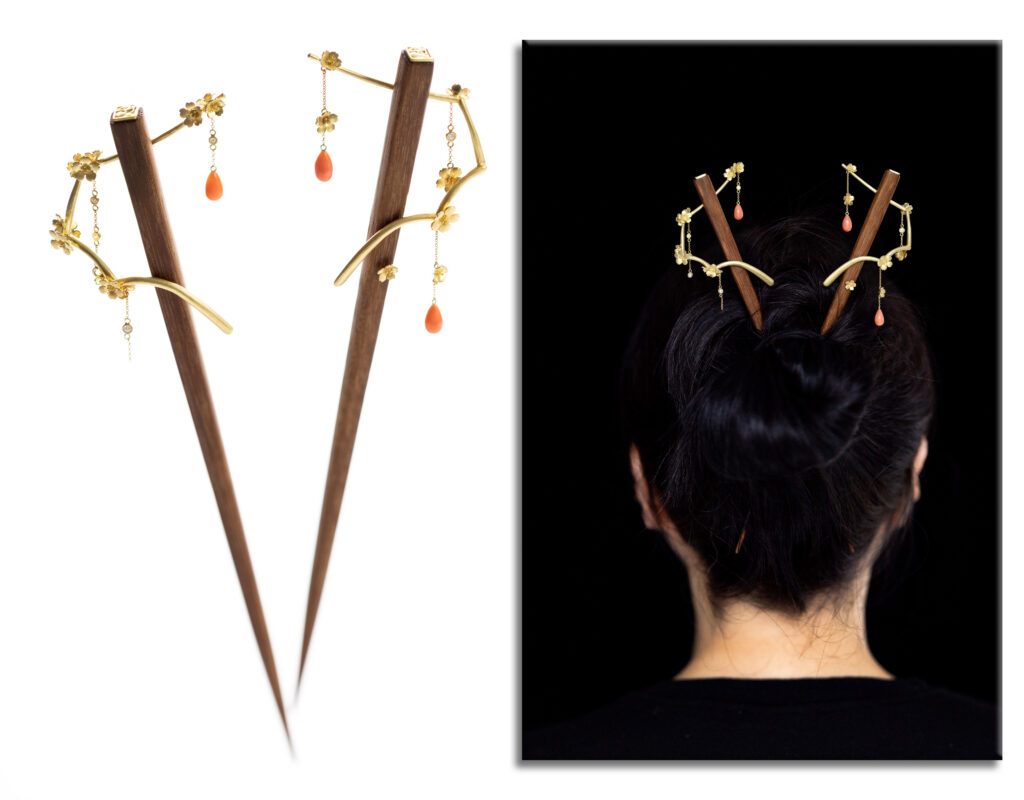
Guldsmed Louise Degn, model.
Photographer: Tia Borgsmidt
For Louise Degn, inspiration began just outside Gavnø Castle. But we’ll get to that in a moment.
The first thing that caught my eye wasn’t the gold—or even the beautiful Mediterranean coral drops.
It was the bamboo chopsticks.
Looking for a culturally significant hair ornament, Degn reached for a pair of bamboo chopsticks. She then mounted delicate flowering gold cherry tree branches—an unmistakable nod to the Japanese influence behind the design. Tiny round brilliant-cut diamonds give the design the necessary sparkle amongst the coral drop blossoms.
Sometimes the simplest design is the most elegant.
Now, about that Japanese influence.
It isn’t simply a reference to a distant culture. More than a century ago, Baron Kjeld Reedtz-Thott returned to Gavnø from Japan carrying a writing set presented to him by the Mikado following the death of King Christian IX. He must have also brought home Japanese sakura cherry trees. Today, some 40 100-year-old Sakura trees bloom in the Castle Park, joining the historic cherry trees that line Gavnø’s famous avenue.
So perhaps it shouldn’t be surprising that Louise Degn found both her inspiration—and the perfect setting for it—right here at Gavnø Castle.
Jochen W. Neustädter, Bjarne Lange, and Bolette Louise Sig Matthiasen for Bolou Fine Jewellery
“Whisper”
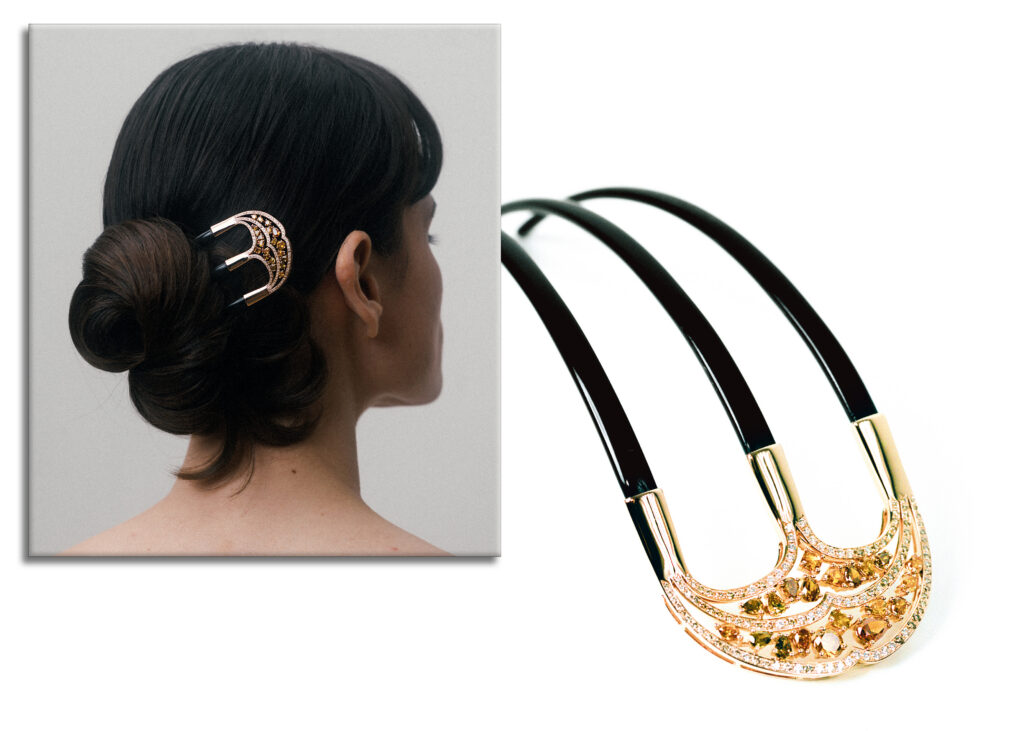
Jochen W. Neustädter, Bjarne Lange og Bolette Louise Sig Matthiasen for Bolou Fine Jewellery
Made of 18 Karat rose gold, buffalo horn and a total of 2.77 carats of colorless,
champagne and cognac colored diamonds, orange and intense yellow diamonds.
Model: Simone Noa Hedal
Photographer: Benjamin Tarp
At first glance, the eye goes immediately to the rows of champagne, cognac, orange, and intense yellow diamonds framed by delicate curved lines of colorless melee. But look a little farther and you’ll notice something equally interesting.
The comb itself is fashioned from buffalo horn—a natural material long associated with fine hair ornaments and a thoughtful modern alternative to the now endangered tortoiseshell once prized for combs. Once worn, most of the horn disappears into the hair, allowing the rose gold and diamonds to appear almost suspended in place.
Inspired by the graceful arches of Italian Renaissance architecture, the design balances elegance with practicality. It’s large enough to make a statement, yet engineered to be light enough to wear comfortably.
Sometimes the finest design isn’t what you notice first. It’s what quietly makes everything else possible.
A Shout Out from the team at Bolou Fine Jewellery: Thank you to Søren Hedegaard for the collaboration on the creation of and understanding of the importance of a hair ornament that, in both a functional and lovely way, creates a story with a whisper.
Fifty Shades of Blue: Jette Poulsen’s Tiara
“Aphrodite”
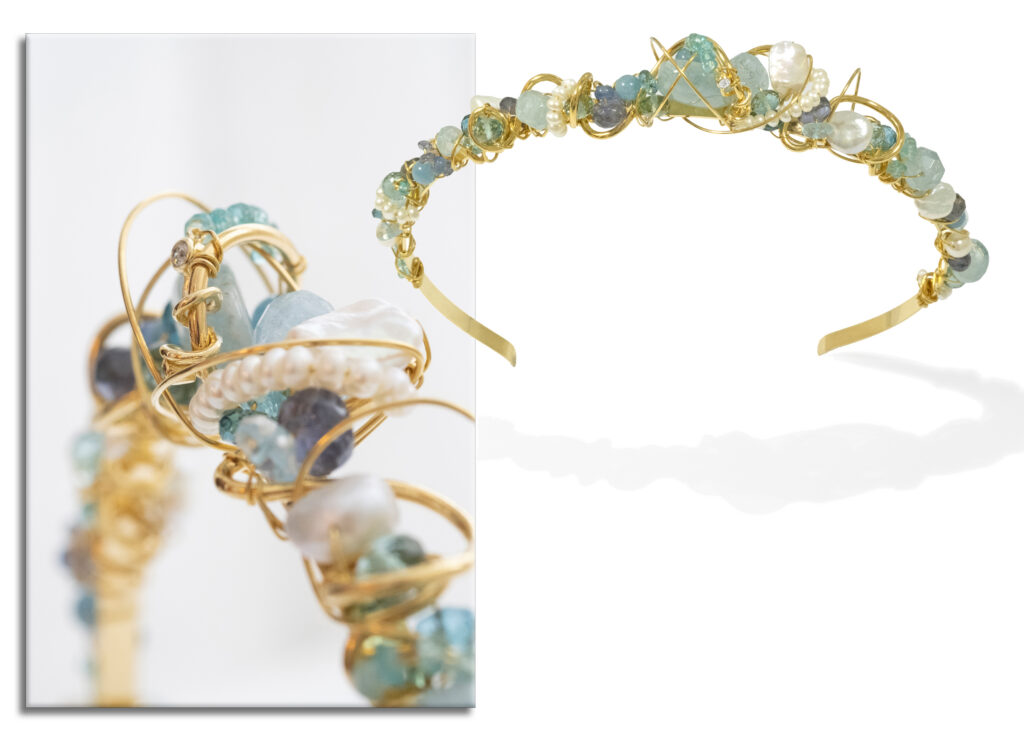
Made of gold-plated steel and gold-plated sterling silver, with 46 white freshwater cultured pearls in various shapes and sizes, a total of 50 carats of aquamarines, 6 carats of London blue topaz, 8.5 carats of Sky blue topaz, 13 carats of iolites, 4 carats of kyanites, 13 carats of blue quartz, 5 carats of apatites and two synthetic cubic zirconias (2 mm in diameter).
Photographer: May-Britt Nohr
This design makes perfect sense.
According to Greek mythology, Aphrodite emerged from the sea.
Suddenly, the flowing gold curves become waves. The white freshwater cultured pearls suggest sea foam… or perhaps just a bad day for the oysters. Aquamarine—well, that one’s obvious. The remaining shades of blue, including London Blue topaz, Sky Blue topaz, iolite, kyanite, blue quartz, and apatite, create layer upon layer of ocean blues.
As gemologists, we spend a great deal of time distinguishing one blue gemstone from another. Jette Poulsen reminds us why. Each contributes its own hue, tone, saturation, and personality, together creating a palette that a single gemstone could never achieve.
Rikke Engel, Guldværk
“Reflection”
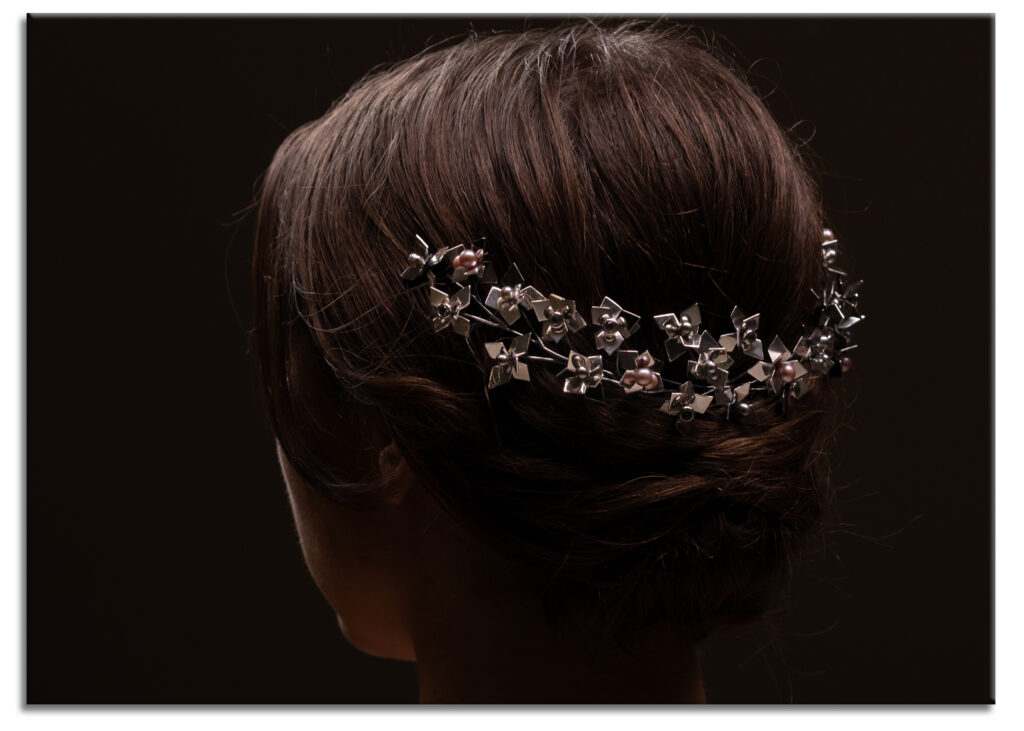
Made of silver with nine grey-violet brilliant-cut spinels (total 1.75 carats), five pink freshwater cultured pearls (diameters from 6-6.5 mm) and twelve light grey Tahitian keshi cultured pearls (diameters from 4.5-5 mm).
Photographer: Lasse Baltzer
Model: Emma Engel
Some artists find inspiration in history.
Others in nature.
For Rikke Engel, inspiration comes from the women in her life.
This is one of the exhibition’s most personal creations.
About her creation, Rikke Engel has written: “With a naked face I meet life, reflect on what meets me, reflect myself in the people who surround me, and stories of lives lived that I am told. Portraits of women, reflections on women’s lives. I reflect my life in the imprints left by my predecessors. When I leave the room, you see my back, what I leave behind – small mirror flowers that send reflections of my life. Small glimpses of my light, my story – for reflection and mirroring in the lives that come after me. A thought for all the women whose lives light my path.”
More Than an Exhibition
To the Ball at the Castle is Nina Hald’s fifteenth jewelry exhibition, and perhaps one of her most ambitious.
Holding a Master of Arts degree from the University of Copenhagen, Hald has spent much of her career demonstrating that jewelry is far more than adornment. She has curated exhibitions in Denmark and internationally, written extensively on the subject, and authored twelve books exploring jewelry, history, and culture.
With To the Ball at the Castle, Hald once again invites visitors to look beyond the sparkle. The thirty-three headpieces are not simply beautiful objects; they are stories told in metals, gemstones and imagination.
Whether inspired by royal history, nature, architecture, family, or even an ordinary onion, each creation offers its own interpretation of what contemporary head and hair jewelry can be.
By the time visitors leave Gavnø Castle, they may never look at a tiara—or any headpiece—quite the same way again.