A chance discovery in a Berkeley antique shop became
an eight-decade provenance investigation—showing how research
can become the most valuable part of a piece of jewelry.
What would you do if you walked into an antique shop and found an unusual old necklace? Would you ever imagine it had once been worn in one of Hollywood’s classic films?
Would you admire it?
Would you buy it?
Would you walk away from it?
Well, vintage collector and costumer Tara Rech did something else. She asked a question.
“What is this necklace trying to tell me?”
The answer would take years to uncover and would ultimately trace the necklace back to one of the most recognizable actresses in horror film history—Elsa Lanchester—and to one of the most celebrated horror films ever made, the Bride of Frankenstein (1935).
Gary Roskin
Roskin Gem News Report
A necklace with a familiar face
The story began in 2013 when Rech wandered into an antique shop in Berkeley, California.
Displayed in its own case was an unusual portrait necklace that immediately caught her eye.
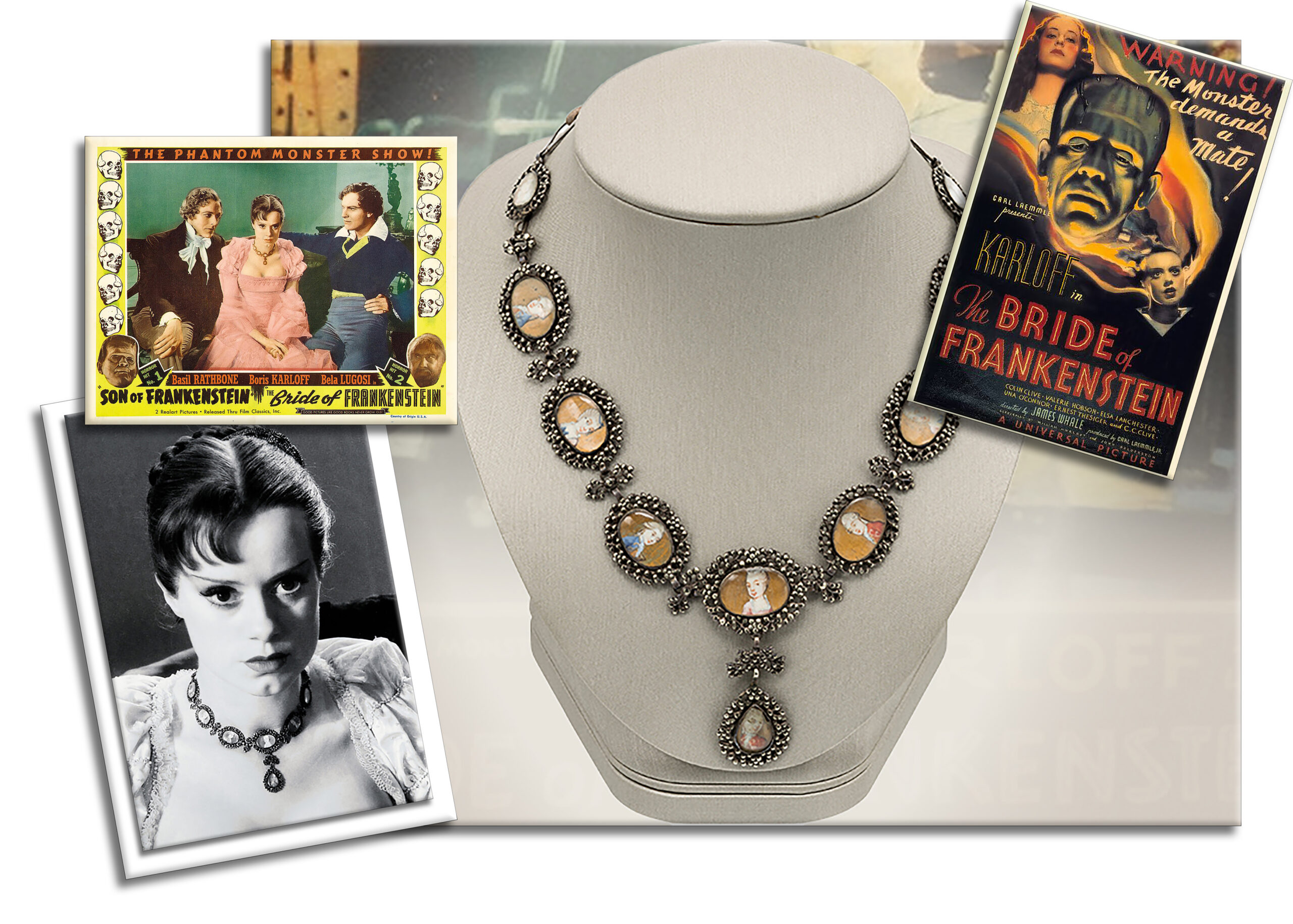
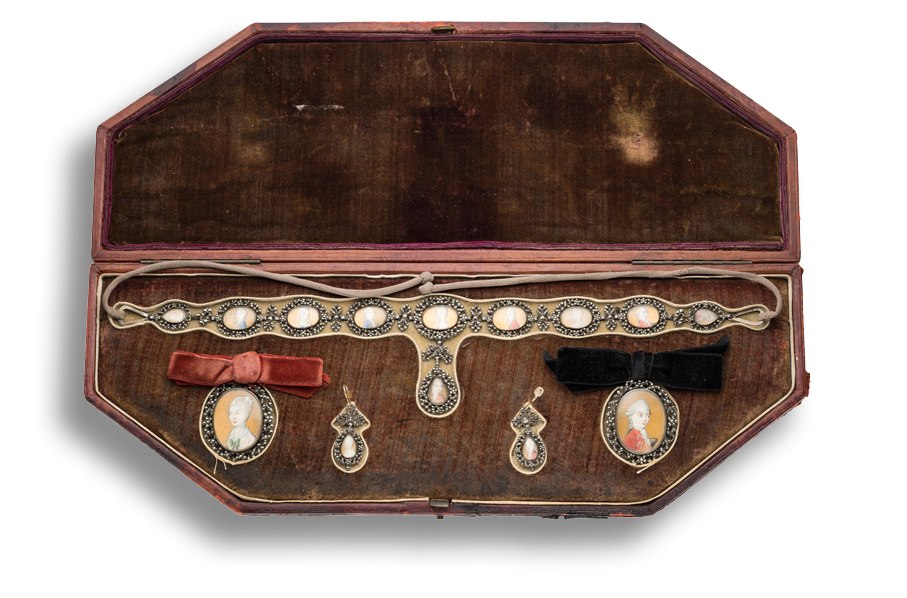
The necklace wasn’t set with diamonds or colored gemstones. Instead, its beauty came from ten exquisitely hand-painted reverse-painted portrait miniatures on glass, each framed in delicate marcasite. Seven of the portrait miniatures are oval, while three—including the pendant drop—are pear-shaped.
Accompanying the necklace is a matching suite consisting of two large oval brooches and a pair of pear-shaped earrings, each decorated with reverse-painted portrait miniatures, one depicting a gentleman and the other a lady. Together, the suite presents a remarkably cohesive example of antique jewelry craftsmanship.
The necklace was beautiful. It was unusual. And there was something about it that stayed with her.
She photographed it and left.
Halloween night
A few weeks later, while watching Bride of Frankenstein on Halloween night, Rech suddenly froze.
There, in the film’s opening sequence, Elsa Lanchester appears—not as the Bride herself, but as author Mary Wollstonecraft Shelley—wearing what appeared to be the very same necklace.
The distinctive arrangement of reverse-painted portrait miniatures and hand-cut marcasite was simply too recognizable to ignore.
Most people might have smiled at the coincidence.
Rech went back to the antique shop.
Building provenance
Buying the necklace was only the beginning.
Recognizing that extraordinary claims require extraordinary documentation, Rech began assembling the evidence.
Her research led to the Margaret Herrick Library of the Academy of Motion Picture Arts and Sciences, where production stills confirmed that the necklace worn by Elsa Lanchester matched the necklace she had purchased.
Production paperwork offered another intriguing clue. Estimates prepared for what was then known as The Return of Frankenstein failed to identify the necklace among the studio-supplied costumes and props. While not conclusive on its own, the omission suggested that Lanchester may have supplied the necklace herself as part of her costume portraying Mary Shelley.
The investigation eventually led Rech to Betty Goldfield, jewelry appraiser and member of the American Society of Appraisers. Goldfield was the representative responsible for liquidating the estates of Elsa Lanchester and her husband, Academy Award-winning actor Charles Laughton.
In a March 28, 2014 letter accompanying the necklace, Goldfield confirmed that the jewelry originated from Lanchester’s personal collection, strengthening the provenance and connecting the necklace directly to the actress’s estate.
What began as an intriguing antique had become something far more significant: a documented piece of Hollywood history.
Auction Results
July 13 – 17, 2026
Heritage Auction Live
Hollywood & Entertainment Signature® Auction Session 2
Bride of Frankenstein (Universal, 1935), Elsa Lanchester “Mary Shelley” Screen-Matched 18th Century Antique Gothic Necklace from the Estate of Elsa Lanchester
The necklace is comprised of reverse-painted portrait miniatures on glass—seven oval and three pear-shaped—each individually framed in marcasite. Accompanying the necklace are two matching oval brooches and a pair of pear-shaped earrings, each decorated with miniature portraits, one male and one female.
Once again, this necklace reminds us that craftsmanship and artistry—not intrinsic gem value—are often what make antique and estate jewelry so desirable.
Although the necklace did not sell during Heritage’s live July auction, its story isn’t over. Heritage is now offering this unique piece of Hollywood history for $37,500.
More than a movie prop
For collectors of Hollywood memorabilia, the necklace represents a rare screen-matched artifact from one of the greatest horror films ever produced.
For jewelry historians, however, it offers something equally compelling.
This was not simply another costume accessory created by a studio wardrobe department.
Evidence suggests it was an antique necklace that Elsa Lanchester personally selected to wear while portraying Mary Shelley before returning it to her own jewelry collection after filming concluded.
That distinction transforms the necklace into something remarkably personal.
It is simultaneously an antique jewel, a piece of personal jewelry, and a screen-used artifact.
Few objects comfortably occupy all three worlds.
A lesson for estate jewelers and appraisers
For estate jewelers, appraisers, auction specialists, and anyone who handles previously owned jewelry, this story offers an important reminder.
Provenance is rarely complete when a piece first arrives.
Sometimes it comes with family history.
Sometimes it comes with old receipts.
Sometimes it comes with nothing at all.
And occasionally, as Tara Rech demonstrated, it has to be uncovered one clue at a time.
On a Personal Note:
The experience reminded me of an estate jewelry dealer I met years ago during a jewelry exhibition in Basel. The dealer had a beautifully carved cameo but had no idea who had created it. I walked over to another booth and borrowed an expert in historic German hardstone carvings. Within minutes he identified the carver and placed the work within its proper historical period. – gr
The jewelry hadn’t changed.
Our understanding of it had.
Research has a way of doing that.
Provenance isn’t something you always inherit—it can be something you discover.
The story behind the story
The Bride of Frankenstein necklace will undoubtedly attract collectors because of its connection to one of cinema’s most enduring classics.
Yet perhaps its greatest contribution is showing us that jewelry often carries stories far beyond the materials from which it is made. Sometimes those stories are obvious. Others remain hidden for decades
For estate jewelers, appraisers, and anyone who handles previously owned jewelry, it’s a reminder that provenance isn’t always handed to us. Sometimes we have to uncover it.
Tara Rech looked at an old necklace and saw something familiar. Most people would have admired it and moved on. She followed the clues, asked the right questions, and uncovered a story that had remained hidden for nearly eighty years.
Tap here to see all of the Hollywood Memorabilia
for sale at Heritage Auctions