

The 74th Bangkok Gems & Jewelry Fair: Events and Activities
Color stability, Turkish diaspore, jade origin, pearl testing,
diamond fluorescence, emerald color mapping
— and lab and field notes from Billie and Richard Hughes
The 74th Bangkok Gems & Jewelry Fair opens September 8 at Bangkok’s Queen Sirikit National Convention Center.
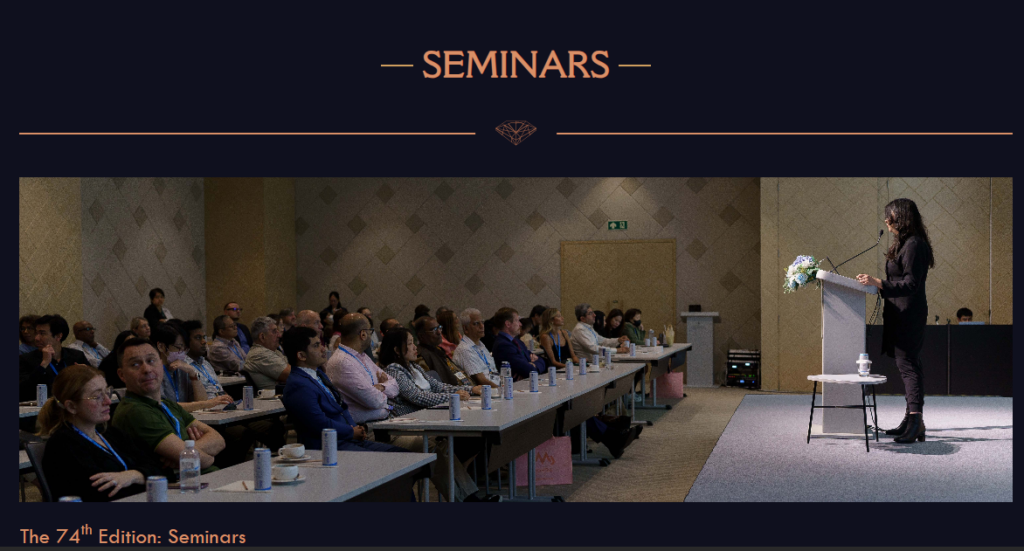
Not that we want to be dragging you away from someone’s booth, but from September 9 through 11, the fair’s seminar program brings together researchers, laboratory gemologists and members of the trade for three days of presentations.
And there is quite a bit here for gemologists.
◈
Here are the gem-related presentations that caught our attention.
Wednesday, September 9
Gemstone Color Stability Testing: From Irradiation Effects to LED-Based Testing System Development
10:30 a.m.–12:30 p.m. | Room 110AB
Thanapong Lhuaamporn
Chief of Advanced Technique Development Division, Gem and Jewelry Institute of Thailand (GIT)
Dr. Bhuwadol Wanthanachaisaeng
Chief of Research and Standard Development Department, GIT
Color stability has become an increasingly important laboratory issue, particularly with gemstones whose color may be altered — intentionally or otherwise — by radiation, heat or even exposure to light.
Lhuaamporn and Wanthanachaisaeng will look at irradiation effects and the development of an LED-based system for testing gemstone color stability.
Anything that helps laboratories determine whether a gemstone’s color is stable — and gives the trade a practical way of testing it — has obvious implications for identification, disclosure and care.
◈
Zultanite / Turkish Diaspore: The Rare Color-Changing Gemstone from Türkiye — Origin, Identification and Market Challenges
2:00–4:00 p.m. | Room 110AB
Fazil Ozen
ICA Ambassador to Turkey and Founder of Harmony Gems & Harmony Academy
Color-change diaspore from Türkiye has been in the gem trade for years, although the terminology surrounding it — including the name Zultanite — has sometimes been as interesting as the gem itself.
Ozen will examine the gemstone’s Turkish origin, identification and challenges in the marketplace.
Here is a colored stone that combines an unusual optical phenomenon, a geographically important source and an interesting marketing history.
◈
Thursday, September 10
Jade Markets in Southeast Asia and Origin Determination
10:30 a.m.–12:30 p.m. | Room 110C
Dr. Bhuwadol Wanthanachaisaeng
Chief of Research and Standard Development Department, GIT
Dr. Montira Seneewong Na Ayutthaya
Chief of Research and Knowledge Development Division, GIT
Jade is both a gemological and a market story in Southeast Asia.
The GIT researchers will bring those two subjects together, looking at Southeast Asian jade markets as well as one of the more challenging areas of modern gemological research: geographic origin determination.
◈
The Legacy of Pearl Testing at GIA
2:00–3:00 p.m. | Room 110AB
Chunhui Zhou
Senior Manager of Research (Pearls), GIA, New York
Pearl testing has changed dramatically as cultivation techniques and treatments have become more sophisticated — and imaging and analytical techniques have evolved along with them.
Zhou will look at the history and development of pearl testing at GIA.
◈
The Impact of Fluorescence on Diamond Appearance
3:00–4:00 p.m. | Room 110AB
Dr. Yun Luo
Director, Metrology & Quality Control, GIA, Carlsbad, California
Few diamond subjects have generated as much continuing trade discussion as fluorescence.
Luo will examine the impact fluorescence has on diamond appearance — an especially interesting subject given the difference between laboratory measurement of fluorescence and the trade’s long-running debate over its visual and commercial significance.
◈
Friday, September 11
Emerald Color Mapping for Gemological Applications
2:00–4:00 p.m. | Room 110AB
Supparat Promwongnan
Chief of Gem and Jewelry Testing Department, GIT
Now this one caught our attention.
Exactly how GIT is using color mapping — what is being measured, how variations in color are being recorded and how the results can be applied gemologically — should make this an interesting presentation.
◈
Beyond the 4Cs: Lessons Learned from the Diamond Industry for the Colored Gemstone Sector
2:00–4:00 p.m. | Room 110AB
Thanong Leelawatanasuk
Deputy Director (Technique), GIT
Diamonds have the 4Cs and a highly standardized system for communicating quality. Colored gemstones most certainly do not.
Leelawatanasuk asks what the colored gemstone sector can learn from the diamond industry’s experience.
That immediately raises an interesting question: Which parts of diamond standardization translate to colored gemstones — and which do not?
Color, origin, treatment, rarity and individual character make colored stones a very different proposition.
◈
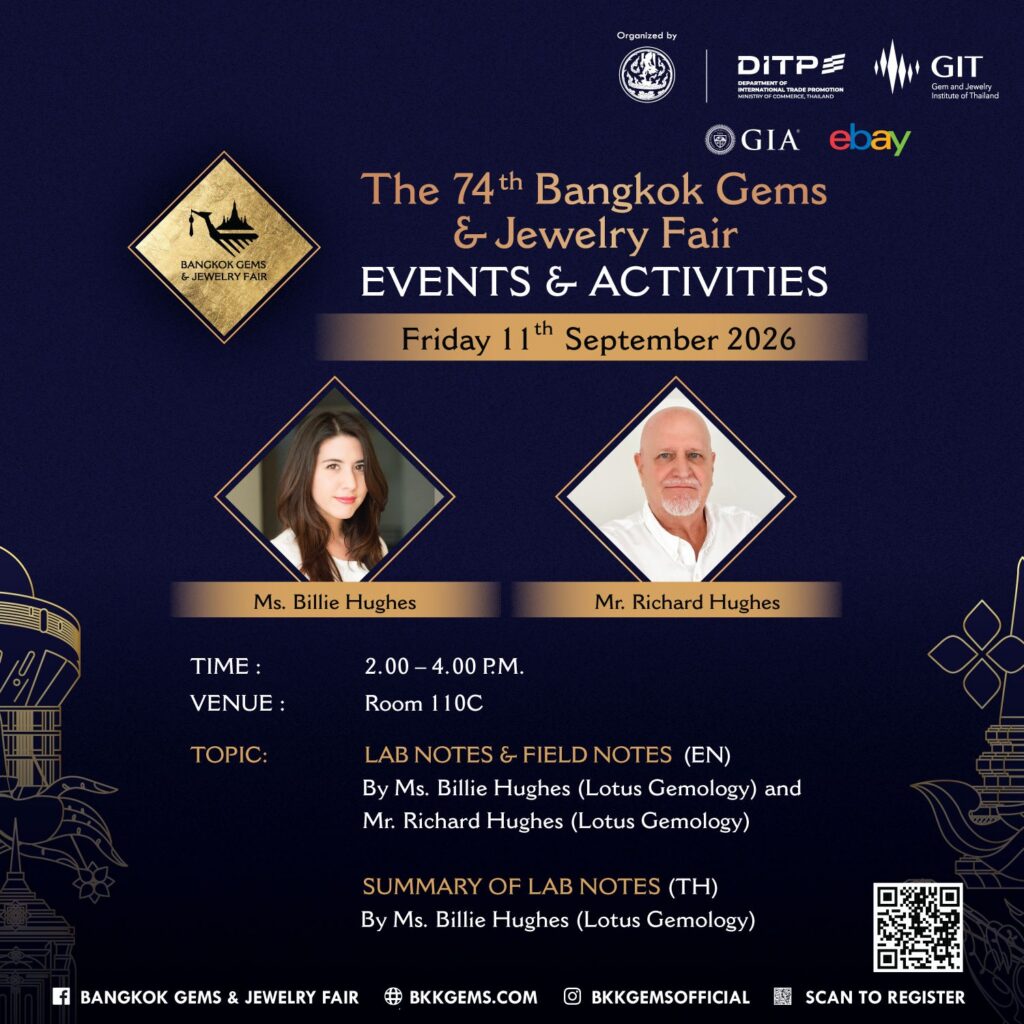
Lab Notes & Field Notes
2:00–3:00 p.m. | Room 110C
Billie Hughes and Richard W. Hughes
Lotus Gemology
The Hugheses close out our Bangkok gemological calendar with discoveries from both sides of gemology — the laboratory and the field.
Billie Hughes will present recent laboratory case studies and observations, while Richard Hughes heads into the field with highlights from his recent expedition to Guatemala’s jade mines.
◈
Summary of Lab Notes – in Thai
3:15–3:45 p.m. | Room 110C
Billie Hughes
Lotus Gemology
Hughes follows Lab Notes & Field Notes with a Thai-language summary of the presentation.
◈
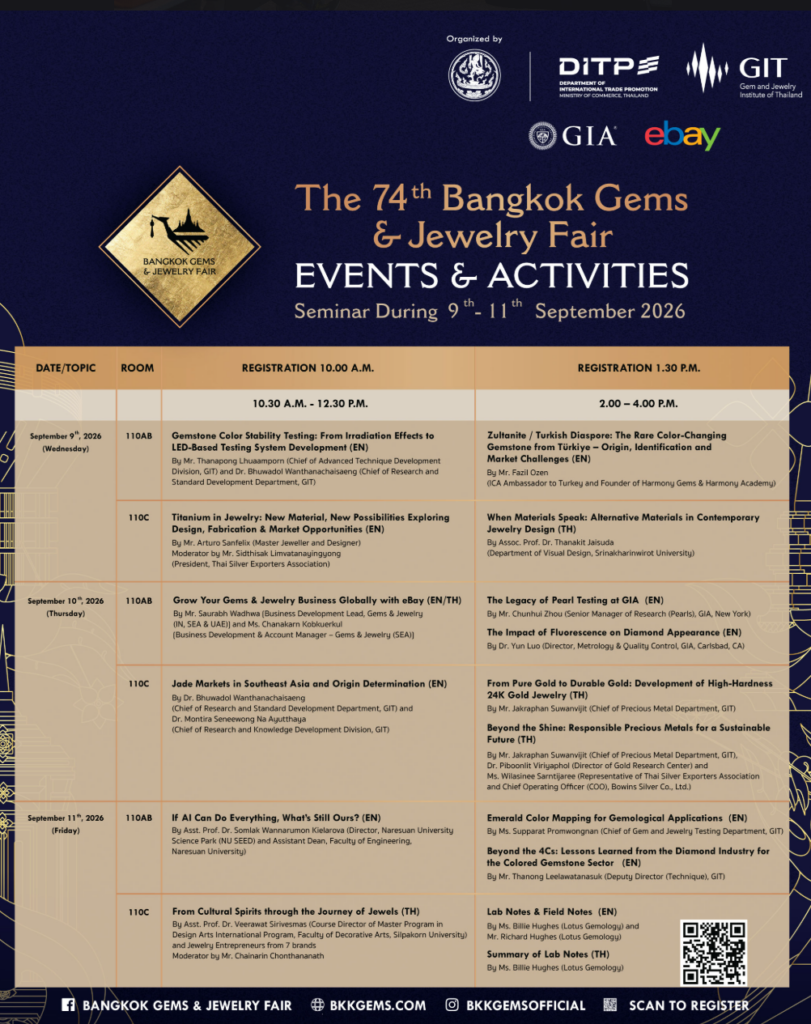
We’ve focused here on the gemological presentations, but the complete seminar schedule also includes sessions on 24K gold, silver, titanium in jewelry, alternative materials in contemporary jewelry design, artificial intelligence, international selling and the journey of cultural influences through jewelry. (see below)
For more on Billie and Richard Hughes’ Lab Notes & Field Notes, visit Lotus Gemology.