
New enhancement symbols, updated treatment and care guidance
— and a change in terminology for synthetic gemstones
◈
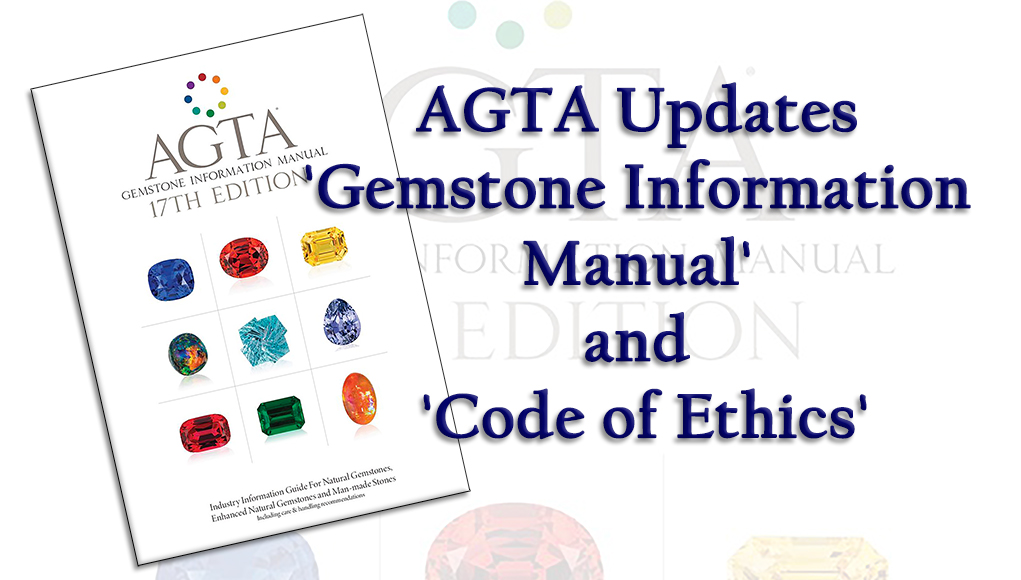
There’s more to the American Gem Trade Association’s newly released 17th edition of its Gemstone Information Manual than the change that’s been getting much of the attention — the word “synthetic.”
AGTA has added three symbols to the Manual’s Specific Forms of Enhancement, updated treatment information in its Gemstone Information Chart, and revised care guidance for certain gemstones.
The association has also revised its Code of Ethics regarding terminology for man-made gemstones.
But first, let’s look at what AGTA requires of its members when it comes to disclosure.
◈
Gary Roskin
The Roskin Gem News Report
AGTA and Disclosure
AGTA has long taken a leading role in colored gemstone disclosure — establishing requirements for its members that the association itself notes are more stringent than the FTC minimum requirements.
All AGTA members annually commit themselves to the association’s Code of Ethics and Principles of Fair Business Practice and are required to disclose gemstone enhancements and treatments.
And AGTA doesn’t simply ask members to agree to those standards.
Firm Members, Colored Diamond Dealers, Estate Dealers and Manufacturers are required to submit a sample commercial document — such as a memo or invoice — twice a year, demonstrating compliance with AGTA’s enhancement disclosure requirements.
AGTA reviews those documents and says it closely monitors exhibiting members’ commercial documents at its trade shows.
So when AGTA changes its disclosure guidance, its members aren’t simply expected to follow it. In certain cases, they’re expected to demonstrate that they do.
◈

What’s New in the 17th Edition?
The revised Manual adds three symbols to its Specific Forms of Enhancement section:
ASBL — Assembled Stones, including doublets and triplets
HR — Heating with Residue
W — Waxing
AGTA has also revised entries in its Gemstone Information Chart.
Among those revisions, irradiation (R) and heat (H) are now identified as common, stable treatments for pink Morganite.
And AGTA has updated information in the chart’s Special Advice column, including cautions against ultrasonic cleaning for certain gemstones, among them Jade and Moonstone.
◈
Now, About That Word “Synthetic”
Much of the early attention surrounding AGTA’s revisions has focused on one terminology change: “synthetic.”
Under the policy approved by the AGTA Board of Directors in June, members must use the word “synthetic” when describing a manufactured material having essentially the same chemical composition, crystal structure, and physical and optical properties as its natural counterpart.
The term “lab-grown” may not be used alone to describe such a gemstone.
AGTA’s announcement further states that retail jewelers may describe these materials as either “synthetic” or “man-made,” together with the name of the gemstone — for example, “synthetic Ruby.”
The Roskin Gem News Report asked AGTA President Bruce Bridges for some additional clarification.
Bridges confirmed that “lab-grown” may still be used, provided it is preceded by “synthetic.” In other words, “synthetic lab-grown Ruby” would comply with AGTA’s new terminology policy.
Bridges also confirmed that SYN is the symbol used on AGTA invoices and other trade documents.
And none of this changes AGTA GemFair policy: synthetic gemstones are not permitted for sale at any AGTA trade show.
Trust
As you can see, AGTA’s latest revisions are about more than just the word “synthetic.”
Responsible selling of colored gemstones can be complicated. AGTA’s Gemstone Information Manual takes a lot of that complication and makes it easier to follow.
So, know what you’re selling. Know what needs to be disclosed. And make sure the next person knows it too.
That’s what AGTA calls “promoting trust through the industry’s strictest Code of Ethics.”
See below for the actual AGTA Press Release
Press Release: AGTA Updates ‘Gemstone Information Manual’ and ‘Code of Ethics’
DALLAS, Aug. 24, 2026 – The American Gem Trade Association (AGTA) has released the 17th edition of its “Gemstone Information Manual” and updated its “Code of Ethics,” reflecting the association’s continuing work to promote clear disclosure, ethical trade practices, and current gemstone care guidance.
The revised Manual adds three symbols to the “Specific Forms of Enhancement” section: ASBL for assembled stones, including doublets and triplets; HR for heating with residue; and W for waxing.
AGTA also updated entries in the Gemstone Information Chart. Among the revisions, the chart now identifies irradiation (R) and heat (H) as common, stable treatments for pink Morganite. Updated care guidance in the chart’s “Special Advice” column cautions against ultrasonic cleaning for certain gemstones, including Jade and Moonstone.
“I congratulate the Board of Directors and the AGTA Industry Rules Committee on completing the 17th edition of the ‘Gemstone Information Manual,’” said John W. Ford Sr., CEO of AGTA. “This trusted resource gives our members and the broader international gemstone industry practical, current guidance that supports responsible disclosure and ethical business practices.”
AGTA President Bruce Bridges recognized the committee members whose work made the revisions possible.
“The Industry Rules Committee’s diligent work keeps the ‘Gemstone Information Manual’ current and useful,” Bridges said. “These updates help AGTA members apply consistent disclosure and care standards throughout the supply chain while continuing AGTA’s longstanding role in setting standards the broader industry follows.”
AGTA also revised its “Code of Ethics” regarding terminology for man-made gemstones. Under the policy approved by the Board of Directors in June 2026, AGTA members must use the word “synthetic” when describing a manufactured material that has essentially the same chemical composition, crystal structure, and physical and optical properties as its natural counterpart. The term “lab-grown” may not be used alone to describe such a gemstone.
The Manual further states that retail jewelers may describe these materials as either “synthetic” or “man-made,” together with the name of the gemstone—for example, “synthetic Ruby.”
“Clear and consistent language is essential to consumer confidence,” Bridges said. “This policy gives AGTA members a straightforward standard for describing synthetic gemstones while reinforcing the association’s commitment to natural-colored gemstones.”
Tap here for this press release on agta.org.
—
The American Gem Trade Association (AGTA) is a not‐for‐profit association serving the natural colored gemstone and natural and cultured Pearl industry since 1981. Headquartered in Dallas, members are trade professionals based in the U.S. and Canada, and AGTA is widely regarded as “The Authority in Color.” AGTA’s activities include organizing educational programs, trade shows, and printed materials and maintaining strong relationships with government officials and other jewelry trade groups. AGTA is committed to upholding the highest ethical standards and practices.