There Are Gem Shows — and there is Sainte-Marie
Martin Steinbach reports for The Roskin Gem News Report from the 61st Sainte-Marie-aux-Mines Mineral & Gem Show
Martin P. Steinbach, Idar-Oberstein, Germany
Introduction
“Edition 2026 du Salon International de Sainte-Marie-aux-Mines” — a name like a poem for the French Mineral and Gem Show.
Or, as the show’s Instagram channel describes it: “Mineral and Gem is so much more than a show. It is a vibrant, welcoming gathering place, a time to come together, share stories and discoveries, and celebrate our shared passion for minerals, gems and the wonderful encounters they bring.”
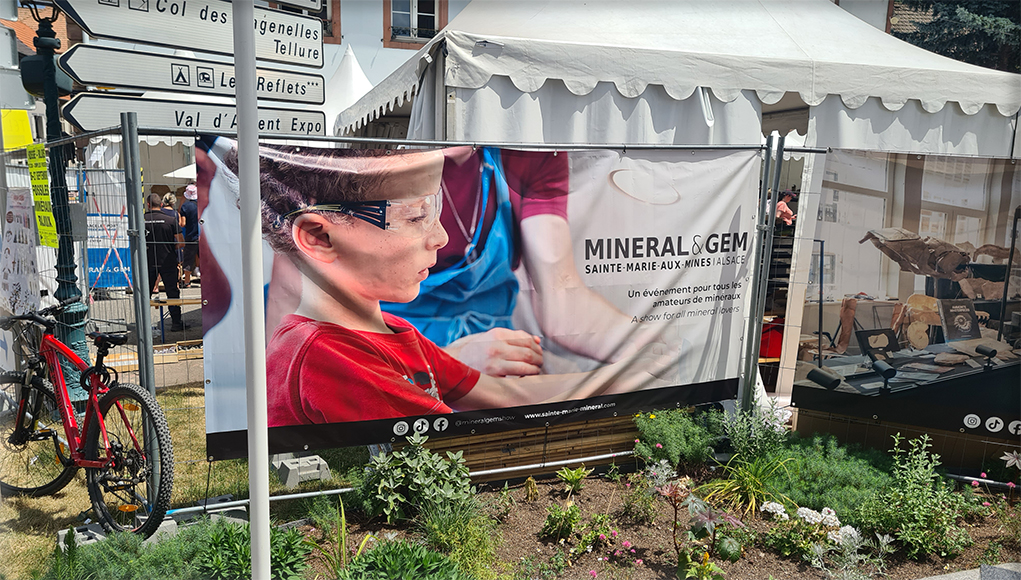
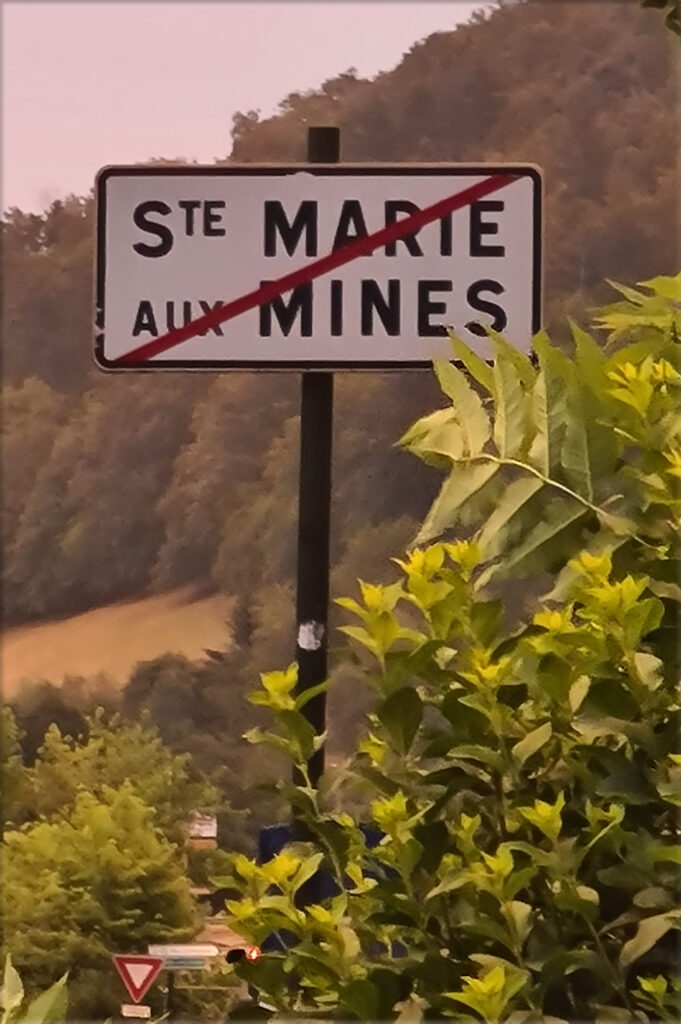
After the yearly Tucson events, the French Show is the second largest on the planet. Since 1965, thousands of visitors have traveled to Ste Marie, normally a small city of about 5,000 people, located in the beautiful Vosges mountains of the Alsace Region, a wine area in eastern France. In the now 61st edition, this year’s theme was “Nuances de FER” (“Shades of Iron”).
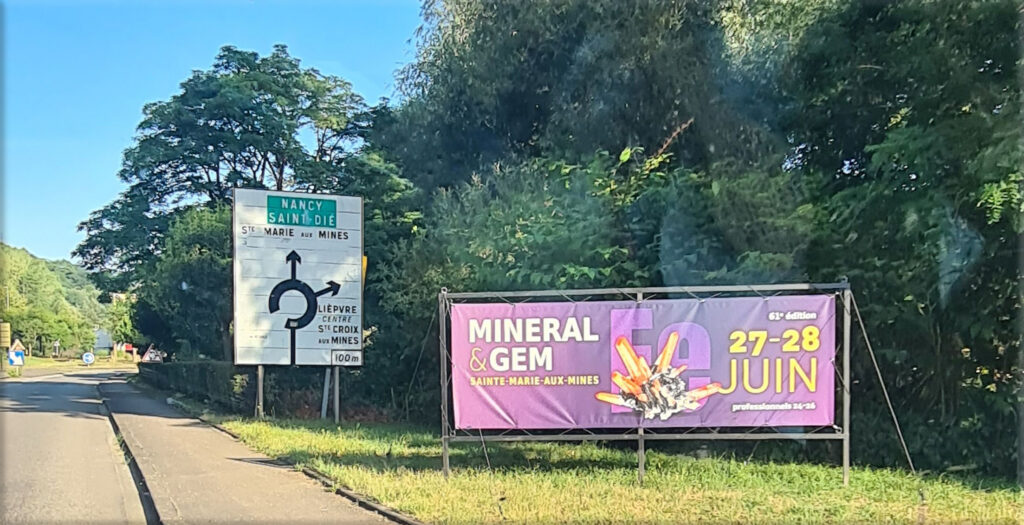
Photo by Martin P. Steinbach
◈
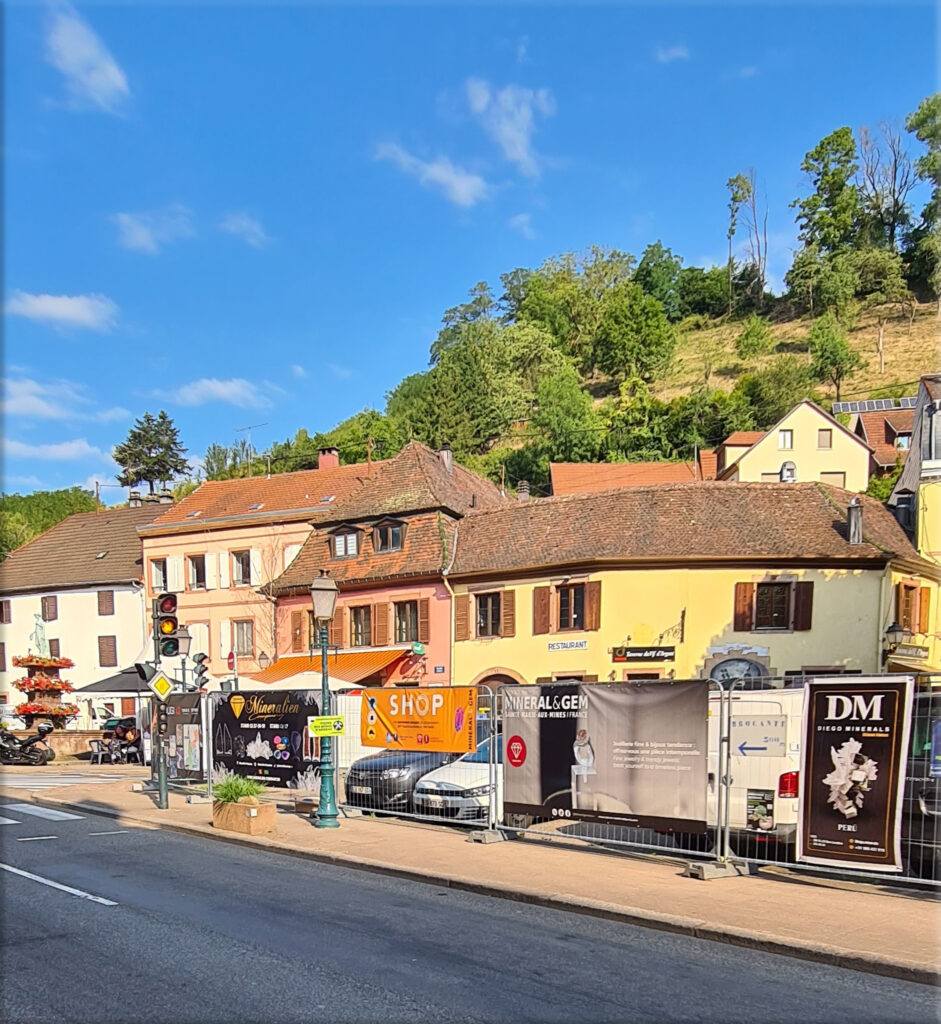
Photo by Martin P. Steinbach
History
The mining history of Sainte-Marie-aux-Mines (SMAM) reaches back centuries. During the Gallo-Roman period, digging for metals was already mentioned.
In the 10th century, taxes on mainly silver ore (“Val d’Argent”), but also on zinc, copper, cobalt, even arsenic, were well documented.
The 16th century marked the “golden,” or better yet, the “silver age”: Especially German miners formed many companies and a kind of “silver rush” began. The local population boomed and attracted thousands of European workers. About 500 active mines were reported. The population of Ste Marie peaked in 1900 at exactly 12,372.
In the early 1960s, interest in the region’s mining heritage led to what became the Sainte-Marie mineral show. A “Mine Day” was held in 1963, followed by the first mineral show in 1965. In 2012, Mayor Claude Abel and the municipality took over the organization of the show. Since 2015, SPL EVA (Événementiel en Val d’Argent) has been in charge of organizing Mineral & Gem.
Some Data
In 2025, there were more than 45,000 visitors. This year, the extreme heat caused many problems, and attendance dropped to around 30,000. About 1,000 exhibitors from 58 countries set up their booths, tents and tables throughout the show. Also, 700 local volunteers, the “red-vest team,” were there to assist.
The 2026 Show
Well, there are gem shows and there is SMAM. The little town is transformed into one gigantic exhibition area: the local schools, the streets, marketplaces, the theater, even the swimming pool. Dealers and collectors from across the globe are smashing in.
These collectors, dealers, gemologists, mineralogists, geologists, museum curators, investors and connoisseurs of the most precious items on our planet were welcomed in two main areas: the ZM (Zone Mineral), with about 700 exhibitors, and the ZG (Zone Gem), with 300 specialized exhibitors. I will talk here briefly only about the ZG.
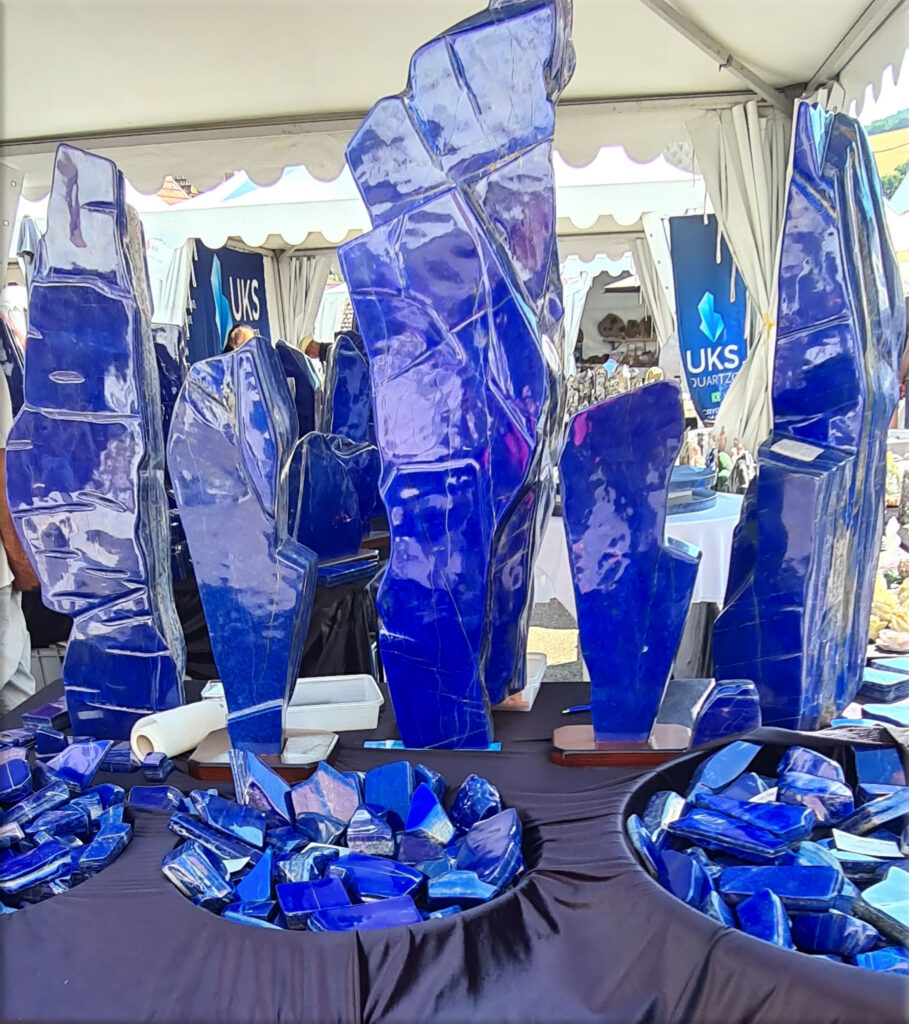
Photo by Martin P. Steinbach
ZG — Zone Gem
In ZG’s main location, the SP (Salle Prestige), huge fans were cooling down exhibitors and guests. Yes, it was absolutely HOT this year: Blue sky, no clouds and the sun was burning without mercy. The weather became the No. 1 topic this year. Plenty of water stations and fountains were there to refill your bottles, and the spraying showers chilled the crowd. All because of climate change!
In this gem area, companies with Indian merchandise especially dominated. Prices, compared to last year, were stable, and if you bargain hard, surely, you could get a good deal.
Tanzanite was still going strong, heated and unheated — as seen at the French company Paris Precious and the Indian company Himayat Gems. I saw some rough Greenland rubies. Denis Gravier, the sphalerite king, carried a lot of cut sphalerites, and quite a selection of Sri Lankan sapphire crystals was available at the ZG.
Many of the cut amethyst and citrine — big stones, fine qualities and clean — are, in my opinion, mostly Russian hydrothermally grown synthetic quartz. Be aware! To prove whether they are natural, infrared spectroscopy can be an important gemological test.
Larimar was offered by the popular German dealer Marco Schreier. Opals were pretty strong this year; I counted at least six opal dealers. Welo opals from Ethiopia in good qualities started already at a few dollars per carat. Tourmaline was offered in all cuts, forms and shapes, emeralds were plentiful, cut and in beautiful Colombian matrix. Diamonds were on sale, a good buy these days because of their extreme price drop! Besides fluorite, I noticed trapiche and star sapphires from Auvergne, France — so unique, rare French gemstones!
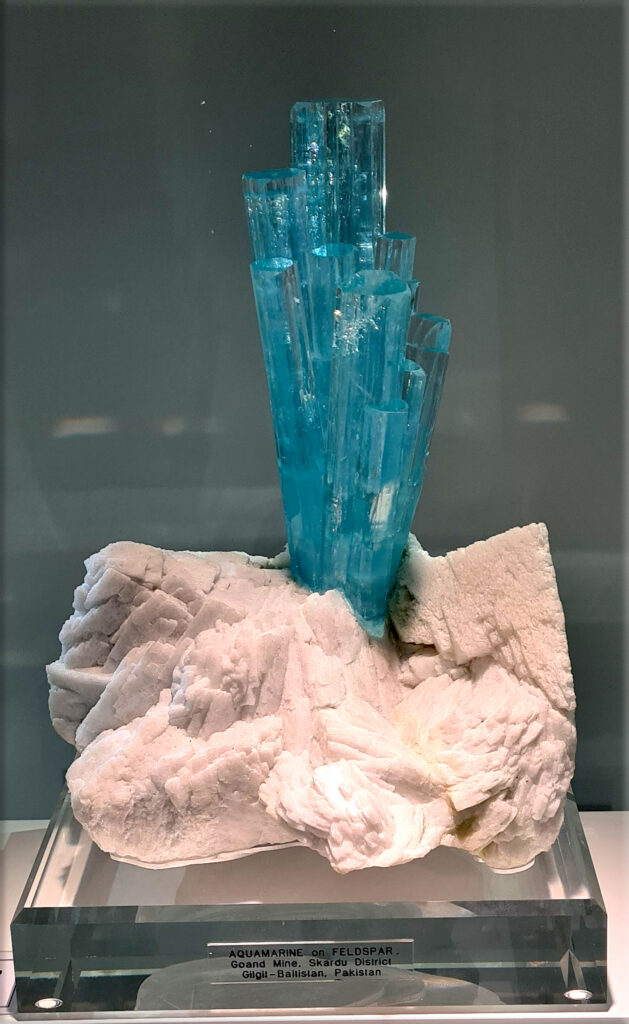
Photo by Martin P. Steinbach
Talking With the Dealers
To get a better impression of the fair, I talked with several colleagues.
Harald Mühlinghaus, a German opal dealer, has been exhibiting here for 35 years. His sales were close to 2025, but he missed regular customers. The unique atmosphere, the particular charm and the buyers from all over the world make Ste Marie special for him. Harald offers the whole range of Australian opals and mined in Australia himself for a couple of years. His favorites were opal fossils; his price range went up to $40,000 for his best gem.
I talked with Sabry Lafir, a rare gem dealer from Sri Lanka, who has been exhibiting at SMAM for 20 years. Sabry called it a “Mini Tucson in Europe.” “The environment creates a good atmosphere.” His specialties: cut sapphires, sapphire crystals and rare phenomenal gems. For 2027, he suggested that the cooling should be improved, “because for 10 years, it has been getting hotter every year — climate change. It might get even worse next year.”
Mr. Hayaa, a diamond dealer from Germany, has been coming to SMAM for 10 years and also likes the beautiful area. His diamonds are cut and polished at a partner factory in Surat, India. His sales were a bit slow. For 2027, he would like air conditioning in the SP of the ZG.
Axel Kalb, a German colored stone specialist, has been exhibiting here for five years. He likes this event as a meeting point for the whole world. Not in a sterile exhibition hall, but in a wonderful historical mining village. Visitors exchange ideas and experiences here, and also sell and buy.
Ste Marie is always good for gem carvings, mostly from India. I talked with Mr. Sharma, an Indian merchant. His huge carvings are hand-carved in Jaipur, and Shivas and Ganeshas are his best items. Because of climate change, Mr. Sharma has already suggested to the organizers that they move the fair from June to May.
Well, he was now the third dealer to suggest it.
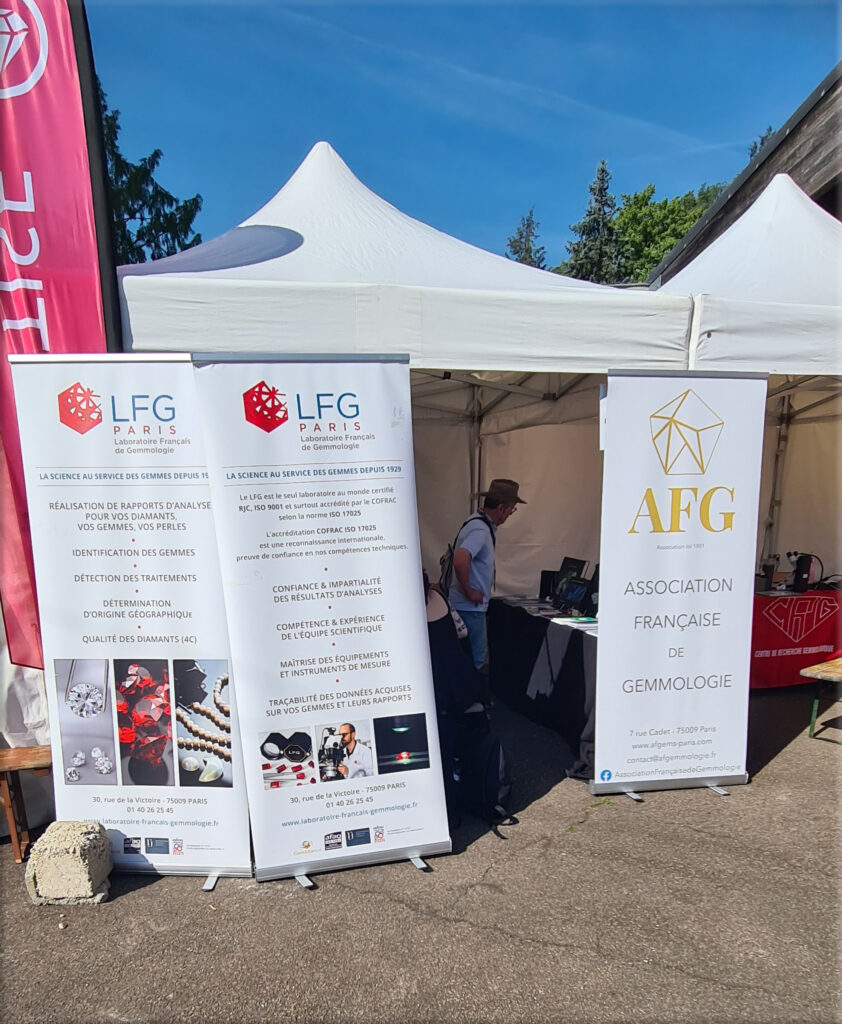
Photo by Martin P. Steinbach
Gemological Labs
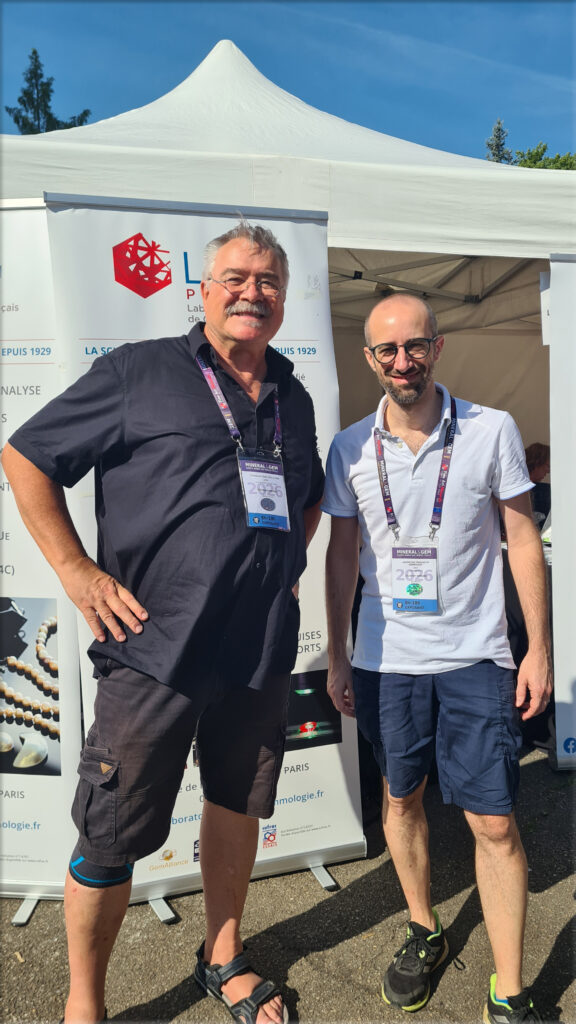
Like years before, exhibitors and visitors had the opportunity to have their gems tested for free (and/or for a small donation) by the LFG. For the first time, LFG (Laboratoire Français de Gemmologie) and AFG (Association Française de Gemmologie) were together in one tent. Aurélien Delaunay, Director of LFG, was there with his team checking a lot of gems.
That reminds me, I also saw some treated Welo opals with a ZG dealer.
Scientific conferences were offered for free, but sadly, 16 presentations were in French, with only three in English. Not very supportive of the many visiting international guests.
◈
Joanna Hardy
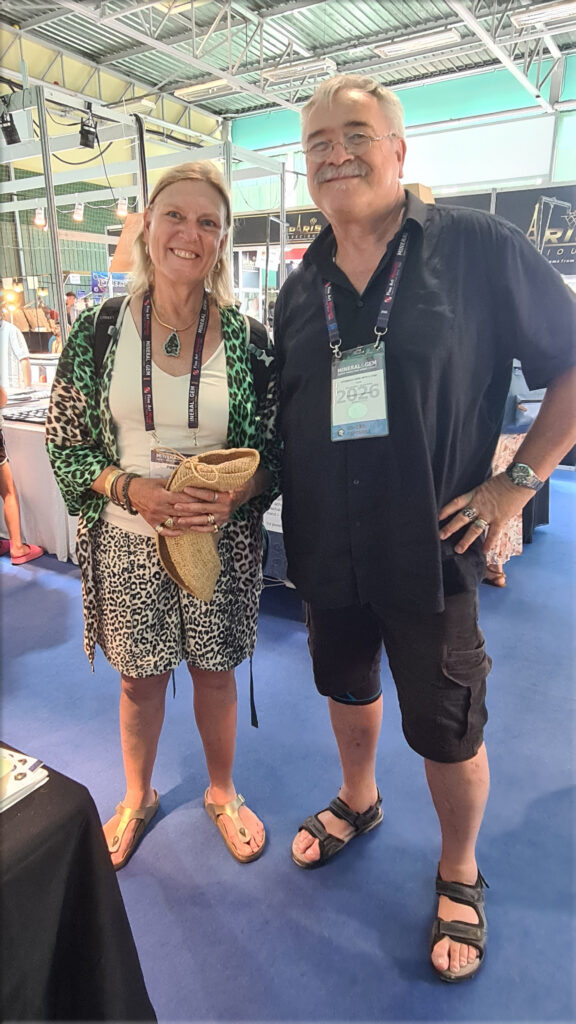
I had the honor to meet renowned gemologist and book author Joanna Hardy. She visited my booth in ZG, and we had a very pleasant talk. Joanna has written and contributed to seven books, is a regular jewelry specialist on the BBC’s Antiques Roadshow, and lectures on jewelry and gemology around the world.
Joanna was visiting SMAM this year for the very first time! Like nearly everybody, she was touched by the outstanding countryside and was struck by “the whole space full of minerals, gems and fossils and especially full of people, who love what they do.”
For her, “SMAM is a gemological heaven, a French Tucson surrounded by vineyards.”
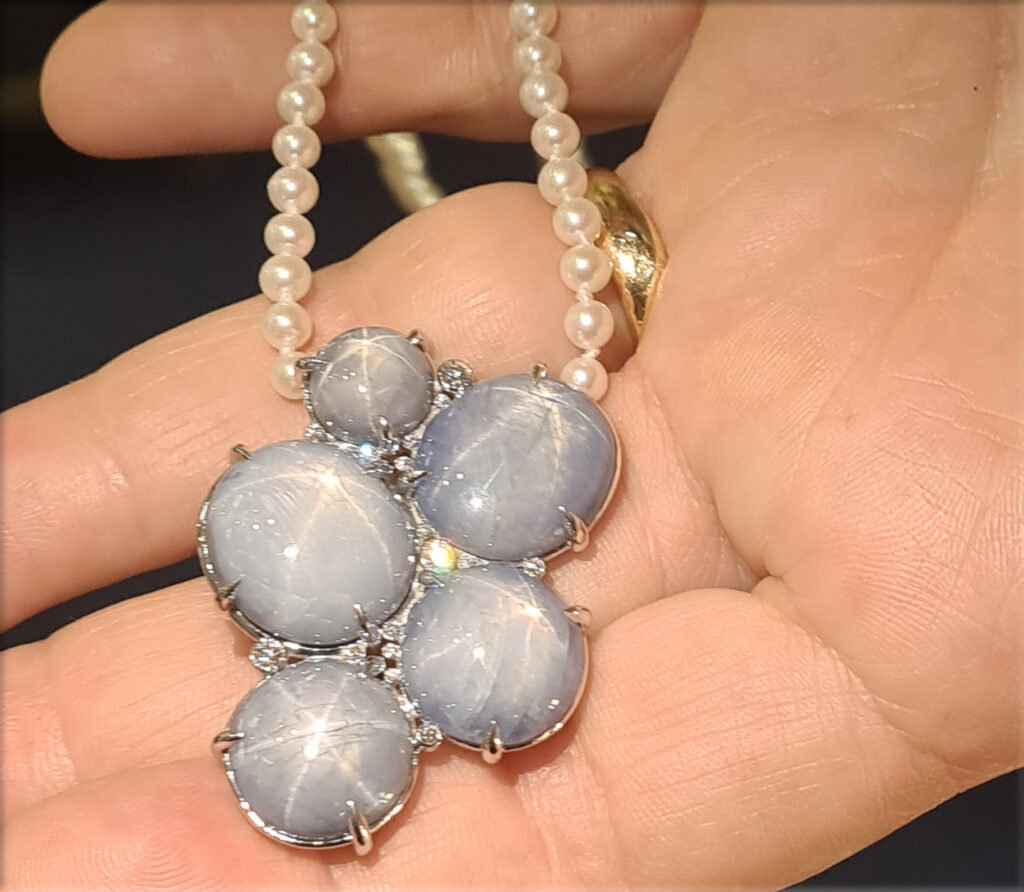
Photo by Martin P. Steinbach
The Jewellery Section
Paris designer Muriel Beigbeder has been exhibiting here for 10 years. This year, she didn’t have too many visitors because of the sun. “The government says, too hot, so many people stayed home.” Her special talent is “creating something special, other jewelers don’t do.”
I talked with Konstantin Stavridis, a German silver jewelry manufacturer from Berlin. He produces jewelry at his company in Jaipur, India, and has been coming here for 20 years. For him, SMAM is the only important European open-air fair, with a touch of a folk festival. “You have plenty of time to sit down and discuss with a potential customer. The disadvantage is the total dependency on the weather.” Konstantin works only in wholesale, with prices ranging from 20 euros to 600 euros a piece.
Mine Trips
The organisers offered visitors tours of two historic mines. The Gabe Gottes Mine, in the Rauenthal valley, was opened in the second half of the 16th century for silver-bearing ores and later mined for arsenic. It remained active until 1940, making it the last mine operated at Sainte-Marie-aux-Mines.
The Saint-Louis Eisenthür Mine opened in 1549 for silver and is preserved much as the miners left it in 1570.
Summary
Like every year, there are too many things to see. You need a lot of time — and to be in good physical condition. I remember well, when I was hunting my stars in Ste Marie during the last 40 years, it was very exciting and very exhausting. This year, my prey was only an oval bronze-colored, opaque 2,020-carat! star sapphire the size of a baby’s hand.
The Sainte-Marie-aux-Mines fair is a paradise for buyers, maybe not so good for sellers, because of too much competition and a weak buying situation, especially in the cut precious and semiprecious gem sector.
Generally, I feel, the times now worldwide are not good for the gem and jewelry business at all: there are too many wars, too many crises in politics, economics and societies, a profound climate problem (while I am writing these lines, in Germany, many small to medium rivers are close to drying out!!), a huge competition from China and no young gem and mineral collectors coming into our industry.
Next year, how will the weather be?
Anyway, see you in SMAM in 2027. Sure.
About the Author:
Martin P. Steinbach, Idar-Oberstein, Germany
Martin P. Steinbach is a gemologist, gem dealer, author and longtime specialist in gemstones displaying asterism — gems with a star.
Based in Idar-Oberstein, Germany, Steinbach has spent decades studying and collecting star gems. His Martin P. Steinbach Star Collection now includes more than 1,200 specimens, including some weighing more than 1,000 carats.
He is the author of two books devoted to the subject. His nearly 900-page Asterism — Gems with a Star was followed in 2023 by Star Gems — A Fascinating World.
Steinbach graduated as a gemologist and diamond expert from the German Gemmological Association and later earned his Accredited Gemologist diploma from the Asian Institute of Gemological Sciences in Bangkok.
Learn more about Martin Steinbach, his books and his remarkable collection of star gems on his website.
Martin P. Steinbach — Gems with a Star
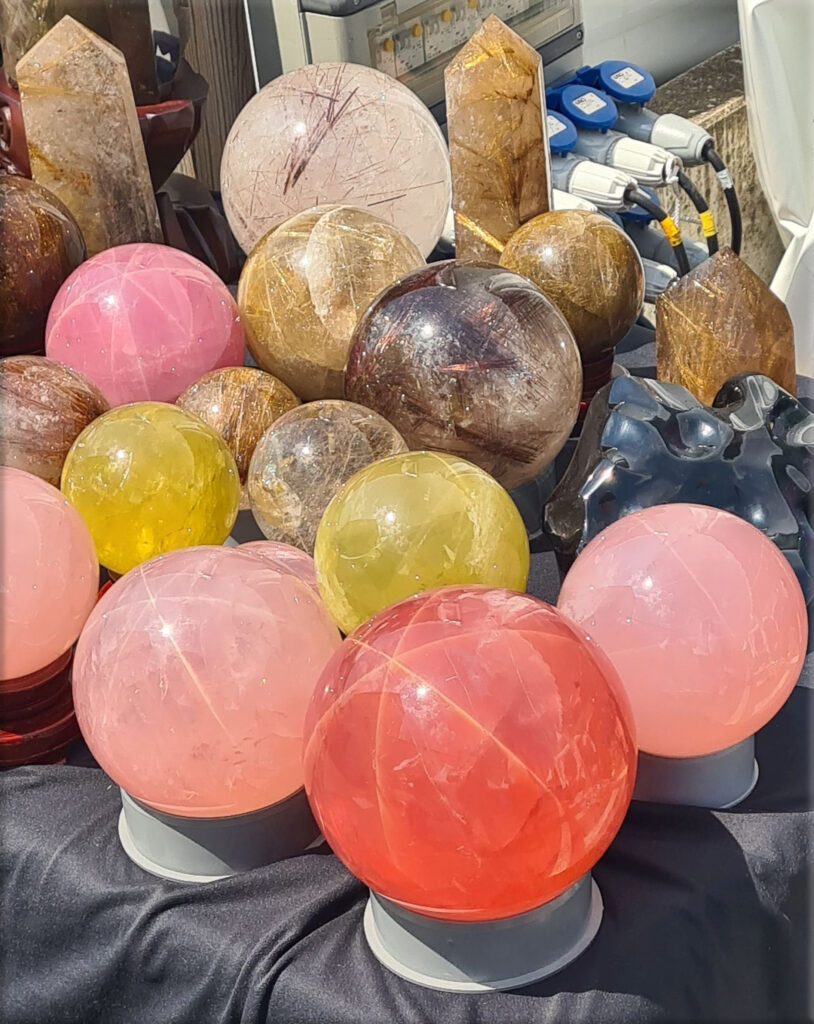
Photo by Martin P. Steinbach