
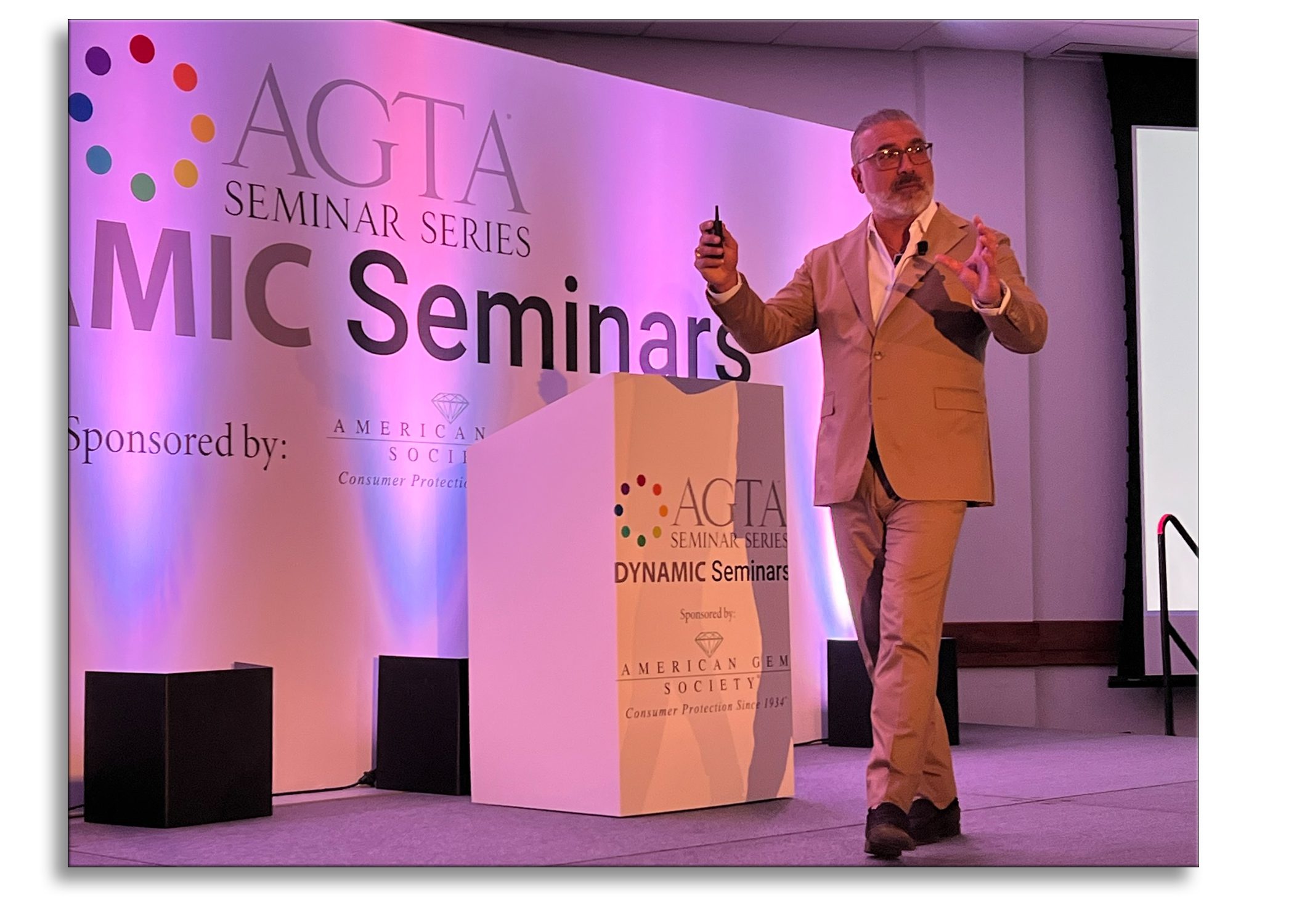


A 2026 AGTA DYNAMIC Seminar Presentation
During the 2008 financial crisis, Rodney Rahmani watched his company’s sales drop by roughly 50%. Longstanding U.S. retail accounts — some close enough to feel like family — began returning goods instead of sending checks. One large return from a close friend made it painfully clear: the money simply wasn’t there.
“A bad year, you’re down 10% — okay. Twenty-five percent, you start to worry,” Rahmani said. “But fifty percent? It’s impossible to survive.”
Rahmani’s response was not to cut deeper into the same shrinking market.
It was to look for markets that weren’t collapsing.
“I said to myself, wait a minute — there are people in this world who have not been affected at all by this crisis. I’ve got to get to them.”
Follow Stability — Not Familiarity
Instead of fighting for shrinking share domestically, Rahmani began researching which countries were least affected by the housing crisis and global financial meltdown.
He noted a couple of things… Canada’s banking system had remained more conservative. China’s government aggressively stabilized its internal economy. And Australia’s commodity exports tied it to ongoing Chinese demand.
The key from this research: Economic downturns are not evenly distributed.
And so he thought, if liquidity still exists somewhere, you go there.
Start With Relationships — Not Cold Calls
Rahmani made it simple, and personal. He began with his contact list. But not for selling.
“I can’t stress how important this has been,” he said. “Pick up the phone. Ask for advice.”
His approach was disarmingly simple:
- “Who do you trust?”
- “If you were me, where would you go?”
- “Can you introduce me?”
He emphasized that most people respond positively when asked for guidance. It makes them feel important. And they are.
“People love it,” he said. “If Gary calls me and says, ‘Rodney, I need your advice,’ I feel like a million dollars.”
Introductions replaced cold calls. Built-in credibility replaced risk. And when you are dealing with high-value goods, that difference matters a lot.

Show Up — In Person
From there, Rahmani went physical.
He drove into Canada with declared goods.
He flew repeatedly to Australia.
He spent years building legal, compliant access into mainland China.
“You wouldn’t believe how receptive they are,” he said of foreign markets. “Now you’re not one of 250 salespeople who visited that store this year.”
When the owner of an American company travels personally to another country, the dynamic shifts. The visit signals respect. In many markets, American-made jewelry carries prestige — craftsmanship, ethics, brand credibility.
That shift alone can reduce competition.
Use Events as Market Entry
Rahmani’s most effective tactic: events.
“Bring a truckload of product,” he said. “Have an event together. What could go wrong?”
His model:
- Partner with a retailer — or even a non-jewelry luxury business. (Did you read that carefully? … “even a non-jewelry luxury business”?)
- Share modest hosting costs.
- Invite top clients.
- Present in person.
- Educate.
Even modest sales create entrée. Follow-up often exceeds the event itself.
“After the event, the phone rings,” he said. “‘That woman you met last month wants to see sapphire rings again.’”
He also challenged a quiet assumption: “Nobody ever made a rule that jewelry has to be sold in a jewelry store.”
High-end gown makers. Luxury handbag boutiques. Private client circles.
In other words, go where the clients are.
China: Difficult, But Possible
Rahmani acknowledged that mainland China was definitely the hardest market to enter.
“It took me about three years to learn the system,” he said. You need certifications, relationships, compliance, and local introductions to make it here.
He described leveraging relationships formed in Singapore to gain entrée into cities beyond the obvious hubs — including rapidly growing interior markets.
His message wasn’t that China is easy or hard. It was that persistence — done legally — can pay off.
The Real Advantage: Different Product Moves
Perhaps the most strategic insight of his presentation was this: Global diversification allows you to sell different categories of goods.
He gave examples:
- Large, lower-quality emeralds and colored stones finding buyers in Dubai, India, and Indonesia.
- Very low-color, high-clarity diamonds selling in certain Asian markets.
- Heated rubies accepted in budget-driven environments.
- Heavy, color-forward bead jewelry resonating in Latin countries.
Add even one or two overseas markets, and entire inventory categories can open up.
As Rodney says, “When you’re only in one market, you’re stuck with what that market wants.”
That flexibility, he argued, transformed his company after the financial crisis.
Cash Flow Matters
Rahmani also highlighted a practical difference many wholesalers recognize immediately.
The U.S. market runs heavily on credit terms and memo culture. Overseas, payment expectations can differ.
In one Hong Kong example, he asked a buyer to delay payment for seven days so he could reconcile inventory. The response:
“Our computer system doesn’t work that way. If you give me the stones today, tomorrow the money is released.”
His point: Cash velocity changes everything. Even a 10% margin behaves differently when cash turns quickly.
Merchant Checklist: Rahmani’s Global Expansion Playbook
Use this as a working tool.
☐ Identify Economically Resilient Markets
- Research where downturn impact is lighter
- Follow liquidity, not headlines
☐ Activate Your Existing Network
- Call clients
- Ask for advice
- Ask for introductions
- Replace cold calls with warm credibility
☐ Show Up in Person
- Go Visit
- Build relationships before selling
- Let the owner represent the brand
☐ Use Events as Market Entry
- Partner for trunk shows
- Share modest hosting costs
- Educate and present
- Treat events as long-term positioning
☐ Think Beyond Jewelry Stores
- Luxury boutiques
- Gown makers
- Private client circles
☐ Adapt Product to Local Taste
- Understand cultural preferences
- Accept that different markets value different attributes
- Unlock inventory categories that stall domestically
☐ Prioritize Cash Velocity
- Understand the local payment culture
- Structure transactions for faster settlement
☐ Stay Compliant
- Learn ATA Carnets
- Ship sold goods properly
- Understand tariffs before traveling
Strategic Takeaway
Rahmani’s presentation was not about chasing every country.
It was about resilience.
When one market contracts, another may hold steady.
When one product category slows, another may thrive elsewhere.
“You have no reason not to try,” he told the room. “The world has become very small.”
For merchants willing to research, network, travel, and adapt, global diversification is no longer reserved for multinational firms.
And it can all begin with just a single phone call.