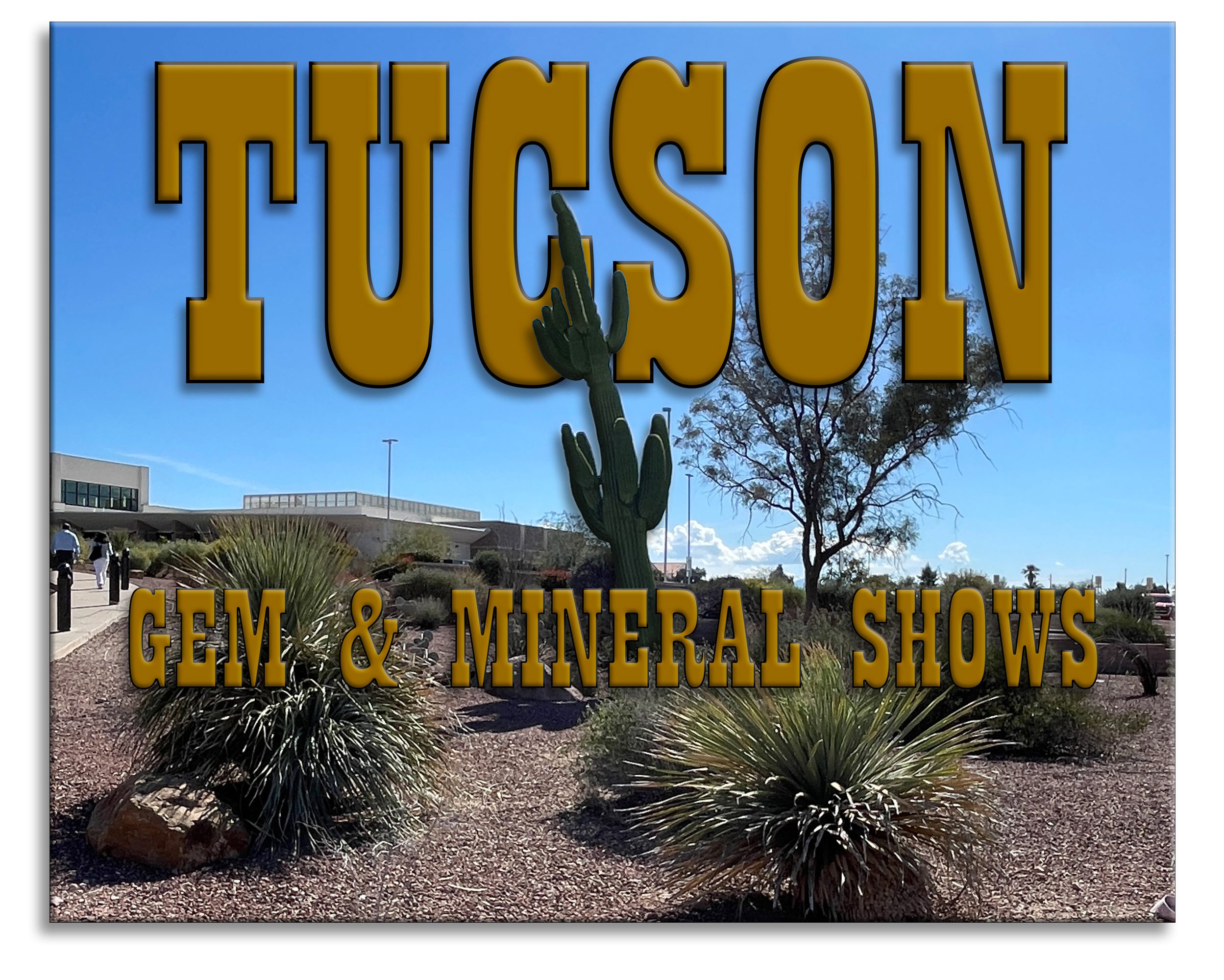
A first-hand look at the Tucson Gem & Mineral Shows
—and the stones that might spark your next jewelry design or inventory idea.
Why Tucson? Tucson is, by far, the largest temporary gathering of gem and mineral shows in the world. You’ve heard that before—but just how many shows is that?
It almost sounds fictional—but if you’ve ever been to Tucson, you know it’s not. This year, there were forty-nine (49) gem, mineral, and fossil shows.
Yes—that’s the number. According to the “Original Indispensable” Tucson Show/EZ-Guide Magazine, there were forty-nine different shows this year. So much to see, so much to find—and material arriving from every corner of the globe, all in one place, for one brief window of time. That’s why we place so much emphasis on Tucson here in the Roskin Gem News Report.
Not everyone can spend a week (or more) walking the Tucson shows—and even if you could, it’s impossible to see everything. So we do our best to visit as many key venues as possible in the time that we have, and report back on what we saw and heard—to give you a clear, practical look at what’s out there, and what might matter for your business and your passion.
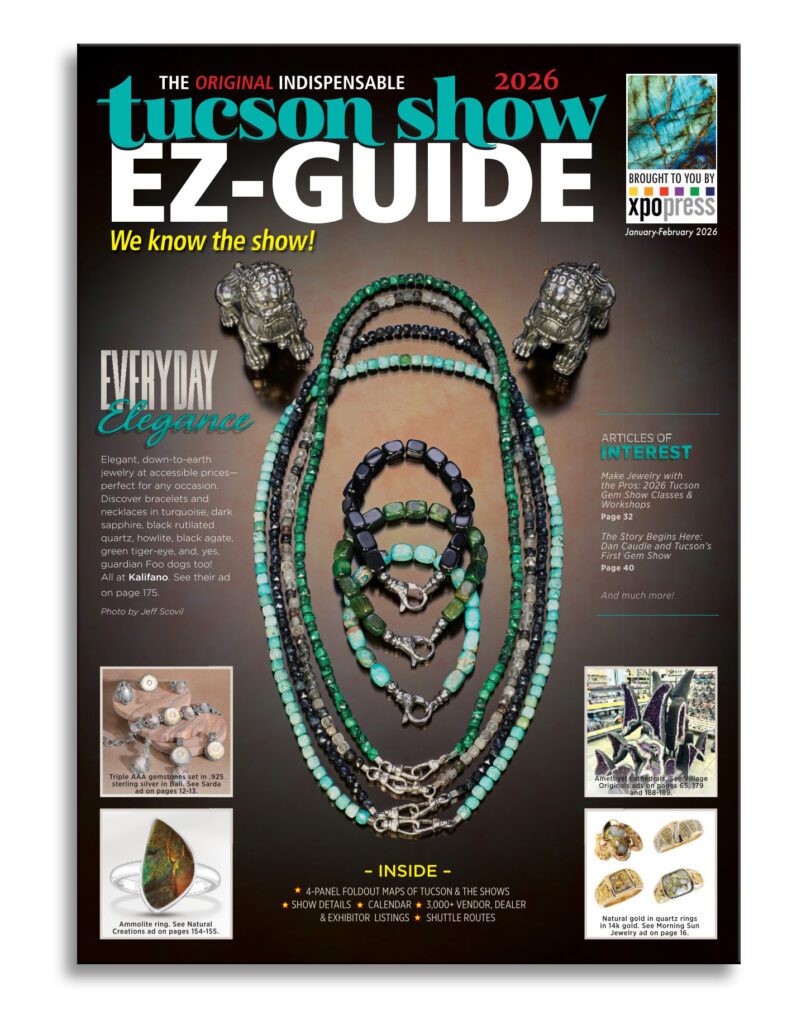
Tap here to view the entire Tucson show guide.
Tap here if you are interested in purchasing a hard copy show guide.
Of those 49 shows, five were trade-only, including the AGTA GemFair, the Gem & Jewelry Exchange (GJX), two GLW Gem & Lapidary Wholesalers shows—one at the Holiday Inn Holidome and one at “the GemHall”—and JOGS Gem & Jewelry Show.
[JOGS Gem & Jewelry Show—This is a fun show, and one of the few Tucson venues where the name looks and sounds like an acronym, but no one seems entirely sure what it stands for. Over the years, we’ve heard everything from Jewelry, Organics, Gem Show—which would be fitting, given the number of organic (or, more precisely, biogenic) gem materials seen here—to Just One Giant Show. None of it is official, and all of it somehow fits.]
Six Shows—Out of those Forty-Nine
Over eight days, we visited six different shows—from the polished aisles of the AGTA GemFair to the sprawling tents and warehouses that define the Tucson experience. What follows is a short field report from each stop—short, at least by Tucson standards—including a pictorial look at the stones and scenes that make Tucson what it is, and the kinds of gems that might spark a new design, fill a gap in your inventory, or just make you say “Wow!”
Show #1 — the AGTA GemFair
The American Gem Trade Association’s AGTA GemFair Tucson, held at the Tucson Convention Center (TCC) is the anchor for the major gem trade shows. It hosts AGTA members who adhere to the association’s ethics and disclosures policies. For the buyer, you are working with knowledgeable merchants, and receiving required written disclosure—making it the only venue to consistently offer that level of transparency. AGTA – Tap Here
Two Floors
The main activity takes place downstairs in the arena – the Gem Hall, where over 200 exhibitors show loose and mounted gems, along with manufacturing and gem testing equipment. Special exhibits are also featured here, including the Smithsonian’s National Gem Collection, showing recent donations displayed alongside a few special pieces from the museum’s gem hall in Washington, D.C.
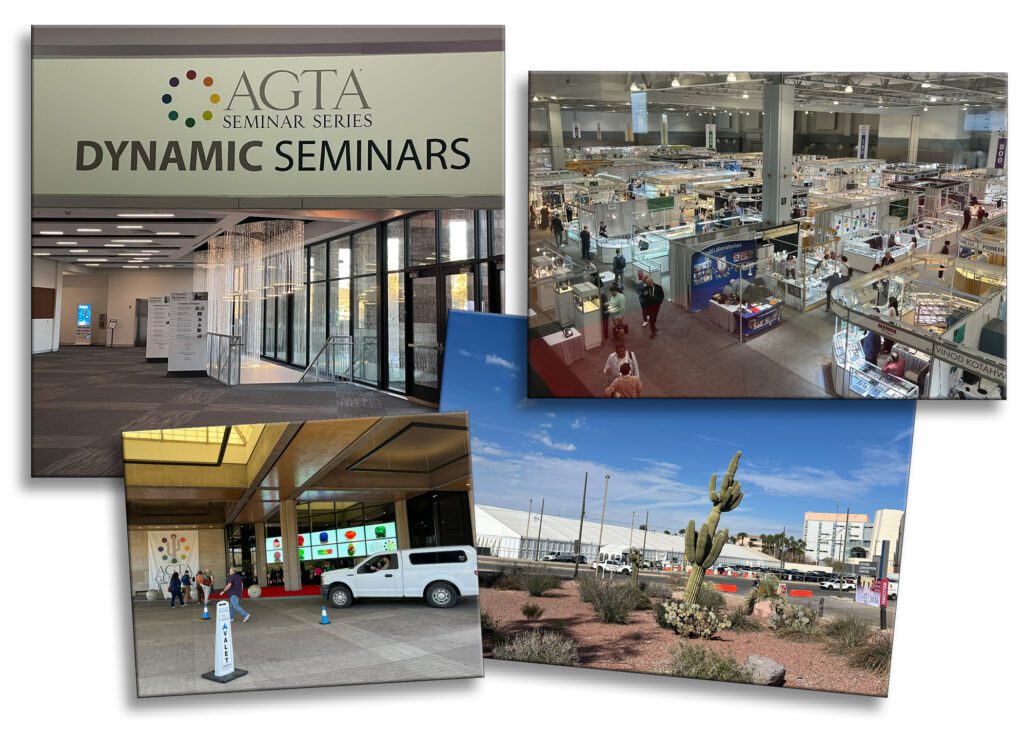
Upstairs, in the main entry Galleria, are associations and services exhibitors, including GIA, AGTA, and many of the major gem laboratories performing on-site identifications. Jewelry designers, along with antique and estate dealers, are located in the Grand Ballroom. AGTA’s DYNAMIC Seminars also take place on this floor.
5 Days Only
This year’s five-day show—an experimental shortened calendar compared to past years—began on Monday, February 2, and saw very active buyers in the aisles over the first two days. By Wednesday, predictably, the crowds had thinned a bit, with competition from the AGA’s annual Gemological Conference, the 2nd day of the AGTA seminars, and, in case you forgot, the other 48 gem & mineral shows around town.
Friday
By the end of the week, business had slowed enough to shift into dealer-to-dealer activity, with exhibitors filling out their inventory to carry them through the next few months.
Was it a good show?
We are always asked—and we always hear—that some dealers had their best Tucson ever, while others didn’t cover their show expenses. Overall, we would place this year in the plus column… with a significant caveat.
Yes, it was a good show—but there was caution in the air. The outlook for the next few months remains uncertain, with ongoing concerns over tariffs and now the conflict in the Middle East.
Next Year’s Show Dates
As the show wrapped up, the question quickly turned to what’s in store for next year—a five- or six-day show, and when? Just announced this past week, AGTA’s GemFair Tucson will once again run for five days, only this time starting on Sunday and running through Thursday (Sunday, Jan. 31 – Thursday, Feb. 4, 2027). This format is scheduled to continue through 2029.
Tap here for more of the 2026 AGTA GemFair Tucson.
It is now time for a look at just some of the gems we saw at the AGTA GemFair.
Show #1 – the AGTA GemFair Pictorial
◅◈▻
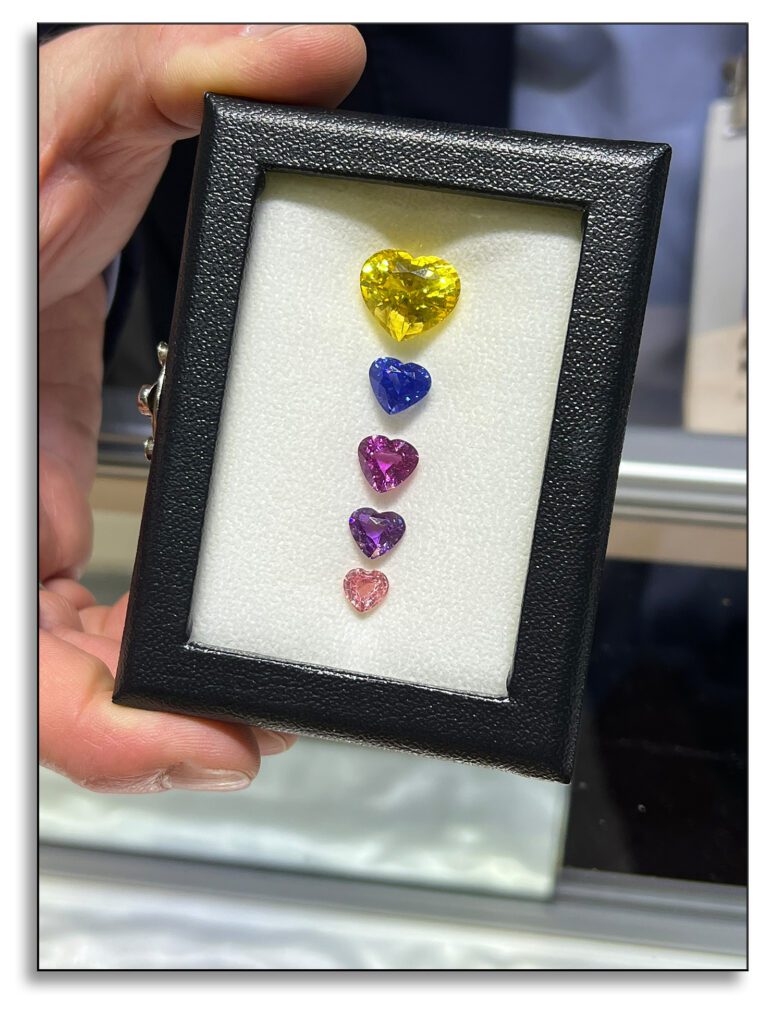
A suite of unheated, natural color, natural Sapphire hearts – “Suite Hearts,” weighing 31.85 ctw.
18.19 cts. Yellow
5.03 cts. Blue
4.08 cts. Pink
2.67 cts. Purple
1.88 cts. Padparadscha
Unheated Sapphires are indeed very rare and highly sought after.
Add exceptional color, size and shape, and we have a collection.
◅◈▻
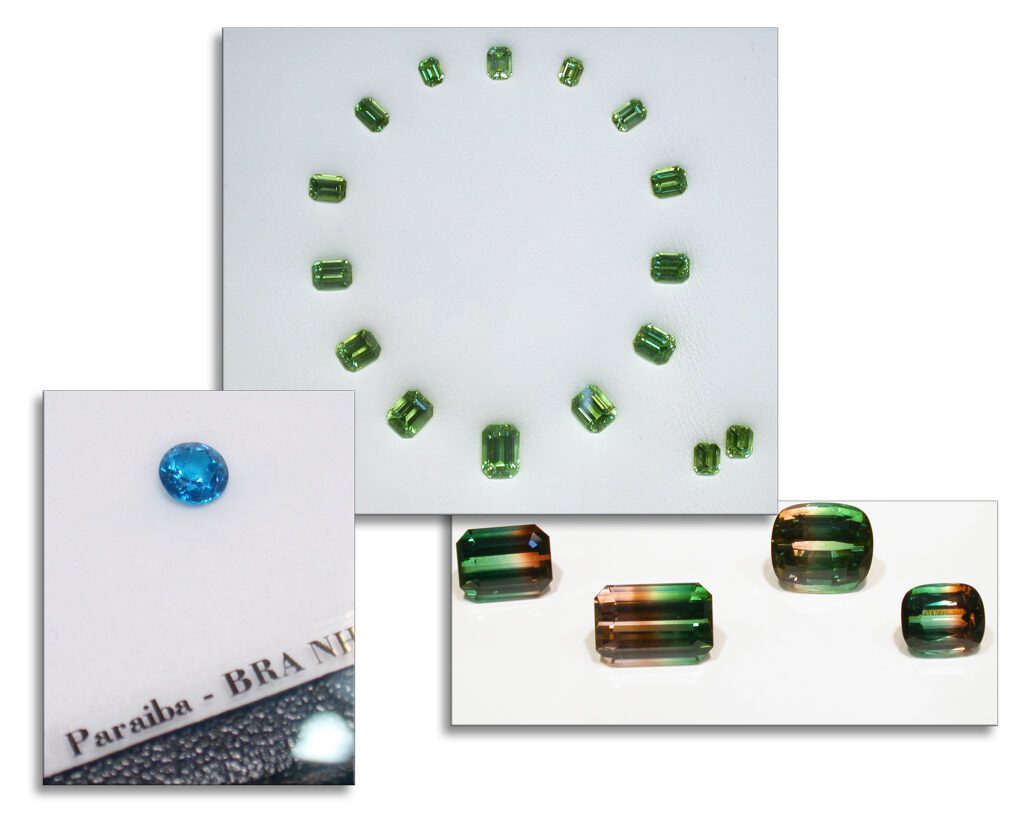
BiColor Tourmalines,
Peridot layout (Necklace, Earrings, Ring/Pendant),
and a magnificent 2.50 cts. unheated Vivid Color Brazilian Paraiba Tourmaline.
Exceptional cutting and matching on the peridot necklace.
◅◈▻
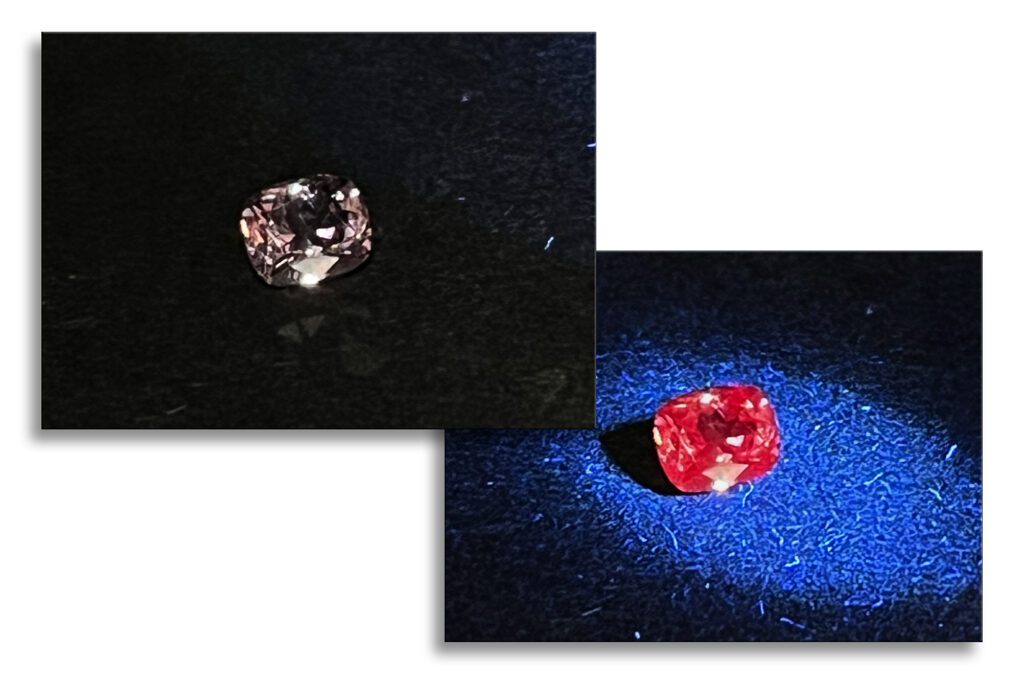
Dragon Garnet – a Malaya with strong red fluorescence. It is very unusual for a garnet to fluoresce.
Dragon Garnet
https://roskingemnewsreport.com/the-dragon-garnet/
Written up in the Roskin Gem News Report in March 2023, this Malaya garnet shows a distinct color shift along with a screaming red fluorescence under long-wave UV (see image above). Raja Shah, of Color First, pulled us aside to show a tray full of Dragon Garnets—each exhibiting both color change and red fluorescence. It had been a few years since we’d seen any, so it was a nice surprise to see the dragon’s flame again.
◅◈▻
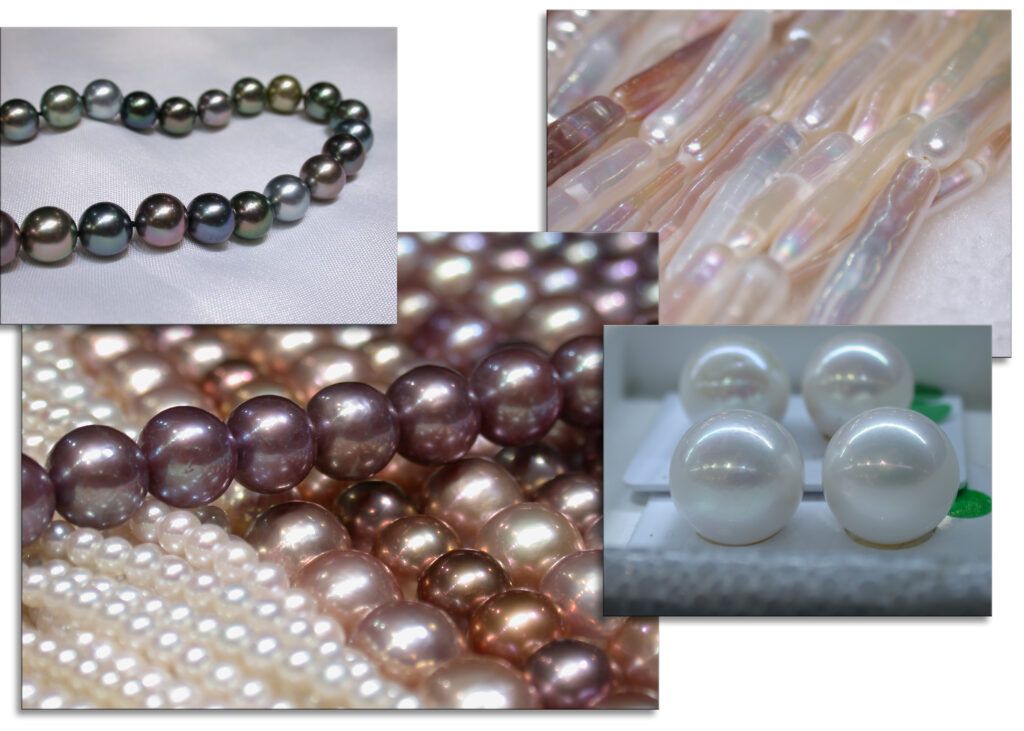
Matching size and lustre, multi-color Tahitian Pearls
4.5 mm x 25 mm CFW Stick Pearls,
South Seas Australian White Cultured Pearls,
9 x 11.5 mm, Edison – bead nucleated, Cultured, Freshwater Natural Color Purple Round Pearls.
Tucson Has an Ocean of Pearls
For the pearl lover, Tucson truly delivers. So many pearl merchants, so many varieties—from natural to cultured, saltwater to freshwater, rounds to unique shapes, from seed pearls to double-digit millimeter sizes, singles to multi-strands—it doesn’t take long before you feel like you’re diving into the deep end.
What you need is to find the vendors you’re comfortable with. And there’s no one more comfortable to be with than the pearl goddess herself, Betty Sue King of King’s Ransom. Whites, chocolates, greys, blacks—and multi-colors to choose from. Classic rounds to baroques, along with intentional shapes such as the stick pearls seen here—proof that even in pearls, the best finds aren’t always perfectly round.
◅◈▻
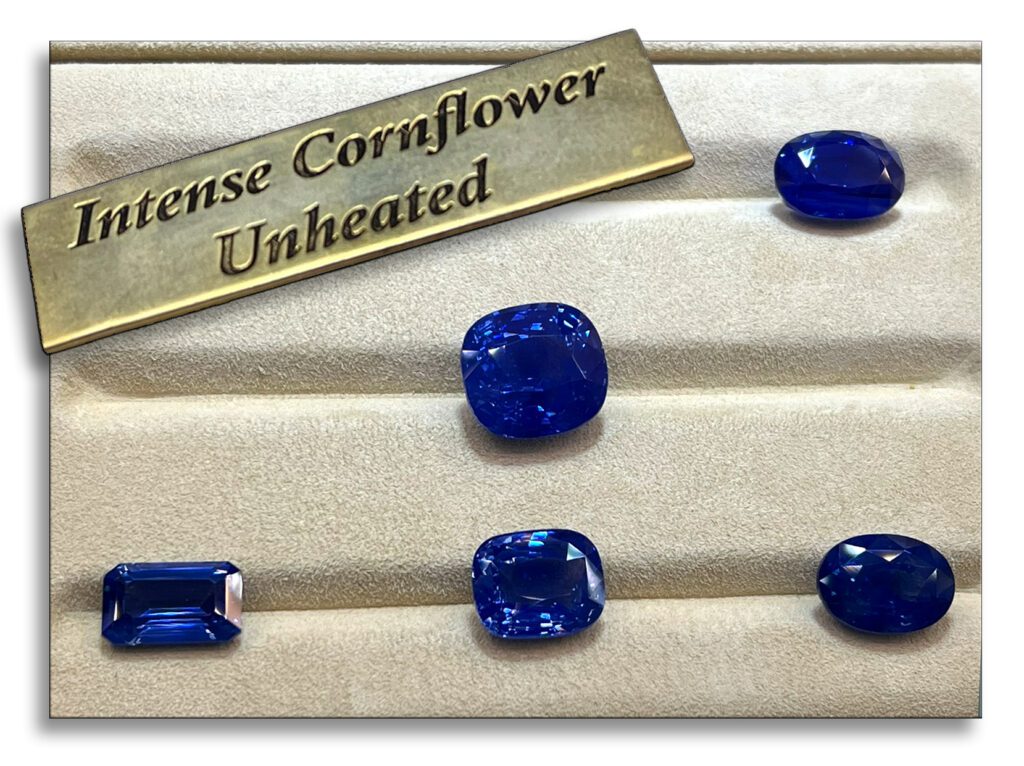
Natural, unheated “Cornflower Blue” sapphires
“Cornflower” describes that silky blue color, long associated with important Kashmir sapphires.
As you should know, this silky cornflower color can also be seen in stones from Sri Lanka and Madagascar.
All three origins are represented in the image above.
Which is which? Call Sailesh to find out.
Blue sapphires have been strong—and continue to be so. Because of their substantial price per carat, a professional gem lab report accompanying fine and extra-fine quality stones is essential. Treatments and country of origin can make significant differences in value.
Commercial color descriptions such as Royal Blue and Cornflower Blue are also appearing on those lab reports. As for what color these descriptions actually represent—since there is no international grading standard—it depends on the specific laboratory. Most importantly, it depends on your eyes. What do you see? Without standards, your opinion carries real weight.
As for the sapphires above, I saw that silky cornflower blue with my own eyes—which is why I had to take the picture. —gr
◅◈▻
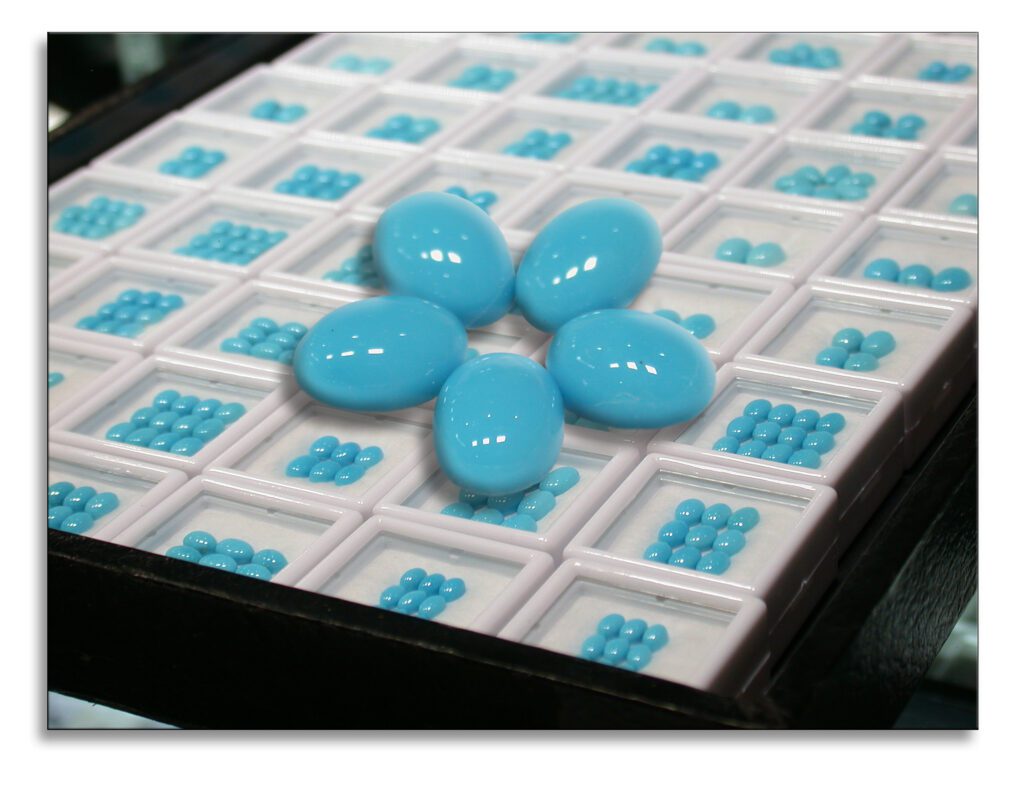
From the Castle Dome Mine: natural Arizona turquoise, natural color, no stabilization.
For those of you who do not know, Tucson, Arizona is in the southwestern United States, an area of the world where turquoise is found and culturally important. So yes—you expect to see a lot of it here, and you do.
The Castle Dome material shown above displays a beautiful, evenly strong saturated robin’s egg blue. It’s not color-enhanced, nor has it been stabilized – two enhancements/treatments that are fairly common when dealing in turquoise.
Mine Matters
With so many varieties of turquoise in the market, rather than trying to describe color or matrix patterns, it’s common to see material labeled by mine origin—as with these, identified as Castle Dome. Helen and Richard Shull, of Out of Our Mines, had a number of different turquoise varieties on hand, each with distinct color and matrix patterns, all clearly labeled by mine.
So what do we know about Castle Dome?
“This mine was a copper mine in Pinto Valley near the Sleeping Beauty mine,” says Helen. “It hasn’t produced in decades but was known for turquoise similar to Sleeping Beauty—generally smaller, but with a higher percentage of hard, gem-quality blue nuggets. The small nuggets were perfect for our calibrated gem cuts.”
Other turquoise at Out of Our Mines include:
◊ Nevada Blue Mine, NV – a classic old Nevada mine that produced beautiful blues and spiderweb stones. Our material was mined in the 1970s, and we have most of what is left of the production from that period. Natural, backed stones.
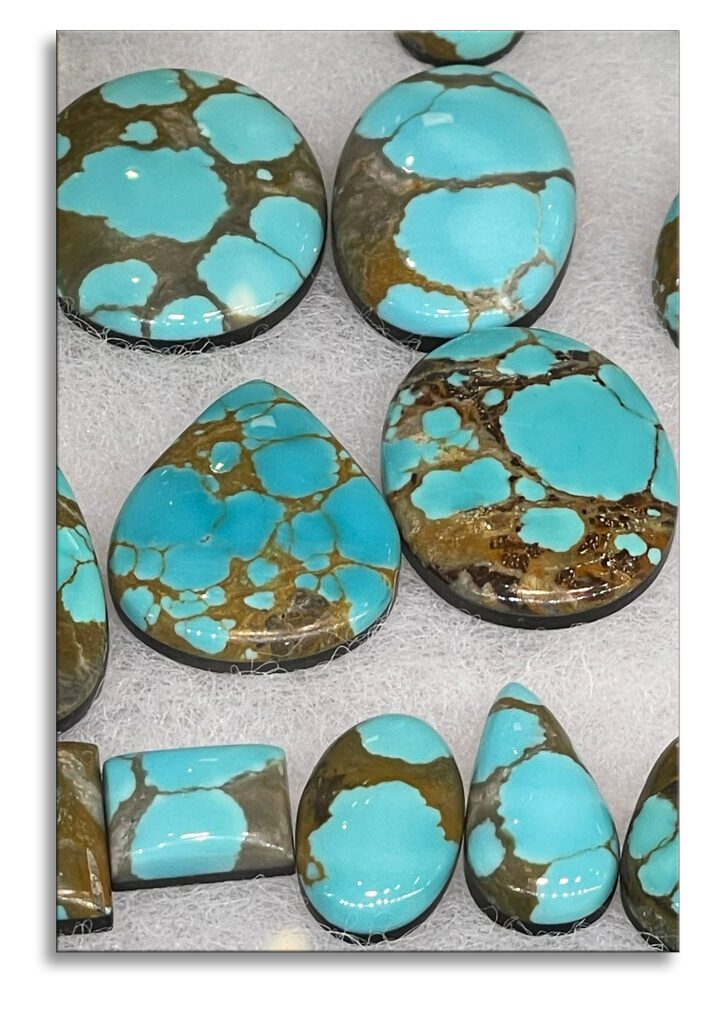
Supernova Mine, Nevada Turquoise, Stabilized
◊ Black Widow Mine, NV – Known for its high grade natural black spiderweb stones, as well as blues without web. We have select high grade natural stones as well as a line of stabilized stones from Black Widow
◊ Supernova Mine, NV – gem cut calibrated from 3mm up to 11mm with some larger stones, also free size backed stones in a variety of shades of blue and green and both clear and with spiderweb patterns. Stabilized, and rarely some natural stones too.
◊ Fox Mine, NV – natural calibrated stones, 3mm up to 10x8mm
◊ Royston, NV – from our Carmelita claims in Royston, an incredible selection of free size backed stones in blues, greens, and matrix patterns. Stabilized and natural stones are available
◊ Ajax Mine, NV – known for its greens, intense blues and multicolor stones. We have a selection of colors and matrix patterns in stabilized, free size stones, as well as select natural stones
◊ Roadrunner Mine, NV – a new find this last year. We have a line of stabilized stones in free sizes from this mine.
◊ Select high grade natural stones from a variety of mines: Northern Lights (electric green), Dyer Blue (calibrated gem cuts), Double Eagle (blues and multicolor with matrix), Blue Diamond and more.
The Tucson Effect
Because turquoise is so readily available in Tucson, it’s everywhere you look. This creates what we label as the “Tucson effect”—there is so much of it here that it can feel as though turquoise is everywhere.
In reality, once you leave Tucson, that level of selection quickly disappears. If turquoise is on your list, this is the place—and the time—to buy.
◅◈▻
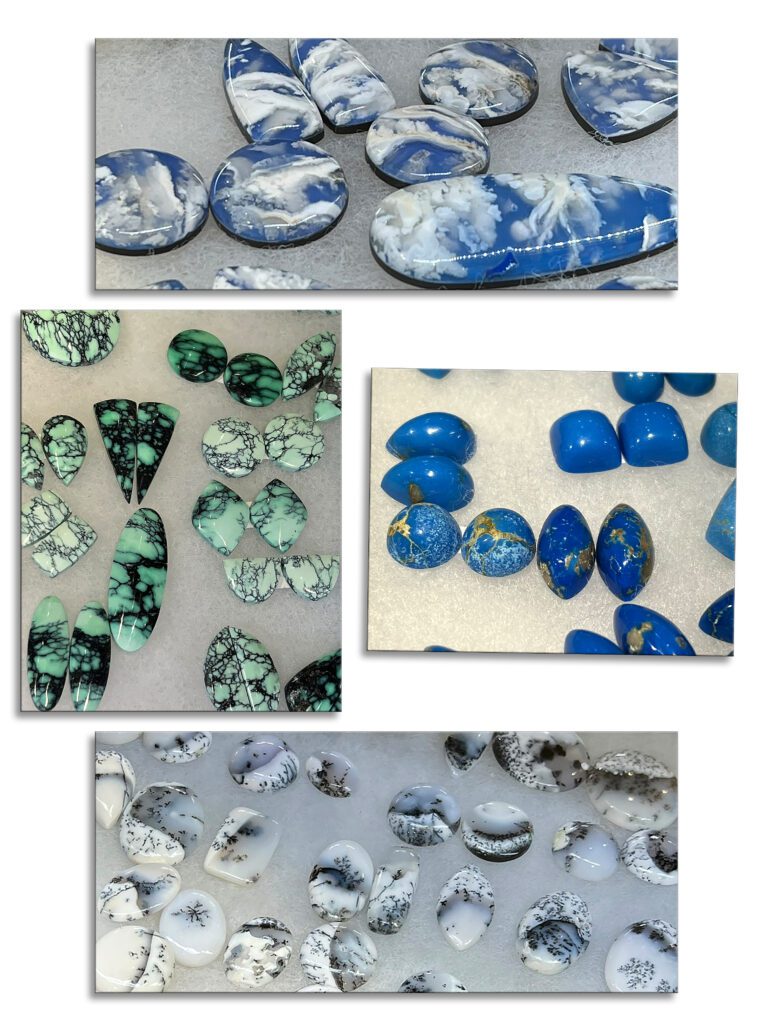
Top – Sky Plume Agate
Bottom: Snowbowl, a dendritic opal from Turkey
Left: Persian Variscite
Right: Chilean Ceruleite (rare)
Broad Inventory Specialists
The number of vendors offering hundreds—yes, hundreds—of gem materials to choose from seems endless here in Tucson. At the AGTA GemFair, we stopped by Rare Earth Mining and found exactly that kind of enormous inventory. Selections like these are truly a designer’s paradise.
We photographed just a small sampling—enough to spark a few ideas.
◅◈▻
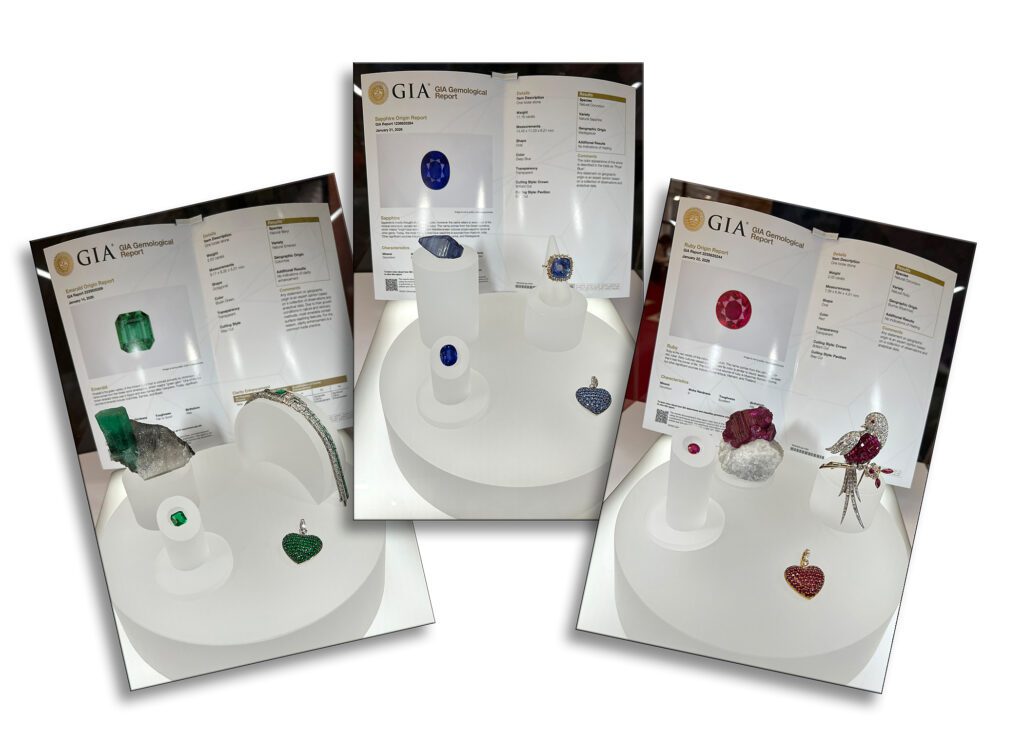
GIA’s redesigned Colored Gemstone Reports,
seen at the GIA booth, Tucson Convention Center
GIA
GIA had a prominent stand in the TCC Galleria, with staff on hand to discuss gemology courses and laboratory services. The mobile lab was located nearby. With AGTA’s GemFair focused primarily on colored gemstones, the new design of GIA’s Colored Gemstone Reports was drawing considerable attention. We’ll take a closer look at what’s new—and what it means for the trade—in next week’s newsletter.
◅◈▻
The Smithsonian’s Gem Collection
Each year, the team from the Smithsonian’s Gem & Mineral Hall brings a selection of rare and beautiful pieces from Washington, D.C., along with recently donated gems and jewelry. The display is not only filled with exceptional pieces to admire—it also serves to inspire future donations to the national collection.
Here are just a few of the pieces we saw in Tucson this year—perhaps a little inspiration for the next great donation.
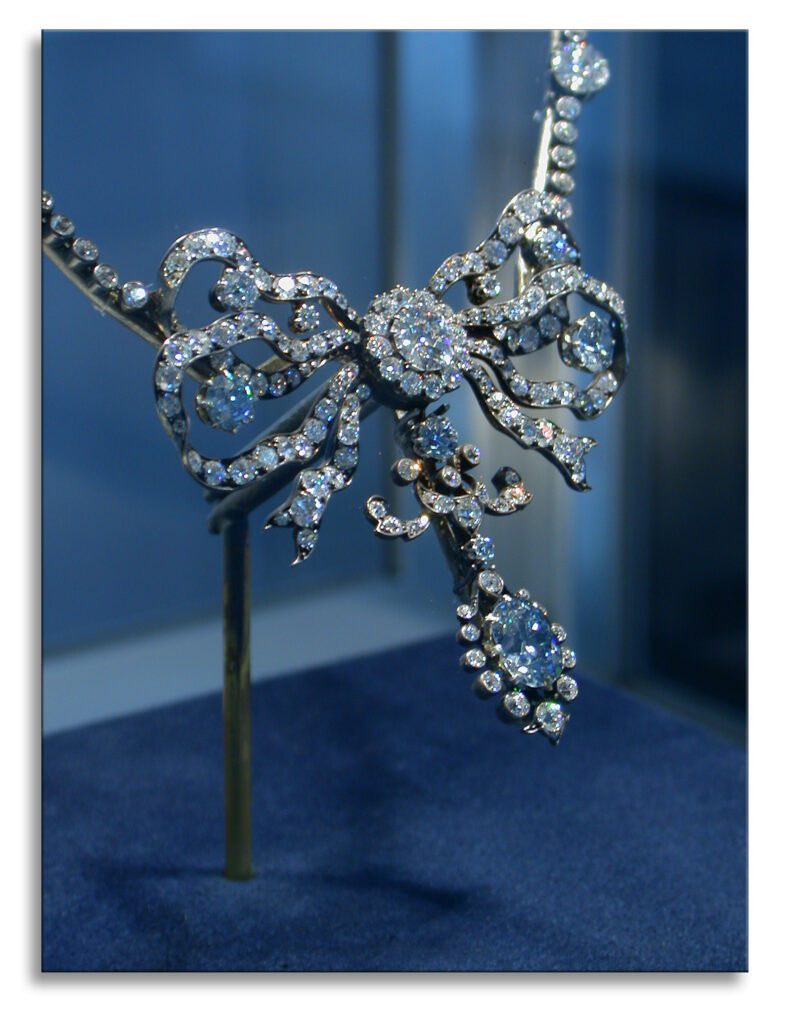
.. featuring 9 blue diamonds, including the 2.60 carat center.
All accented by 243 colorless diamonds.
These diamonds are mounted in rose gold and silver.
Gifted to the Smithsonian in 1992 by Stephen Silver Fine Jewelry
◅◈▻
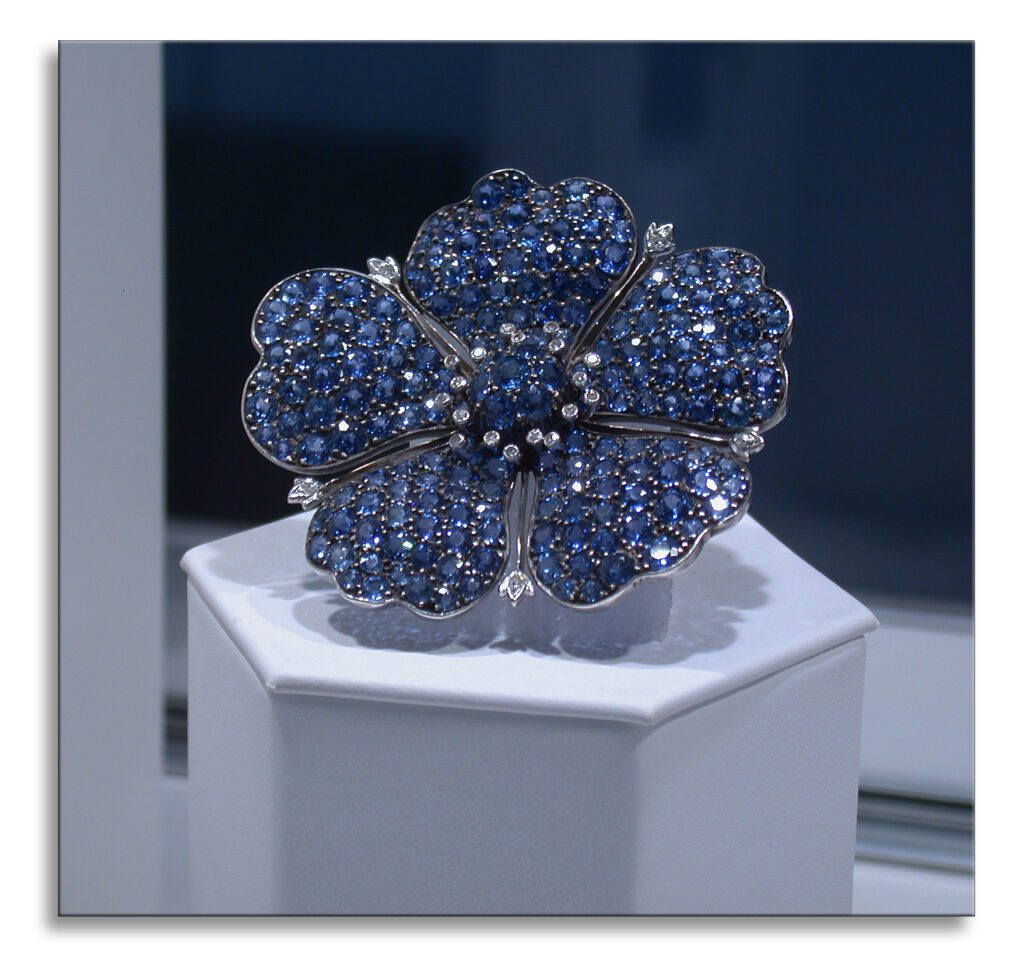
approximately 50 carats total weight
Montana Sapphires from the famous Yogo Gulch mine
Beautiful for its color, and extremely rare for its origin.
Gift of Coralyn W. Whitney
◅◈▻
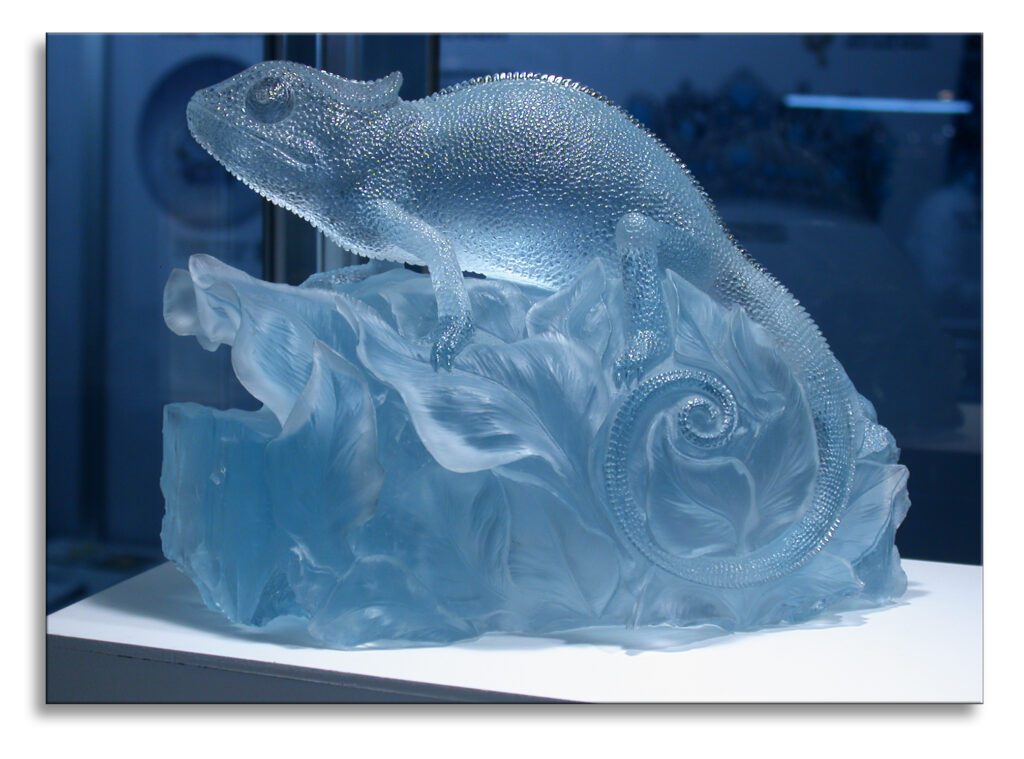
Carved by Alfred Zimmermann, Idar-Oberstein
Take a closer look at the carving detail – amazing workmanship!
a Gift of Jane Mitchell & Jeff Bland
◅◈▻
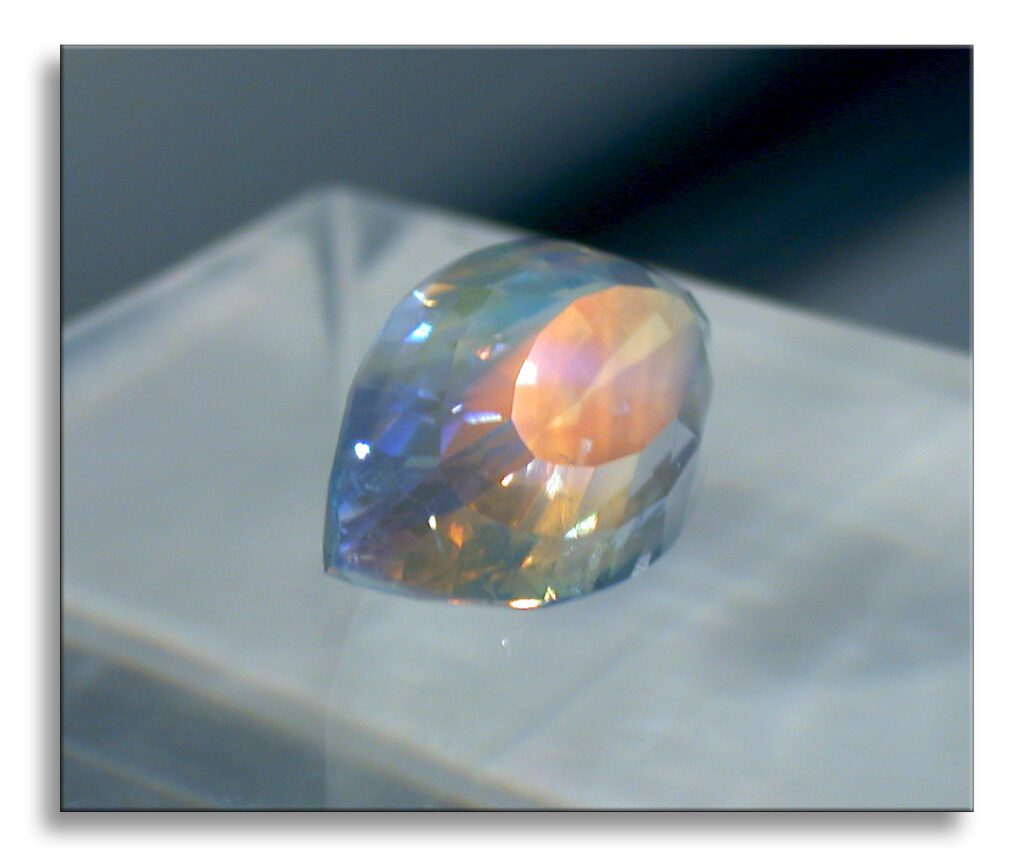
Rainbow moonstones from Madagascar are known for their strong orange “flash” (adularescence).
This 17.24-carat stone is a museum-worthy example showing that phenomenon.
Gift of the Winston Fund
◅◈▻
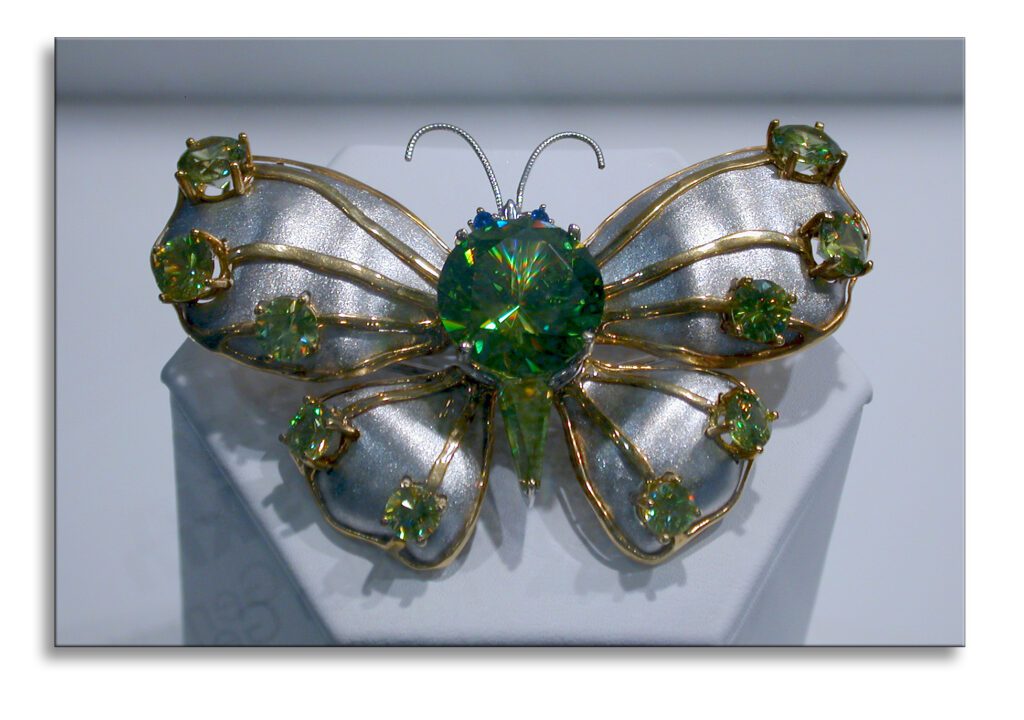
15.83 carat center Sphene from Madagascar
Sphene has high dispersion, which is often challenging to capture in a photo.
The dispersion is at its peak a few centimeters off the surface of the stone.
Therefore, when the stone is in focus, one only sees a small percentage
of this rainbow of colors.
Gift of the Smithsonian Gem & Mineral Collection
◅◈▻
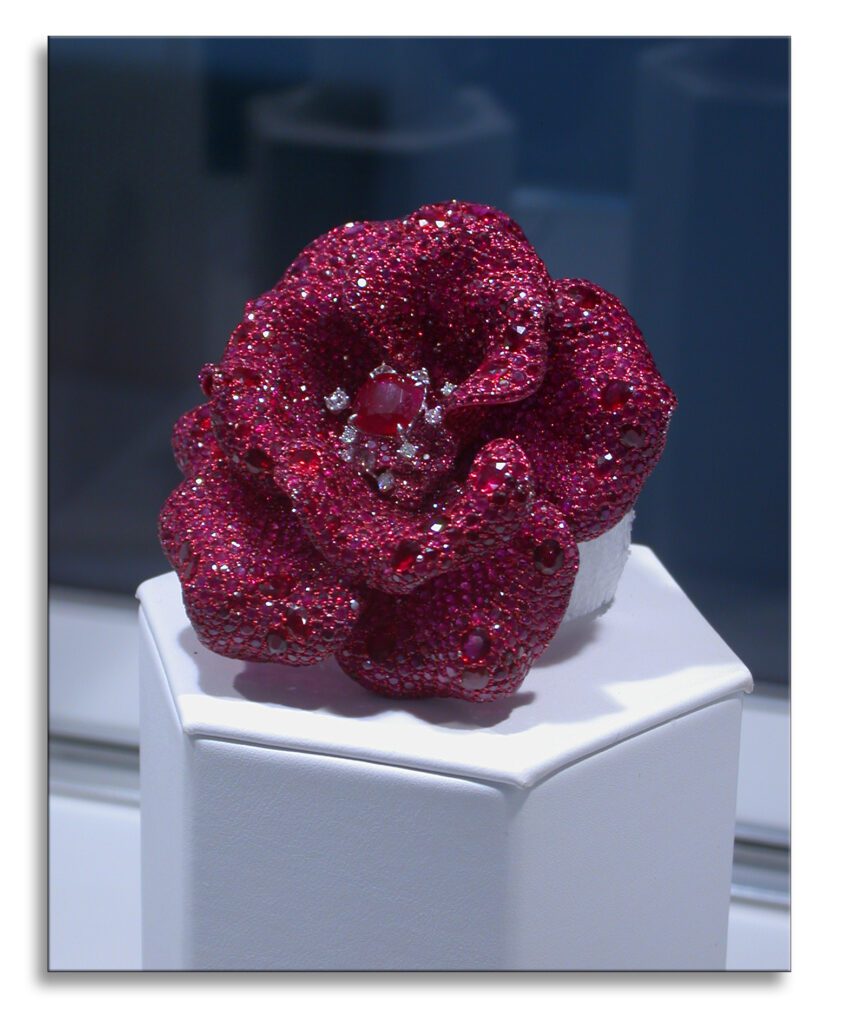
5.07 carat center stone (it’s a large brooch!)
surrounded by Burmese rubies, 100 carats total weight
The color, the design, the size … absolutely stunning!
Gift of Christine Dai
And now on to venue #2 … time for a look at some of the gems inside the GJX tent!
◅◈▻
… a five minute walk across the street from the TCC
Show #2 — the GJX Gem and Jewelry Exchange
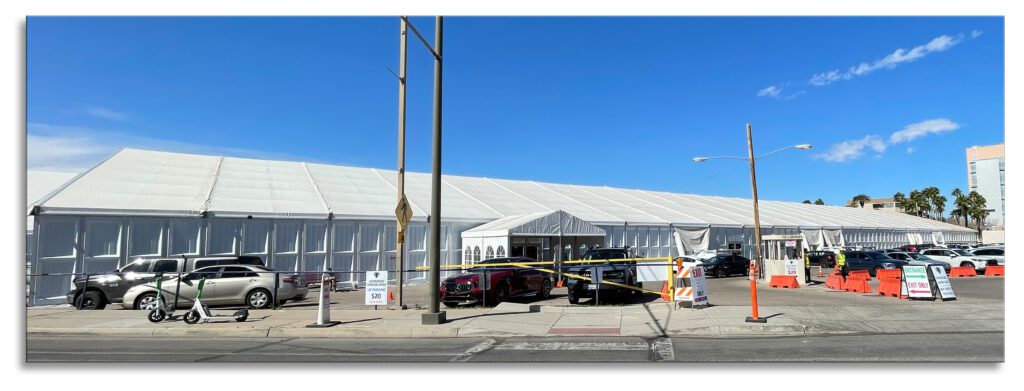
If the AGTA GemFair represents a hub for North American dealers, then GJX is where the rest of the world gathers. Here you’ll find groups of Germans, Sri Lankans, Thais, and Brazilians—along with many other nationalities, and yes, even a few North Americans. The GJX tent is a fine gem and jewelry venue—and a must-stop on any Tucson visit.
A Tent – but do not Judge a Tent by its Cover.
Yes, this venue is a tent. There has been talk for decades about putting up an actual building here, but at this point, few expect that to materialize.
Anyway, no matter what it looks like from the outside, it’s what’s inside that counts. The Germans, in particular, pull out all the stops, bringing their top gem cutters—Münsteiner, Constantin Wild, Kreis Jewellery, Paul Wild, Pauly, Hermann Lind II, and many more.
Looking for Australian black opal from an Australian? You’re in the right tent. How about Brazilian imperial topaz from a Brazilian? This is the show.
This is also the venue that hosts the annual “run for the corner”—the unofficial stampede to Stand 1436, Coast to Coast Rare Stones, proving rare gems are in short supply and in high demand. On opening day, buyers line up before the gates open, ready to move at full speed to the far back right corner to secure the best of the best that the Coast to Coast team has to offer. It’s one of those “only-in-Tucson” moments.
Tap here for a link to the GJX floorplan and exhibitors’ list.
Okay, let’s see a few gems from inside the GJX tent.
◅◈▻
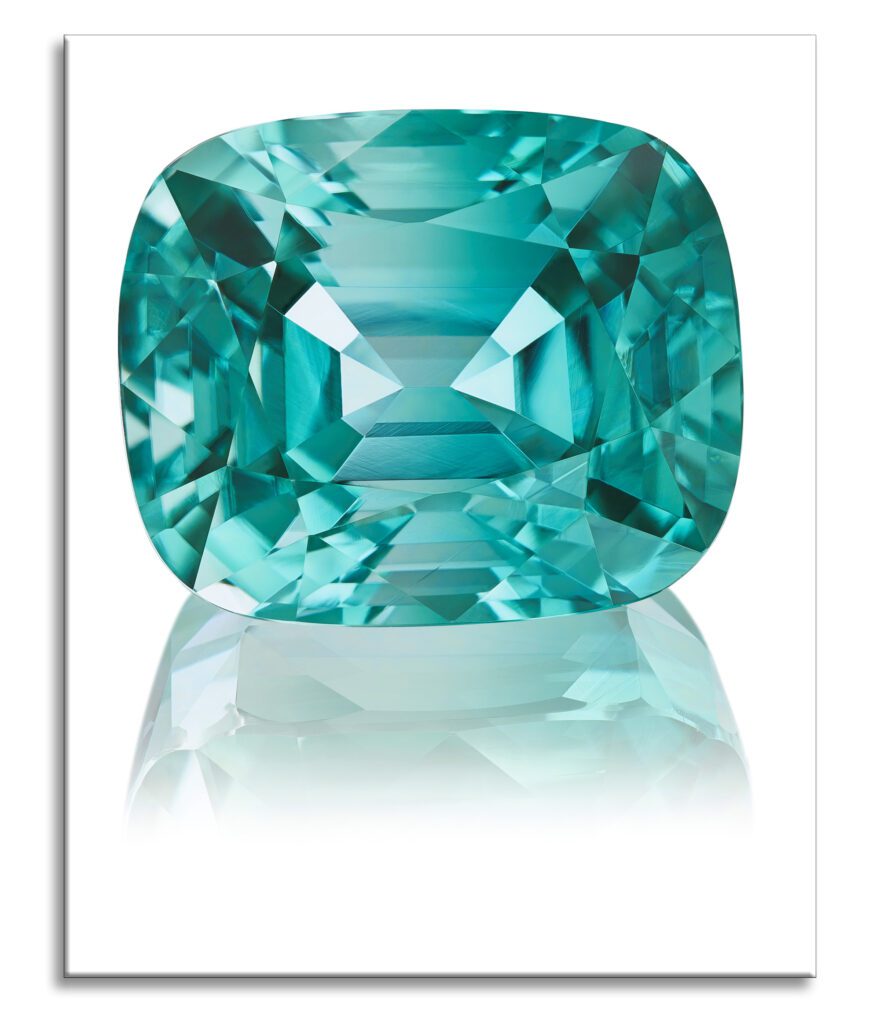
40.80 carats, Lagoon Tourmaline
This was in the front corner showcase. Simply jaw-dropping.
Image courtesy of Constantin Wild
◅◈▻
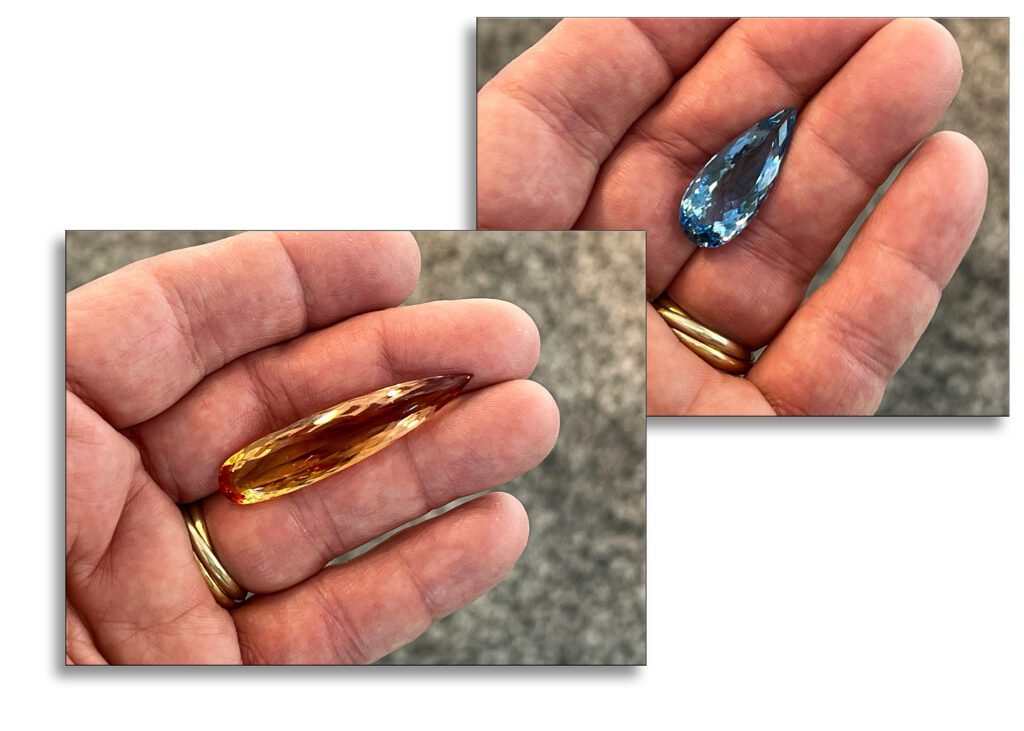
Imperial topaz, 31.26 carats, 47 mm long
Aquamarine, 12.63 carats, 28 mm long
Long pears, marquises, ovals—even baguettes—are especially popular right now.
For all you “old-timers,” this technique of showing gems in hand is a personal tip I learned from Fred Ward (1935–2016),
National Geographic photographer, gemologist, and author of nine gemological books.
◅◈▻
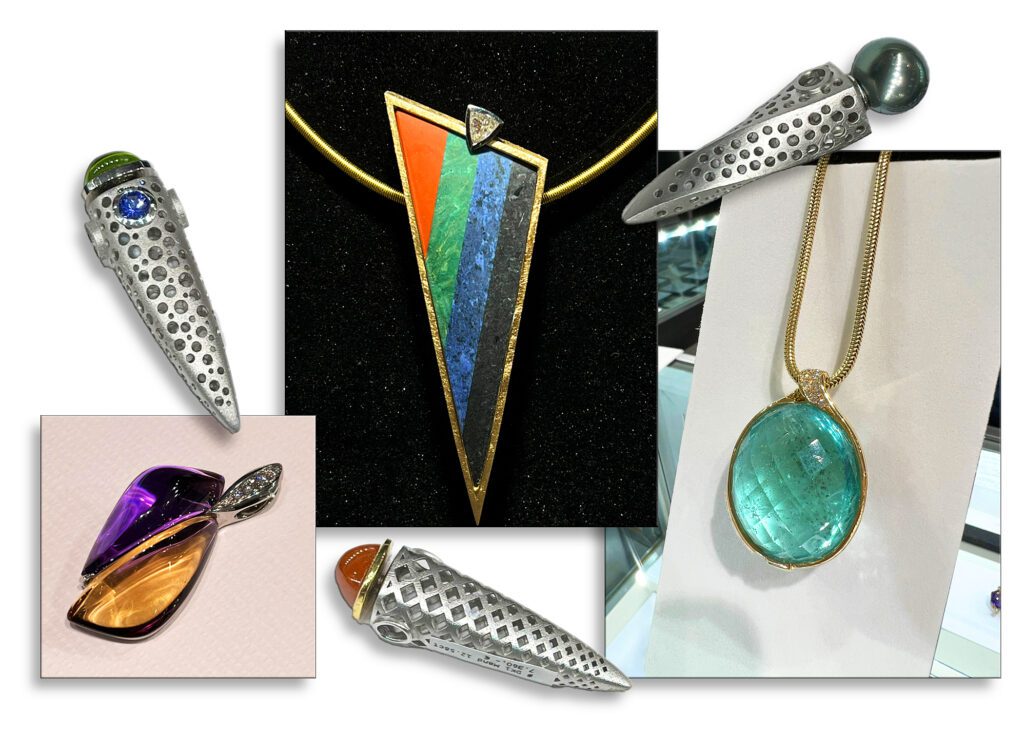
Ametrine (yes, one stone) pendant, 53.4 carats, 0.20 ct. diamonds, 18 karat white gold
Reversible Aquamarine pendant, faceted/cabochon, 128 carats, diamonds and pink sapphire melee.
Thunderbolts!
Mandarin Garnet sugarloaf pendant, 12.58 carats, 18K
15.2 mm Tahitian cultured pearl pendant, 18K
Peridot sugarloaf 11.75 ct., Tanzanite 0.62 ct. pendant
Lightning Strikes
18 karat gold and diamond – 94 mm long
set with Granite, Dumortierite, Verdite, and Jasper
the diamond trillion weighs 0.53 ct.
◅◈▻
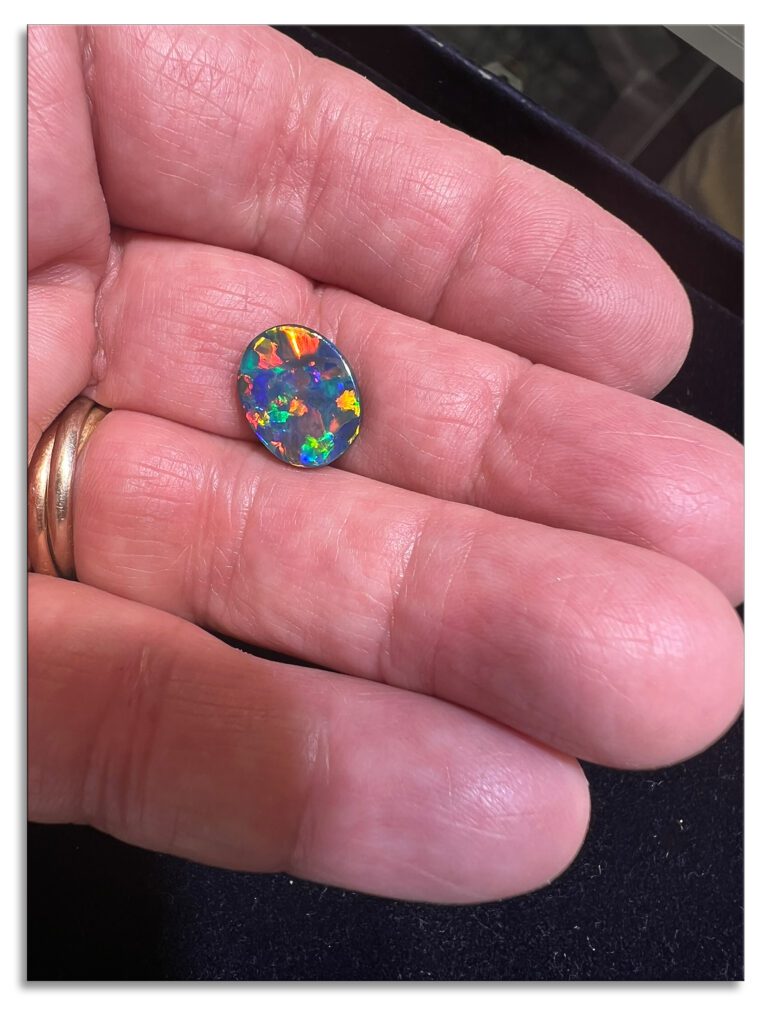
Natural Black Opal
4.19 carats, 17.8 x 13.1 x 4.3 mm
Mouth-watering. The color is not Photoshoped, and looks even better when moving.
This black opal has everything going for it—size and a full play-of-color against that dark background: reds, oranges, purples, blues, greens, and yellows, with no dead spots that we could find
—easily seen from several paces away.
◅◈▻
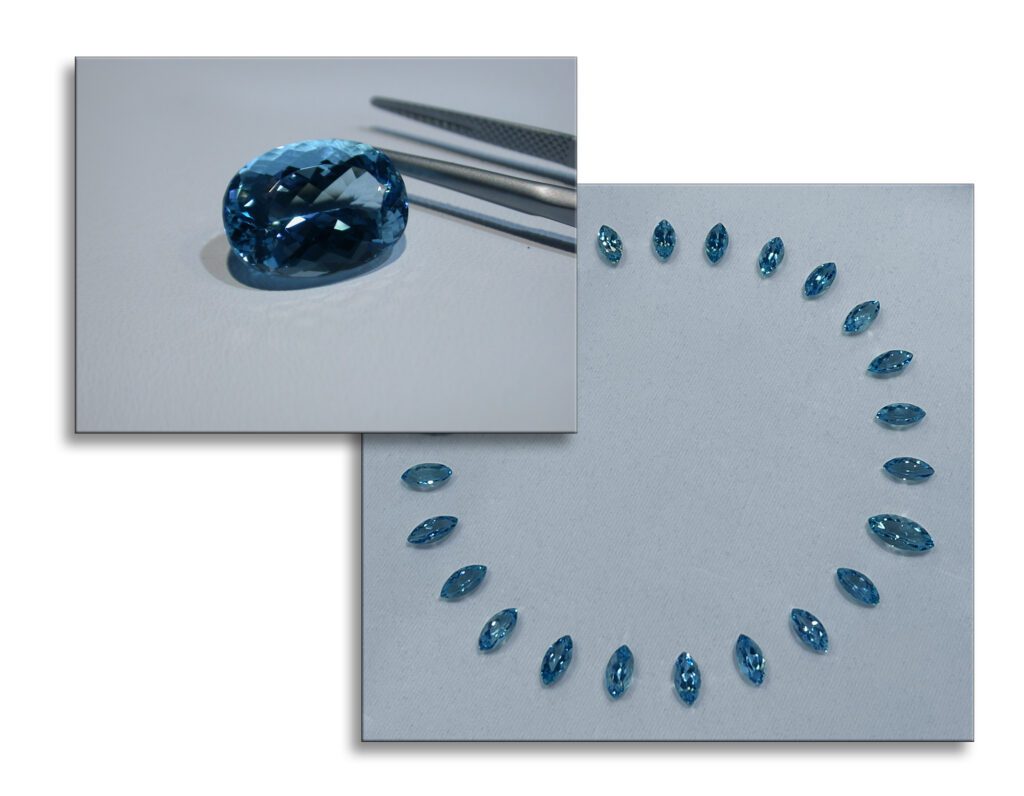
8.93 carats – Oval Aquamarine
Aquamarine necklace layout
This was a very nice matching color and shape necklace layout.
Special thanks to Daniel Bronfen of P.B. Gems.
◅◈▻
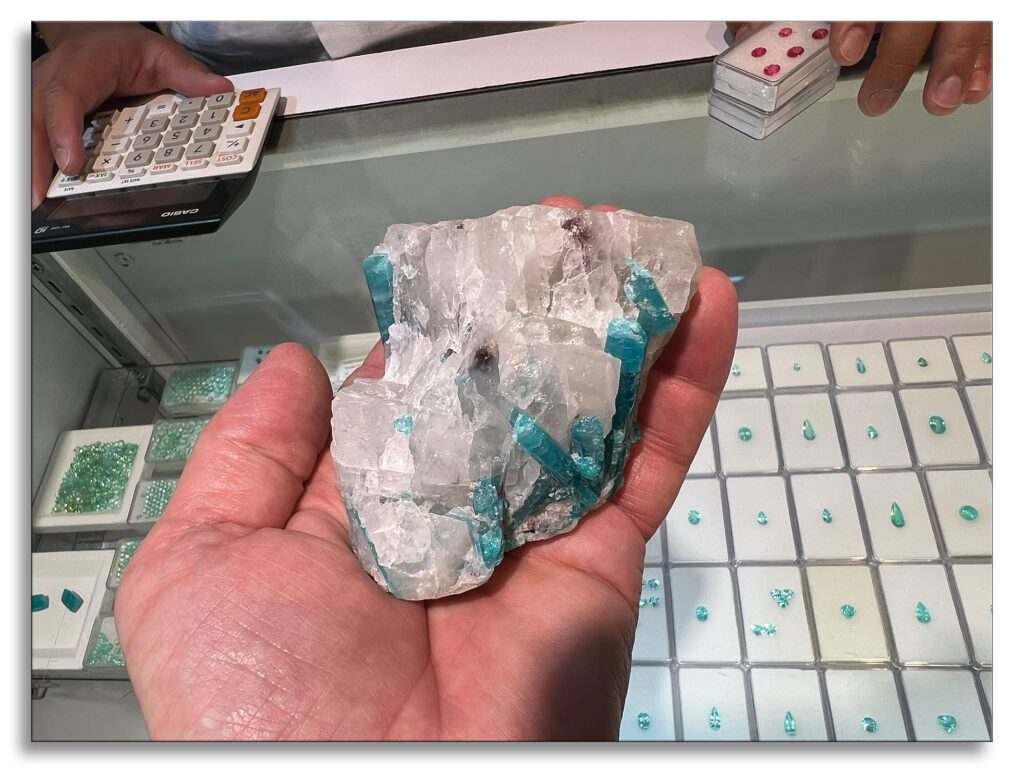
Brazilian Paraiba Tourmaline in quartz.
Walking the show with Ken Rock of the D.C. Mineralogical Society, João Martins of JS Gems showed us several mineral specimens of Brazilian Paraíba tourmaline in quartz. The color of the tourmaline was a medium to dark, strongly saturated slightly greenish-blue, as you can see.
While we don’t typically ask prices—since we rarely publish them—let’s just say the five-figure price tag on this piece was both surprising and, at the same time, entirely expected.
◅◈▻
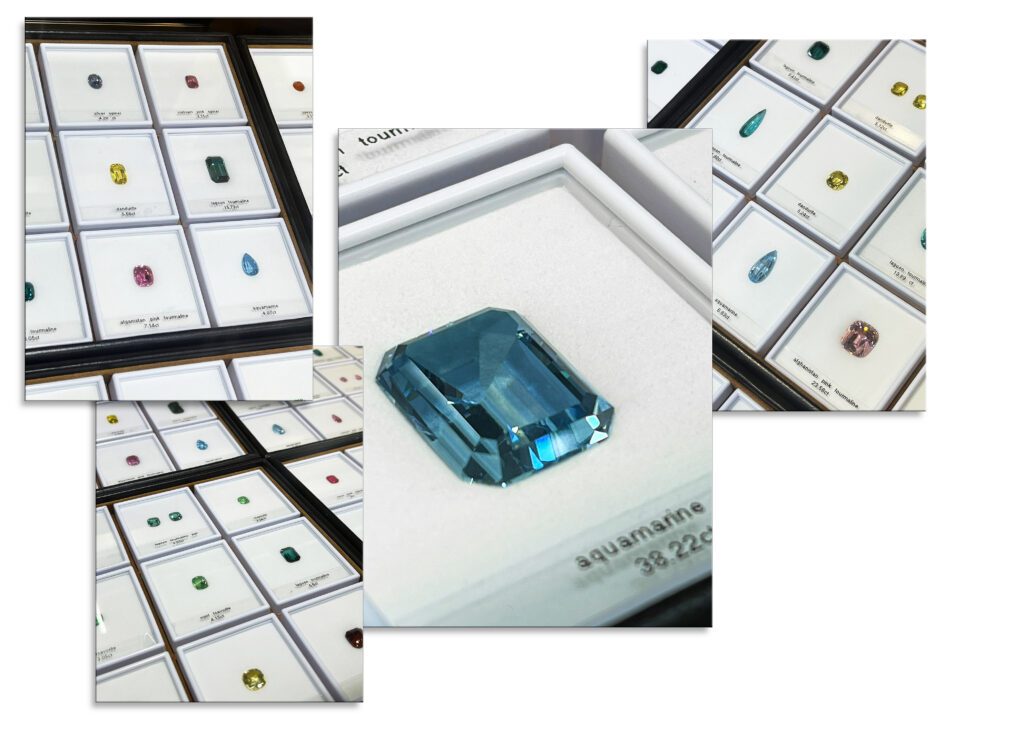
A very impressive, quiet and elegant display of fine-quality gems across a variety of species: spessartite and tsavorite garnets,
danburite, sphene, aquamarine, Vietnamese spinels, and Afghan tourmalines.
Loose Gems, Big and Small
GJX is a show with a strong presence of loose gem dealers—some with more inventory than could ever fit into a single showcase, and others, like RA, presenting a more focused selection to keep the eye from being overwhelmed, highlighting fine to extra-fine quality goods.
You’ll find this level of quality throughout the AGTA GemFair, GJX, the Pueblo Show (coming up next), and the 22nd Street Show. You simply have to know where to look—and that’s the challenge.
Comfortable walking shoes are a must—you’ll be racking up the miles as you move through the aisles… in search of that one stone worthy of the steps.
◅◈▻
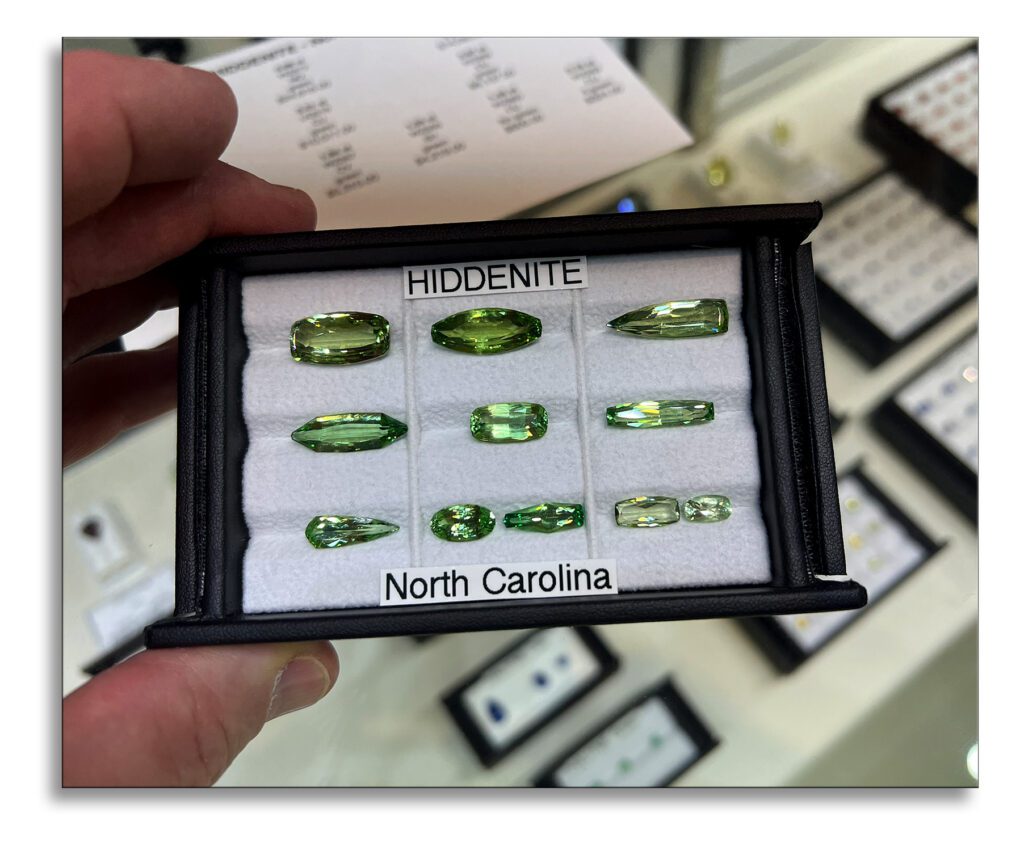
Super rare – Hiddenite from North Carolina
Top Row: 7.62 cts., 5.99 cts., 5.14 cts.
We were pleasantly surprised that these were still in the showcase! That gave us the opportunity to show them to you here.
Yes, this is the booth that gets the early morning rush… the unofficial “Run for the corner.”
◅◈▻
Münsteiner
The artistry of the Münsteiner family is truly legendary. From the quality of the gem materials to the design, cutting, polishing, and finished jewelry, the work is nothing short of breathtaking.
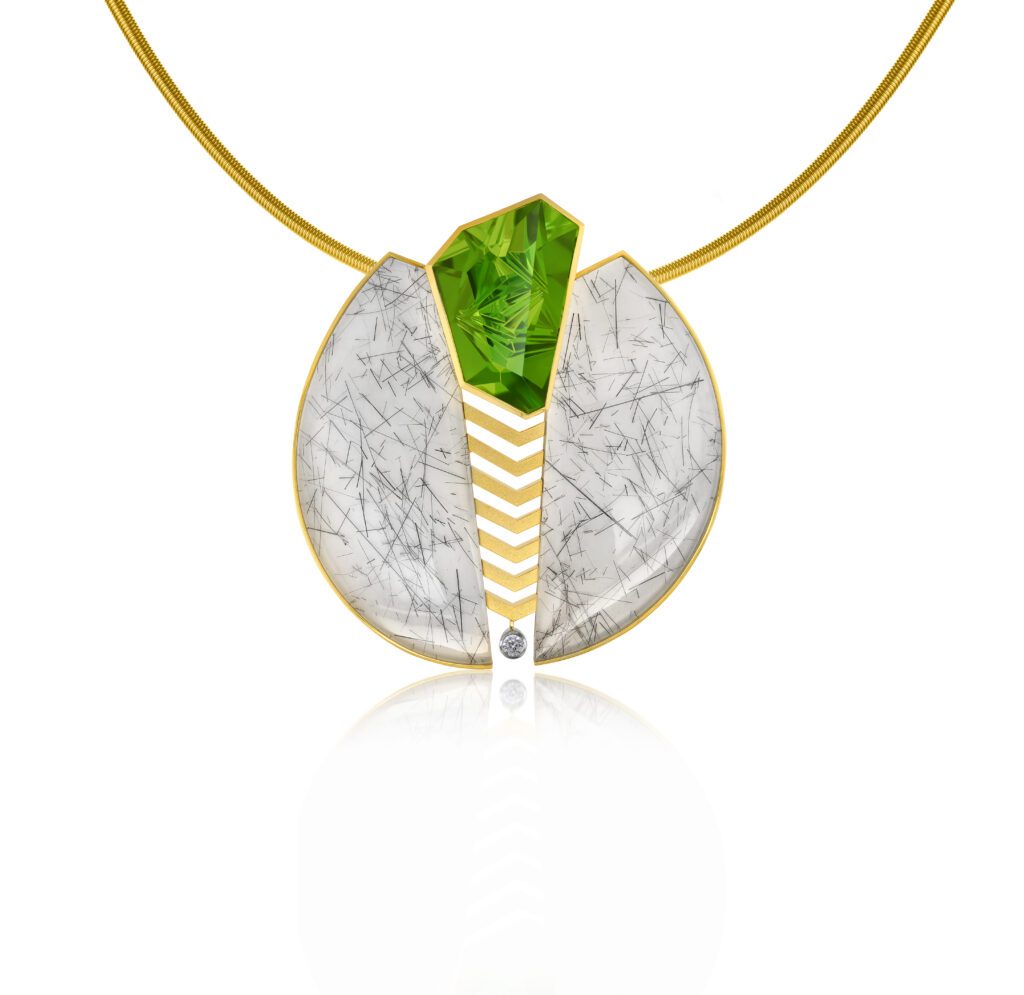
Necklace “Earth Power”
Peridot 45.86 carats
Tourmalinated Quartz
Brilliant cut diamond, 18K
Jutta & Philipp Munsteiner, Stipshausen, Germany
Image by Münsteiner
◅◈▻
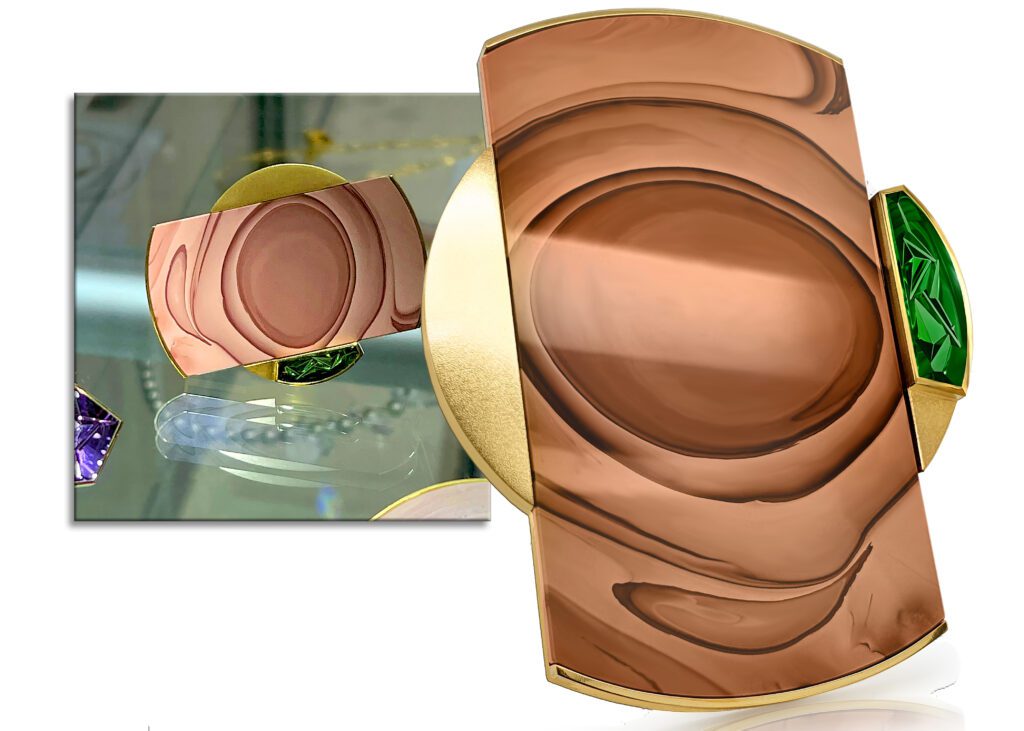
Necklace/Brooch “Earth Painting meets Gemstone Reflection”
Chrome Tourmaline 3.68 carats, Cappuccino Jasper in 18K
Jutta & Philipp Munsteiner, Stipshausen, Germany
Images by Münsteiner and Roskin
◅◈▻
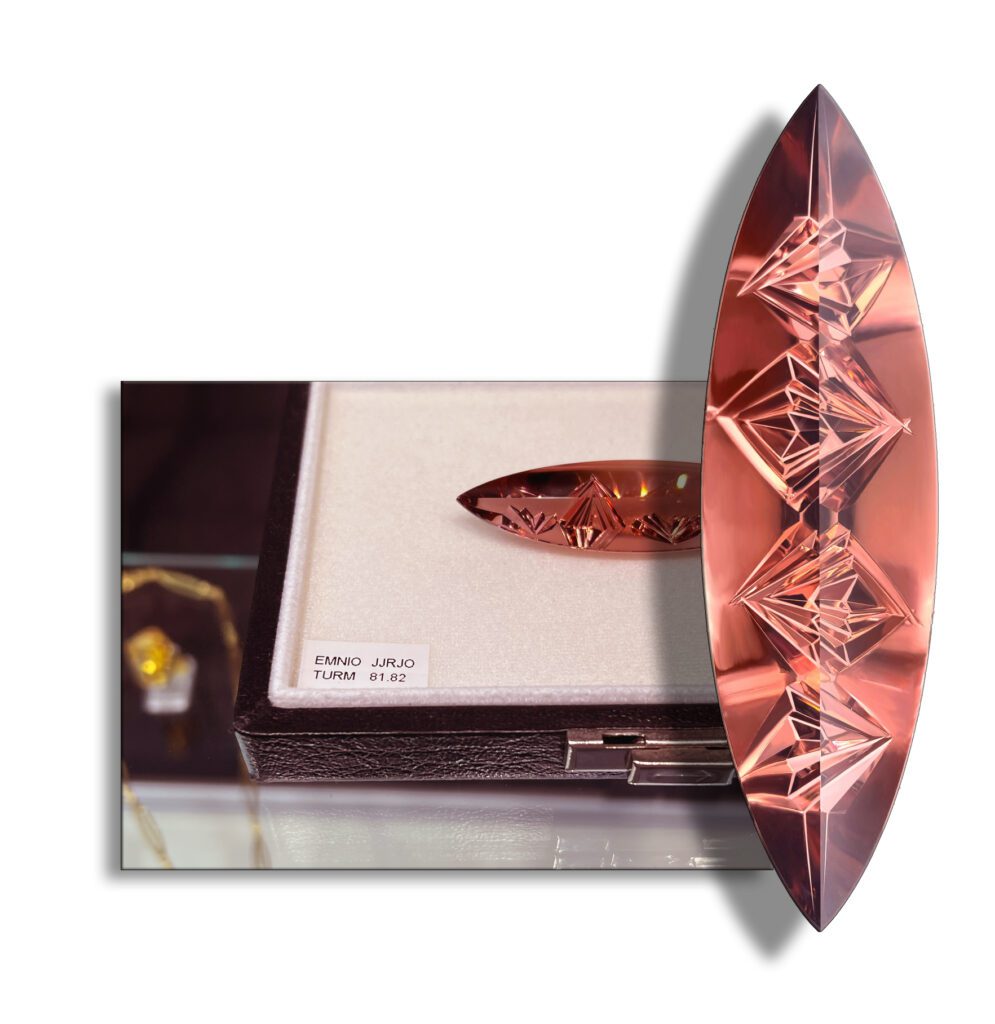
Tourmaline 81.82 carats.
Philipp Munsteiner, Stipshausen, Germany
Images by Münsteiner and Roskin
◅◈▻
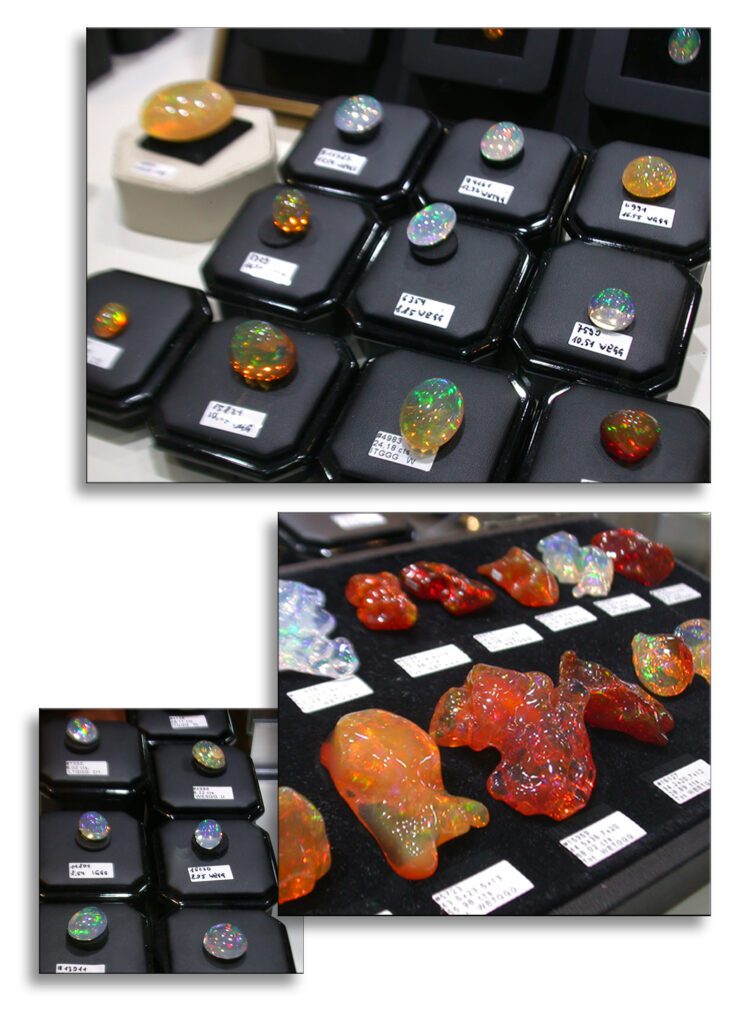
Kirschweiler, Germany
Assorted Opals
OPALS
There were plenty of opal dealers in Tucson to stop and discover Australian, Mexican, Brazilian, and Ethiopian material, but we always manage to check in with Jürgen Schütz at Emil Weis, Kirschweiler, Germany. Their collection of Mexican Fire Opals and Water Opals is a special treat.
◅◈▻
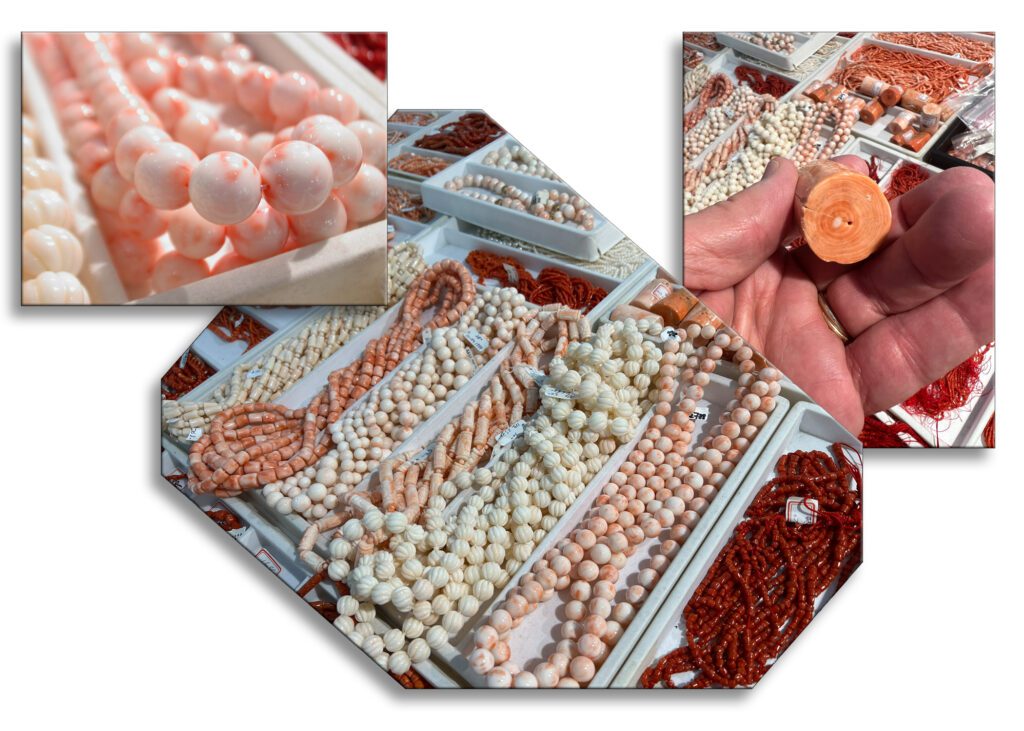
Assorted Coral – in white, and shades of pink to red.
Want to do your own carving? There are sections of stems available.
Good sources for fine quality, responsibly sourced, sustainably harvested coral is important.
Because coral is considered a protected species, it is highly recommended that you
check local and international regulations regarding import and export. Always ask.
Do not be afraid – be smart!
Here’s the link to CIBJO’s Coral BlueBook: https://cibjo.org/wp-content/uploads/2022/08/CIBJO-Coral-Blue-Book-2020-12-22.pdf
◅◈▻
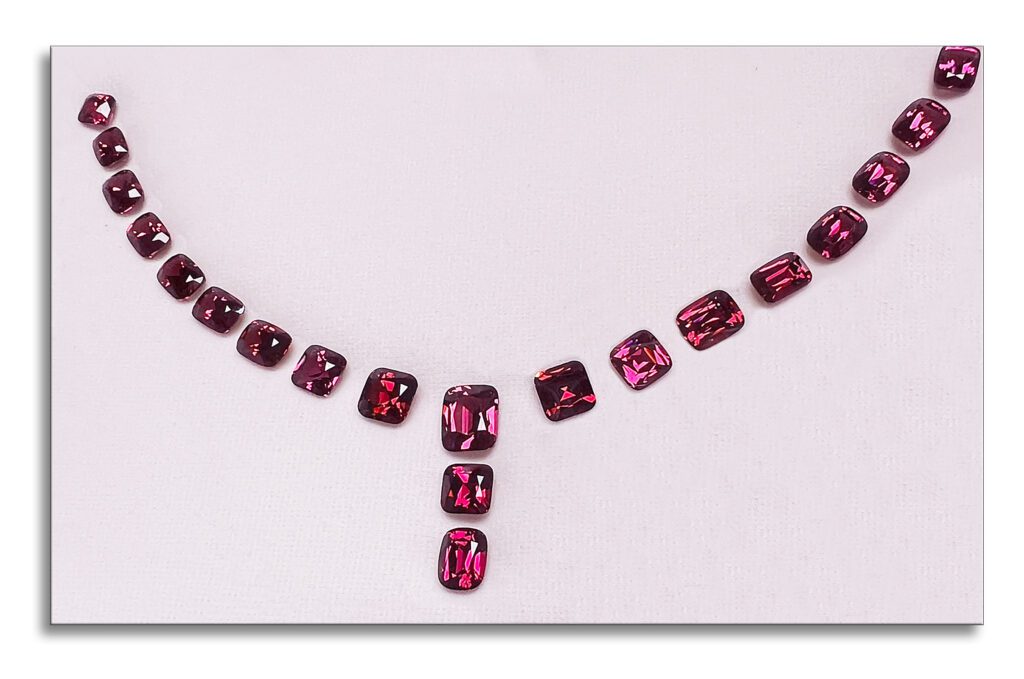
Spectacular Color
63.87 carats of purplish-pink sapphires, 27 pieces, including earrings and a solitaire.
This was a special color! You have to see this collection in motion.
A striking layout, with exceptional cutting that enhances bright flashes of these dark pink and raspberry hues.
◅◈▻
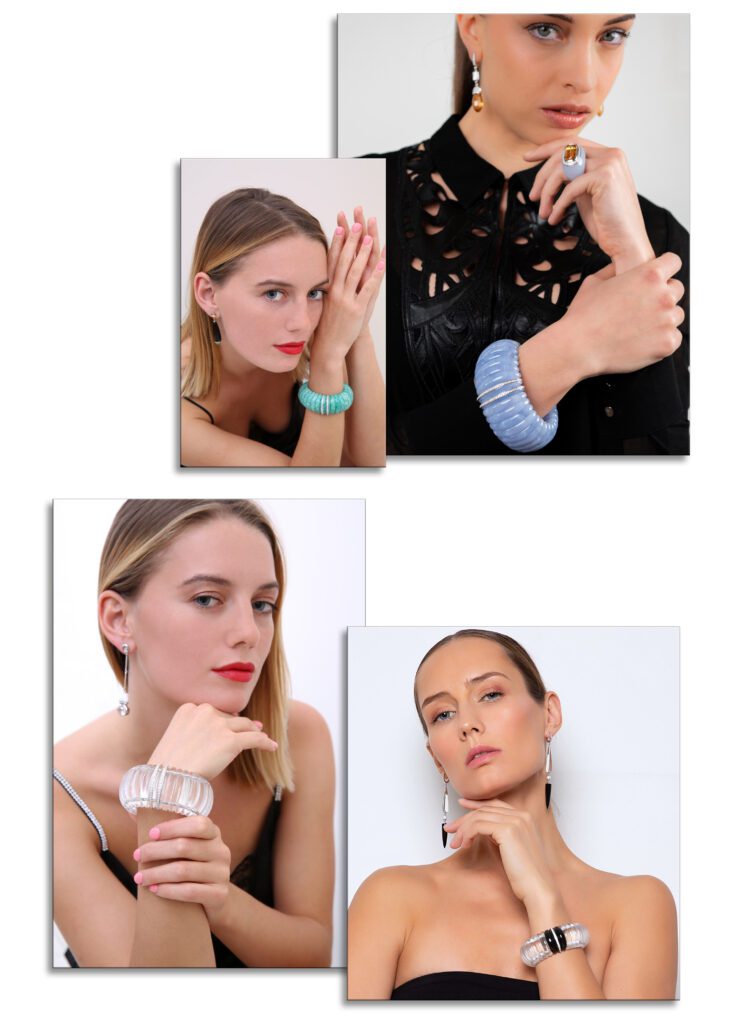
Top – Amazonite bracelet with 18K gold and diamonds – Earrings in Smokey Quartz and chrysoprase with 18K gold and diamonds
Chalcedony bracelet and ring with 18K gold and diamonds
Bottom – Rock Crystal bracelet and earrings with 18K gold, diamonds
Rock Crystal bracelet with Black Obsidian with 18K gold and diamonds
High Jewelry Made of Gem Materials
Running through GJX (aka… walking very fast) on the final day, we made one last stop—at Sanalitro Gioielli, where Massimo Sanalitro walked us through a collection built around bold, ornamental stones: rock crystal, amazonite, amethyst, obsidian, chalcedony, lapis, onyx, tiger’s-eye, and more. Well-designed, well-made, big and bold—and full of ideas for jewelers looking beyond the usual.
This proves that you do not have to have the most expensive gem materials to make beautiful exquisite jewelry.
You just have to know what to do with it.
◅◈▻
And now on to venue #3 … the Pueblo Show!
… a fifteen minute walk from the GJX underneath Interstate highway 10. (… or you could take the free trolley.)
◅◈▻
Show #3 — the Pueblo Gem & Mineral Show
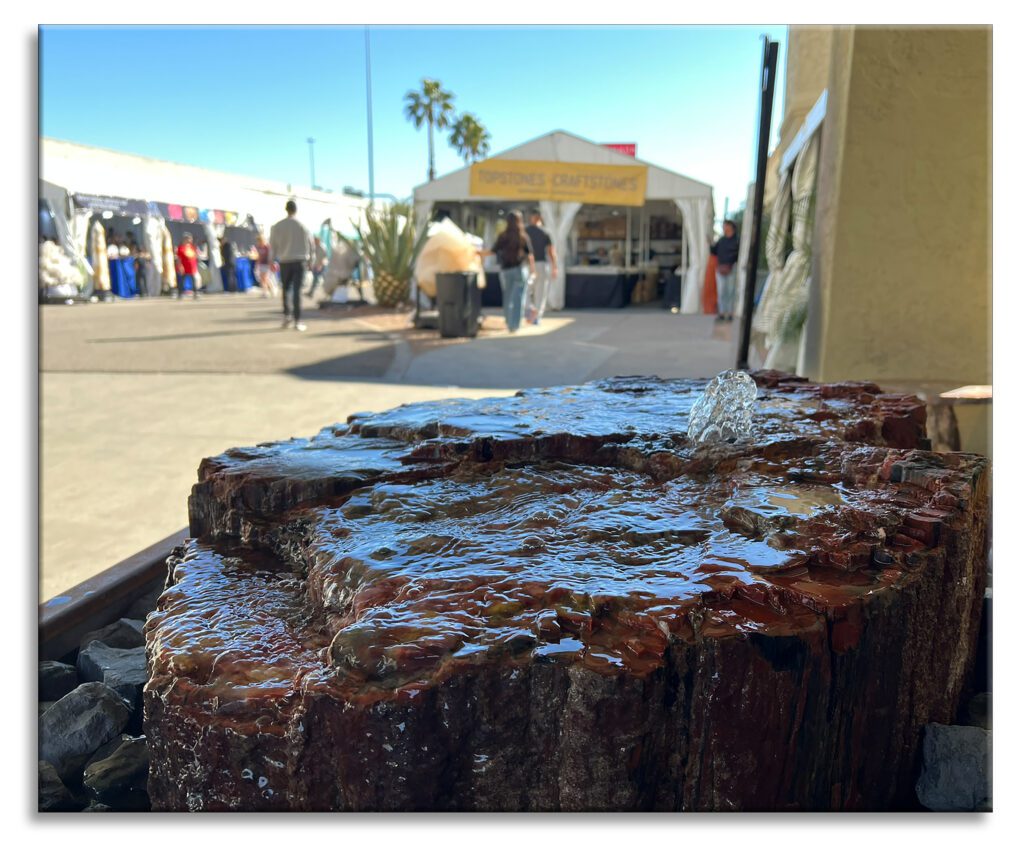
Arizona Petrified wood fountain at the entrance to the Pueblo Show
Yes, the company that creates beautiful objects using Arizona petrified wood is in France.
Check out their website. You will be impressed.
The Pueblo Gem and Mineral Show
The Pueblo Show is one of the most interesting—and eclectic—of all the important Tucson gem shows. Held at the Ramada, an old two-story motel, exhibitors set up in tents throughout the parking areas and central courtyard, while others display directly from their ground-floor motel rooms, often extending out onto their patios.
You’ll find everything here—from massive geodes (big enough to actually stand in), to polished spheres, and obelisks, to fine gems, ornamental materials, carvings, meteorites, and more.
With an outdoor bar and grill, it offers one of the most relaxed—and uniquely Tucson—buying environments you’ll find. And this year, the weather could not have been better.
Here are just a few of the gems we saw at the Pueblo Gem & Mineral Show.
◅◈▻
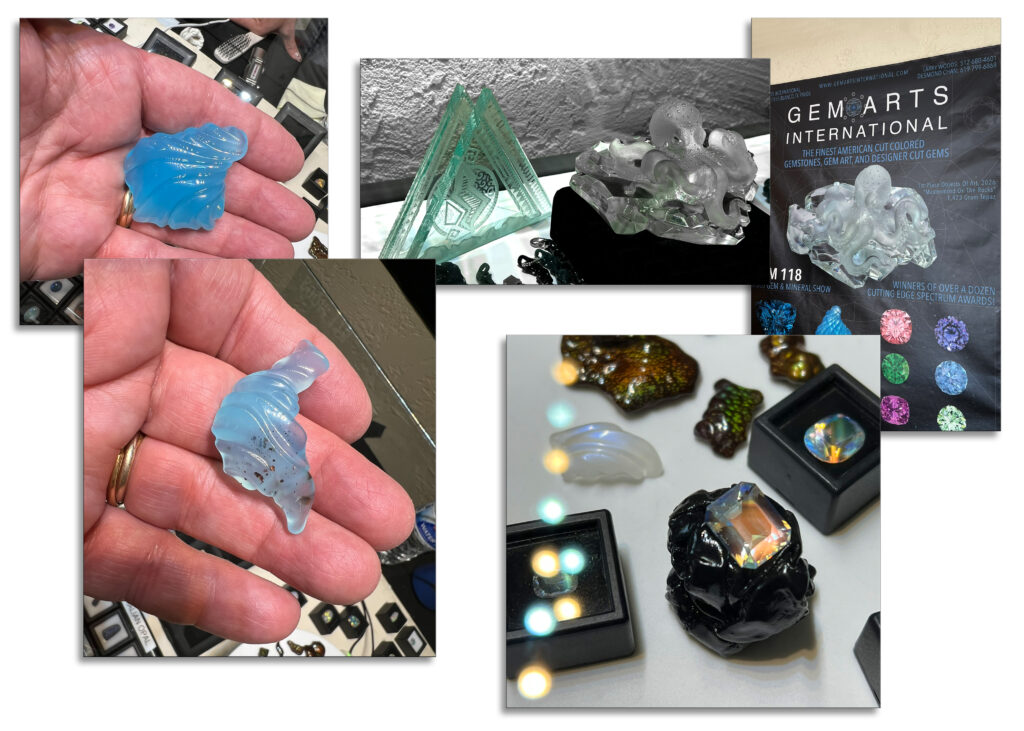
We met up with Larry Woods, award winning gem artist, on the patio of his ground-floor motel “showroom.”
On display were some very special pieces, including the two beautiful gem silica carvings in hand,
and a couple of very large faceted Madagascar rainbow moonstones with that signature orange flash.
Also on display was Gem Arts International’s 1st place, AGTA’s Cutting Edge Awards, Objects of Art, 2025,
“Mastermind on the Rocks” – weighing in at 1,423 grams, an octopus on topaz.
◅◈▻
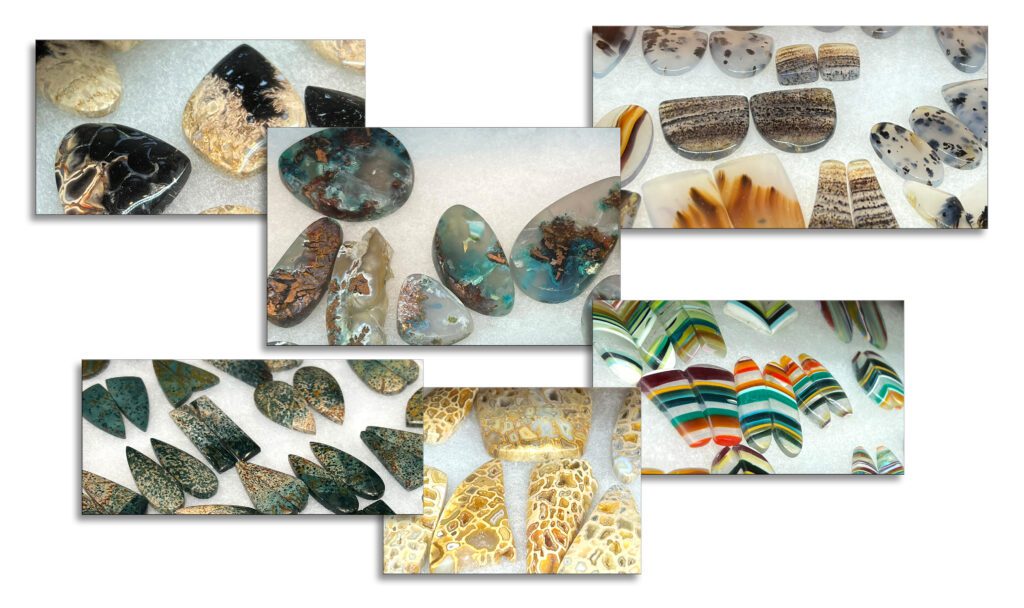
Inside the main tent, we found another broad inventory specialist.
Genovese offers dozens upon dozens of trays
filled with beautiful ornamental gem materials—along with a few surprises.
Seen here (top row, left to right):
Petrified palm root, copper and chrysocolla, Montana agate
Bottom row (left to right):
Morning dew jasper, honeycomb drusy pocket palmwood—
…and, last but not least, “Surfite,” made from layers of overspray resin and paint collected from Southern California surfboard spray rooms.
Over time, it hardens and is cut and polished into cabochons—like “Fordite,” only surfboards instead of cars.
Looking for unique? Be honest – You don’t see that every day!
◅◈▻
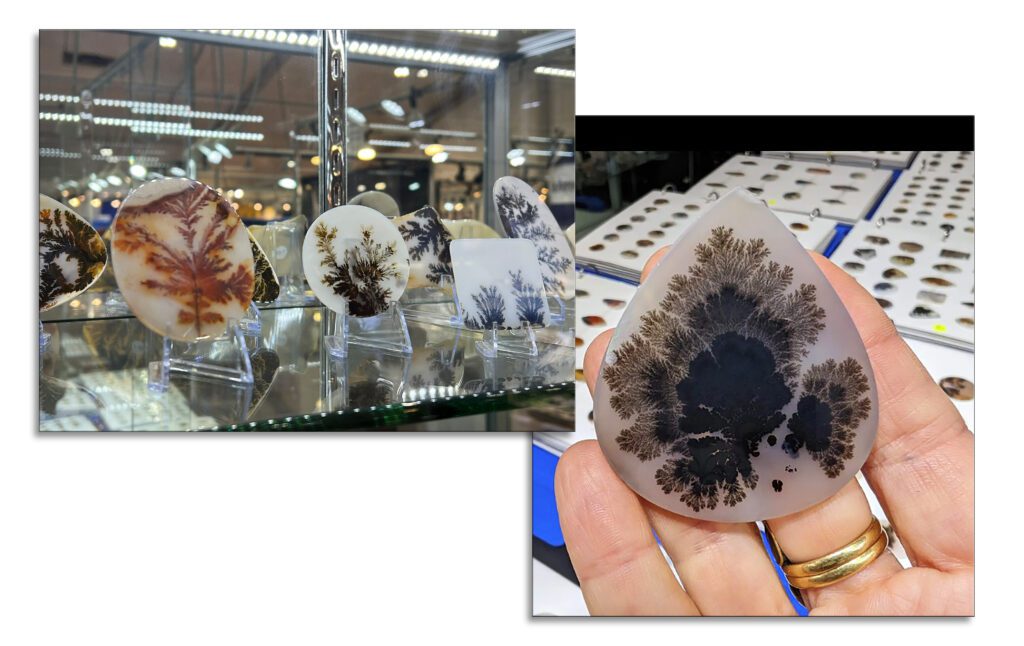
Gem lovers often gravitate toward inclusions—and here, the inclusion defines the material.
The Collectionist displayed selections of dendritic agates, with larger pieces on stands
and smaller plaques neatly arranged in easy-to-use three-ring binders.
Images by Roskin and The Collectionist
◅◈▻
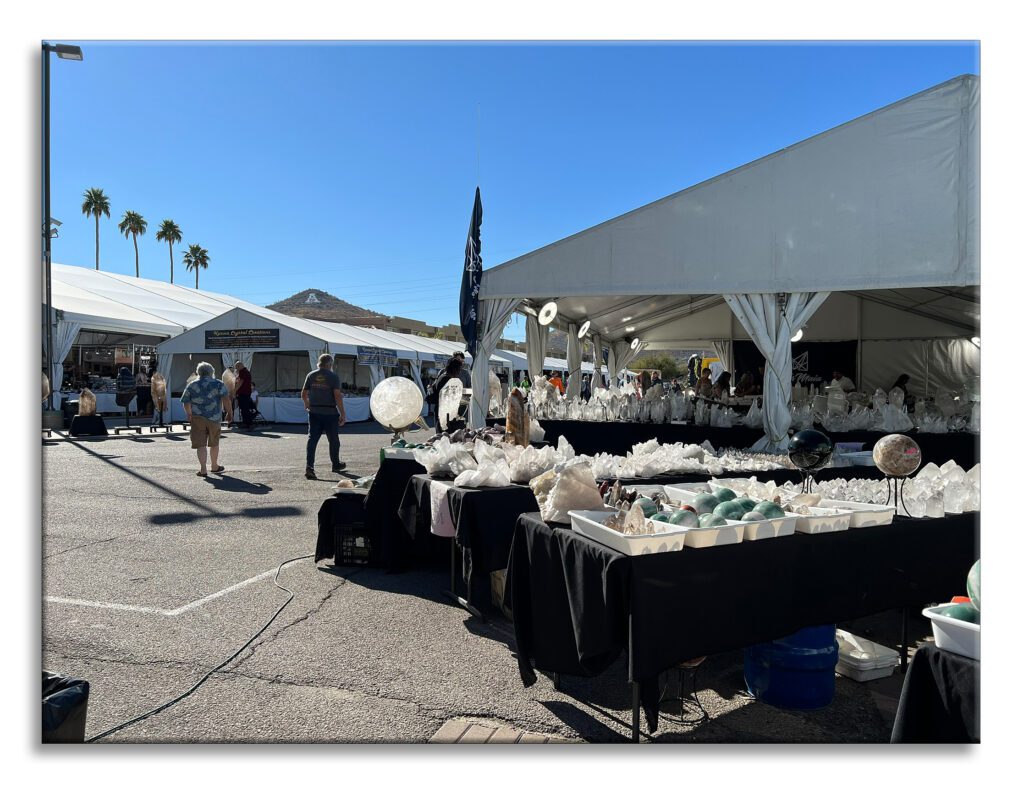
More vendors than space allows—this is a common sight in the parking areas
at the Ramada/Pueblo Show. Being outdoors makes room for larger displays.
◅◈▻
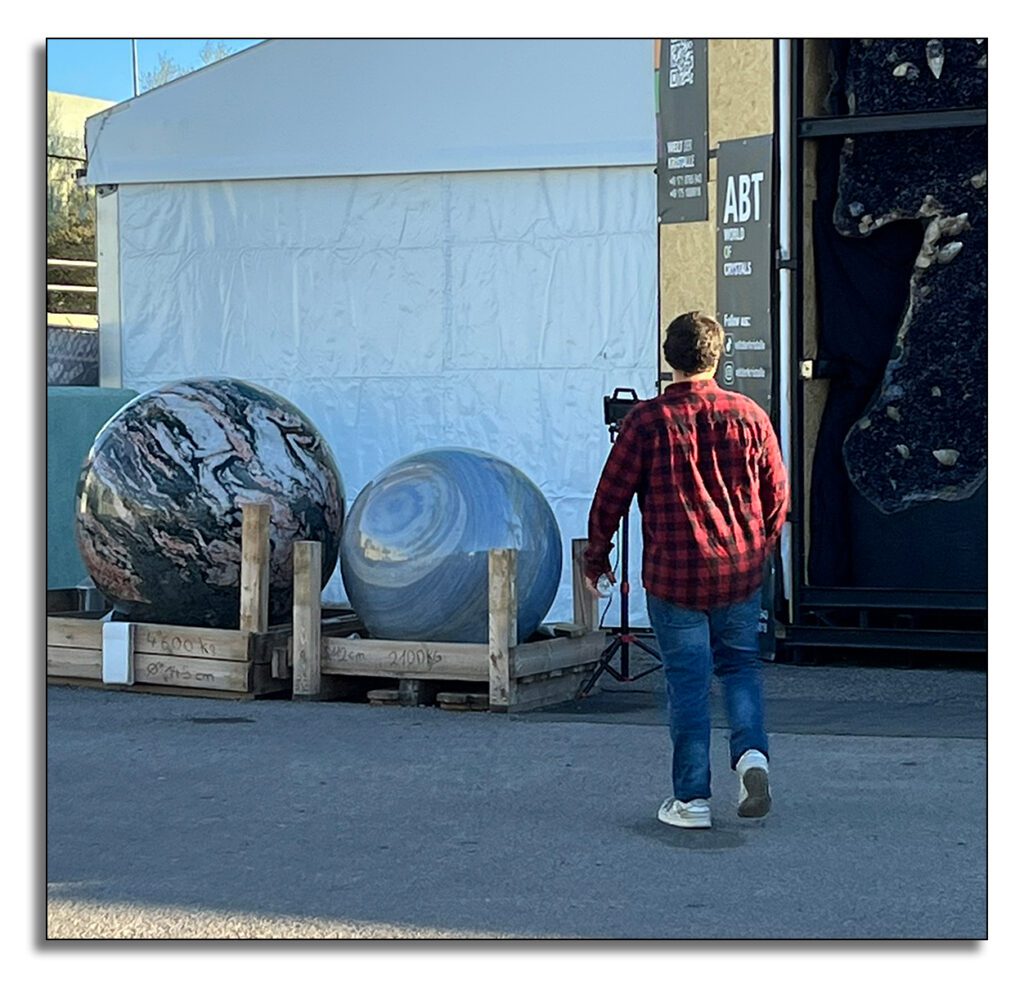
How large is large? I ask myself, “Do I really need a sphere that big?”
More from the parking area at the Ramada/Pueblo Show—now that’s what we call Huge!
◅◈▻
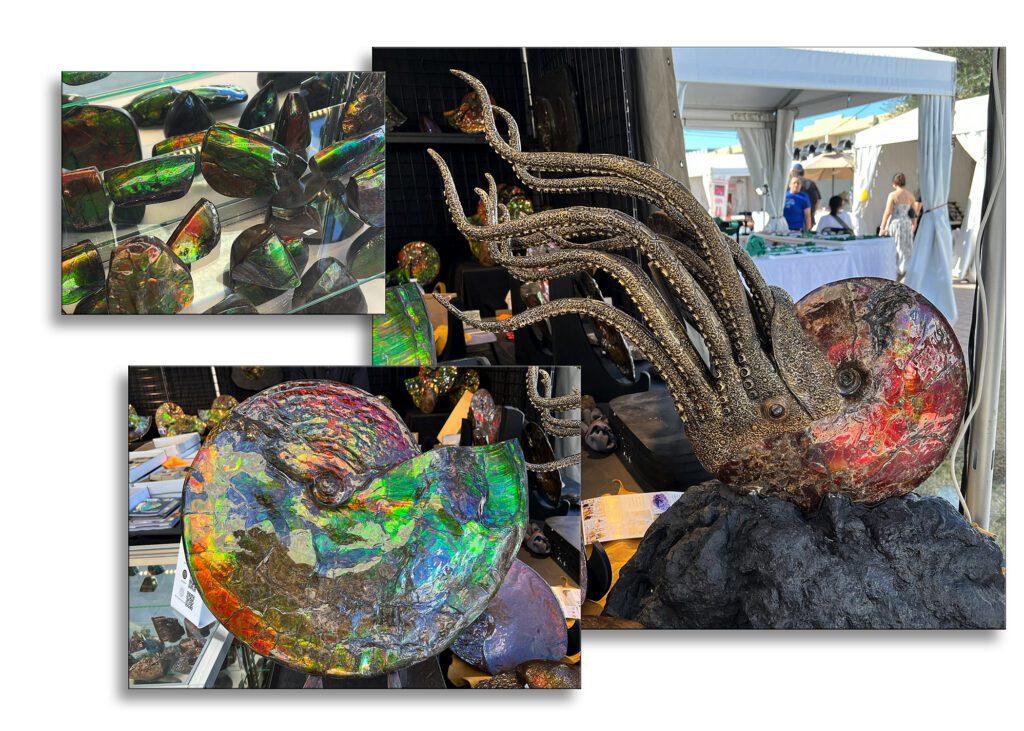
Ammolite (fossilized and polished ammonite shell) found in Canada
Photo in bottom left. This is a whole colourful Canadian ammonite specimen. The species here is Placenticeras costatum. These are approximately 73 million years old from the Bearpaw Formation in Southern Alberta, Canada. The Canadian Government considers these fossils a “National Treasure” so export permits are required to take these out of Canada. All whole fossil specimens are numbered and registered with the Provincial government.
Right hand side of Photo – This is a sculpture added to a real Canadian ammonite fossil. This is an artist’s interpretation of what the creature would have looked like 73 million years ago. It is quite accurate in my opinion. These animals are cephalopods so they are related to an octopus, squid or nautilus. They had large eyes and long tentacles.
The base is lava rock. [The sculpture appears to be cast in a bronze-like metal alloy.]
Special thanks to John Issa, Enchanted Design’s Marketing Director.
Ammolite from Enchanted Design, Alberta Canada
From fossil shell to finished gemstone—ammolite is one of the trade’s more unique success stories.
We spoke to the folks at Enchanted Designs to get you detailed information about what the material is, and why we are so fascinated by it.
“These are polished specimens of Ammolite, or what we like to call ‘Lucky Stones’,” says John Issa, Enchanted Design’s Marketing Director. “More than 90% of what we find in our mine are broken pieces, fragments of the ammonite fossils. [see image top left above.] These broken pieces or fragments are used to cut the Ammolite Gemstones we use in our jewellery. We would never destroy a whole fossil to make gemstones.”
“Some pieces are truly not suitable for cutting into gemstones. There are many reasons for this, but the majority would be that the nacre is not thick enough, or maybe the surface is too bumpy etc. These pieces are still beautiful and are polished and turned into lucky stones or hand specimens.” A palm stone.
The colours in ammolite come from light interference. The numerous layers break up the white light, like a prism, into its component colours so we can see every colour of the spectrum.
The specific color produced depends on the thickness of the layers.
Thinner layers produce blues and violets.
Thicker layers produce reds and greens.
Opal?
Okay, it may look like opal, but no, it is not an opal as there is no water or silica involved.
Did you know: Ammolite is the provincial gemstone of the province of Alberta. (… and now you know.)
◅◈▻
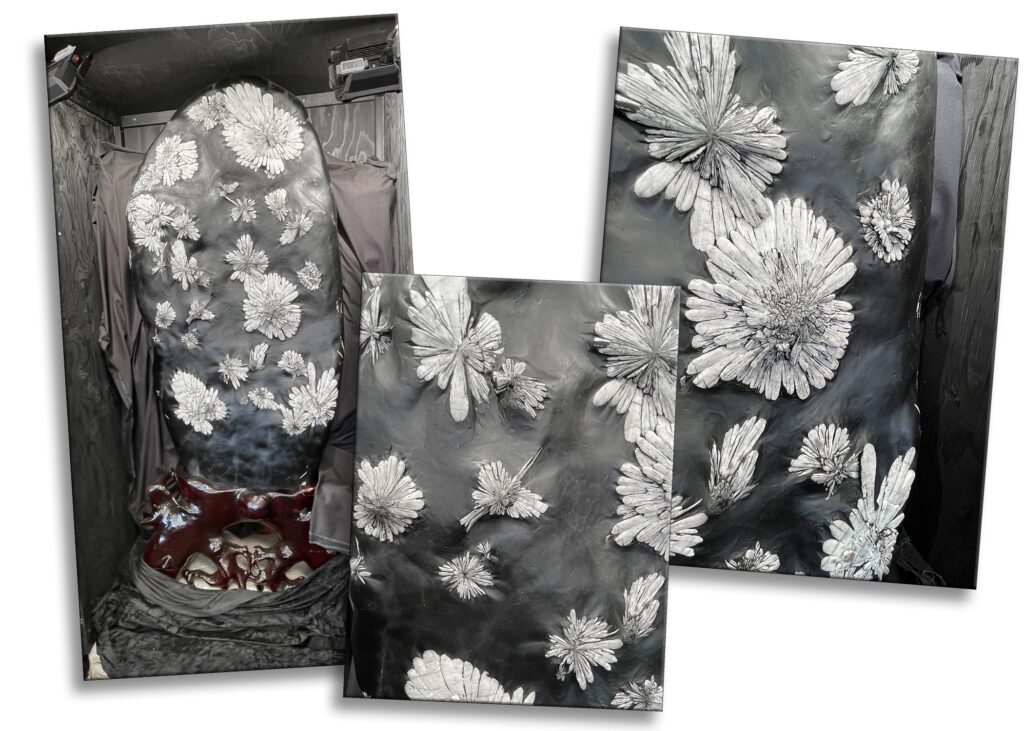
ABT World of Crystals – Dietingen, Germany
Natural “chrysanthemum stone”—radial celestine/calcite crystal growth in dark limestone/dolomite
—cut and selectively worked to expose and enhance the three-dimensional “flower” formations.
The color and patterns are entirely natural—and at nearly five feet tall, this is one of those “you have to see it to believe it” Tucson moments.
◅◈▻
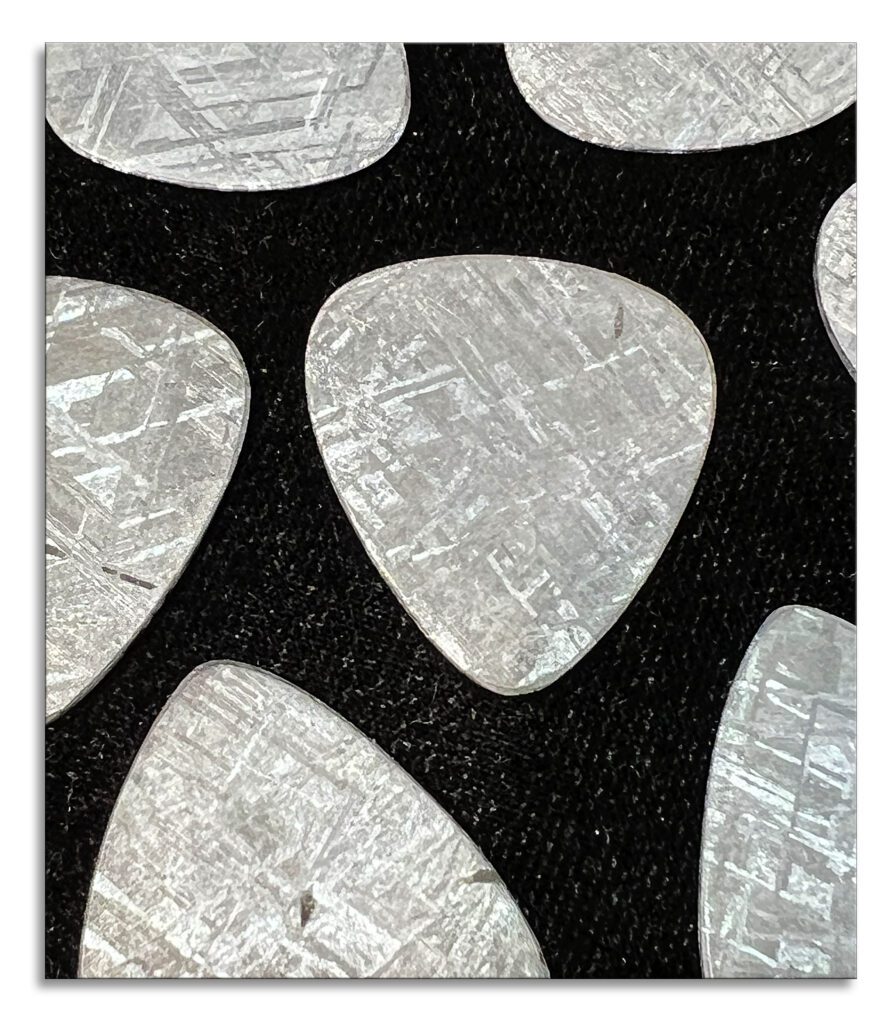
Meteorite Guitar Picks
Meteorite is used for watch faces, rings, pendants, inlay—and even guitar picks, as seen here. Priced more than your standard plastic pick, you know these will last a lifetime.
Usually sold by the gram, it’s worth remembering that meteorite is essentially iron (iron and nickel)—so it’s hefty. At $4 or $5 per gram, it may sound manageable… until you realize that the beautiful slice you’re looking at weighs in at over hundreds of grams.
What is that criss-cross Pattern?
What you see here is an iron-nickel crystallization known as the Widmanstätten pattern. That is part of the meteorite and not saw markings as one might suspect.
On to show number four!
… a ten minute walk from the East side of the TCC
◅◈▻
Show #4 – the Ethical Gem Fair
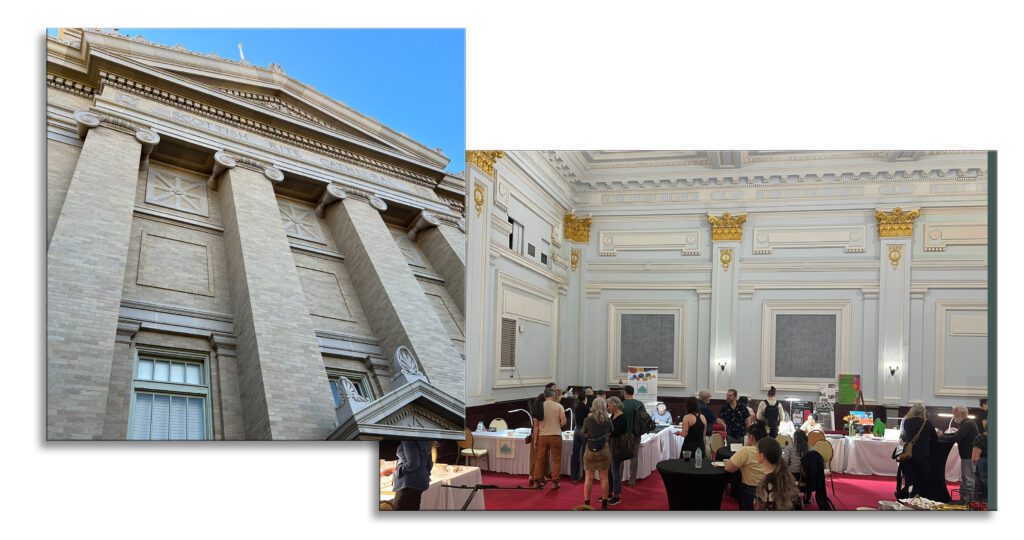
within walking distance from the TCC
◅◈▻
The 4-day Ethical Gem Fair is one of the smaller, and shorter shows around town—but its importance is significant.
With roughly a dozen exhibitors, the focus here is clear: responsibly sourced gem materials. These are suppliers working directly with smaller mining communities, artisanal miners, cutters, and ethical supply chains—where origin, traceability, and working conditions matter.
What that means in practice is transparency. Many of the exhibitors can trace their material not just to a country, but in some cases to a specific mine—or even the miner. Sources represented include Sri Lanka, Australia, Malawi, Tanzania, Kenya, Brazil, Ethiopia, and the United States.
There is also an emphasis on environmental responsibility, health and safety standards, and, in some cases, SCS-certified recycled diamonds and gemstones.
For jewelry designers and buyers, this is a place to view and purchase gemstones with a clearer understanding of where they come from—and how they were brought to market. That level of transparency is becoming increasingly important in today’s market.
If you are at all interested in this type of venue, you must check the show dates. This year, the Ethical Gem Fair began two days prior to the AGTA Gem Fair. If your normal plan is to arrive the day before the AGTA Gem Fair begins, then you may only have two days to get over to the Cathedral. Plan accordingly.
Now, let’s see a little of what they had on display.
◅◈▻
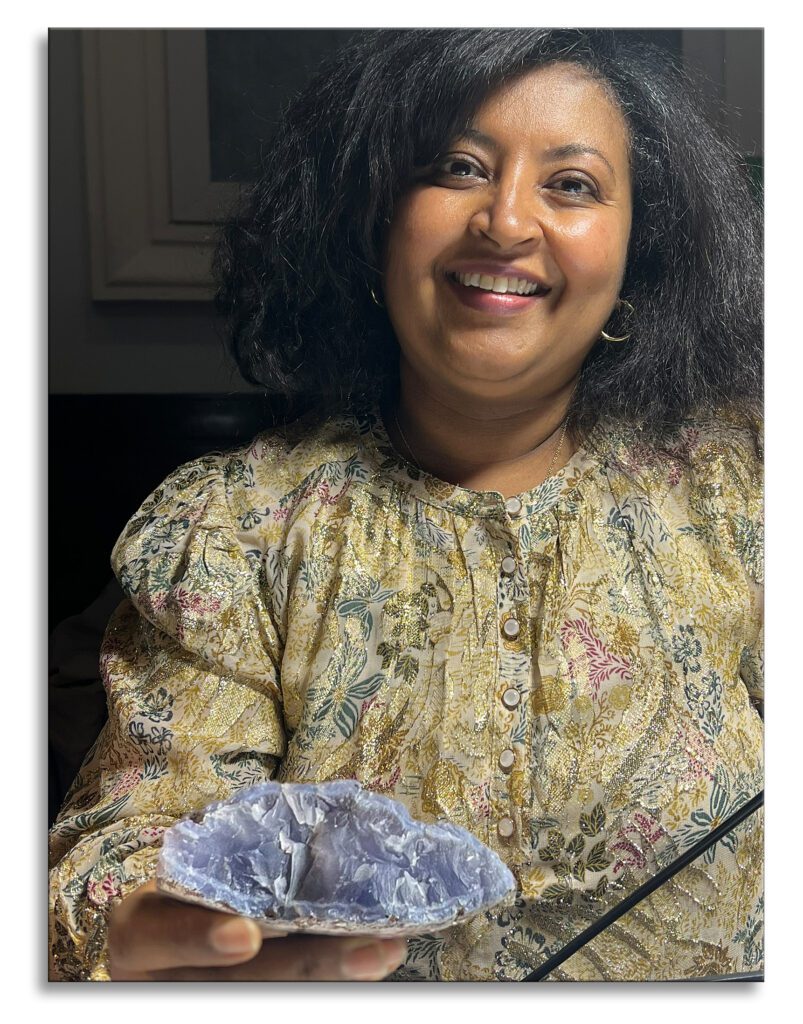
Hewan Zewdi, gemologist and jewelry artist, shown here with a selection of rough Ethiopian chalcedony.
Alongside numerous other gem materials, she had a strong selection of
Ethiopian aqua, tourmaline, and morganite rough, including this lavender chalcedony.
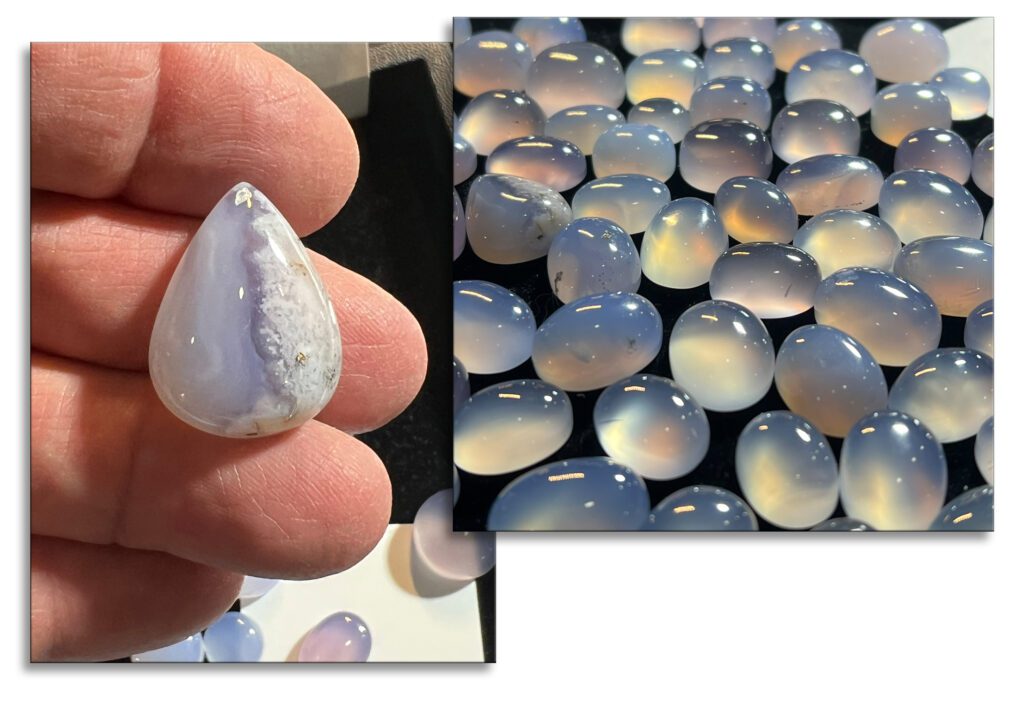
Cabochons were available in a range of sizes and qualities.
When you purchase a gemstone here, you’re also supporting Ethiopian artisanal mining communities.
◅◈▻
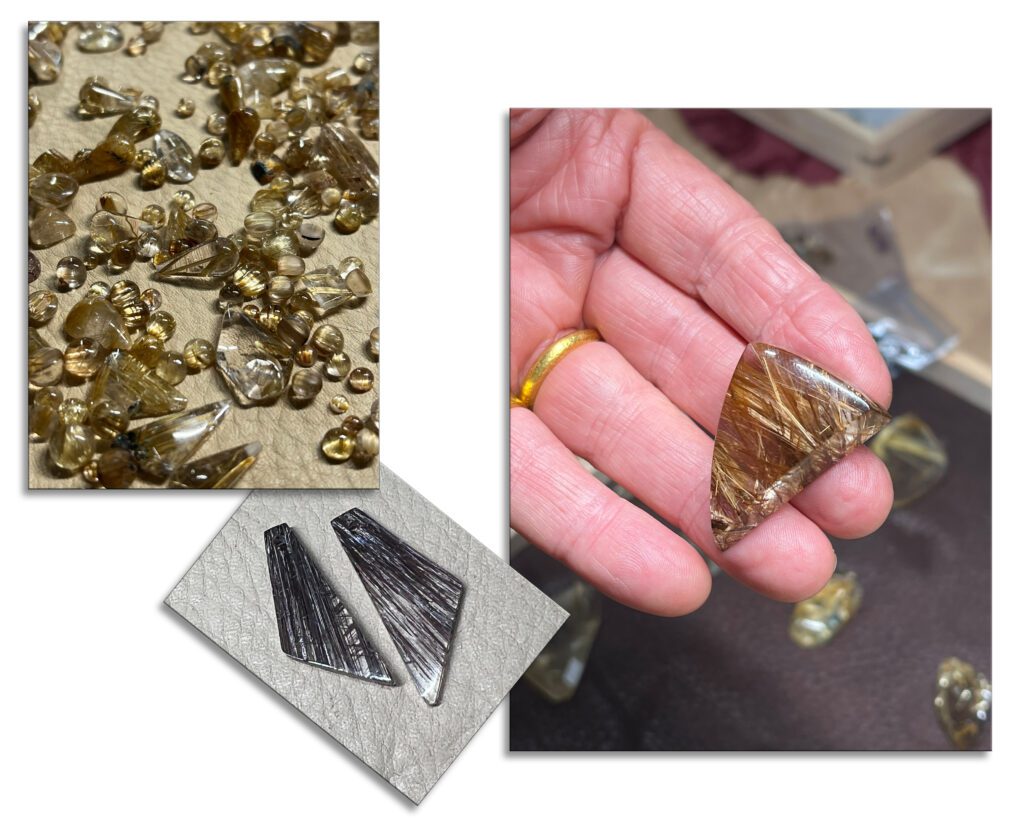
Brian & Quendi Cook shared their inventory of Brazilian rutilated quartz, rough, polished, and jewelry.
Cook has been a strong advocate for responsible sourcing, sustainable mining, and community investment.
◅◈▻
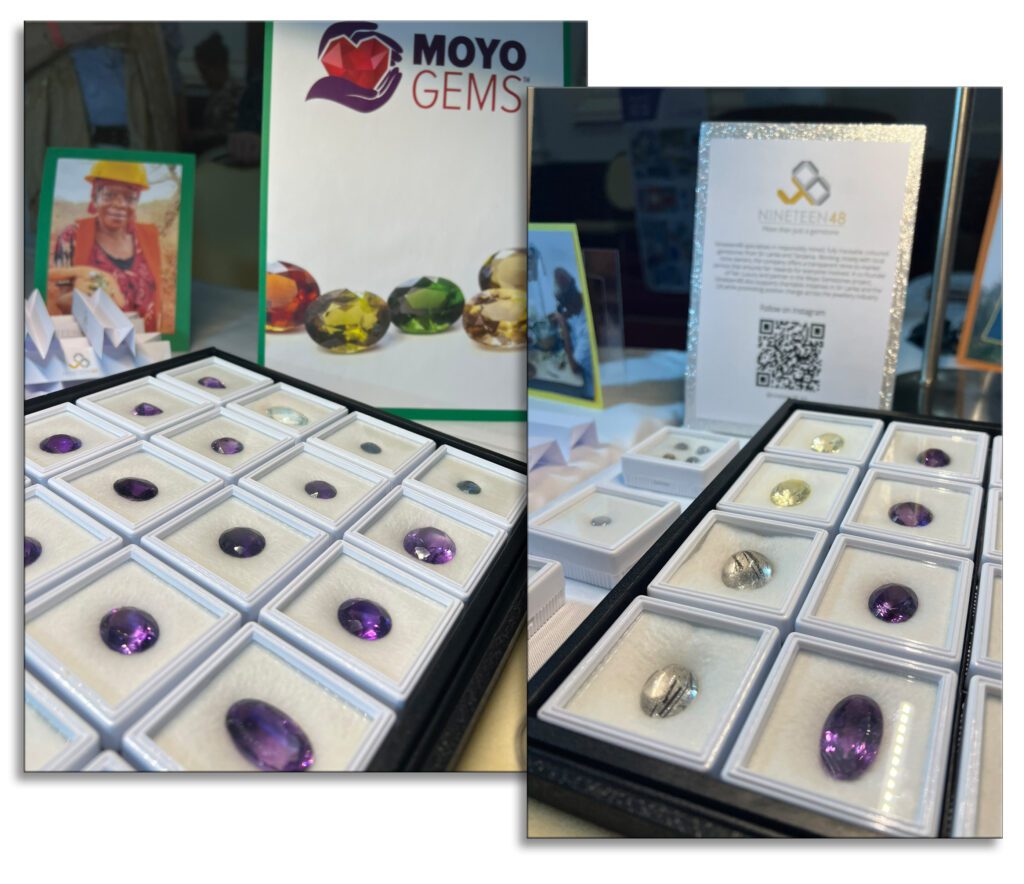
Moyo Gems represents directly sourced gemstones from the women miners of East Africa.
They work with the women artisanal gem miners and their male allies in Tanzania and Kenya
to track rubies, sapphires, tourmaline, garnets, citrines, and amethysts, from miner to market.
Nineteen 48 represents responsibly mined, fully traceable gems from Sri Lanka and Tanzania, and works closely with Moyo Gems.
◅◈▻
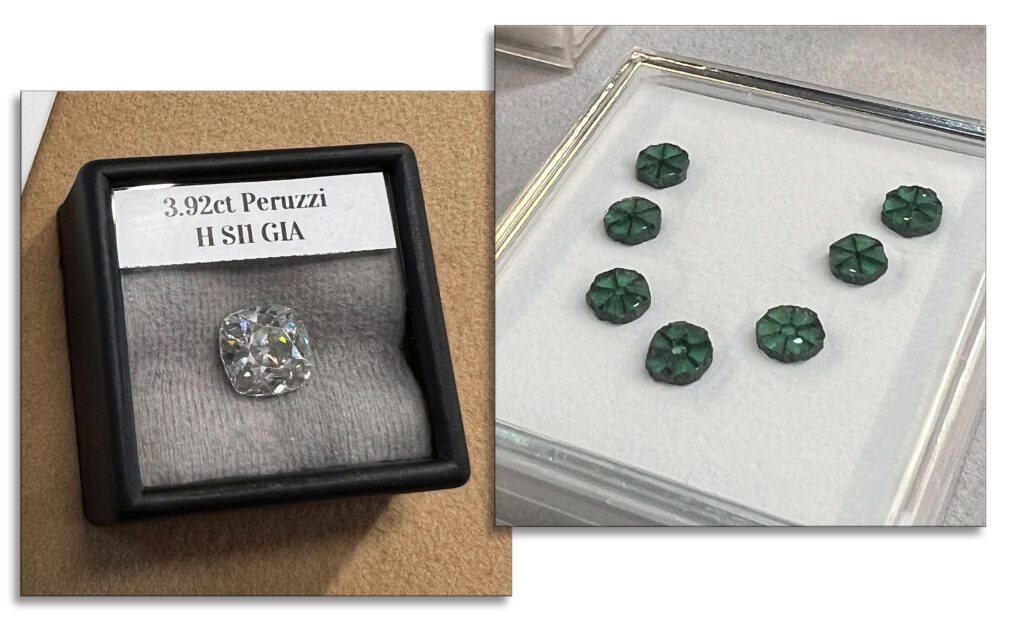
Jay Moncada was there promoting “certified post-consumer recycled diamonds & gemstones.”
He showed us this fabulous 3.92-carat old squarish cushion brilliant, high crown deep pavilion, labeled a “Peruzzi Cut.”
[There is an interesting note in Al Gilbertson’s book, “American Cut, the First 100 Years” on the Peruzzi Cut – pg. 9]
Also showing was this beautiful 7-stone suite of trapiche emeralds.
◅◈▻
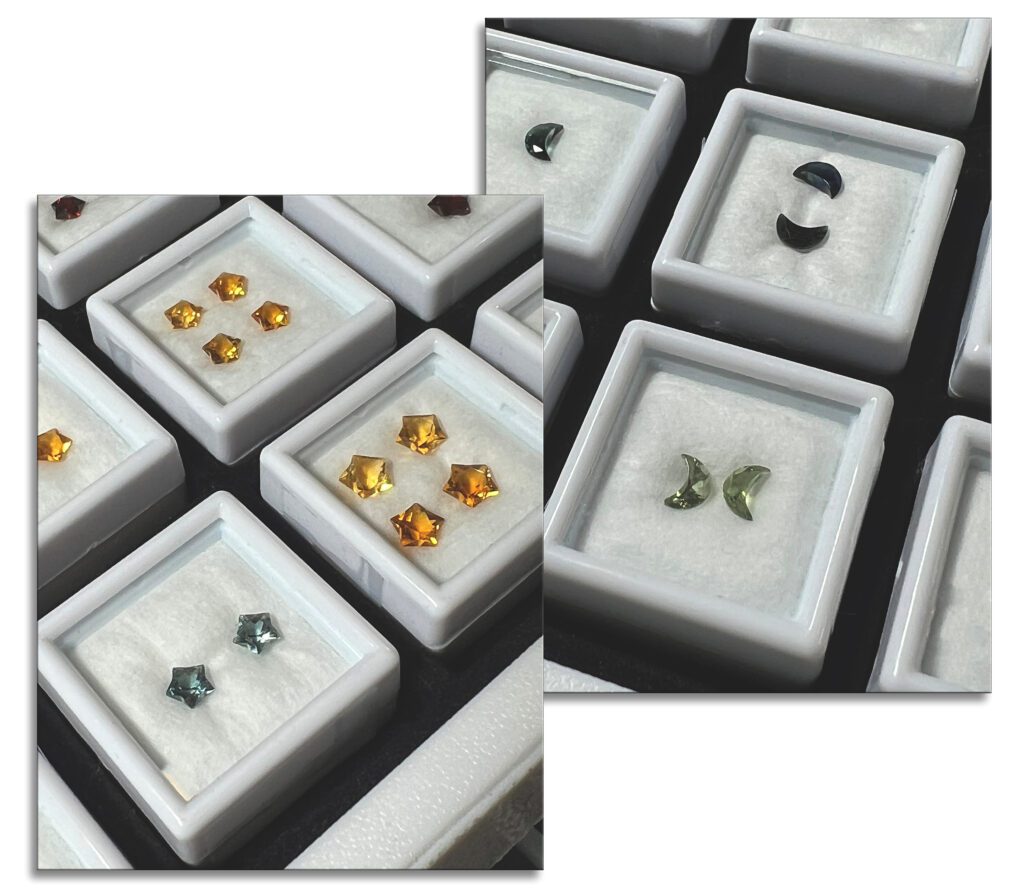
Columbia Gem House brought a large inventory or responsibly sourced gem materials, worthy of the room.
Numerous gem varieties, calibrated and singles, and showing their latest stars and moons.
Columbia Gem House has been a long-time supporter of the artisanal mining community,
promoting ethical supply chains, and providing Fair Trade Gems – tracked from Mine to Market.
◅◈▻
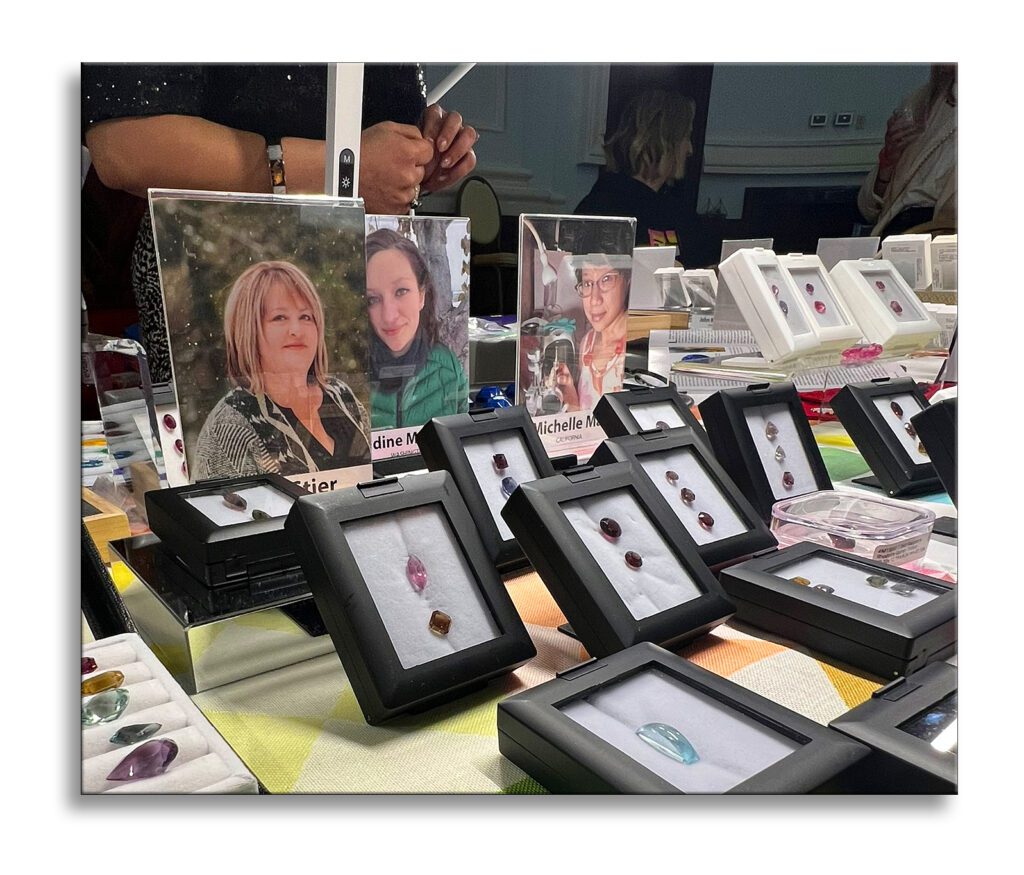
At this show, you get to find out who mined your gemstone, who cut your gemstone, and maybe even get to meet them right there at the show!
ANZA supports artisans at every level, beginning with purchasing directly in-country in Tanzania and Kenya,
then using US and Kenyan artisanal cutters–a number of them women–to facet the gems into one-of-a-kind creations.
◅◈▻
Let’s go… another 15 minute walk from the Tucson Convention Center and GJX to the 22nd Street Show.
◅◈▻
Show #5 — 22nd Street Show
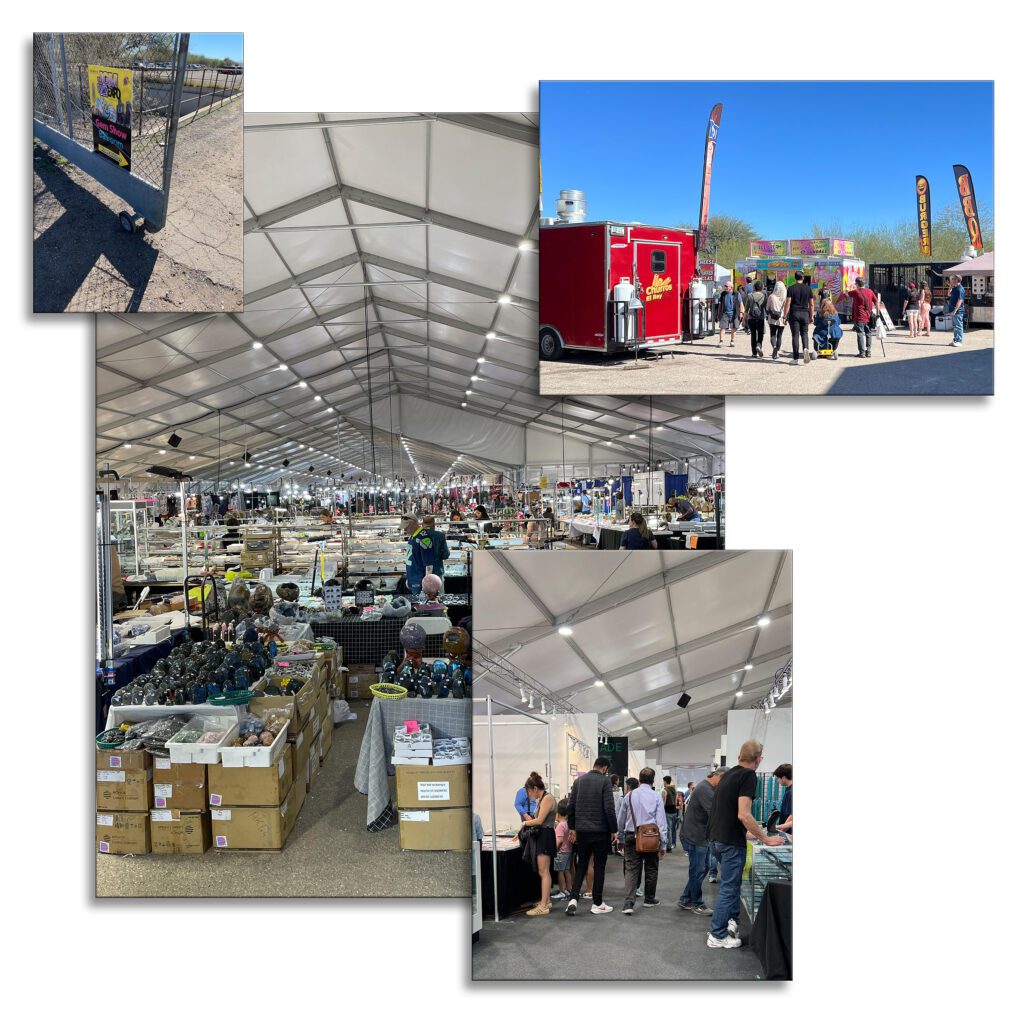
The 22nd Street Gem and Mineral Show
22nd Street is a series of large tents (off 22nd Street, of course). Two of the tents are filled with a wide-ranging mix of material—large gem pieces spread across tables, carvings ranging from paperweight size to full-scale bathtubs and tabletops.
Broad inventory specialists such as Village Silversmith are here, alongside smaller vendors displaying their goods next to merchants with inventory still packed in box after box of polished material.
The third tent is the fine jewelry section, where you’ll find everything from rare gems to more common ornamental materials, along with finished jewelry and mineral specimens. Highlights include Herkimer diamonds at Just Herks, transparent rhodonite at Mine Invest Brazil, hauyne and benitoite at Vance Gems, Montana sapphire at Lewis & Clark Sapphires, and more.
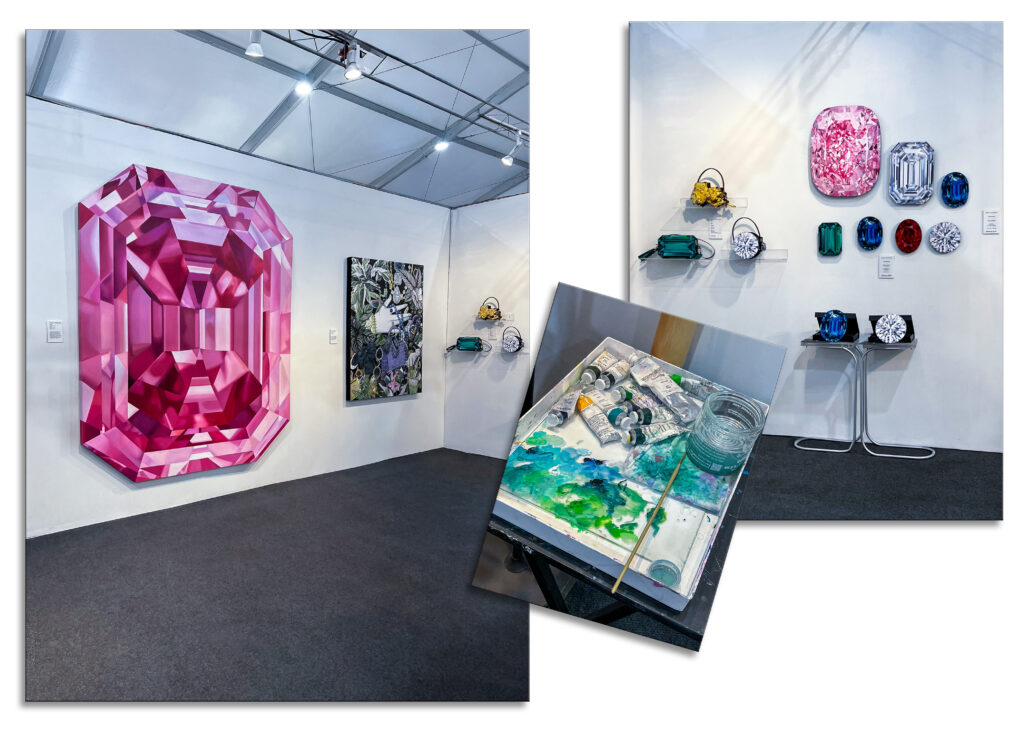
Whoa! The size and bright colors stopped us in our tracks. We had to go look, and the details are stunning.
Gems on the Wall
Another gem find—but this time, one that hangs on the wall instead of being worn on the hand.
Angie Crabtree is known for her large-scale paintings of gemstones, and it’s the size that first catches your attention. These are not small works. They are bold, highly detailed, and beautifully executed—and priced accordingly.
By enlarging gemstones to this scale, the paintings take on a different presence. You find yourself looking at color, facet shapes, and light in a way that feels surprisingly familiar—just in a format you don’t usually hang on the wall.
Crabtree holds a BFA from the San Francisco Art Institute and currently lives and works in Long Beach, California.
◅◈▻
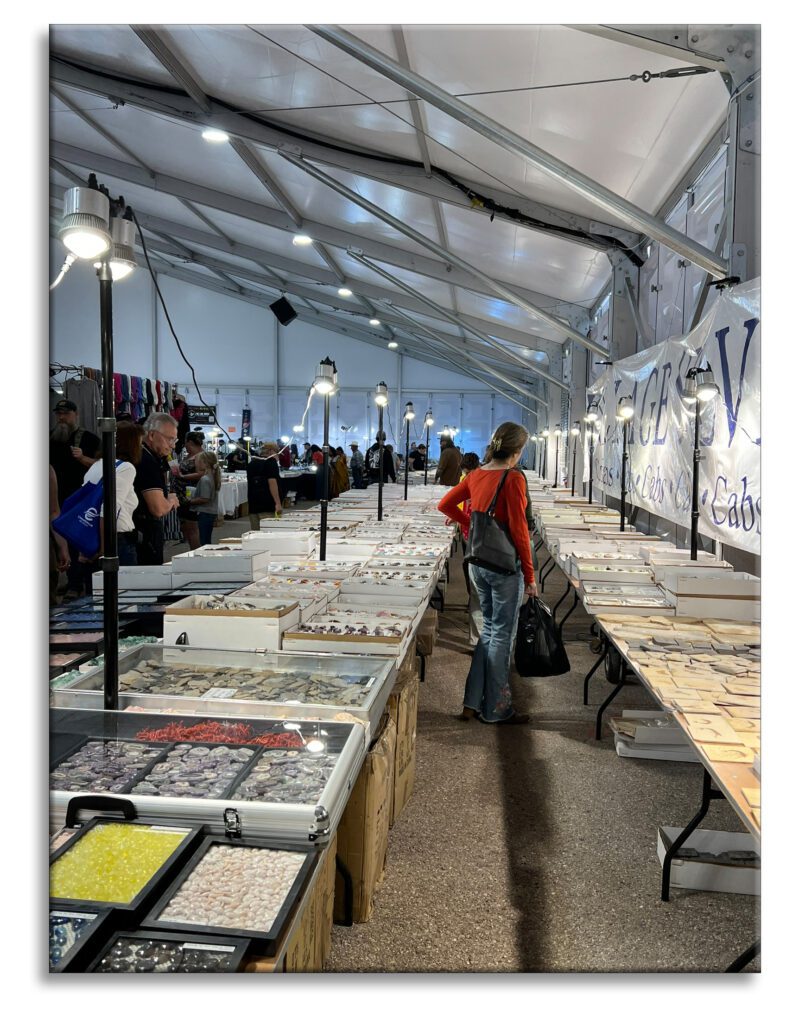
We met up with John at Village Silversmith in one of the large tents.
His stand stretched nearly a quarter of the length of the venue—as far as the eye can see—
filled with trays holding hundreds of varieties in cabochons and tablets.
This is the definition of a broad inventory specialist.
We could have stayed there for hours—and if we were designing jewelry, we probably would have.
◅◈▻
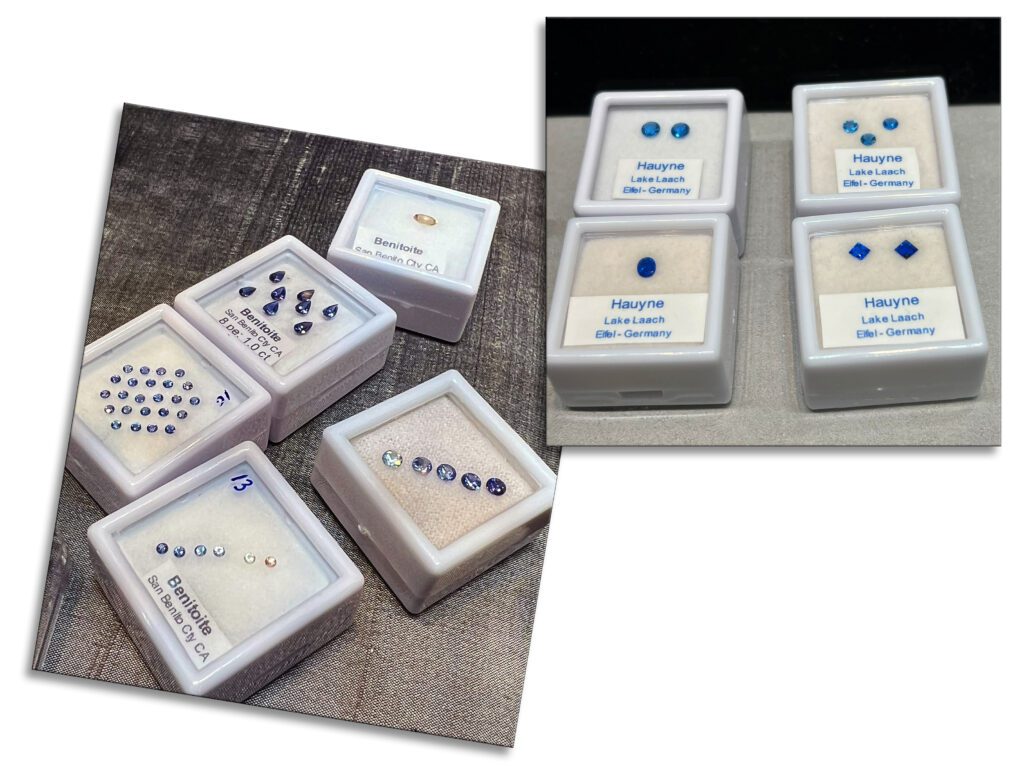
Known for its rare and unique gemstone inventory, Vance Gems is always one of our first stops at the show.
We saw trays of sphene and zircon—but what really stood out were the boxes of hauyne and benitoite.
The saturated, vivid blue of hauyne is remarkable, though it is typically found only in small sizes, like those seen here.
Benitoite is rare, and it’s exceptional to find matching suites like these.
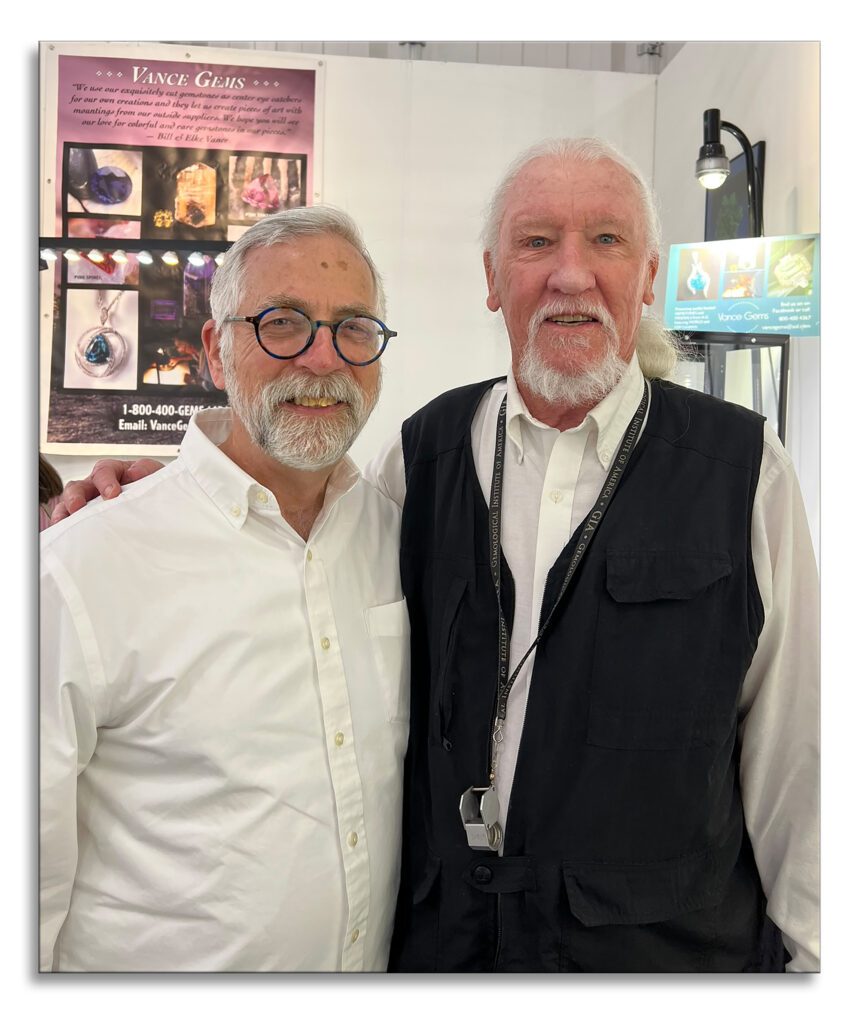
Gary Roskin, Bill Vance
A Personal Note
Bill Vance passed away on March 14, 2026. As his wife, Elke, noted, “He was a passionate gemologist who truly loved stones, always seeing beauty and meaning in them and sharing that wonder with others. He had a special gift for teaching, and nothing made him happier than helping others learn, grow, and discover something new.”
That is the man I met back in 1978—and the one I was fortunate to share a long and wonderful gemological friendship with.
We will be publishing a more complete memoriam for Bill in the coming weeks.
◅◈▻
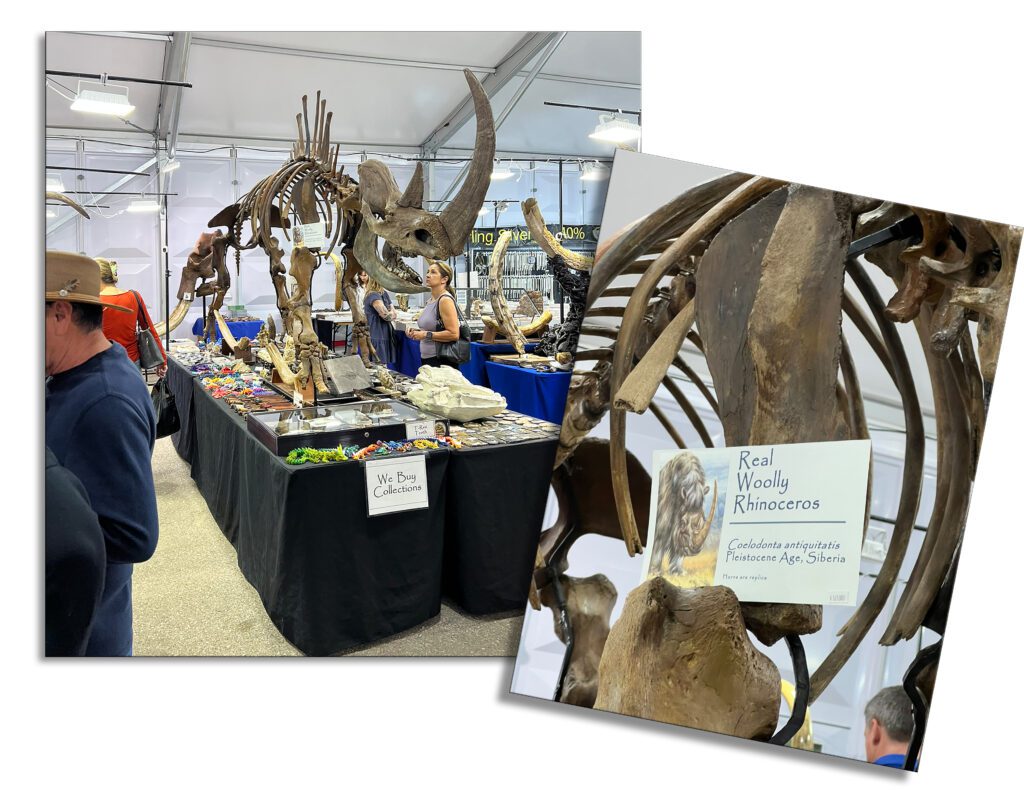
“Ricky Rhino”
Standing approximately 7 1/2 feet tall, this Siberian Woolly Rhinoceros, species name, Coelodonta antiquitatis,
is an extinct species of rhinoceros that inhabited northern Eurasia during the Pleistocene epoch
(from approximately 2.58 million to 12,000 years ago, give or take a few years).
Hagar’s Fossils and Minerals – St. Louis, Missouri
“Ricky Rhino”
Briefly breaking our rules—again—this isn’t exactly a gem material. But dinosaurs (and dinosaur bone) are very much part of the Tucson Gem & Mineral Shows experience. Dinosaur bone cabochons were seen throughout the shows, but for those thinking bigger, we spoke with Lisa and Rich Hagar of Hagar’s Fossils and Minerals.
For only $165,000, you can bring home one of the most complete dinosaur skeletons available for private display or museum use.
Note: The horns of a rhinoceros are made of keratin—the same structural protein found in human hair and fingernails. Because they are not bone, they do not fossilize. The horns shown here are cast.
◅◈▻
Last stop, Mineral City. It’s north of downtown, about a 10 minute Lyft from the convention center. Let’s go…
◅◈▻
Show #6 — Mineral City
Mineral City is not another town in Arizona, but a district of warehouses in Tucson where mineral dealers both show and store their inventory.
We wandered through four large warehouses, each divided into a dozen or so showrooms. Along the way, we met up with Stefan Nicolescu from Yale, who was sourcing mineral specimens for the university’s research collection.
We visited Arkenstone, Dr. Rob Lavinsky’s showroom—and could have lingered there for hours. We also made a special stop to meet Leonard Himes, mineral dealer and avid reader of the Roskin Report.
Nicolescu found a few additions for the Yale collection, and I found a few minerals to photograph.
Here’s just a sampling of what we found.
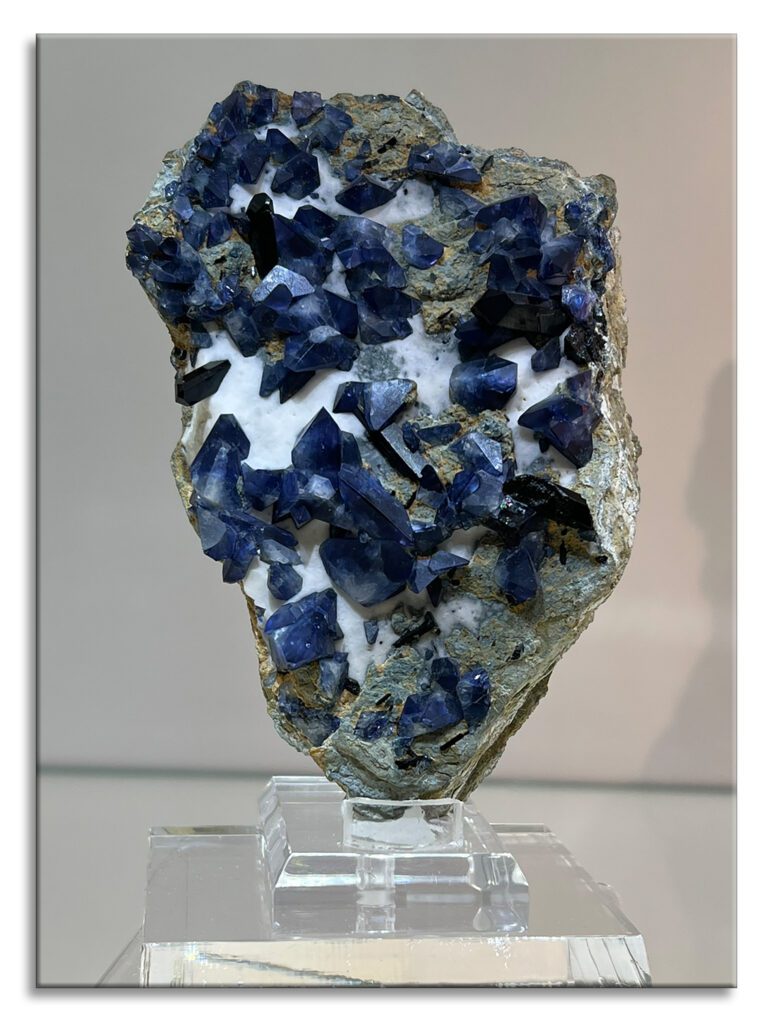
From the Dallas Gem Mine, Santa Rita Peak, in the New Idria Mining District, San Benito County, California… the only locality for benitoite.
from Frazier’s Minerals
This piece was on display at an evening fundraiser. Benitoite specimens such as this are stunning,
with beautiful crystal formation and that dark sapphire blue of the Benitoite against the pure white of the Natrolite.
◅◈▻
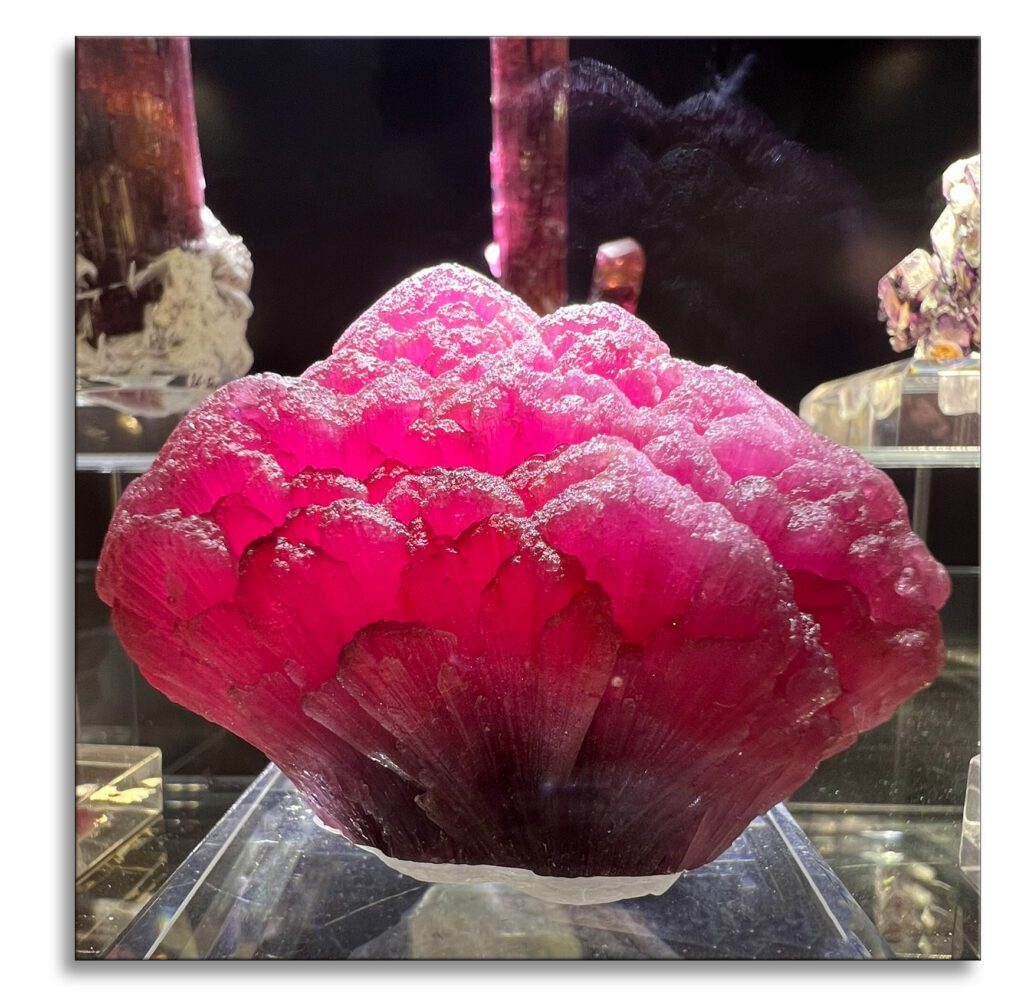
“Mushroom” (sometimes called “Cauliflower”) Rubellite Tourmaline, Khetchel, Malo, Burma
These unusual shape tourmalines are definitely a collector’s item. The pink red rubellite sprays are coming off a black schorl tourmaline core.
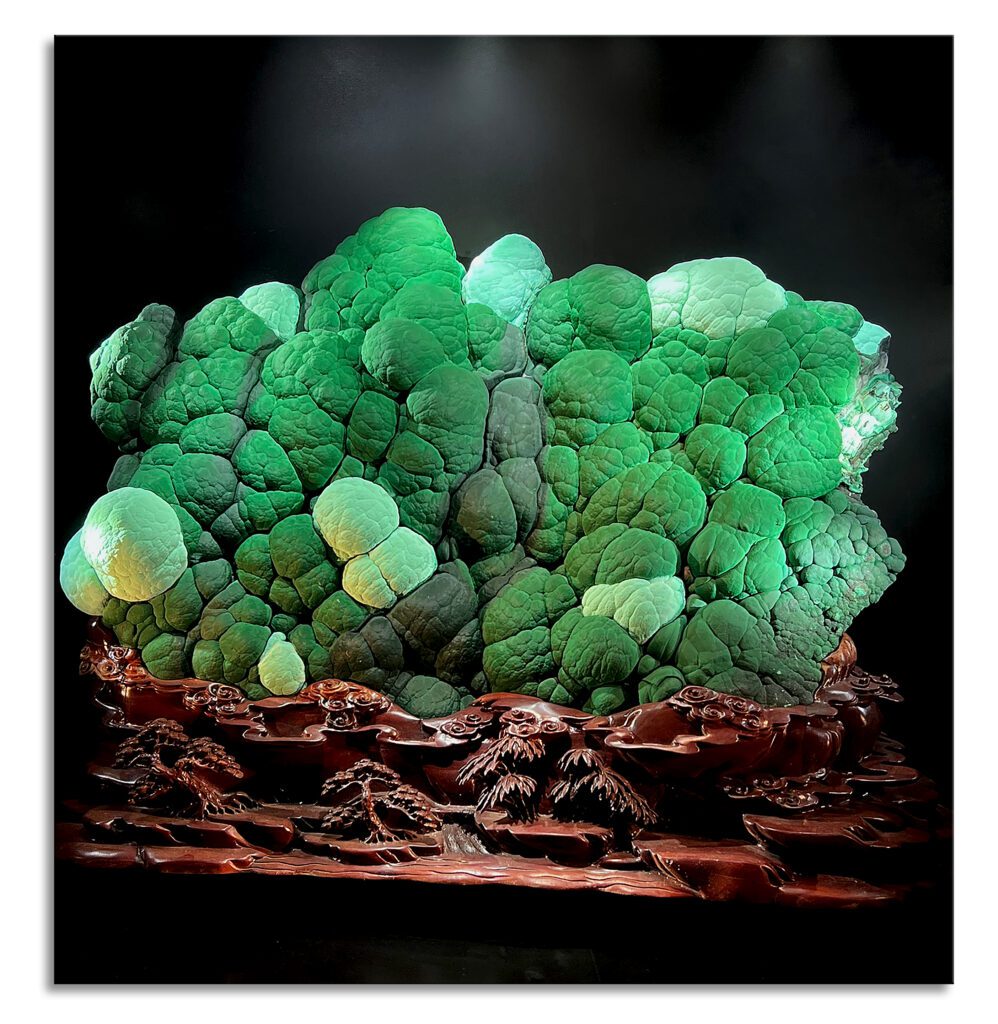
Malachite
Star of the Congo Mine, Katanga, DRC
This is quite large, measuring approximately 1 meter across.
◅◈▻
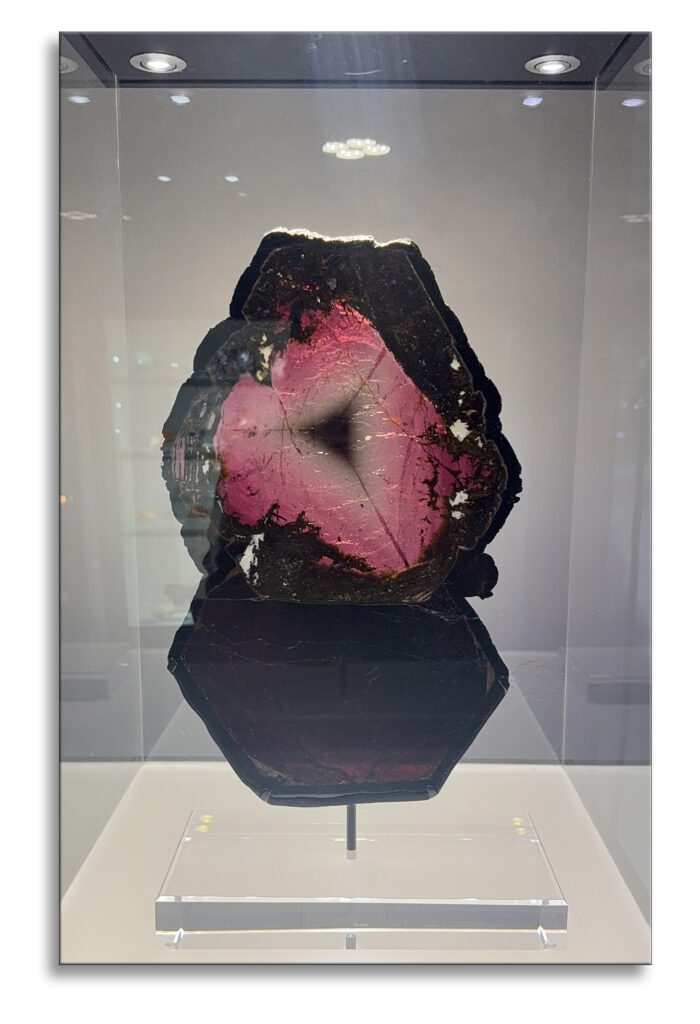
Tourmaline slice from the core of a massive liddicoatite crystal
Madagascar, circa 1960s, approx 28 inch tall
Image courtesy of Arkenstone
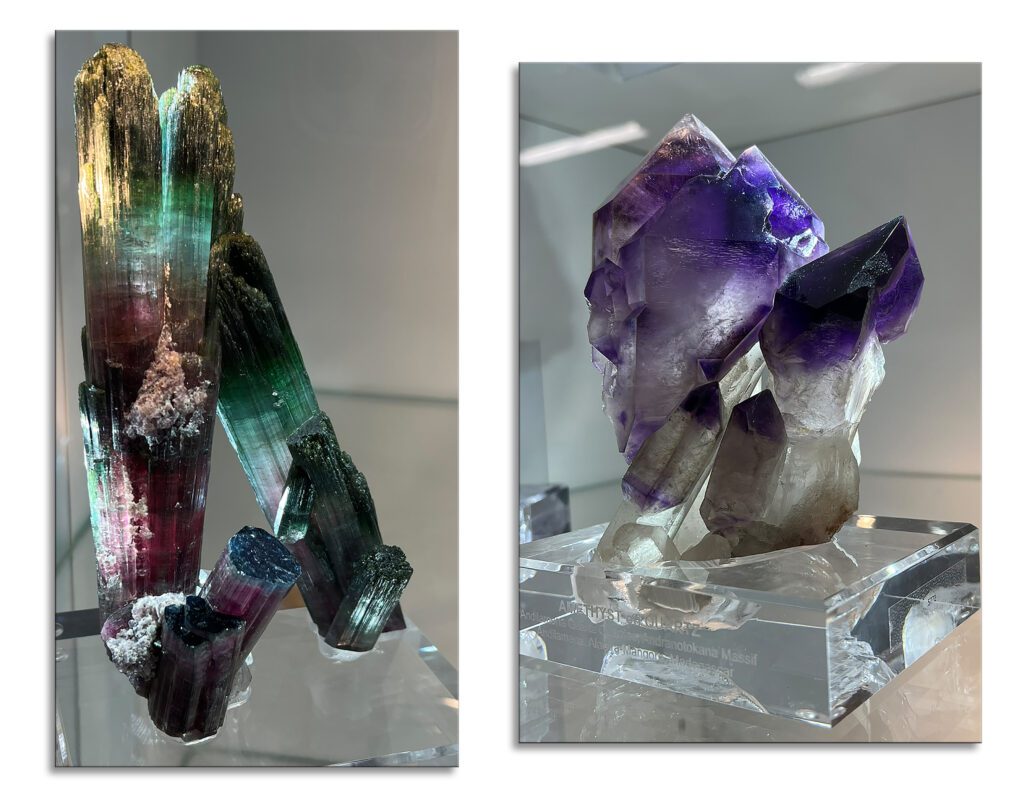
Left: Tourmaline on Cleavelandite, Aricanga Mine, Minas Gerais, Brazil
Right: Amethyst on Quartz, Madagascar
◅◈▻
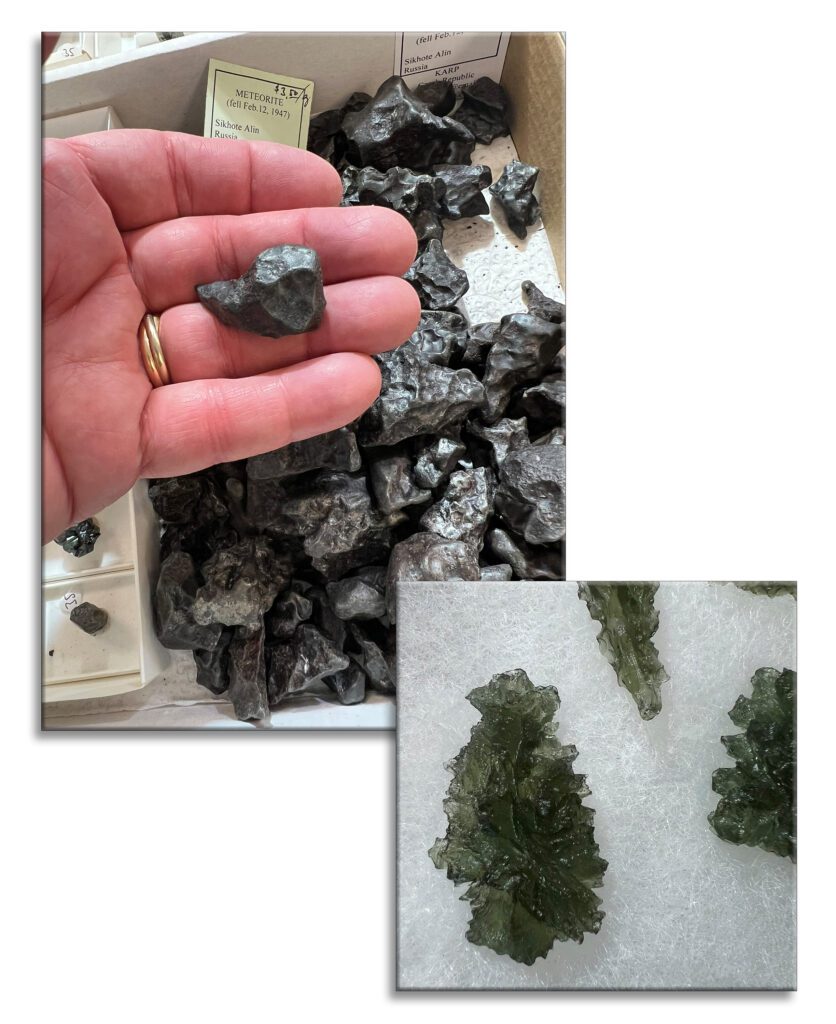
Meteorite – Sikhote Alin, Russia (fell February 12, 1947)
This particular meteorite is known to be the largest witnessed fall of iron meteorites
in modern history, exploding in mid air, and spreading 23 tons
of iron meteorite debris. No wonder there are so many pieces in this box!
Moldavite: from Besednice, in the Czech Republic.
Besednice moldavites are reportedly some of the finest natural glass
caused by meteorite impact. They have extremely detailed, and spiky surface etchings.
◅◈▻
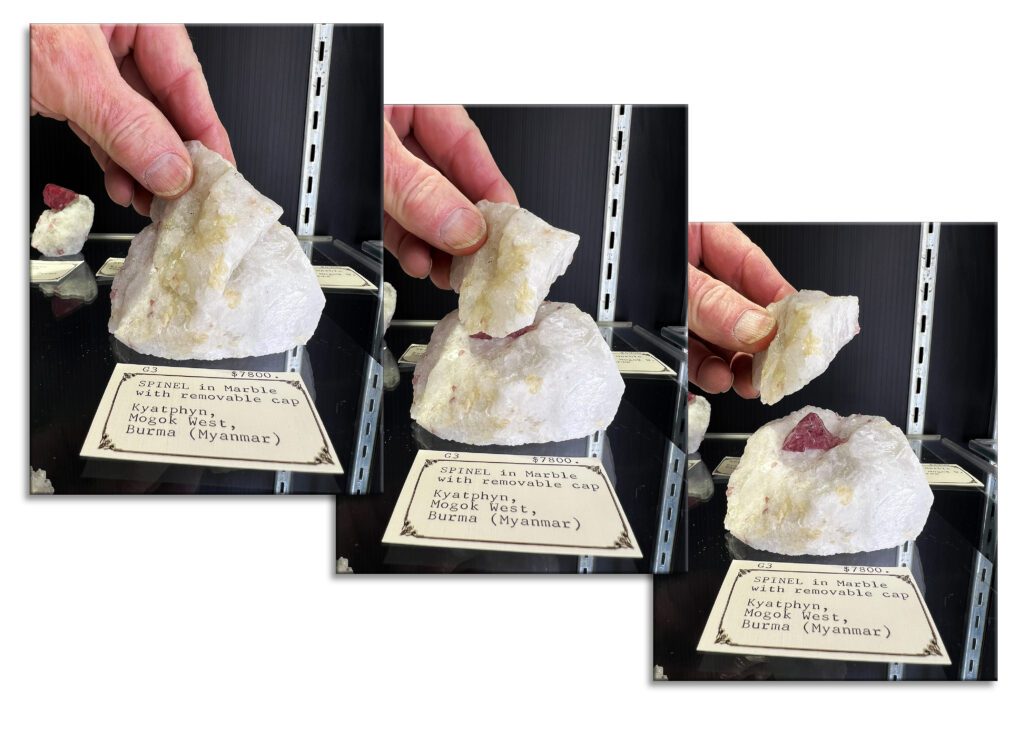
Burmese spinel in marble, with a removable cap.
Thanks to Leonard for showing us this little beauty. The debate in the showroom?
Do you keep the marble cap on—only to remove it when someone asks about the “removable cap”?
Or leave it off so the spinel is visible… but the label makes less sense?
We’ll stay out of that one—but we were more than happy to have Leonard
serve as both our showcase guide and hand model.
◅◈▻
And that’s our Tucson pictorial—so much to see, far more than could ever be covered in a single visit.
One last note: While this Tucson Shows Review is complete, there are still a few additional Tucson reports to come. We’re not done with Tucson just yet.
We tip our marble cap to you all—and thank you for hanging in there to the end.
So long—until the next newsletter.