

New Research takes a closer look at Ethiopia’s newest gemstone discovery
— and at what it takes to confirm a new source
Vincent Pardieu and Colleagues
take a closer look at the copper-bearing tourmalines from Abuloo
We now know that Ethiopia is producing paraiba tourmaline.
But here’s the next question:
Is every blue-to-green copper-bearing tourmaline coming out of Abuloo actually paraiba?
And the answer, according to the latest studies, is an emphatic “No.”
◈
Gary Roskin
The Roskin Gem News Report
Want to dig deeper? Get your shovel. We’ve included several links to original laboratory studies, field reports and our earlier RGNR coverage in the Read More section at the end of this feature. – gr
◈
From Rumor to Rush
On June 18, the Swiss Gemmological Institute SSEF reported that it had received “credible reports from trade sources” of a new deposit of copper-bearing tourmaline in Ethiopia.
At the time, SSEF had also received several paraiba tourmalines for examination whose geographic origin proved difficult, and in some cases inconclusive. The laboratory hypothesized that they might be Ethiopian and reported that preliminary trace-element analyses showed considerable overlap with stones from previously known sources, particularly Brazil.
The announcement spread quickly, and buyers from around the world began traveling to Ethiopia.
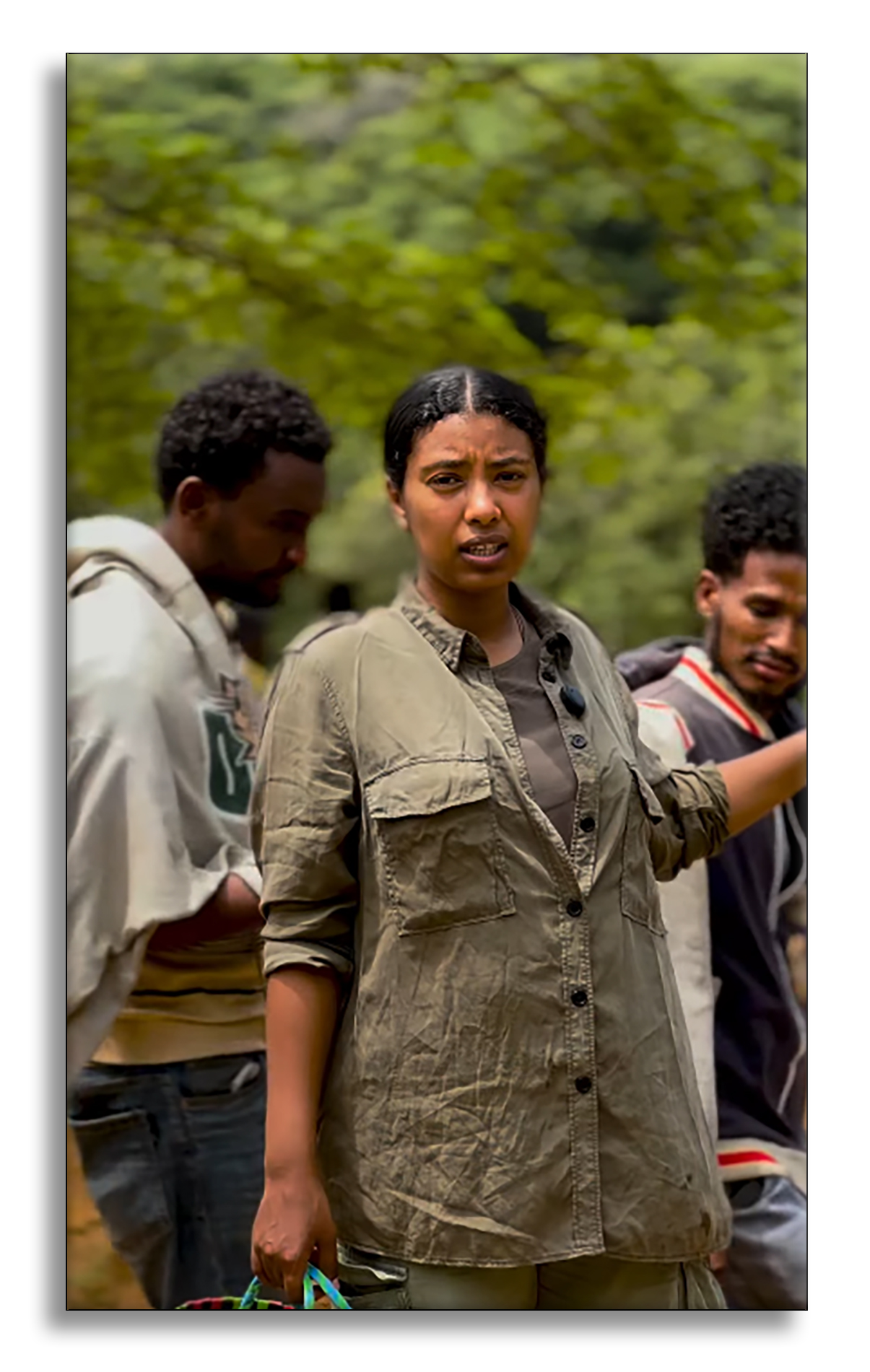
On June 25, Haimanot Sisay, GIA GG, traveled to the newly reported mining area to see firsthand what was happening on the ground and document the reported deposit while Vincent Pardieu and his colleagues were examining Ethiopian material in Bangkok. She found a remarkable rush underway near Abuloo village, close to Shakiso in Ethiopia’s Oromia region.
More than 3,000 people had descended on the area. More than 20 open pits were being worked side by side, with miners digging through secondary deposits to depths of approximately six meters.
And there was tourmaline.
Lots of colors of tourmaline.
There were bright blue-to-green stones containing copper, along with deep blue indicolite, pink, green and black tourmaline.
But even then, another important distinction was emerging from laboratory examination of the material Pardieu had obtained in Bangkok: not all of the blue-to-green copper-bearing tourmaline necessarily qualified as paraiba.
Sisay’s first-hand account was first published on social media on July 4 and later by IGR – Italian Gemological Review. Her report gave us our first detailed look at what was actually happening on the ground at Abuloo, which we subsequently shared with RGNR readers in “Ethiopia’s Paraiba Rush — Sisay’s First-Hand Report.”
Putting the Story Together
Brecken Branstrator, GIA GG, recently brought much of the early story together in her colored stone market report for The GemGuide.
Branstrator followed the discovery from SSEF’s initial announcement through Sisay’s visit to Abuloo and the rapidly developing market for the rough.
She also reported on one of the continuing difficulties surrounding the discovery: determining just how much gem-quality material is actually being produced while buyers, dealers and miners converge on a rapidly changing market.
For GemGuide subscribers, her report provides an excellent overview of how quickly the Abuloo discovery moved from rumors of a new source to one of the most talked-about developments in the colored gemstone trade. [To read the article or subscribe, Tap Here]
And that brings us to the science.
Taking a Closer Look
It was in June when Vincent Pardieu and colleagues began examining a parcel of 21 rough tourmalines reported to have come from Abuloo.
Their preliminary results were first published on social media on June 27, shortly after Sisay returned from the mining area. The work has since been published in English in IGR – Italian Gemological Review #23 – Autumn 2026 and in French in Gemmologie & Francophonie #8 – Automne 2026.
The study brings together four gemologists with extensive laboratory and field experience:
▻ Vincent Pardieu, of VP Consulting WLL, is a field gemologist, consultant to the Laboratoire Français de Gemmologie (LFG), and author of Rubies from Greenland.
▻ Christian Dunaigre operates C. Dunaigre Gem Lab in Bangkok.
▻ Aurélien Delaunay is Director of the Laboratoire Français de Gemmologie in Paris.
▻ Dr. Stefanos Karampelas is with LFG and Aristotle University of Thessaloniki in Greece.
Their study involved chemical and spectroscopic examination of 21 rough tourmalines reportedly from Abuloo and obtained in Bangkok.
And what they found makes the Abuloo story considerably more complicated.
Copper — and Iron
Most of the elbaite tourmalines examined contained significant concentrations of copper.
But copper wasn’t necessarily acting alone.
Many of the stones also contained moderate to high concentrations of iron, along with varying amounts of manganese.
That matters because the presence of copper by itself does not make a tourmaline paraiba. Copper, iron and manganese can all act as chromophores, contributing to the color of tourmaline.
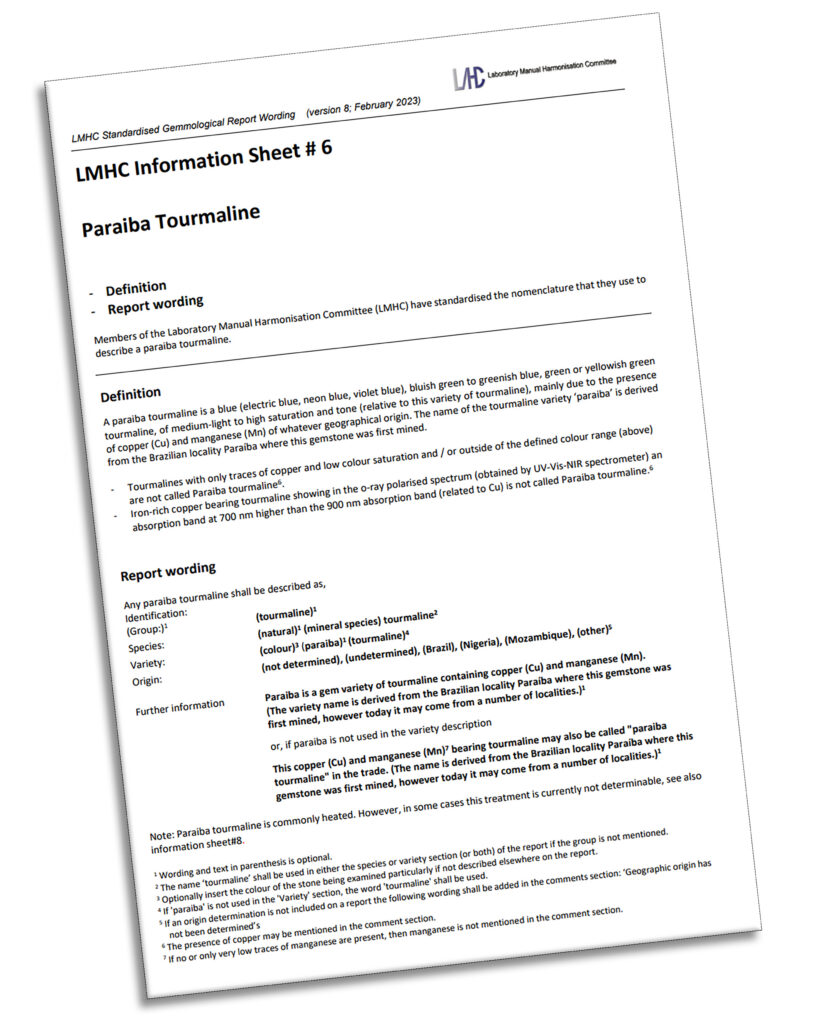
Under the terminology established by the Laboratory Manual Harmonisation Committee (LMHC), a paraiba tourmaline is blue, bluish green to greenish blue, green or yellowish green, with its color mainly due to the presence of copper and manganese. LMHC-Information-Sheet_6_V8_2023
In some of the Abuloo stones, copper is indeed the dominant chromophore. With copper and manganese present, those stones meet the LMHC definition of paraiba.
In others, however, iron is the main chromophore. When iron rather than copper is primarily responsible for that blue-to-green appearance, the stone would more appropriately be described as indicolite.
And some stones appear to fall somewhere in between.
The problem?
They can look remarkably similar.
Can You Tell Just by Looking?
Not reliably, no.
As Pardieu and his colleagues put it:
“Visual separation is extremely challenging.”
That may be one of the most important conclusions for the trade.
A beautiful blue or green tourmaline from Abuloo cannot automatically be called paraiba simply because copper is detected in the stone.
Determining what is actually producing the color requires UV-Vis-NIR spectroscopy.
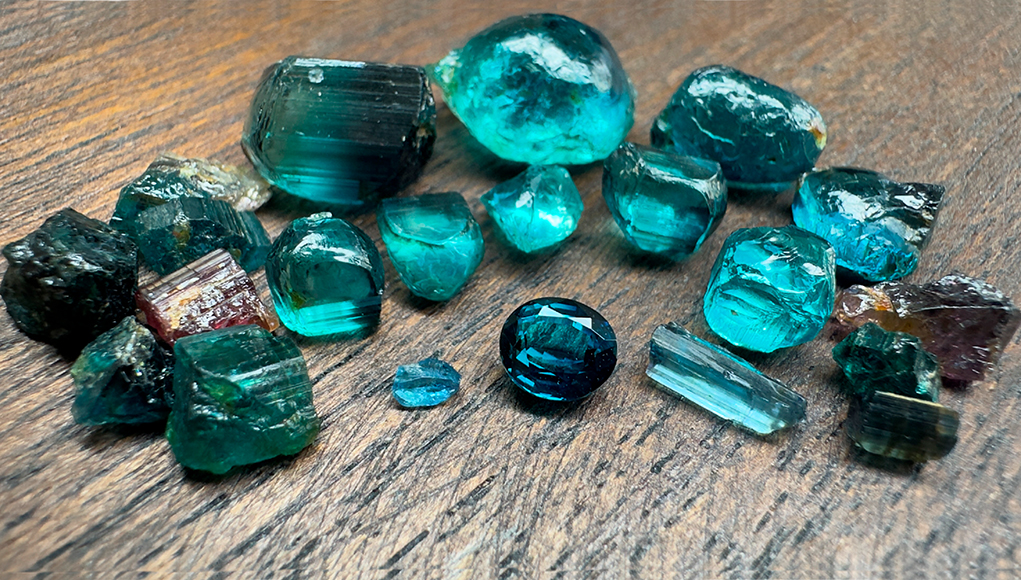
The photographs accompanying the IGR study make the point particularly well.
Five of the largest specimens examined are shown together. To the eye, they all appear to belong to the same general family of blue-to-green tourmaline.
But only three of those five were clearly colored principally by copper and therefore qualified as paraiba under the LMHC criteria.
That’s a distinction that could matter considerably in the marketplace.
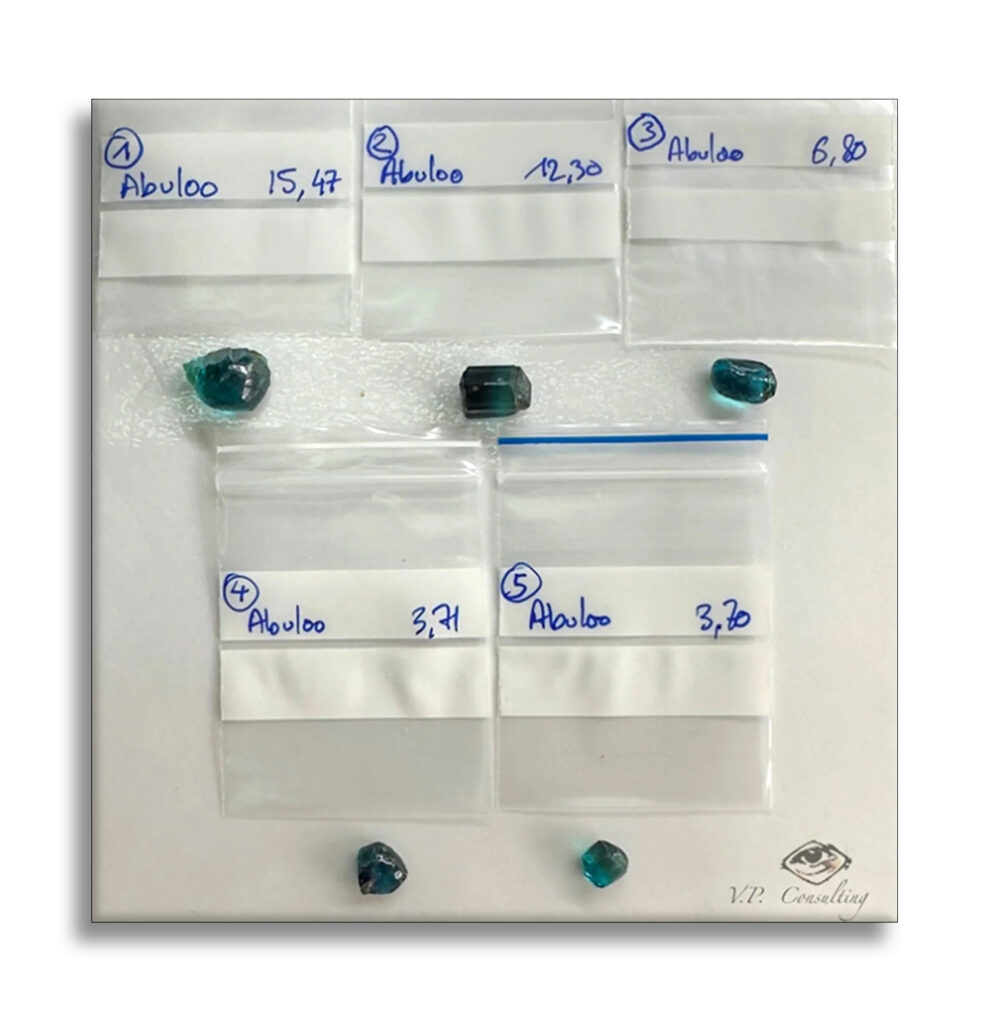
Only three of these stones were found to be clearly colored by copper
and thus can qualify as Paraíba according to the terminology proposed by LMHC information sheet number 6.
Photo, courtesy of Vincent Pardieu
from Rivista Italiana di Gemmologia
A New Peer-Reviewed Study
Within weeks, researchers at DSEF in Germany and CGL in Japan independently reported similar findings from material obtained through different sources.
Those preliminary reports were important. But the next step was publication of the findings in a peer-reviewed scientific journal.
On September 21, Minerals, an international peer-reviewed journal, published “Copper-Bearing (‘Paraíba’) Tourmaline from Abuloo, Ethiopia: Preliminary Results.”
The new study expands the research team to eight authors: Stefanos Karampelas, Ugo Hennebois, Emmanuel Fritsch, Haimanot Sisay, Léonard Cornuz, Quentin Dartois, Aurélien Delaunay and Vincent Pardieu.
Seven unheated blue tourmalines reportedly from Abuloo, selected from the material involved in the preliminary study, were subjected to a much broader series of analyses, including microscopy, visible-near infrared spectroscopy, Raman and photoluminescence spectroscopy, and LA-ICP-MS chemical analysis.
Six of the seven could be classified as paraiba tourmalines.
One could not.
In that specimen, iron rather than copper was the principal chromophore.
Once again, the message was clear:
Not everything that looks like paraiba coming from Abuloo is paraiba.
Ethiopian Paraiba Has Its Own Chemical Fingerprint
The new research also begins to answer another important question: Can laboratories distinguish Ethiopian paraiba from stones originating in Brazil, Mozambique and Nigeria?
The results are encouraging.
The researchers found that the Ethiopian paraiba tourmalines have distinctive trace-element compositions. Gallium was particularly high, generally exceeding 500 ppm — a concentration previously found in only a small number of paraiba tourmalines from Mozambique. Vanadium was also unusually high, exceeding 60 ppm in the Ethiopian samples and, according to the researchers, higher than concentrations reported for paraiba tourmalines from Brazil, Mozambique and Nigeria.
Lead can also be high, while bismuth is elevated in some stones. Taken together — particularly when gallium is compared with copper or lead — these trace elements place the Ethiopian samples in a distinct chemical group that can be separated from paraiba tourmalines from the three established producing countries.
The authors report that these chemical signatures can be measured using LA-ICP-MS and even EDXRF.
A few days later, researchers at SSEF published their own peer-reviewed study in The Journal of Gemmology. Working with a different group of Ethiopian samples and a substantially expanded analytical dataset, they also found that the Ethiopian material could be separated from material from the established sources.
Researchers at Central Gem Laboratory (CGL) in Tokyo were the first to identify elevated vanadium as a particularly useful characteristic for separating Ethiopian paraiba from material from the established sources. SSEF, working independently with its own samples and reference database, subsequently reached a similar conclusion.
On August 27, GIA and Gübelin Gem Lab had also jointly announced the results of their own independent investigations. Working with separately acquired reference samples, both laboratories reported elevated concentrations of vanadium, gallium and lead in the Ethiopian material and concluded that Ethiopia is a new source of copper-bearing tourmaline meeting the accepted definition of paraiba tourmaline. Both laboratories announced that their full research would be published separately in an upcoming issue of Gems & Gemology.
That is important because geographic origin matters in the paraiba market.
Brazilian Paraíba, particularly material from the historic São José da Batalha deposit, can command substantial premiums. A new source that produces stones visually similar to Brazilian material therefore creates an immediate challenge for gemological laboratories.
And interestingly, some of the Abuloo samples contained extraordinarily high concentrations of copper — levels the researchers say are comparable only to those reported from the historic São José da Batalha mining area in Brazil.
But When Is a New Gemstone Source “Confirmed”?
For Pardieu, there is another important part of the Ethiopian story.
What does it take to actually confirm a new gemstone deposit?
It’s a subject he knows well and is passionate about.
During his years as a field gemologist with GIA, Pardieu developed protocols for collecting, documenting and evaluating reference samples used in geographic origin research.
Central to that work was an A-through-F classification system based on how closely a sample can be tied to its claimed source.
At the top are stones collected at the mine under the most tightly documented circumstances. As the chain between the mine, the collector, the dealer and eventually the international market grows longer, the level of certainty surrounding provenance decreases.
Earlier this year, we heard that system described in detail at AGTA’s DYNAMIC seminar by GIA field gemologist Wim Vertriest, who worked with Pardieu during Pardieu’s years at GIA.
As Vertriest told the audience:
“If you collect a bag of gems, all you have is a bag of gems.”
Without reliable provenance, even the best analytical data can be compromised.
[For more on GIA’s reference-sample collection and origin-determination process, read our earlier RGNR feature: “GIA and the Science of Origin Determination: The Research Behind the Report.”]
Pardieu also emphasizes another safeguard: independent sources.
Rather than relying on one trusted source, he prefers to see material and evidence from at least three independent sources when evaluating a newly reported deposit. In the case of Abuloo, that is increasingly what has happened.
Researchers in France, Germany, Japan and Switzerland have independently studied reportedly Ethiopian material obtained through different sources. CGL studied material brought back by Japanese gem buyers active in Ethiopia; DSEF examined material supplied through German buyers; and the LFG/Dunaigre research involved stones obtained through Thailand-based buyers.
Despite those independent paths, the researchers have reached similar conclusions and proposed comparable methods for separating Ethiopian material from paraiba tourmalines from the established sources.
And that brings us back to Ethiopia.
Studying a Stone vs. Confirming a Deposit
Pardieu has been particularly careful about the word “confirmed.”
“For me, there is an important difference between studying stones said to come from a new locality and actually confirming that locality in the field,” Pardieu told the Roskin Gem News Report.
That’s an important distinction.
A laboratory can obtain stones from a dealer or trusted source and produce perfectly useful analytical data.
But the analytical results tell you about the stone. Establishing that the stone actually came from the claimed deposit requires another layer of evidence.
That is where field gemology enters the picture: visiting the locality, documenting its location, geology and mining activity, interviewing miners and obtaining reference samples with a carefully documented provenance.
And that is precisely what Sisay’s trip to Abuloo added to the story.
Now, Pardieu Says It’s Confirmed
A lot has happened since those first Ethiopian stones began appearing in the trade.
Independent researchers have examined material obtained through different sources. Studies have been published by laboratories and researchers in several countries. Their results increasingly point in the same direction.
And there is now something else: documented field evidence from the mining area itself.
Sisay went to Abuloo.
She photographed and documented the mining activity, spoke with people working there, recorded the location and conditions, and reported on the tourmaline she encountered.
For Pardieu, the combination of independent analytical studies and field documentation has now crossed the threshold.
“With similar results published by several independent laboratories, supported by Sisay’s documented field report, I feel quite comfortable confirming that there is a new source of paraiba tourmaline in Ethiopia,” he told us.
But with an important qualification. The deposit also produces blue-to-green tourmaline that does not qualify as paraiba.
Some is colored primarily by copper. Some is colored primarily by iron. And visually, telling them apart can be extremely difficult.
So, Yes. It’s Paraiba — Sometimes.
That may be the most useful way to describe what we now know about Abuloo.
Yes, Ethiopia has a new source of paraiba tourmaline. The field evidence is there. Multiple independent laboratory studies now support it. And researchers are beginning to identify the chemical characteristics that may allow laboratories to distinguish Ethiopian paraiba from stones originating in Brazil, Mozambique and Nigeria.
But a stone’s journey from Abuloo doesn’t automatically earn it the paraiba name. UV-Vis-NIR spectroscopy still has to tell us why it is blue or green. And sometimes the answer is copper. Sometimes it’s iron.
That little difference makes all the difference.
Read More
First Examinations on Paraiba and Other Copper-bearing Tourmalines from Abuloo, Ethiopia
Vincent Pardieu, Christian Dunaigre, Aurélien Delaunay and Stefanos Karampelas
IGR – Italian Gemological Review #23 – Autumn 2026
Copper-Bearing (“Paraiba”) Tourmaline from Abuloo, Ethiopia: Preliminary Results
Stefanos Karampelas, Ugo Hennebois, Emmanuel Fritsch, Haimanot Sisay, Léonard Cornuz, Quentin Dartois, Aurélien Delaunay and Vincent Pardieu
Minerals, September 21, 2026
Field Report to Paraiba Tourmaline Rush Near Abuloo, Ethiopia
Haimanot Sisay
IGR – Italian Gemological Review
New Source of Paraiba Tourmalines Reportedly Discovered in Ethiopia
Swiss Gemmological Institute SSEF
Characterisation of Cu-Bearing Tourmaline from Ethiopia, and Implications for Geographic Origin Determination
Hao A. O. Wang, Wei Zhou, Yi Sun, Markus Wälle, Michael S. Krzemnicki, Pierre Lefevre, Akitsugu Sato, Laurent Cartier and Tewodros Sintayehu
The Journal of Gemmology, 40(3), 2026
A Preliminary Study of Ethiopian “Paraiba Tourmaline”
Kentaro Emori and Hiroshi Kitawaki
Central Gem Laboratory [ as well as The Journal of Gemmology, 40(3), 2026 – link above]
Neues Vorkommen kupferführender Turmaline in Äthiopien
Claudio C. Milisenda and Jin Guo
Gemmologie: Zeitschrift der Deutschen Gemmologischen Gesellschaft, 75(1–2), 2026
GIA and Gübelin Gem Lab Confirm New Source of Copper-Bearing Tourmaline from Ethiopia
GIA and Gübelin Gem Lab, August 27, 2026
GIA and the Science of Origin Determination: The Research Behind the Report
Roskin Gem News Report, March 5, 2026
Ethiopia’s Paraiba Rush — Sisay’s First-Hand Report
Roskin Gem News Report