
by Emily “D.D.” Frontiere
Contributing Editor
for the Roskin Gem News Report
Each year, the Tucson AGA Conference brings industry professionals together to interact with each other and learn about the work of our colleagues. However, it is exceedingly rare to enjoy a presentation that is fully interactive, educational, and genuinely fun. That is what Gregory delivered with her play-along activity demonstrating how to use and interpret results from a makeshift polariscope, consisting of a single light source, two light filters, a conoscope of her own design, and ten sample stones.
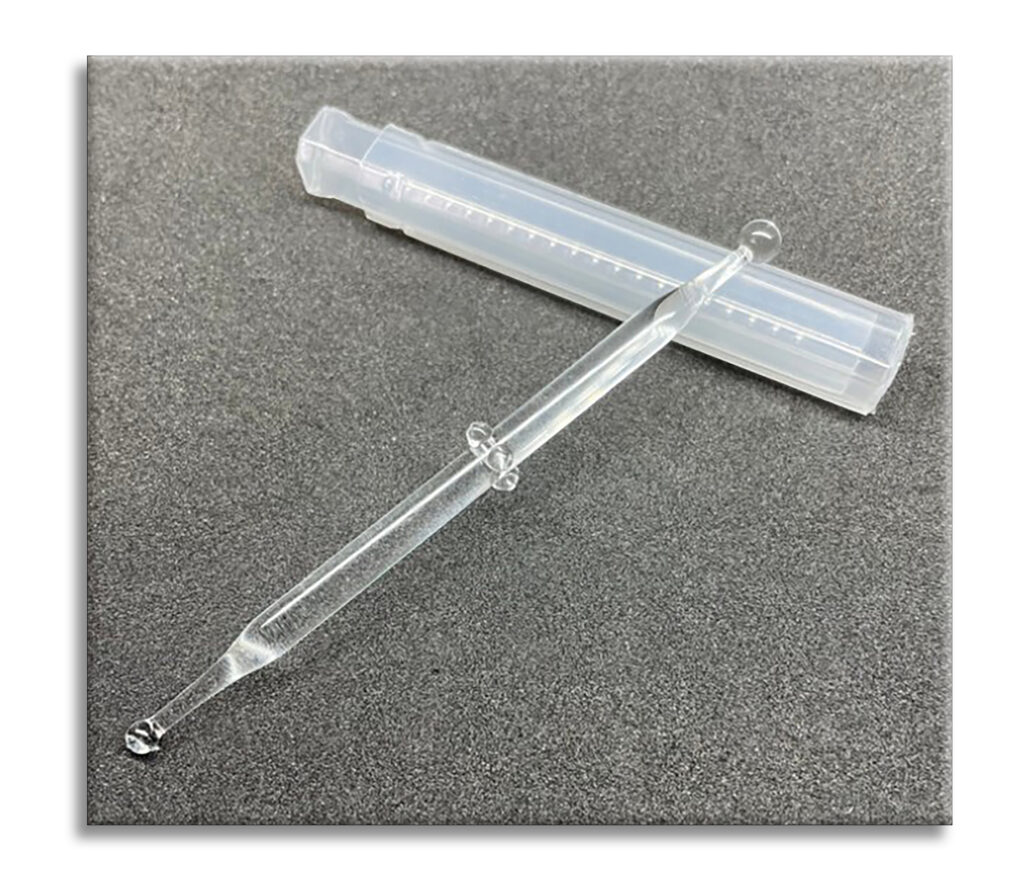
by gemologists for gemologists.
Photo courtesy of Kerry Gregory.
This conoscope, called the Taylor-Gregory conoscope, was created with the intention of being practical for professional gemologists to use. Fashioned by a scientific glassmaker, it features two feet to prevent rolling, a large tip at one end for easy viewing, and a smaller tip suitable to analyze mounted stones.
The goal of Gregory’s workshop was for each member of the audience to use the kit provided to see basic patterns that indicate singly refractive stones, doubly refractive stones, and polycrystalline stones. The structure of the exercise was to build on itself so that participants could gain an upward trending knowledge base.
It’s Not Easy Finding That Perfect Gem!
The preparation for this activity was exhaustive. Gregory reported that she and her team sorted through 14,600 stones, including recycled stones, to create sets of ten “friendly gems”, enough for each registered member of the conference to use individually. These stones were considered “friendly” because, when placed face-down and examined with the conoscope, they readily displayed optic figures centered in the field of view. Every example was accompanied by a video clip showing the desired outcomes. Taking into account the time required to assemble the sets, test all light batteries, and film the clips, Gregory said that the presentation required 48 hours of preparation, and cost more than $7,600.
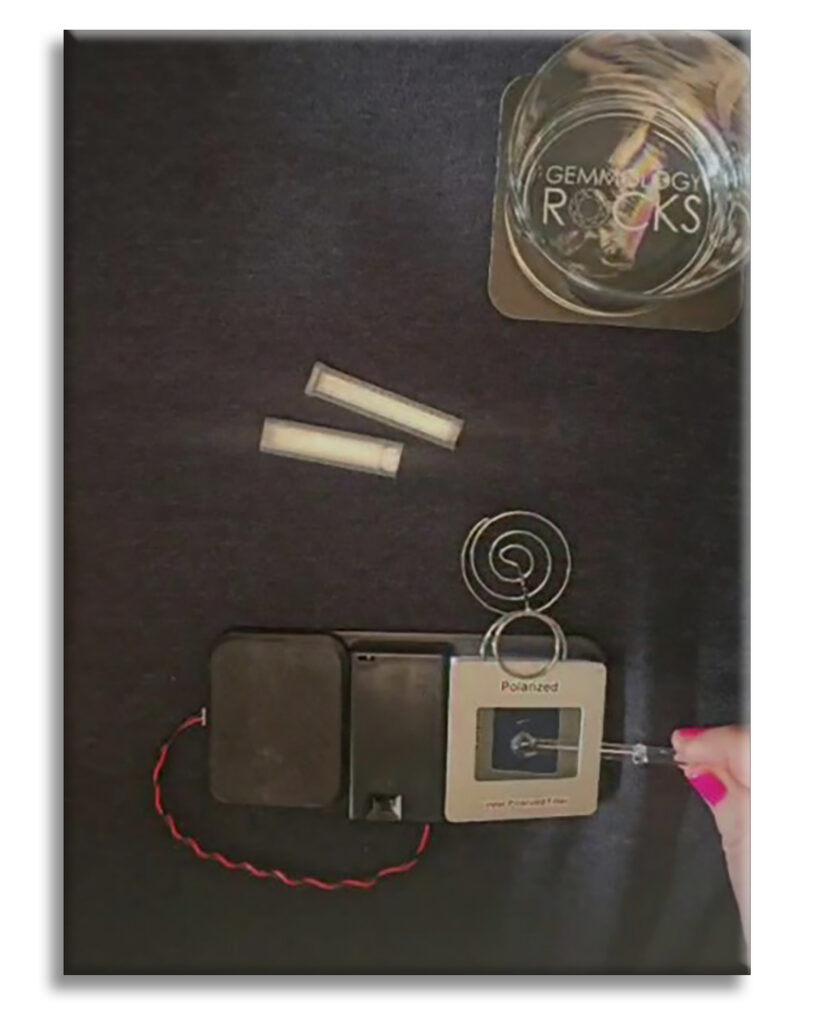
Photo courtesy of Kerry Gregory.
Although this project required a great deal of effort, Gregory said that she was very happy to put in the work. Using a polariscope competently, she stated, is one of the more difficult tasks that new gemologists must learn, and images in textbooks may not be realistic or easy to find. Distance learners in particular, Gregory said, may struggle without an expert present to guide their investigations. Yet, the effort is worth it as the polariscope is an indispensable tool that aids in speedy gem identification. Additionally, unlike expensive and bulky microscopes or refractometers, makeshift polariscopes can be cobbled together anywhere with a polarized light from a phone and a pair of sunglasses, which is perfect for when a random person hears that you are a gemologist and asks you to identify the stone in their ring.
A Well-Organized Workshop
The first three stones were standard singly refractive, doubly refractive, and polycrystalline examples. Stone one was singly refractive glass, which remained dark when spun around in the field of view. Stone two was a synthetic flame fusion corundum that was double refractive. When rotated, it blinked light and dark. Gregory explained that this can show color zoning at different depths on gems like aquamarine and tourmaline. Next was a polycrystalline carnelian which remained lit up when spun. Gregory pointed out that since polycrystalline gems stay illuminated, you might be able to observe darker inclusions that are tricky to see with magnification alone.
Gems four through seven displayed distinctive patterns. Stone four showed writhing snakes which indicated singly refractive glass with strain. Stone five showed tabby extinction which is also indicative of singly refractive gems. Gregory explained that tabby extinction can be paired with the writhing snakes pattern, as seen in some synthetic spinel. The sixth stone was a garnet, which is a group that Gregory said, “are liars”. They may look singly refractive but are doubly refractive and may be magnetic. Next up was a doubly refractive synthetic corundum which showed a triangle-shaped darkness that swept across the stone as it rotated.
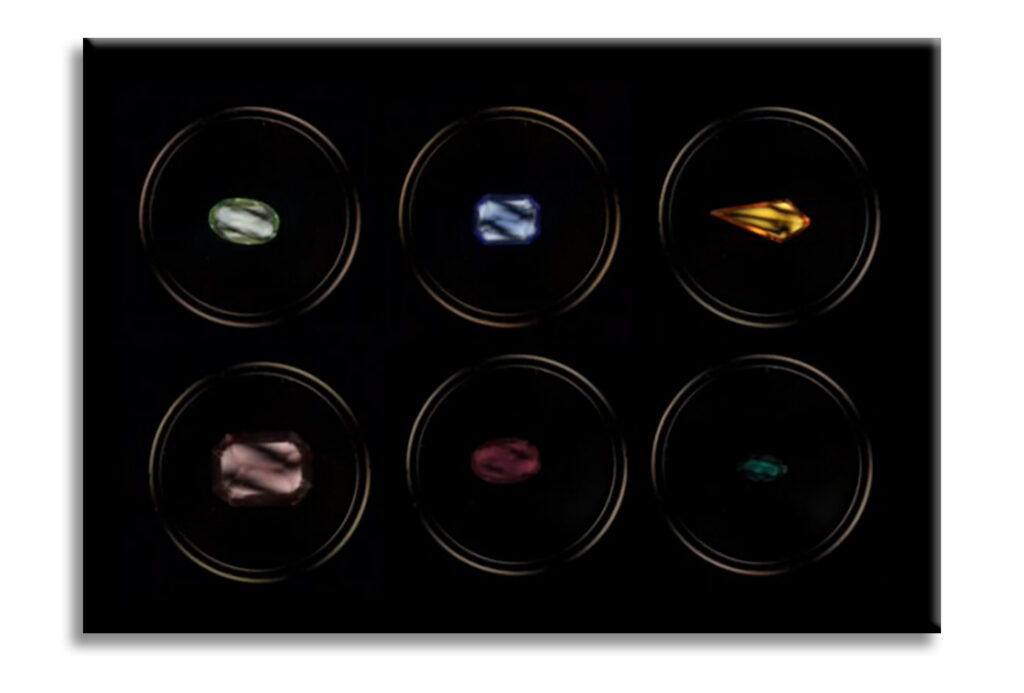
Photo courtesy of Kerry Gregory.
The final three gems showed optic figures. Stone eight was a natural corundum that was doubly refractive and uniaxial. Rotation showed rainbow interference colors and, when examined with the conoscope, a cross with concentric rings around it appeared. Stone nine was quartz, which Gregory explained is the only species that can be identified using the polariscope alone. It is doubly refractive with a bull’s eye optic figure. Gregory stated that you might also see an airy spiral figure whose arms sweep around, a feature that is also diagnostic of quartz. Lastly, we examined a biaxial irradiated topaz which showed a bright center with two gray “swishes” on the sides.
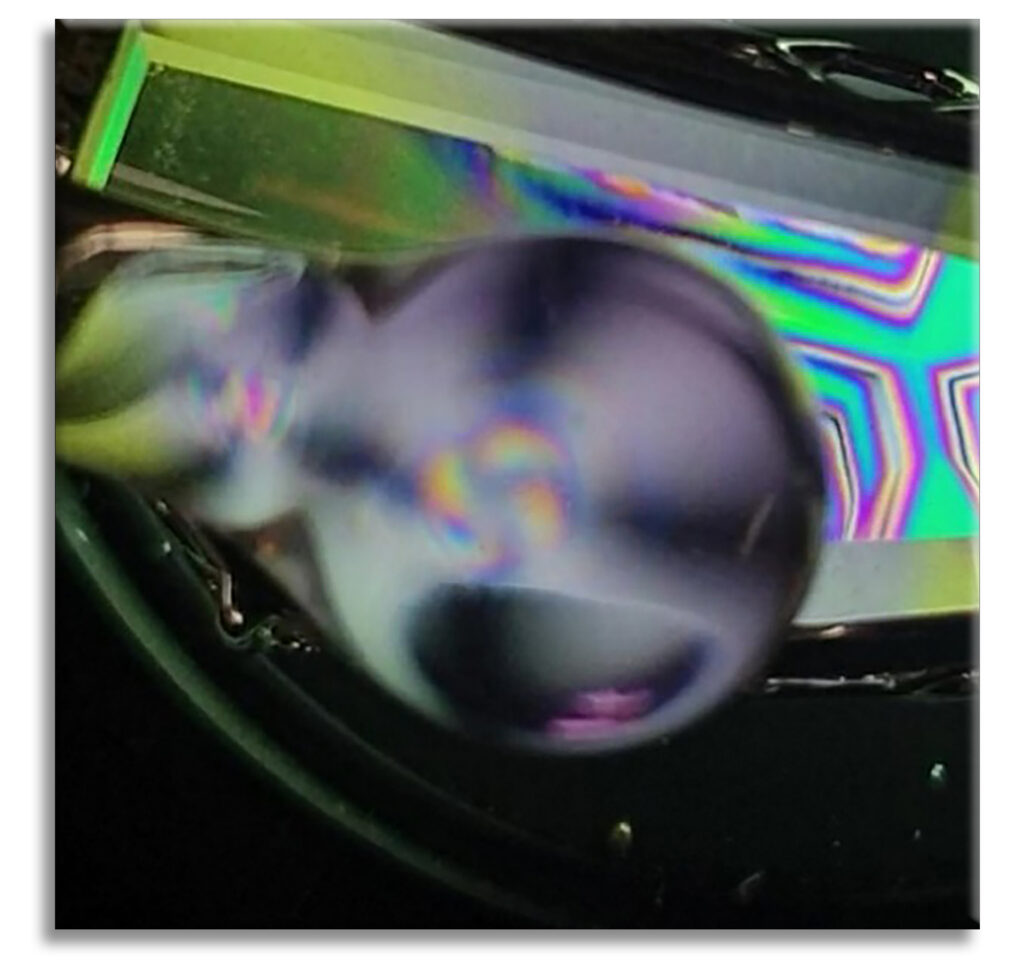
is one of the most satisfying observations for gemologists to make as it is diagnostic of quartz.
Photo courtesy of Kerry Gregory.
As an added bonus following the workshop, Gregory’s conoscope was available for purchase. Her table was quickly crowded by excited audience members clamoring to acquire the tool.
A Second Chance to Experience this Workshop at JVA!
If you missed this valuable and engaging workshop, fret not! Gregory will repeat the exercise at the upcoming JVA conference in Loughborough, UK in September.
Congratulations to the First Winner of the Alan Hodgkinson Medal!
During the 2026 AGA conference in Tucson, members were asked to vote on the three proposed designs for the new Alan Hodgkinson Medal. The award is intended to go to “a gemologist whose generosity, knowledge sharing, and contributions have made a meaningful impact to our profession.” On July 1st, it was announced that the inaugural recipient is Kerry Gregory of Gemmology Rocks.
Gregory’s incredibly engaging and wonderfully curated exercise perfectly illustrated the expertise and dedication to the field of gemology that has won her the honor of being the first recipient of the AGA Alan Hodgkinson Medal. The audience was captivated by her presentation which offered practical information regarding the use of a polariscope, an underutilized tool she said many gemologists are uncomfortable using. Additionally, her innovative conoscope boasts a design that makes the practical use of the tool significantly more convenient.
Congratulations Kerry!
About the Author:
Emily “D.D.” Frontiere is a gemologist, gems and jewelry appraiser, and freelance writer based in Santa Fe, New Mexico. You can read more of her work here as well as posted with the International Gem Society. ddfrontiere@gmail.com.