
The Sapphire had been offered to Jeffrey Bilgore for two years. It was a roughly 15-carat cushion cut, with a feather extending into the gemstone from the pavilion — visible through the table. The dealer in Bangkok had shown it to him… repeatedly, but Bilgore hadn’t been interested.
Then, on one visit, Jeff took a closer look. He saw something they hadn’t, and it wasn’t a cushion with a feather.
JB – “I said, okay, you’ve been showing me this stone for a couple of years now. What’s your bottom line?”
The dealers gave him a price. Bilgore agreed to buy it.
But he wanted their cutter to come in.
JB – “We’re going to make this into an octagon,” he told them.
The dealer was curious, believing that if he wanted to remove the feather, it could be removed with a loss of only 30 or 40 points. Bilgore studied the stone, did calculations and proposed something more ambitious: transforming the cushion into an elongated emerald cut with large corners, combining elements of a French octagon and an Asscher-style cut.
That meant sacrificing several carats.
Bilgore was concerned, but had confidence and hope.
JB – “I bought an emerald cut, and that’s what it’s going to be.”
He returned over the next several days to follow up on the cutting.
The finished Sapphire weighed approximately 12 carats.
In 2002, Jeff entered it in the AGTA Spectrum Awards on behalf of Oscar Heyman & Brothers, where he was working as the Gemstone Buyer at the time.
It received First Place in Classic Gemstones.
The gemstone was subsequently mounted in a three-stone ring and sold for multiples of its purchase price.
JB – “I bought a not-great cushion and saw it could be turned into an amazing emerald cut.”
But the experience meant more to him than that.
JB – “The Spectrum and Cutting Edge competitions strongly influenced me starting Jeffrey Bilgore LLC.”
That first award helped Jeffrey recognize what he could accomplish by trusting his own judgment — and eventually pursuing an independent career.
More than two decades later, he’s still making those decisions.
And he’s still winning awards. Lots of awards.
Seven Awards, Five Winning Entries
At the 2026 AGTA Spectrum & Cutting Edge Awards, Jeffrey Bilgore earned seven recognitions for five of his eight entries.
Two pieces received double honors, including the inaugural Stuller Color of the Year Award.
For a designer and gem dealer who has accumulated more than 40 AGTA awards over his career, seven recognitions in a single year might seem almost routine.
Jeffrey doesn’t see it that way.
JB – “It is incredibly hard to win in this competition. Every recognition is as meaningful as the first.”
And he believes it’s getting harder.
The growing sophistication of jewelry design and manufacturing, and the exceptional quality of gemstones being entered, have raised the standard considerably.
JB – “The level of creativity and the new capabilities with CAD and lasers and the improvements in casting, the capabilities of the designer to imagine something and then create it today are so far beyond what anyone ever imagined 10 years ago.”
What makes Bilgore’s entries particularly interesting is that they don’t necessarily look like the work of a single designer.
He considers that a strength.
JB – “Every piece is totally bespoke.”
Rather than developing a recognizable collection around a single design, he allows the gemstones to suggest what comes next.
And on one occasion, he got a stronger suggestion when his jeweler told him to try again.
Case in point …
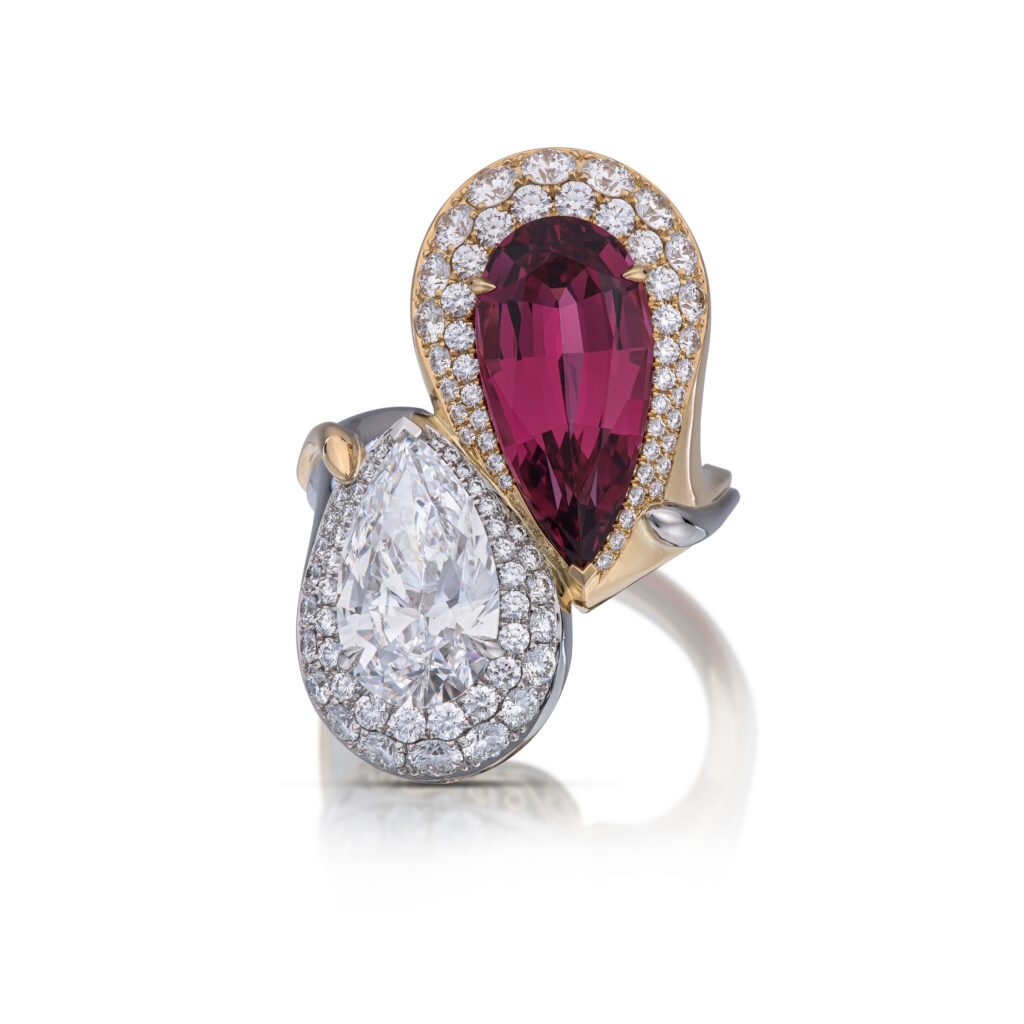
2nd Place — Nouvelle Moi et Toi Forever
Stuller Color of the Year Award
Jeff’s 18K yellow gold and platinum Nouvelle Moi et Toi Forever ring features a clean and bright 6.21-carat unheated red Mahenge Spinel, paired with a 3.06-carat Type IIa colorless Diamond, accented by another 1.32 carats of Diamonds.
The ring earned 2nd Place in Classical and won the inaugural Stuller Color of the Year Award.
For Bilgore, the design began with the Spinel.
JB – “I saw the stone, and I knew immediately what I wanted to do.”
His initial concept was a variation on the classic moi et toi ring, bringing together influences from traditional jewelry design with something more contemporary.
But when he discussed it with his jeweler, the reaction wasn’t what he expected.
JB – “He said to me, ‘Jeff, really? These stones are so spectacular. You can do better than that. Get back to the drawing board.’”
So, he did.
Over the following month, they worked through different approaches, eventually developing the distinctive combination of yellow gold and platinum ribs on opposite sides, with a domed profile and tapering rows of diamond melee.
The contrasting metals acknowledge classic jewelry traditions, while the overall design gives the familiar two-stone ring a different personality.
Bilgore believes the finished piece could have been competitive in Fashion Forward as well, “as it is a totally new approach to a theme of the ages.”
But winning the inaugural Stuller award was particularly meaningful.
Stuller’s selection involved more than appearance. The judging considered salability, design, execution, and the gemstones themselves.
JB – “To be the inaugural winner of the Stuller Color of the Year Award is something you can’t even dream of.”
Jeff Mason Photography
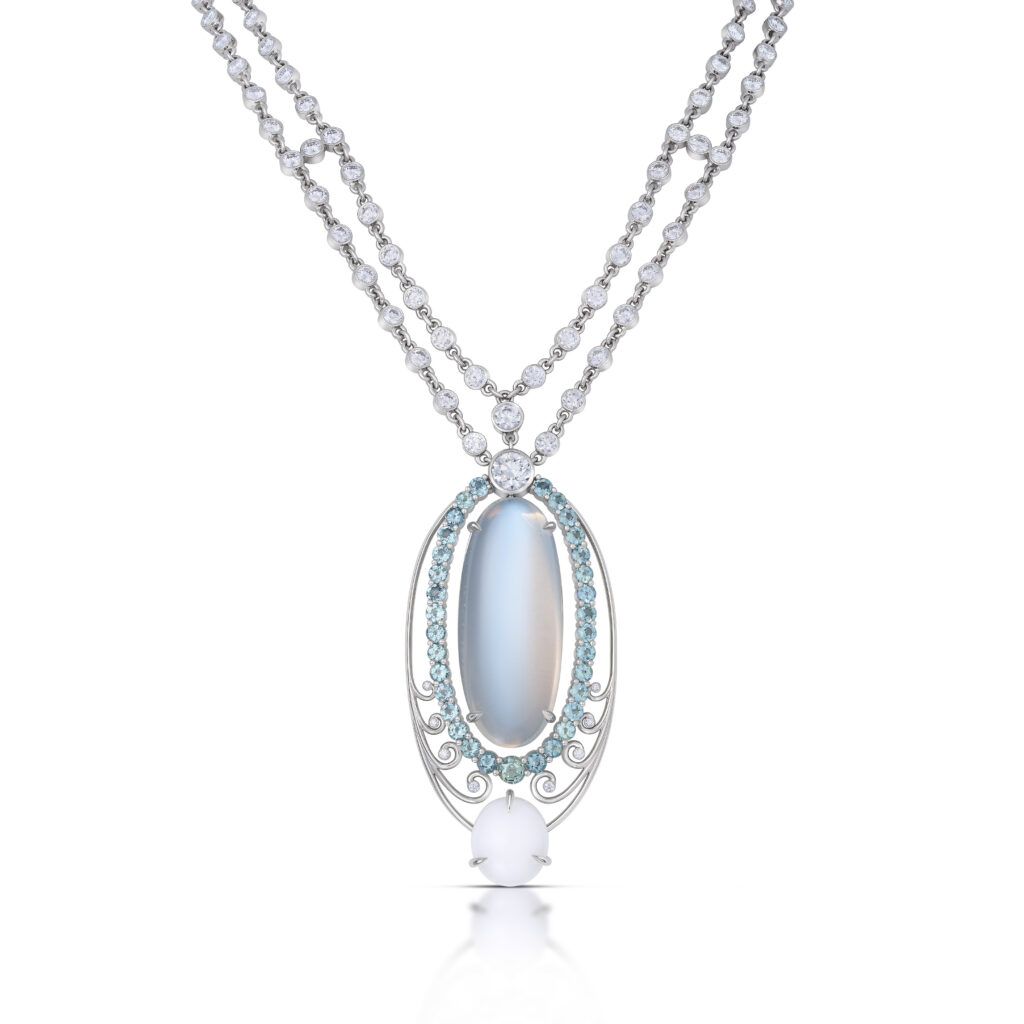
3rd Place — JuneStones for June Brides
Platinum Honors — Bridal Wear
For Bridal Wear, Jeff entered JuneStones for June Brides, a platinum necklace featuring a 24.02-carat blue-sheen Moonstone, a 2.93-carat natural Conch Pearl, 3.50 carats of Alexandrites, and 10.36 carats of Diamonds.
The combination brings together the three June birthstones — Moonstone, Pearl, and Alexandrite — in a design inspired by Louis Comfort Tiffany.
The necklace received 3rd Place in Bridal Wear and won the Platinum Honors award for the category.
Entering the necklace in Bridal Wear was deliberate. Platinum Honors was a bonus.
But even with planning, the outcome is never certain.
Jeff Mason Photography
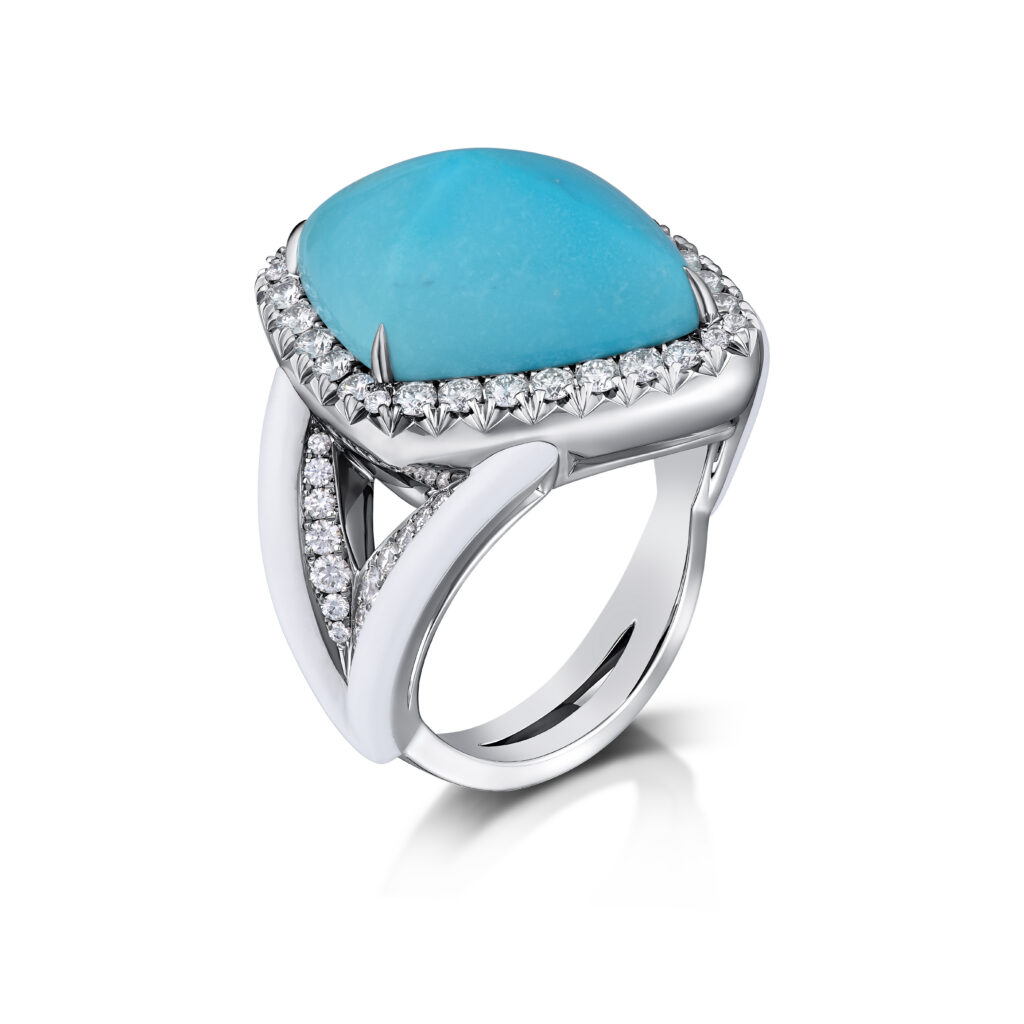
2nd Place — Turquoise Charm
One of Bilgore’s most interesting transformations didn’t involve recutting a gemstone. It involved replacing it.
His platinum Turquoise Charm ring, which earned 2nd Place in Business/Day Wear, features an 8.71-carat sugarloaf Turquoise surrounded by Diamonds and white ceramic.
But the mounting originally held a Kashmir Sapphire.
Bilgore had sold the Sapphire and was now left with a ring design he still loved, missing a center stone.
He recalled a suggestion from Shelley Sergent at Somewhere in the Rainbow that the mounting might work better with Diamonds surrounding the center stone.
The idea stayed with him.
Eventually, he went to YOYO Gems in New York, where he obtained a piece of Sleeping Beauty Turquoise that was subsequently cut into the sugarloaf.
The jeweler added the Diamond surround, and the mounting was fitted with the Turquoise.
JB – “If this isn’t a Business/Day Wear ring, then nothing is.”
Jeff has been using ceramic for a few years now. It’s an alternative to the more traditional enamel, providing greater durability and flexibility in design. It’s harder and more resistant to chipping.
But going from a Kashmir Sapphire to Sleeping Beauty Turquoise to a 2nd Place award — that’s not exactly the progression one might expect. But it worked.
Jeff Mason Photography
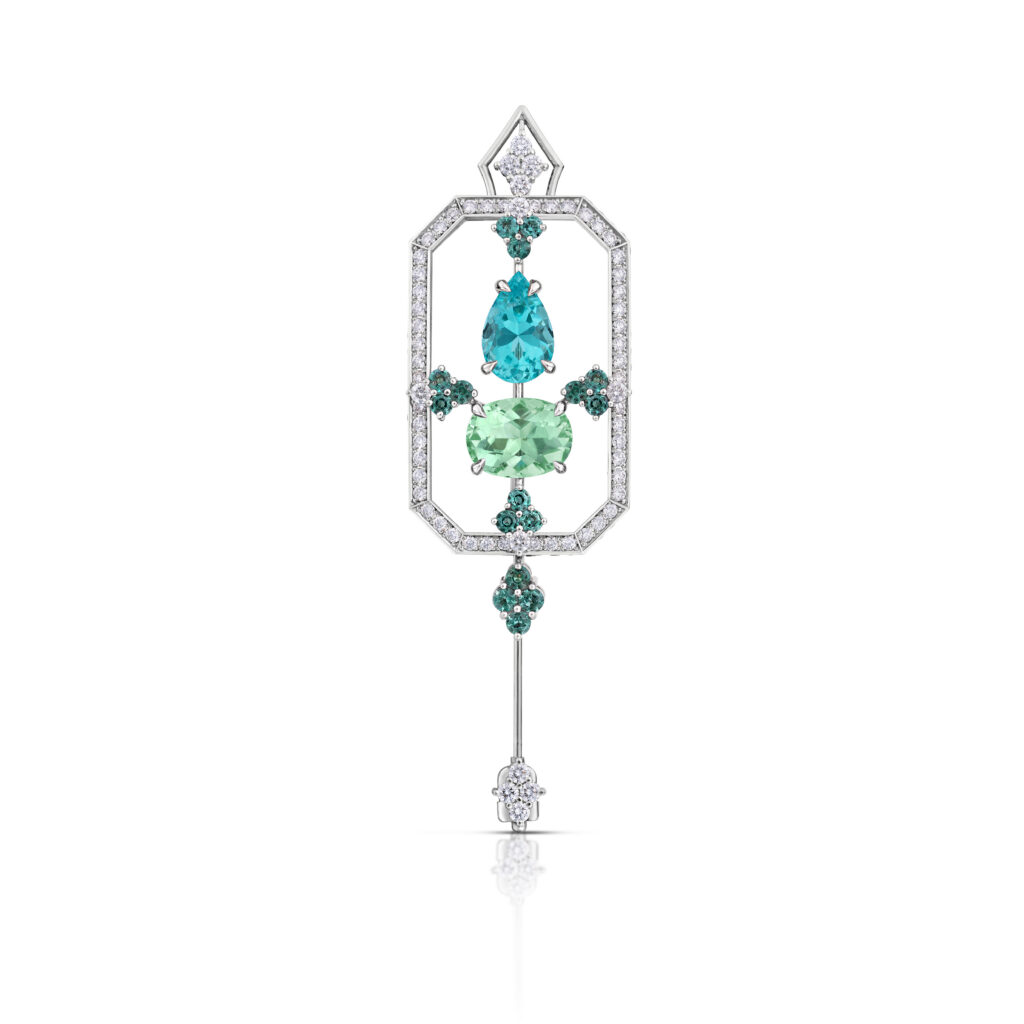
3rd Place — Paraiba Jabot
Bilgore’s Paraiba Jabot pin, awarded 3rd Place in Men’s Wear, features two Mozambique cuprian tourmalines: a 3.39-carat pear-shaped blue and a 4.87-carat green oval, accented by Alexandrites and Diamonds.
The platinum piece began as a variation of a necklace design. But Jeff reconsidered its possibilities, finally deciding the design would work better as a stick pin, with the additional option of wearing it suspended from a chain.
The result is a contemporary interpretation of a traditional jabot pin.
During our conversation, we discussed how easily the pin, with its octagonal frame, could be identified as “a Bilgore design” — unlike several of his other entries.
For Jeff, that is intentional. He isn’t trying to make every piece look alike.
Jeff Mason Photography
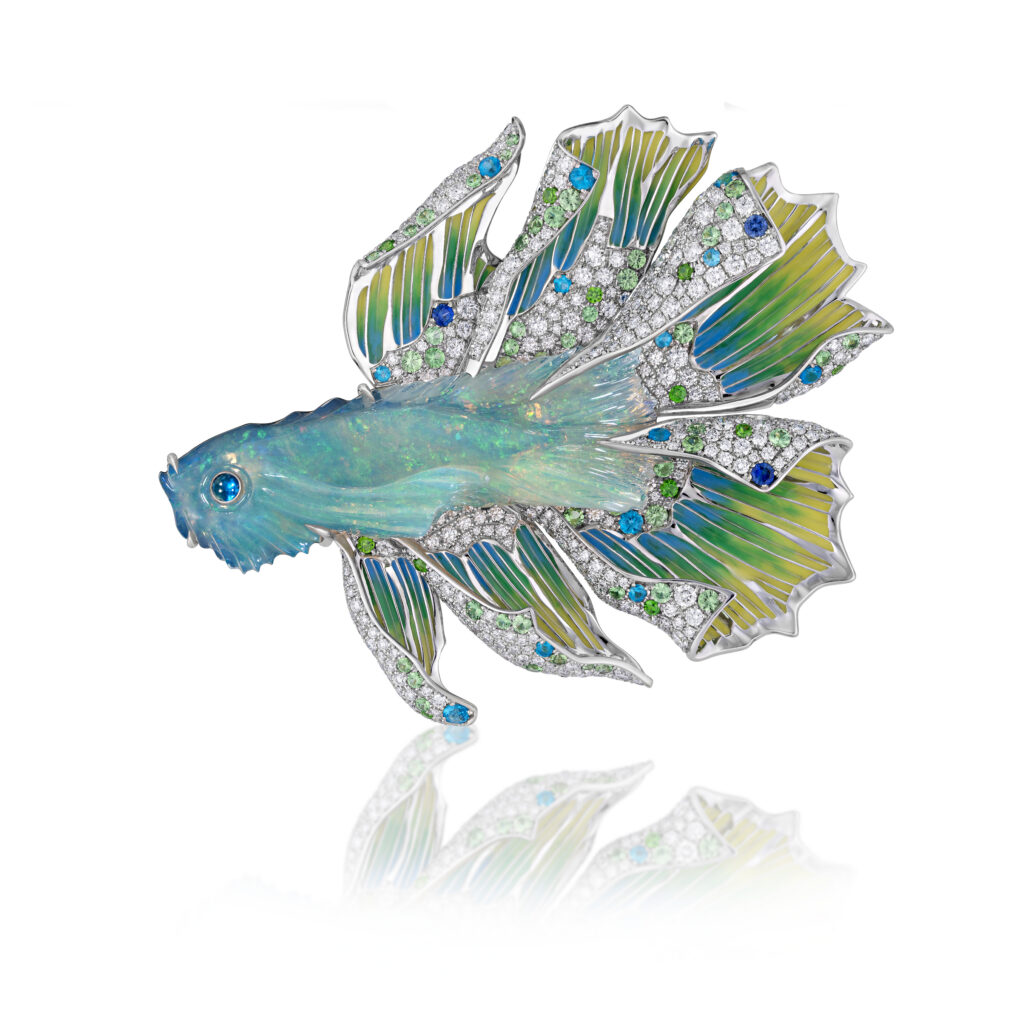
Honorable Mention — Glorious Betta
Of Jeff’s five winning entries, perhaps none carries as much personal significance as Glorious Betta.
The platinum brooch features a carved 42.38-carat jelly Opal, accented by Sapphires, Demantoid Garnets, Apatites, and Diamonds.
Its design and fabrication involved years of work.
The Opal itself had an even longer history.
Jeffrey had kept the material in his safe for approximately 15 years before having it cut and polished. The rough ultimately yielded four pieces, with the largest becoming the centerpiece of Glorious Betta.
The brooch’s development took several more years, combining hand carving by award-winning gem artist Dalan Hargrave and fabrication in platinum.
JB – “It is simply the finest piece I’ve ever been involved in making or even seeing in my 50 years. I really mean it. That piece is astounding.”
That’s quite a statement from someone who has spent so much of his career examining exceptional gemstones and fabricating exceptional jewelry.
It received plenty of attention in the Evening Wear category, both from the judges and the trade press.
JB – “I’m honored that I got an honorable mention.”
Jeff Mason Photography
And Then There Were the Ones That Didn’t Win
For all his success, Jeffrey was equally interested in discussing the entries that received no recognition.
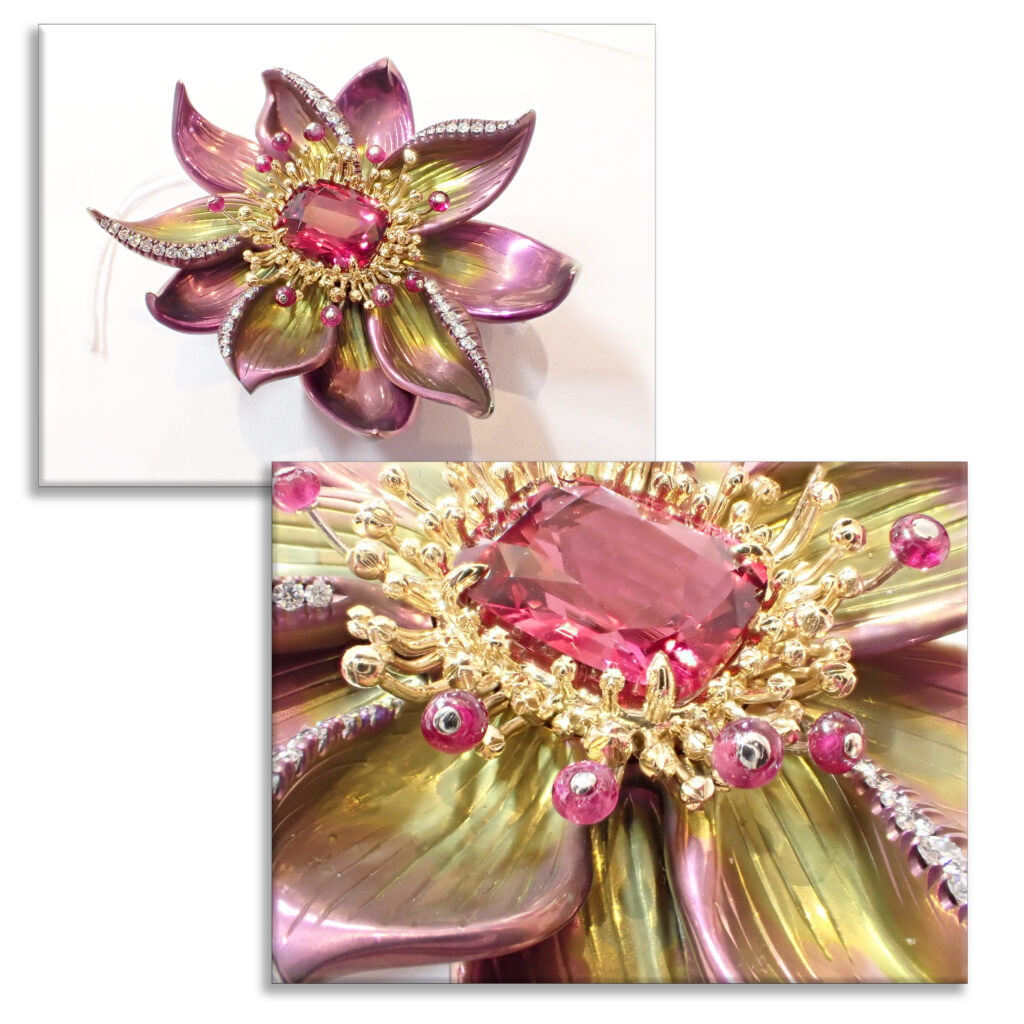
One was Lotus Rises, a brooch featuring a 7.25-carat unheated red Mahenge Spinel, mounted in titanium, 18K yellow gold, and platinum.
He considered it an extraordinary work of art.
We too were impressed and photographed the piece from several angles, not knowing whose it was or that it had received no award.
Jeff explained that the difficulty of winning has increased as the competition has attracted increasingly sophisticated designs and exceptional gemstones.
Even when he feels confident about a particular entry, the judges may see things differently.
JB – “Spectrum is an incredibly humbling experience.”
But Bilgore doesn’t measure the competition solely by his own results. He recognizes what the other designers and manufacturers have invested in their work.
JB – “Every piece on the table represents somebody’s career, you know, the dreams and skills of their career. Combined with the hope for peer recognition.”
And that makes every award that much more meaningful.
Photos by Gary Roskin
You Can’t Design a Piece to Win
There is something Bilgore has said repeatedly over the years about entering the AGTA Spectrum Awards. And it isn’t about designing jewelry to impress the judges. It’s about creating the best piece he can — and then seeing what happens.
During our conversation, we reminded him of that philosophy.
GR – “There is something that you say, almost every year, when you’re asked about creating a piece for the competition. And it’s something to the effect of, well, I don’t create a piece for the competition. I create a piece for me. And then if it happens to win, that’s great.”
Jeff was quick to clarify.
JB – “No one can design a piece to win at Spectrum. Okay? No one.”
With hundreds of entries and a different panel of judges each year, he explained, there is simply no way to predict what will win.
JB – “What everyone can do is design the best piece that you can possibly envision and execute it to your highest standards. And then let the judges judge. But that’s all you can do.”
And this year, he was overwhelmed with what was accomplished.
JB – “Whatever happens, happens. I can be my own worst critic, especially this year, I’m at peace with every piece I entered, truly proud of every piece put on the table.”
Knowing When to Go for It
Looking back at Jeffrey’s career, that Sapphire he purchased in Bangkok more than two decades ago seems an appropriate place to begin — and end — this story.
Jeff saw an opportunity in a gemstone that others had approached differently. He saw within it and wanted to create something better. The result was a Sapphire that helped shape the direction of his career.
Today, that same willingness to reconsider a gemstone or a design remains.
Sometimes it means recutting a Sapphire, or it means replacing a Kashmir Sapphire with Turquoise, or it means returning to the drawing board because a jeweler believes the design can be better.
But the larger story is about learning from mistakes, constantly hearing the counsel of passed and current mentors, all to make the decisions behind them — and the experience required to recognize when a risk is worth taking.
Knowing when to go for it.