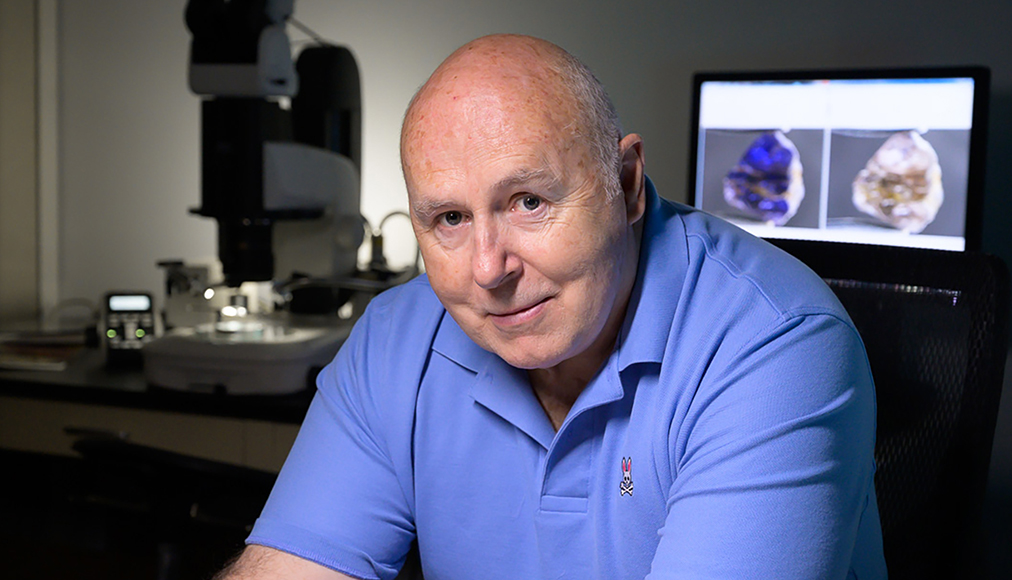


GIA has acquired an unsurpassed collection of 2,665 crystals, gems, and minerals, each exhibiting extraordinary inclusions composed of foreign minerals, as well as trapped fluids and structural characteristics. The unique collection was curated over 60 years by GIA Analytical Microscopist John Koivula, who is widely regarded as the world’s foremost expert in identifying and documenting gem inclusions.
John Koivula is among the most senior researchers at GIA, having joined the Institute in 1976. Through his pioneering work in photomicrography, Koivula revolutionized gemology. He introduced cutting-edge techniques to his research, including fiber-optic illumination, which has since become commonplace in gem labs worldwide.
GIA will debut select pieces from the collection at the AGTA Tucson GemFair and the Tucson Gem and Mineral Show in February 2027.
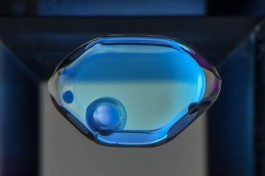
©GIA, photomicrograph by Nathan Renfro
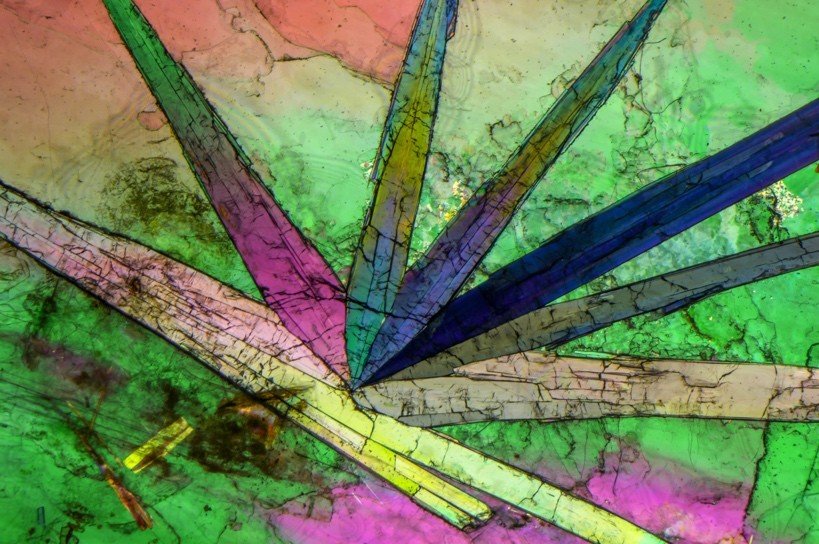
©GIA, photomicrograph by Nathan Renfro
Featuring rare and intriguing inclusions, from a fan of mica in tourmaline to an otherworldly inclusion of fluorescent petroleum fluid in quartz, this collection is unmatched in breadth and quality.
“This one-of-a-kind assemblage could not be reproduced today, not only because many of the pieces are unique, but also because specimens of comparable quality are unlikely ever to be found again,” said Terri Ottaway, curator of the GIA Museum in Carlsbad, CA. “John possesses an extraordinary eye for rarity, often examining hundreds of specimens before selecting a single piece.”
“Preserving the collection at GIA perpetuates the legacy of John Koivula’s skill, expertise and artistry,” said Cathryn Ramirez, GIA senior vice president and chief learning officer. “Generations of students, gemologists and scientists will benefit from his incredible contributions to gemology.”
Carefully cataloged in a custom database, the Koivula collection will support GIA’s education programs, gemological research, and gem identification and origin services. It is an extraordinary educational resource for training future generations of gemologists and dramatically expands GIA’s gemological reference collection.
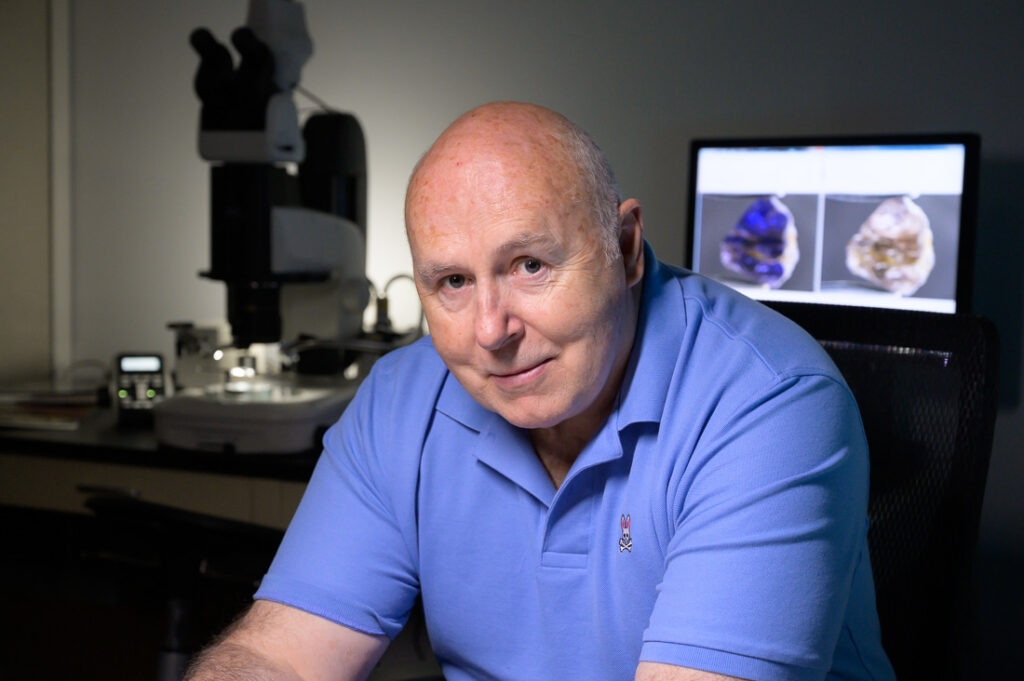
Here we also see the new mineral johnkoivulaite in the background on the monitor (right).
Very strong pleochroism from bright blue to colorless.
©GIA, Photo by Kevin Schumacher
A Conversation with John Koivula
I first met John in October of 1977. He was a diamond grader in the Santa Monica, California, GIA Gem Trade Lab. While grading diamonds, I noticed that he spent an unusual amount of time looking at inclusions. As it turns out, his fascination with what was inside gemstones had begun years earlier.
And now, nearly half a century later, I asked John how this extraordinary collection began, how he managed to keep track of more than 2,600 specimens, and whether he had any favorites.
GR – “So tell me, John, when did you start collecting gems with inclusions?”
JK – “I started collecting them when I was 12 years old. It was 1961.” That’s when he found his very first specimen. “It was self-collected in Washington State… a piece of quartz with a pyrite crystal inside.” The site is still there in Washington, now under claim.
From 1 to 2,665
With more than 2,600 specimens, keeping track of everything must have become quite a challenge.
GR – “Did it take you a while to organize the collection, or were you the type of person that just kept it organized from day one?”
JK – “Well, it started out unorganized, until I realized I’d better organize it.” It didn’t start out as a collection. “It was just research specimens, you know. Just little things that I liked that I thought were interesting.” But it quickly got out of hand. “And then when I realized I couldn’t find any of them anymore…” I think John is describing my office. Maybe we have all had that experience. “I’d want to find one particular specimen… and I’d have to go through bags and bags of stuff. It would take me hours just to find the one specimen. So that was the impetus to get it organized.”
And what a collection it is. Some of these specimens will be familiar to readers of the three-volume Photoatlas of Inclusions in Gemstones, which Koivula co-authored with Dr. Edward J. Gübelin. And there is so much more!
Koivula, who has worked at GIA for fifty years, wanted his collection preserved as a living reference for future generations of gemologists. And he’s pleased that GIA has acquired it. “I wanted it to go to the GIA, and that’s where it went.”
A Diamond with a Blue Inclusion
In 1994, while I was working at the European Gem Lab in Los Angeles, a client’s diamond came across my desk. The diamond had a blue crystal inclusion. I had never seen a blue inclusion in diamond before. I called John and asked what it might possibly be. He mentioned Knorringite Garnet, a garnet I had never heard of. (I had to look that one up.) He was interested in seeing the diamond, so I put him in touch with the client.
GR – “I assume that one of the stones in your collection is that diamond with a blue crystal?”
JK – “Yes, it is.” That blue crystal turned out to be kyanite. “Yeah, I wrote a little paper on that.”
Kyanite in diamond identified by Raman analysis, by John I. Koivula and Shane Elen, Gemological Institute of America, Carlsbad, California, first published in the Journal of Gemmology, Volume 26, no. 4, October 1998.
Two Great Inclusion Researchers, Two Very Different Collections
As you may know, GIA also has the Dr. Edward J. Gübelin Collection, comprising approximately 2,800 gemstones. Given Gübelin’s pioneering work in inclusion research—including two books on the subject before he joined Koivula in authoring the three-volume Photoatlas of Inclusions in Gemstones—one might assume the two collections would be similar. However, the Gübelin collection focuses primarily on gemstones from different geographic localities, rather than specimens selected specifically for their inclusions. It is an extraordinary reference collection in its own right, providing researchers with gemstones from sources around the world for comparative study.
GR – “So GIA has the Gübelin collection and the Koivula collection. How do they differ?”
JK – “Well, the Gübelin collection is not a collection of inclusions. It’s a collection of gemstones. It was never intended as a collection for inclusions, and it has very few inclusions in it of interest. It was a collection of gemstones that he put together over the years from different localities. He was looking for high quality gemstones, flawless ones, nearly flawless ones, that kind of thing.”
How big?
GR – “John, what do you think is the largest specimen that you have in the collection?”
JK – “The largest one? Oh, it’s over 1,000 carats. Probably a sphere… a quartz sphere with a pink fluorite inside of it. I’m just guessing that that’s the largest one. There are several of them that are over 1,000 carats.”
GR – “And where did you find that?”
JK – “I picked it up at auction, from the Rock Currier collection.” (see Heritage Auctions, Rock H. Currier Collection of Fine Minerals Auction)
GR – “Do you think he knew that the fluorite was in there? Was it obvious?”
JK – “Oh yeah, he knew.”
GR – “Did you acquire other pieces from that collection, or just the one?”
JK – “I bought a couple of them from the collection.”
John’s Favorite Inclusion
GR – And then came the most challenging question of all, “Of the 2,600-plus pieces, do you have a favorite?” Of course it’s like asking which child is your favorite, but I just had to ask.
JK – “Do I have a favorite? Boy, that’s a tough question to answer. Oh, yeah, there is one. It’s kind of hard to explain though.” John paused, and then came the description:
“It’s a section of a diamond that has a negative crystal in it. You can see the negative crystal easily, and it has green radiation stains on the inside of it.” That alone would make this a pretty remarkable specimen. But wait – there is an amazing, almost unbelievable surprise. “There’s also a little tiny tube that reaches the surface. And through that tube, you can see an octahedron of diamond that’s too big to get out through the tube, but rattles around inside.” And if that weren’t incredible enough… “And there are natural radiation stains on the octahedron. The outside of the crystal however doesn’t have any radiation stains.” Okay – that should be a favorite!
GR – How did you acquire such a unique piece?
JK – “It was actually given to Bob Crowningshield (former Vice President of GIA). He thought that, because I like inclusions, that I would be interested in it. So, he gifted it to me.”
Preserving the Collection for Future Generations
In addition to applying the collection to education, research, and laboratory services, John and his colleagues are preparing a large-format book featuring many fascinating and beautiful photomicrographs of the specimens.
For more than sixty years, John Koivula has been discovering extraordinary things hidden inside gemstones. Now, with his collection at GIA, future generations of gemologists will have the opportunity to explore those same specimens—and perhaps be inspired to begin an inclusion hunt of their own.
Tap here to visit GIA’s website and to learn more about John Koivula