


We’ve looked at the laboratory reports. Now, here’s a look at what’s actually happening at the mine.
Ethiopian gemologist Haimanot Sisay traveled to the new tourmaline mining area near Abuloo village, northeast of Shakiso in Ethiopia’s Oromia region, and documented what she found in a fascinating first-hand field report published by the Italian Gemological Review (IGR).
Sisay first heard reports of Paraiba tourmaline coming from the area in late May. Within weeks, international buyers were arriving in Ethiopia and the discovery had become the talk of the gem trade.
But rather than rely on reports coming out of the mining district, Sisay decided to go see it for herself.
What she found was a full-blown gemstone rush.
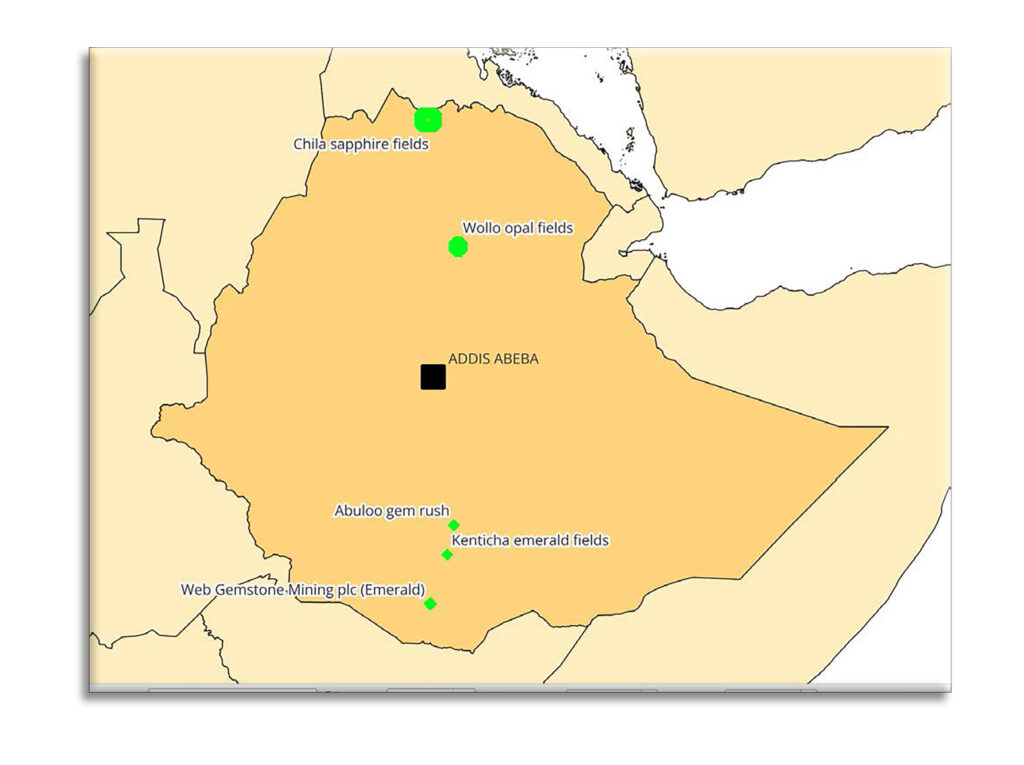
Ethiopia is already famous for its opal mines discovered in the 1990’s,
then discoveries continued with emeralds (near Web village and later Kenticha, near Shakiso)
and also sapphire in the northern Tigray area near Chila.
The discovery of Paraiba tourmalines near Abuloo shows that
Ethiopia is far from having finished to surprise the gem industry.
Map by Léonard Cornuz.
Getting to Abuloo
Sisay and her companions traveled from Addis Ababa to Hawassa, then on to Shakiso. From there, they headed toward Abuloo village.
The final leg was a little more adventurous. They left their vehicle in Abuloo, transferred to motorcycles for about a ten-minute ride, and then walked downhill for another 20 minutes towards the mining area.
Before they could see it, they could hear it. Sisay describes hearing the noise of a huge crowd digging and people washing soil in a nearby stream. The mining area itself sits in a small valley between two hills.
And then they came through the trees.
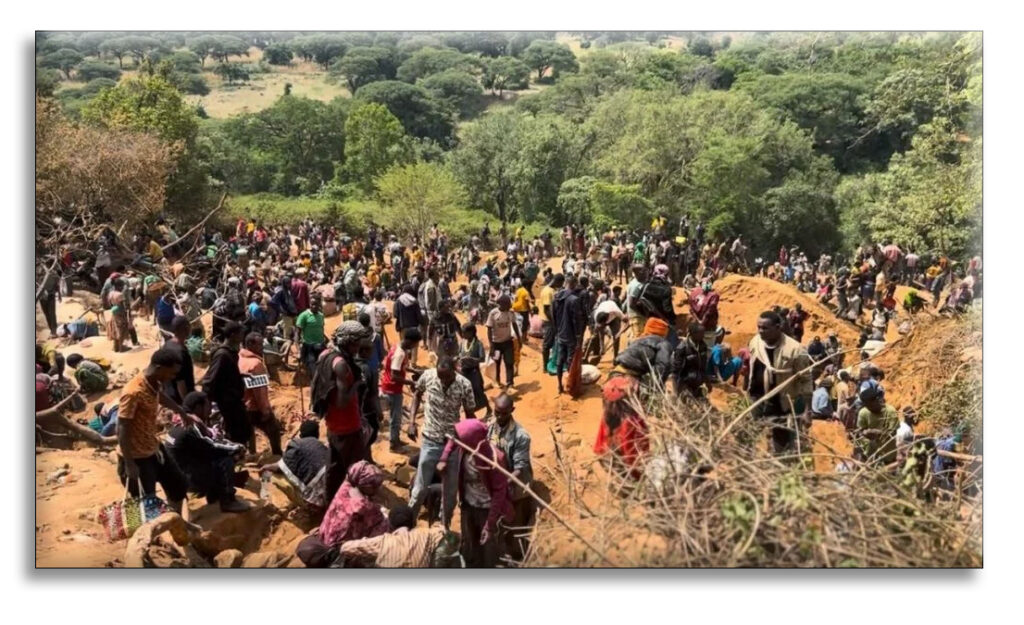
More than 3,000 people were reportedly crowded into the area — digging, washing, carrying, buying and selling.
A Gem Rush
This isn’t mechanized mining.
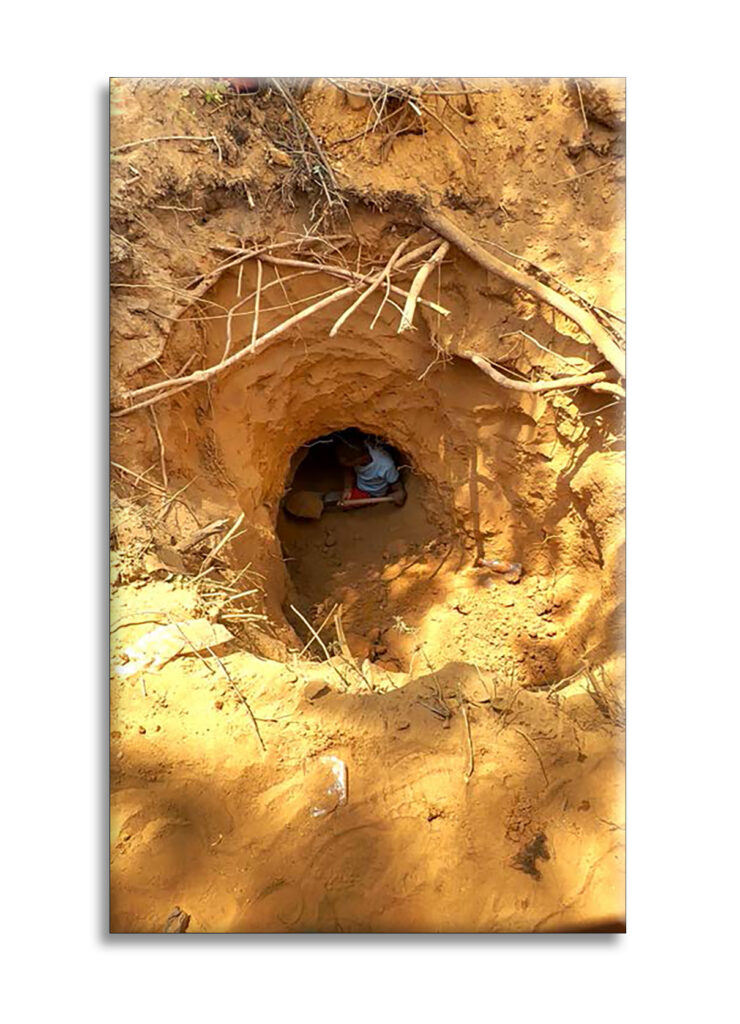
According to Sisay, there were more than 20 active open pits, side by side, with miners using simple hand tools — picks, shovels and bags — to excavate and transport the soil.
Tourmaline was being recovered from near the surface down to depths of about six meters.
And not all of it was Paraiba.
Sisay reports seeing a remarkable variety of tourmaline from the deposit — neon blue-to-green material, deep blue indicolite, along with pink, green and black crystals.
Most of the rough she saw weighed less than two grams, although she reports seeing notable specimens weighing as much as 8.6 grams — 43 carats.
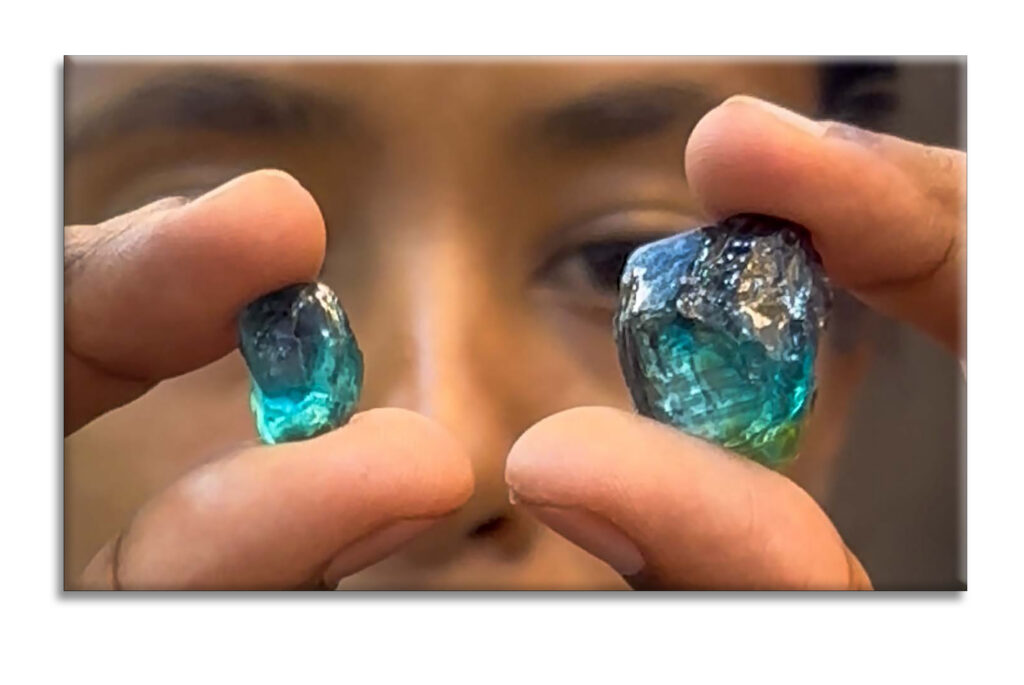
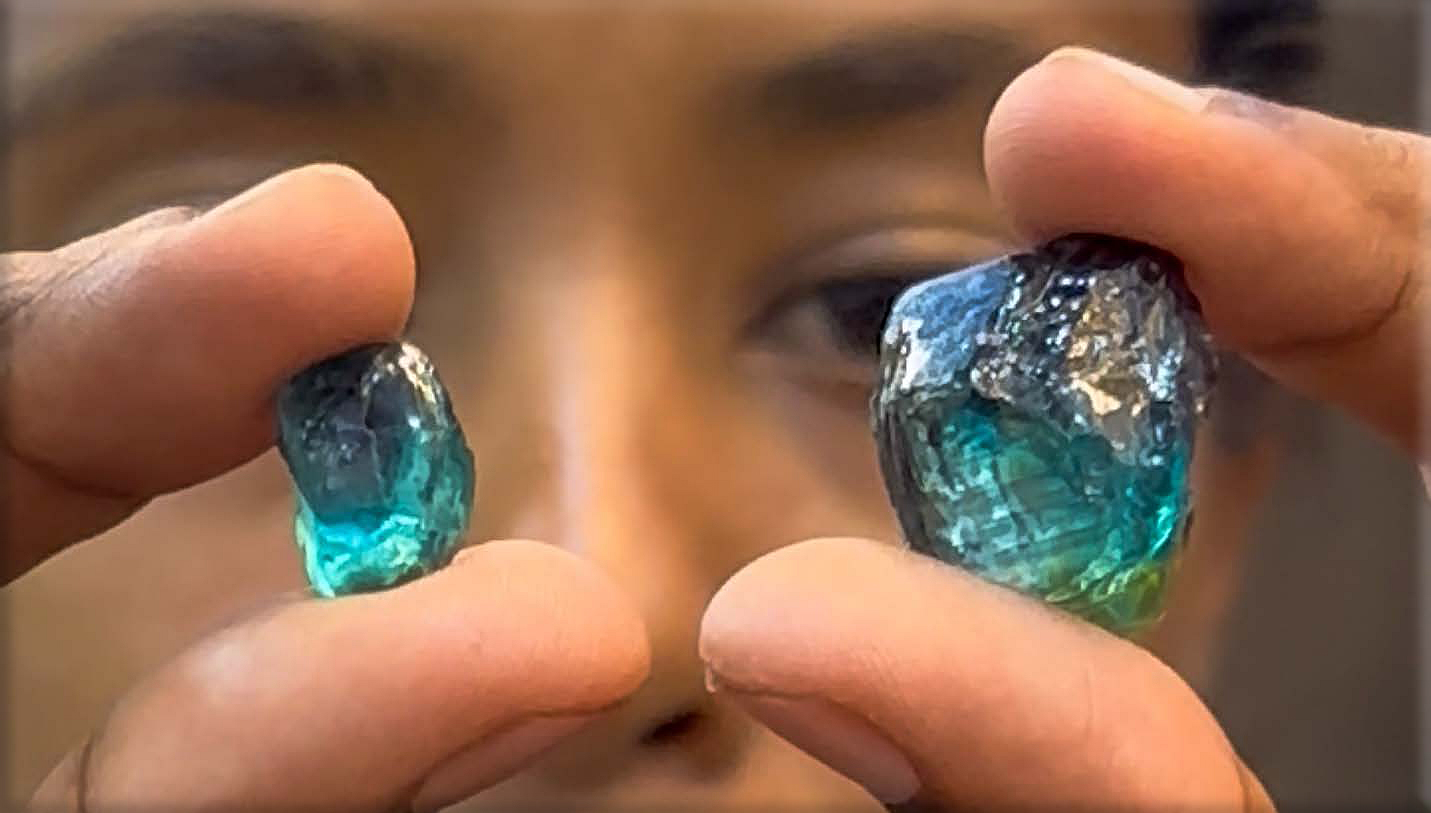
The larger piece weighed 43 carats rough, while the smaller one is over 10 carats with exceptional clarity.
(Photo: Efrem Bogale)
The range of transparency was equally broad, from opaque material to remarkably clean crystals.
From the Ground to the Buyer
The mining is only part of what Sisay documented. There is an entire trading operation taking place around the pits.
Local dealers generally have the first opportunity to buy newly recovered material, while special stones and better-quality parcels may move on to Shakiso, Adola and Hawassa for further negotiations.
And it is a cash business.
Sisay describes seeing duffel bags literally overflowing with stacks of Ethiopian currency at the mining site.
For people living in the surrounding area, the discovery has created the possibility of a life-changing find. Sisay reports that people have left their regular occupations to try their luck digging for tourmaline, while some gold miners have reinvested money earned from gold into the new tourmaline pits.
Some have already been lucky.
Many more are hoping they will be next.
Not Without Risk
There are hazards, too.
The pits reach depths of about six meters, and Sisay notes that excavated soil is sometimes piled directly around their edges. In the soft ground, that creates the danger of the soil collapsing back into the excavation.
And there was another kind of reminder that this was not an ordinary gemological field trip. Sisay reports that nearly every open pit was guarded by armed men. At one point, one of her companions was filming when a security guard reportedly pointed an AK-47 at him.
The situation was resolved, but the encounter was enough to make clear just how tense a major gemstone rush can become.
Watch the Paraiba Rush
Fortunately for us, Sisay not only returned from Abuloo with notes and photographs — she brought back video, too!
The two Instagram reels below provide a remarkable look at the scale of the activity at the mining site — the people, the pits, the digging, the washing and the trading surrounding the new tourmaline discovery.
Take a look.
Read the Complete Field Report
There’s much more to Sisay’s account than we can show you here.
Field Report to Paraiba Tourmaline Rush Near Abuloo, Ethiopia
By Haimanot Sisay, Edited by Vincent Pardieu, with maps by Léonard Cornuz
July 4, 2026
The complete field report, published by the Italian Gemological Review, includes photographs and maps documenting the journey and mining area, along with the videos.
For those of us following the emergence of Ethiopian Paraiba tourmaline, it provides something laboratory reports simply cannot: a first-hand look at where these stones are actually coming from — and the extraordinary gem rush taking place around them.
Tap here to read Haimanot Sisay’s complete field report – PDF!
You can read this and more in the IGR, the Italian Gemological Review, here!