On the face of it, there’s nothing terribly unusual about a watch dial.
But face the facts. Watchmakers have been getting a little stone-faced lately.
Aventurine, lapis lazuli, malachite, opal, pietersite (which we highlighted in a previous newsletter), sodalite, tiger’s-eye, turquoise and more are showing up on some very fashionable wrists, as watchmakers rediscover something jewelers and gem cutters have known for a very long time — Mother Nature can put a pretty good face on just about anything.
Of course, putting a gemstone dial on a watch isn’t quite as easy as it looks.
These stones have to be selected for pattern and color, oriented just right, sliced remarkably thin, polished, backed and fitted into a watch case — hopefully without cracking, chipping or otherwise falling apart along the way. And because no two pieces of natural gem materials are exactly alike, no two finished dials will be exactly alike either.
Which, of course, is the point.
How Do They Do It?
Before we get to the pretty faces, a tip of the loupe to veteran watch journalist Roberta Naas, whose excellent WatchTime feature, “Of Earth and Space: Spotlight on Hard-Stone and Meteorite Dials,” takes us behind the scenes to show just how difficult these dials are to make.
As Naas explains, selected rough is sliced into slabs, then progressively thinner sheets, until the stone destined for the dial may be only fractions of a millimeter thick. It still has to be precisely shaped and polished — without scratching, chipping or breaking — and is often bonded to a metal plate for support.
So, while we’re having fun with all these stone faces, making one is serious lapidary work.
Read Roberta Naas’ full WatchTime feature:
https://www.watchtime.com/brands/luxury-watches/spotlight-on-hard-stone-and-meteorite-dials
So rather than have a face off over which one we like best 🤦♂️, we thought we’d let the watches speak for themselves.
Here are a few of our favorite stone-faced watches.
◈
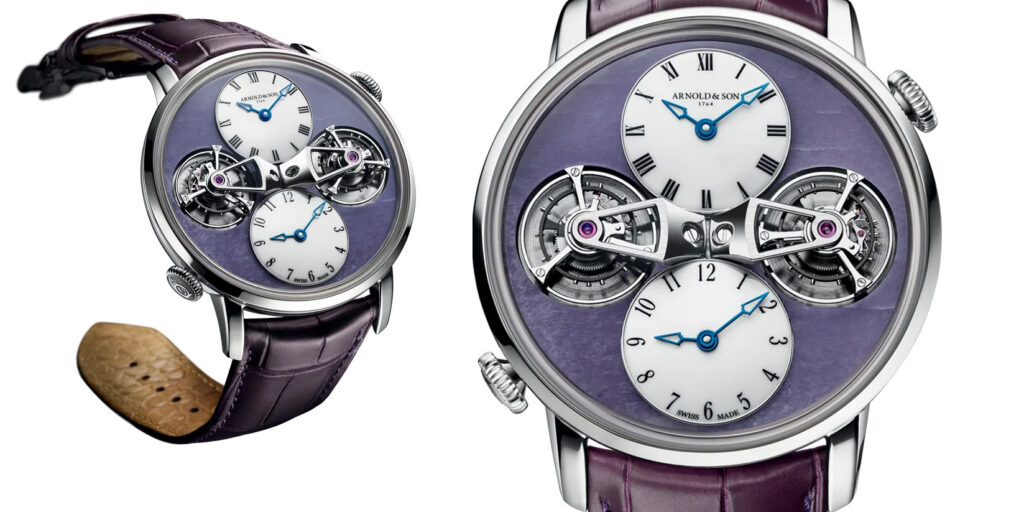
Arnold & Son Double Tourbillon White Gold — With Charoite Dial
Charoite, a violet to mauve (purple-ish) ornamental gem material often confused with Sugilite, is seen here as the face of Arnold & Son’s Double Tourbillon. The thin stone dial must be precisely cut with four large circular openings for the two independent time displays and two tourbillon mechanisms — without breaking the charoite, of course.
Image: Arnold & Son
◈
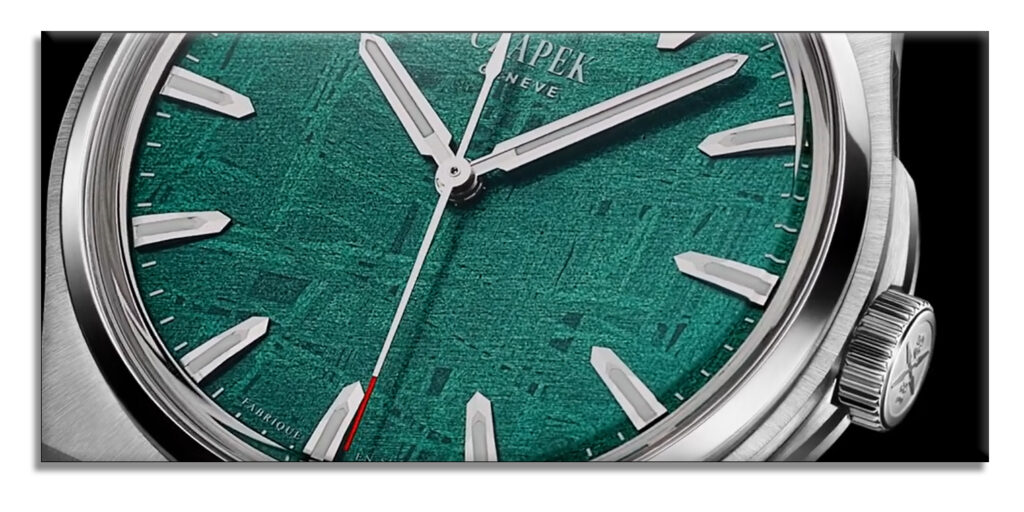
Czapek Antarctique Green Meteor — Gibeon Meteorite
This face really is out of this world. The dial is cut from Gibeon iron meteorite from Namibia. Acid etching reveals its distinctive Widmanstätten crystalline pattern, after which a polished green lacquer gives the naturally silver-gray meteorite its striking color. Each slice reveals a different pattern, making every dial unique.
Image: Czapek & Cie.
◈
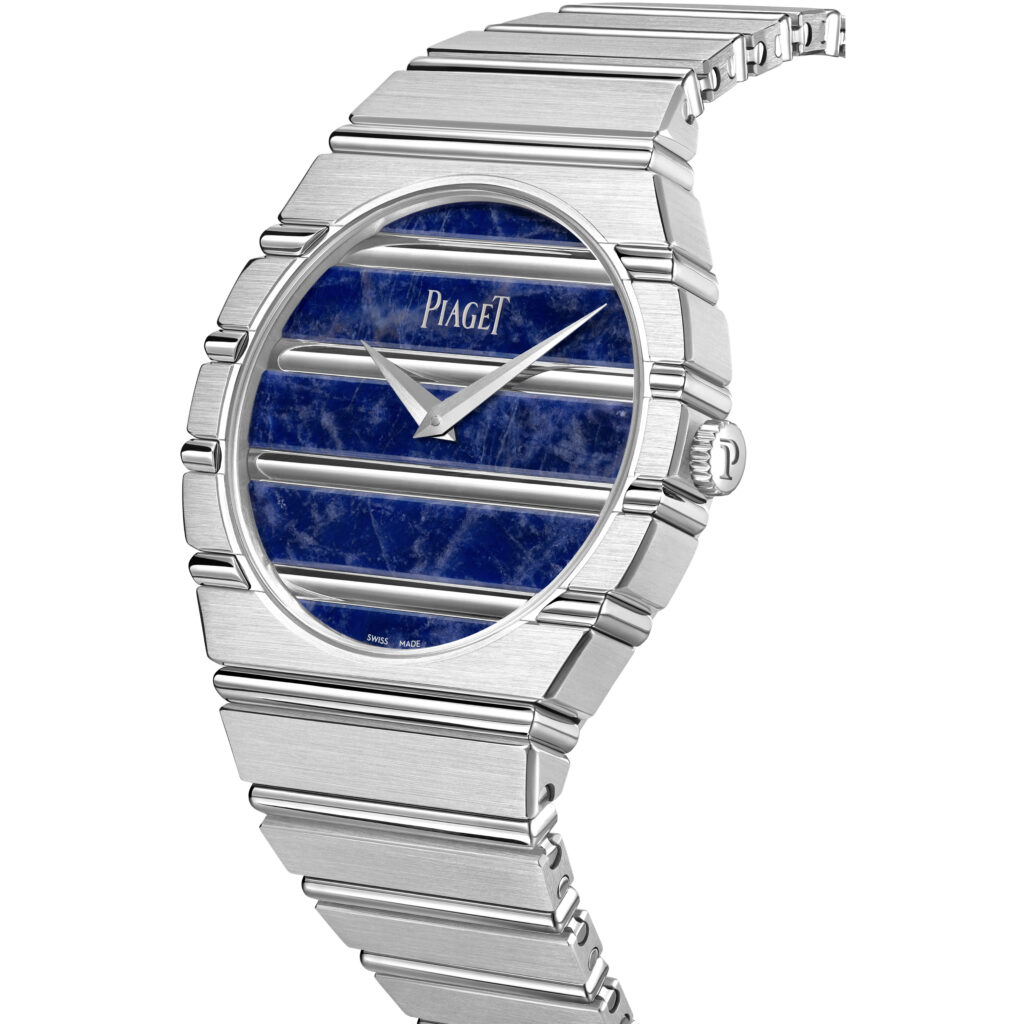
Piaget Polo 79 — Sodalite
Piaget is no newcomer to stone faces. The Maison was creating watches with ornamental-stone dials in the 1960s and ’70s. For 2026, the 38 mm Polo 79 features an approximately 2.8-carat blue sodalite dial, set into an 18K white gold case and integrated bracelet.
As many of you already know, sodalite is a more affordable – and lighter blue – alternative to lapis lazuli. What we find curious is that Piaget actually weighed the sodalite and listed the carat weight in its description. We can readily see how measurements would be helpful, but carat weight?
Image: Piaget
◈
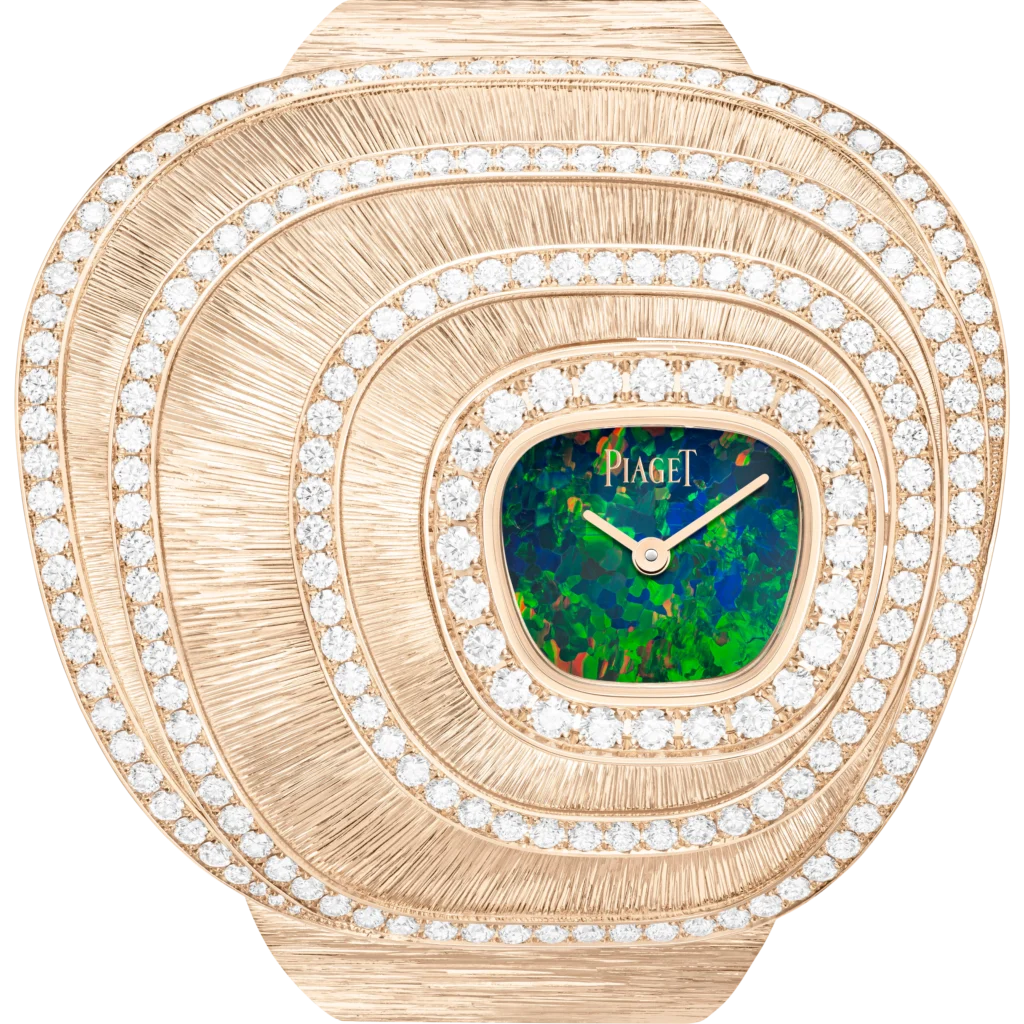
Piaget Sixtie Cuff Watch — Black Opal Dial
Now here’s a face that doesn’t need much help getting attention. Piaget places a spectacular black opal dial off-center in its diamond-set 18K rose gold Sixtie Cuff Watch. The bracelet is hand-engraved in Piaget’s “Décor Palace” style — a very 2026 interpretation of the extravagant jewelry watches the Maison was creating in the 1960s and ’70s.
While Piaget provides no details about the opal itself, with the material necessarily cut quite thin, it would be interesting to know if this is a thin slice of solid opal bonded to a metal support, as is commonly done with other stone watch dials (as reported by Roberta Naas).
Image: Piaget
◈
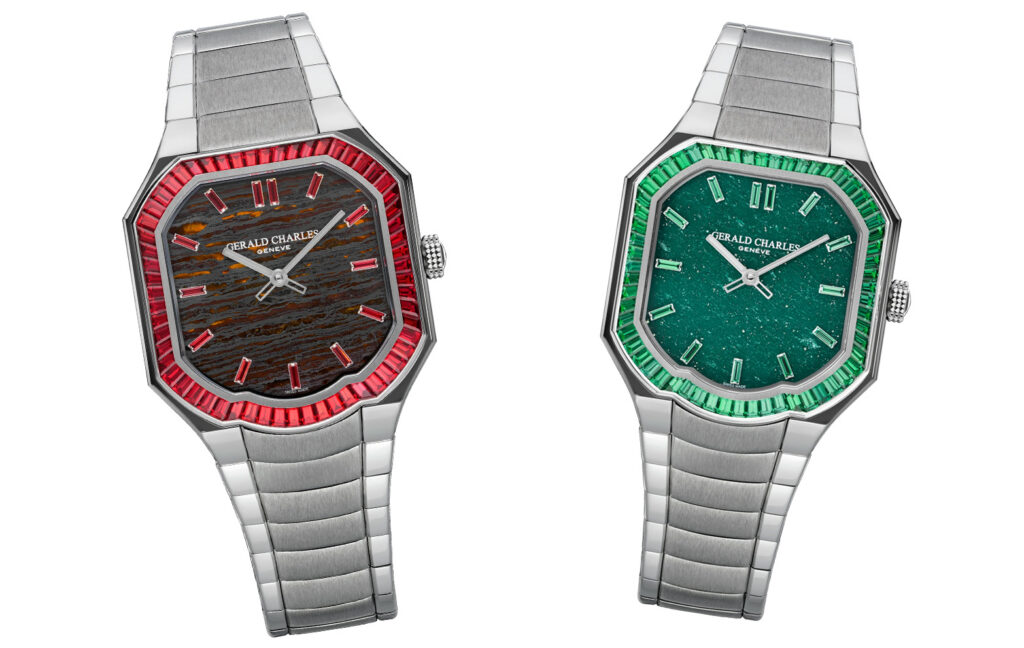
Gerald Charles Masterlink — Iron Eye Dial
Here’s a stone face with a complicated personality. Gerald Charles uses South African Iron Eye, a banded rock composed of hematite, jasper and tiger’s-eye. Those different components can mean three different mineral densities within a single dial, making the material particularly challenging to cut cleanly. The red, orange, brown and black dial is surrounded by a white gold bezel set with 60 baguette-cut “red sapphires” — their terminology, not ours.
We don’t know whether the unusual nomenclature has anything to do with treatment, but gemologists may find the description just a bit curious. [As you know, a red sapphire would normally be called ruby. One reason that we have seen for using this nomenclature is when a sapphire — that was not originally red — is somehow enhanced to change its color to red. Because it was never red to begin with, it is felt that the gem material does not deserve the variety name “ruby.” — gr]
Gerald Charles Masterlink — Aventurine Dial
For its green face, Gerald Charles chose Brazilian aventurine. Classic aventurine gets its characteristic sparkle from microscopic inclusions. Cutting the dial requires precise control to preserve the aventurescence without fracturing the stone. The green continues into the white gold bezel, set with 60 baguette-cut tsavorites.
Images: Gerald Charles
◈
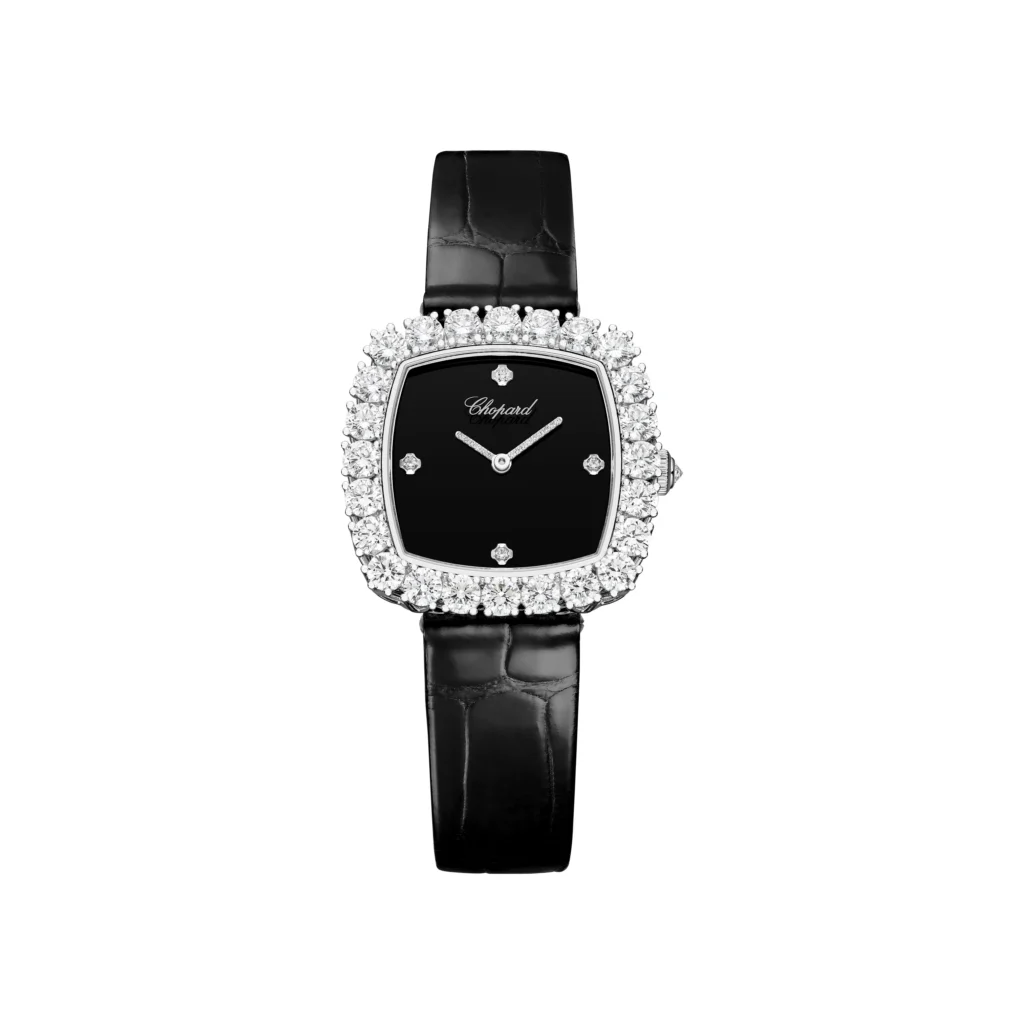
Chopard L’Heure du Diamant — Black Onyx Dial
Sometimes a stone face doesn’t need much color to stand out. Chopard uses a black onyx dial as the backdrop for 4.64 carats of diamonds in its 2026 L’Heure du Diamant. The 18K white gold bezel alone carries 4.40 carats, with additional diamonds marking the hours, decorating the crown (note the culet sticking out) and buckle — and even set into the hour and minute hands [tiny diamonds my father would have called genuine “canardlies,” because you can ’ardly see ’em. — gr].
This tuxedo watch — black and white — is almost a lesson in contrast: the highly polished black onyx provides a remarkably quiet background for a watch that otherwise has absolutely no intention of being quiet.
Image: Chopard
◈
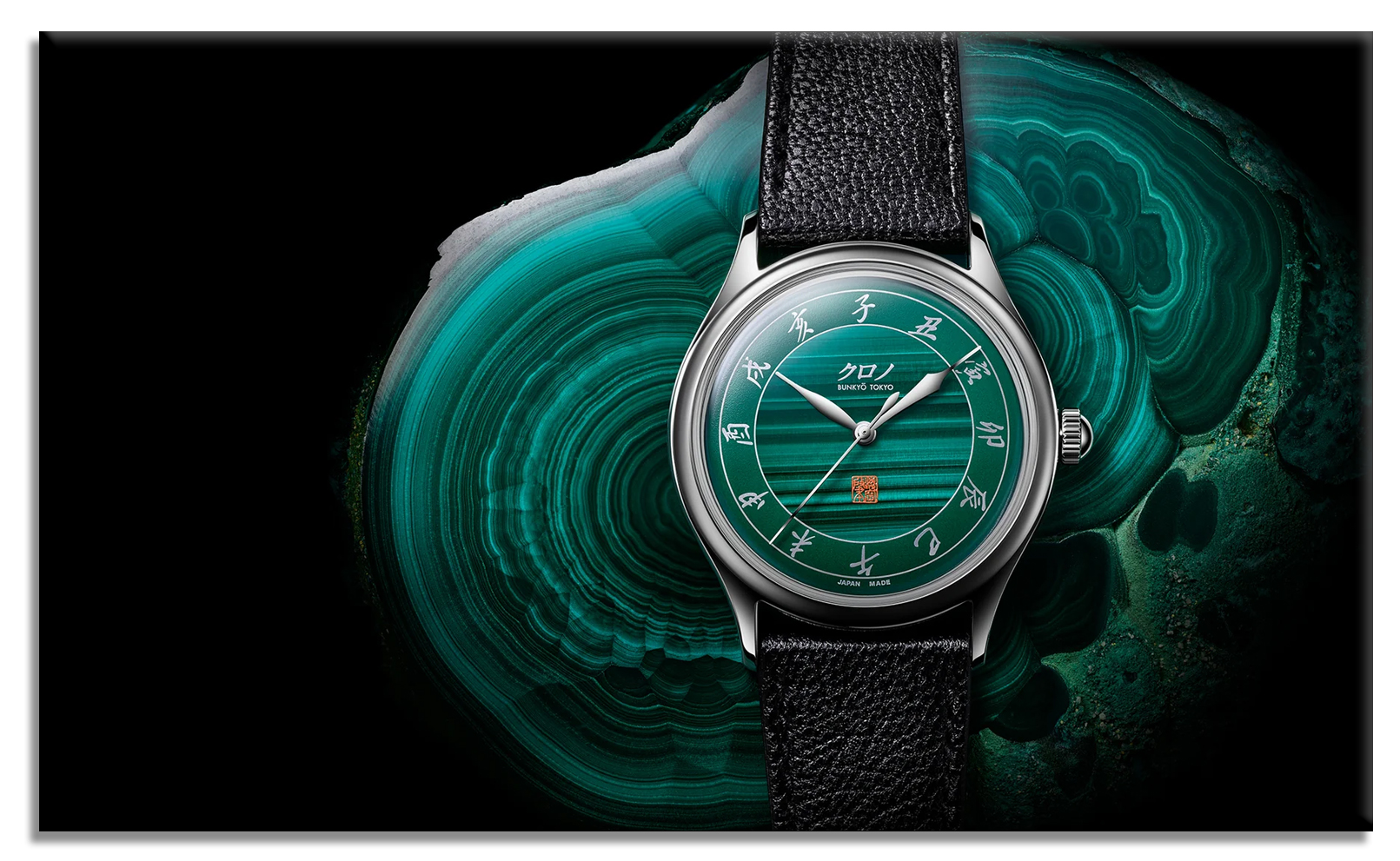
Kurono Tokyo Special Projects — Malachite Dial
Using X-ray was not something we expected to come across while writing this feature story about gemstone watch faces.
But apparently, Kurono Tokyo X-rays each malachite nodule to locate the desired “eye” before it is cut, and only two out of every ten dials survive the slicing process.
Interesting… In Japan, malachite is known as Kujaku-ishi — “Peacock Stone” — named for its eye-like patterns, which resemble the eye-like patterns in peacock feathers.
Also according to Kurono, the malachite banding pattern tells a story, a “lithic recording” of its geological formation. “The varying widths of the green bands are not random; they are the visual ‘sound waves’ of a planet in flux. Each band you see on the dial represents a specific period of seismic water flow and mineral concentration across tens of thousands of years.”
And look closely: the entire green dial isn’t malachite. The stone center is surrounded by a convex brass section colored with rokusho, a traditional copper-derived green pigment. So we have copper giving us the green of the malachite — and the green surrounding it. This section of the dial is then marked with the twelve Kanji Zodiac indices, traditionally used to indicate both time and direction.
Image: Kurono Tokyo
◈
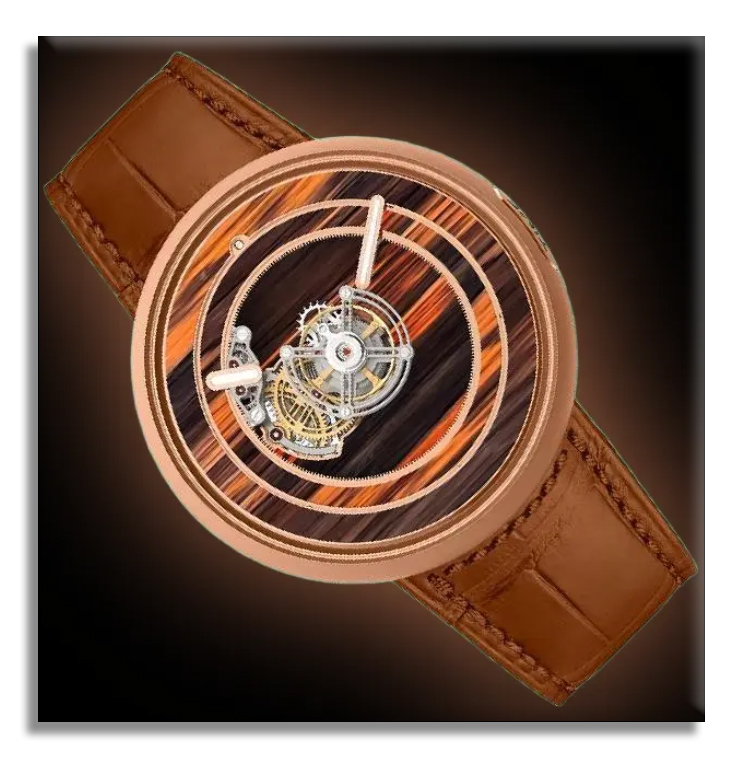
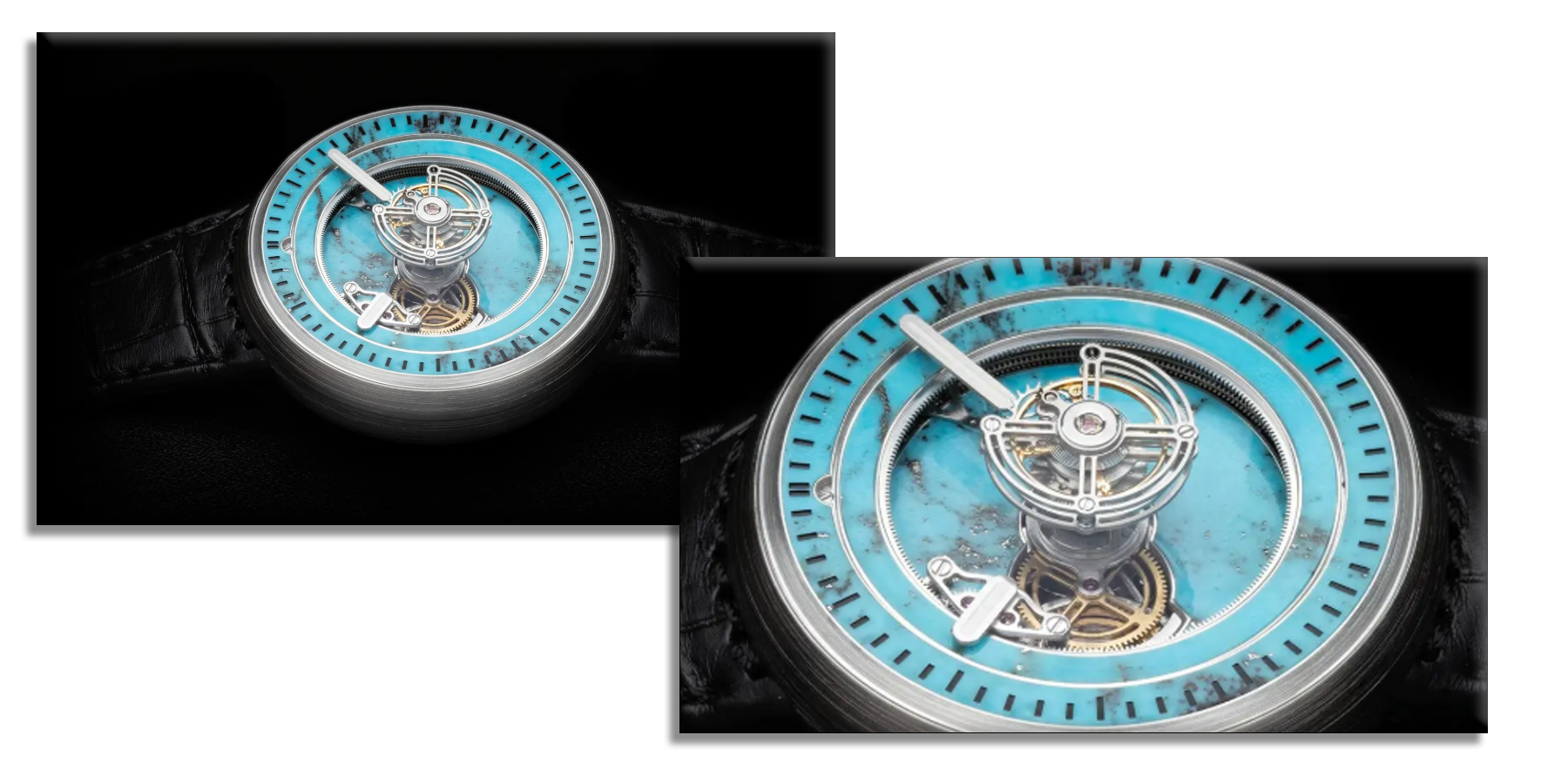
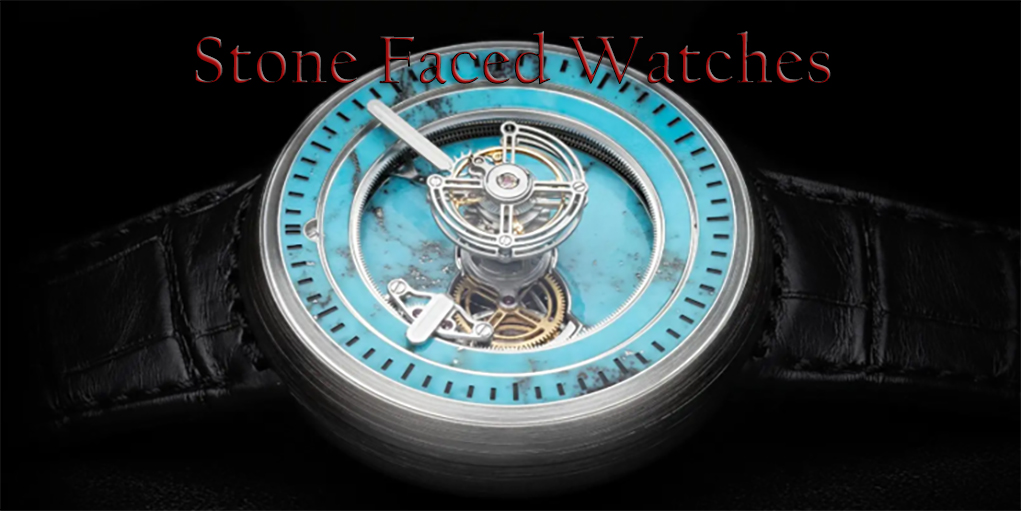
Kross Studio KS 05 — Turquoise Spider Stone & Mahogany Obsidian Dials
Kross Studio gives us two very different stone faces — and neither “is quite a “conventional” dial.
The KS 05 uses a three-part, or “triptych,” dial construction, three different layers, surrounding its central floating tourbillon. One version features Turquoise “Spider Stone,” while the other uses Mahogany Obsidian (a natural volcanic glass, displaying a wood-like pattern in reddish-brown to black bands).
According to TheWatchPages.com, Kross also makes this watch with Sodalite, Violet Jade, Specular Hematite, Malachite, Lapis Lazuli, Maw Sit Sit Jade, and “Ruby Heart.”
[We assume “Turquoise Spider Stone” refers to turquoise with spiderweb matrix. As for “Ruby Heart”? Well, we’re still trying to figure out exactly what that is. — gr]
Images: Kross Studio