

Gemology, diamonds, ancient jewelry, color science and the art of gem cutting come together November 20 at Nantes Université
Gemmologie & Francophonie will hold its first full day conference, Jardin d’Automne, on Friday, November 20, 2026, at Nantes Université, hosted at the Laboratoire de Planétologie et Géodynamique in Nantes, France.
The theme for the day is “Matière” — Matter — bringing together speakers from several disciplines to look at gems and jewelry from very different perspectives: laboratory gemology, mineralogy and color science, archaeology and jewelry history, materials, and the techniques and history of gem cutting.
Gemmologie & Francophonie is a relatively young association created to bring together gemologists, researchers, students and enthusiasts throughout the French-speaking gemological community. The association also publishes Gemmes, its French-language gemological journal, with Issue No. 8 scheduled for publication in September.
From Ancient Gems to Type IIa Diamonds
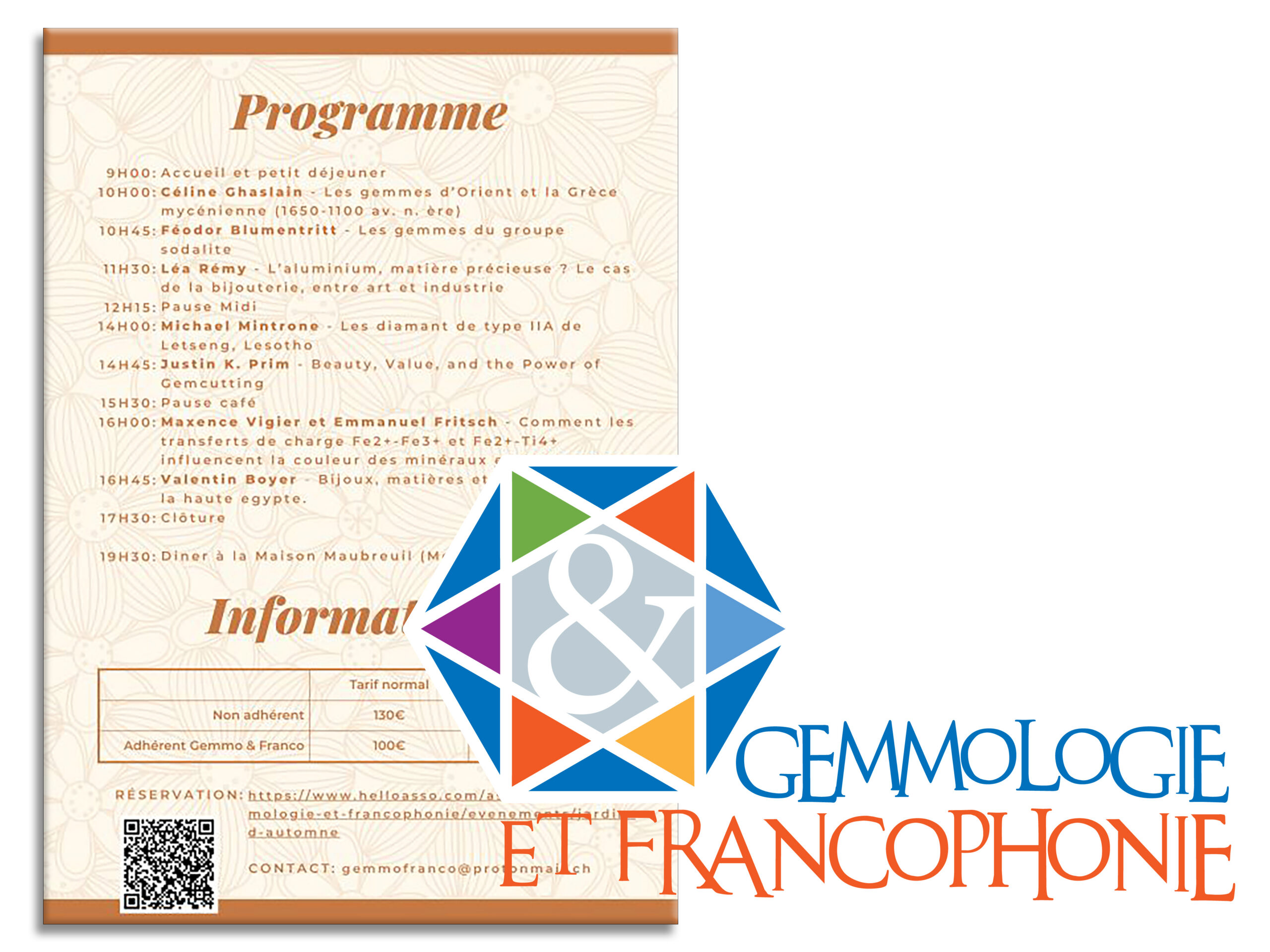
Céline Gaslain-Leduc opens the conference with “Gems of the East and Mycenaean Greece (1650–1100 BCE).” An art historian and archaeologist specializing in jewelry and material culture of the ancient world, Gaslain-Leduc brings an archaeological perspective to the use and significance of gem materials in Mycenaean Greece.
Féodor Blumentritt will present “Gems of the Sodalite Group.” Blumentritt’s scientific research has included the photochromism (a reversible change of color after exposure to visible or ultraviolet light) of sodalite — particularly hackmanite — and related materials. His doctoral research at Nantes was conducted under the supervision of Emmanuel Fritsch and Maria Teresa Caldes.
Léa Rémy, whose research with the Institut pour l’histoire de l’aluminium examines the history of early aluminum objects and jewelry, asks an intriguing question: “Aluminum, a Precious Material?” Her presentation looks at jewelry at the intersection of art and industry — and at a material that was once considered rare and precious before industrial production transformed its availability.
After lunch, Dr. Michael Mintrone, Head of the Diamond Department at the Swiss Gemmological Institute (SSEF), turns the program to diamonds with “Type IIa Diamonds from Letšeng, Lesotho.” Mintrone’s research includes the study of impurities in natural and synthetic diamonds and their identification.
The Power — and Science — of Gem Cutting
American gem cutter, author and researcher Justin K. Prim, now based in Lyon, France, will present “Beauty, Value, and the Power of Gemcutting.”
Prim is the founder of the Faceting Apprentice Institute, an online and in-person school devoted to teaching traditional and modern gemstone faceting. He is also curator of the Museum of Faceting Technology in Lyon, founded in 2018 to preserve the machinery, tools and technological history of gem cutting. The museum’s collection now includes more than 120 machines and accessories representing 24 countries.
Why Are Gems the Colors We See?
For gemologists particularly interested in the science of color, Maxence Vigier and Prof. Emmanuel Fritsch will tackle “How Fe²⁺–Fe³⁺ and Fe²⁺–Ti⁴⁺ Charge Transfers Influence the Color of Minerals and Gems.”
Fritsch, Professor Emeritus at Nantes Université and a former Manager of Research at GIA, has spent much of his career investigating the causes of color in gemstones and the application of spectroscopy to gemological research. Vigier and Fritsch have been involved in recent research examining Fe-Ti and Fe-Fe charge-transfer mechanisms and their effects on color in minerals and related materials.
The scientific discussion then gives way once again to history and archaeology.
Valentin Boyer, an Egyptologist and doctoral researcher, will present “Jewelry, Materials and Imitations in Upper Egypt.” Boyer’s research focuses on jewelry in ancient Egypt, including the materials, forms and social significance of personal adornment. He has studied at the École du Louvre and Heidelberg University and has participated in archaeological research in Egypt.
Conference Information
Jardin d’Automne
Friday, November 20, 2026
Nantes Université
Laboratoire de Planétologie et Géodynamique
Nantes, France
The conference fee, including lunch, is €100 for members of Gemmologie & Francophonie and €130 for non-members. Student rates are €50 for members and €65 for non-members.
A three-course gala dinner will follow at Maison Maubreuil at 7:30 p.m., available for an additional €50.
The association has also announced that an additional activity will be offered to Gemmologie & Francophonie members on November 21, with details to come.