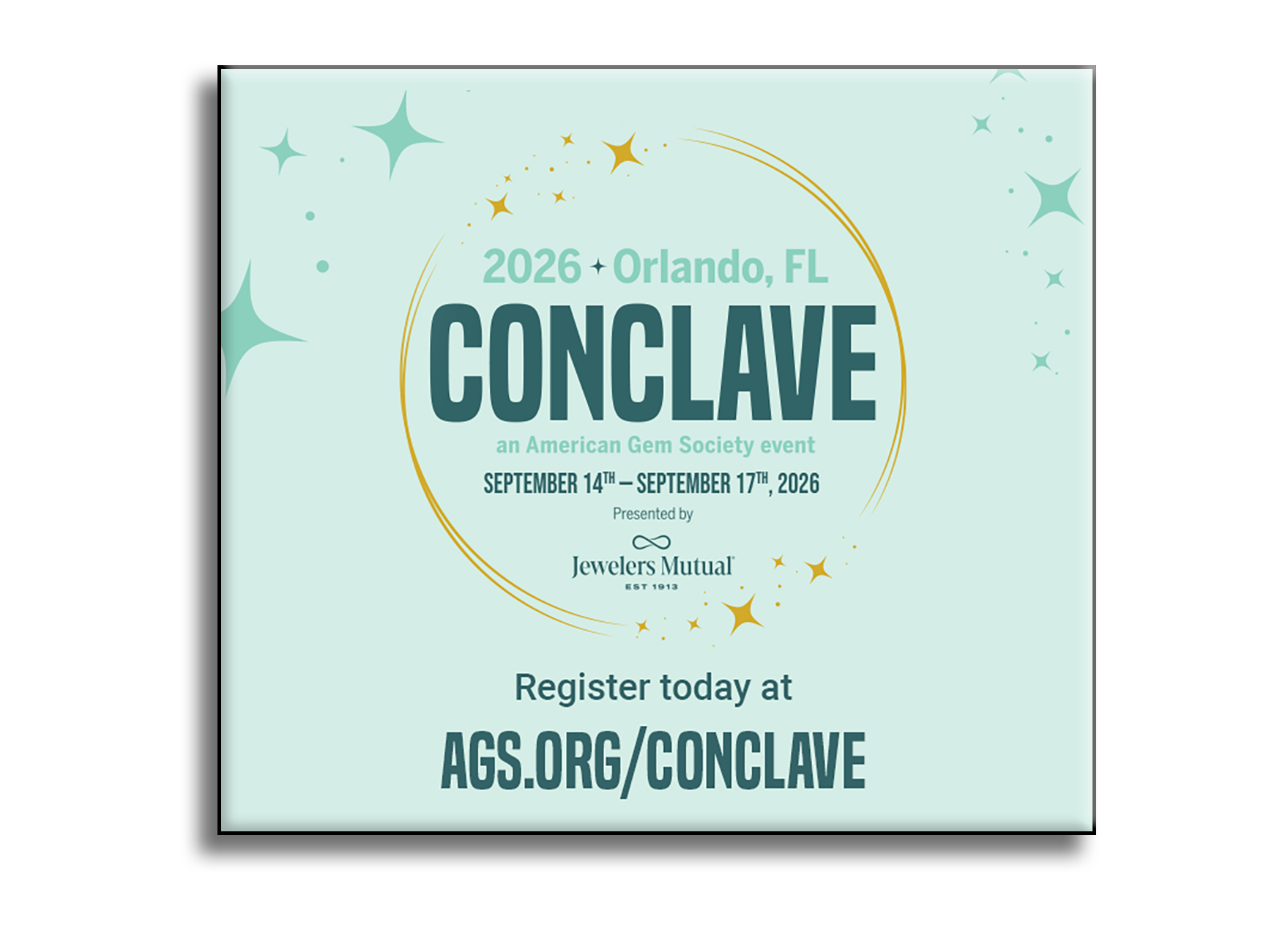


For gemologists heading to AGS Conclave, [and I am one – gr] there is plenty to keep you busy.
This year’s gem educational program ranges from colored stone treatments to synthetic diamond screening, diamond fluorescence, fancy-shape cut, colored gemstone pricing — and here’s one truly for the gemologist at heart… considering a “fancy” clarity for desirable inclusions.
Here are some of the gem-related sessions that caught our attention.
Colored Stone Treatments in the 21st Century
Nicole Ahline, Senior Manager of Colored Stone Research at GIA, will look at treatment methods introduced and developed over the past two decades and why recognizing them has become increasingly important in today’s market.
For working gemologists, this is fundamental. Treatments continue to evolve, which means identification cannot simply rely on what we learned when we first studied gemology (back in the 20th century).
Origin — and Treatments — with Aaron Palke
Dr. Aaron Palke, Senior Manager of Colored Stone Research at GIA, will discuss GIA’s expanding geographic-origin research, including newer origin services for jade, opal, demantoid garnet and peridot. He will also lead a hands-on session examining treatments in ruby and sapphire.
Origin determination has expanded considerably beyond the traditional ruby, sapphire and emerald discussion, making this an opportunity to see where laboratory origin research is heading. And the hands-on treatment session brings that research back to something immediately useful at the gemologist’s desk.
Inside Natural Diamonds
Nathan Renfro, GIA Senior Manager of Identification, returns to the microscope for a hands-on exploration of the internal world of natural diamonds.
Inclusions aren’t simply clarity characteristics. They can provide evidence of geological history and gemological identity — making the microscope one of the best places to understand what a natural diamond actually is.
The Ruby and Spinel Mines of Badakhshan
Laurie Reid takes attendees to the historic ruby and spinel deposits of Badakhshan, Tajikistan, through photography.
For anyone interested in provenance, this is the connection between the gemstone on the desk and the place it came from — a look at one of the world’s historic colored-stone regions and the mining landscape behind the gems.
The Amazing Natural Diamond Story
Dr. Christopher “Mike” Breeding, Senior Manager of Analytics at GIA, and Brenda Harwick, GIA Senior Manager of On Campus and Lab Gemology Instruction, return to the fundamentals: how natural diamonds form and the features that provide positive evidence of natural origin.
Luminescence: Much More Than a UV Lamp
Thomas Hainschwang, director and co-founder of GGTL Laboratories in Liechtenstein, argues that luminescence may be one of gemology’s most underrated physical properties.
This goes far beyond watching a stone glow under long-wave UV. Modern luminescence techniques now play an important role in diamond testing and in the examination of corundum, spinel, beryl and other gem materials, using imaging, spectroscopy and different excitation sources.
Can Your Diamond Screener Keep Up?
Guy Borenstein, FGA EGG, Director of Gemological Research and Lab Services at Stuller, will examine recent advances — and potential blind spots — in laboratory-grown diamond screening technology.
“Gemologist” Does Not Automatically Mean “Appraiser”
Randall Lightfoot, CGA, JEA, of Mayflower Estate Buyers & Consulting, and Mike West, ACGA, appraisal department manager at R.F. Moeller Jeweler, tackle an important professional distinction: earning a GG diploma does not by itself make someone a qualified jewelry appraiser.
Their session looks at the additional education and professional standards required for appraisal work, including the importance of USPAP. It’s an important distinction for gemologists — and for the clients relying on their valuation documents.
A Sneak Peek at GIA’s Fancy-Shape Cut Grade System
Amanda Hawkes, GIA Research Support Manager for the Cut Grade Research Team, and Lisa Kennedy, Technical Advisor for GIA Education, will explore contrast and dark zones in fancy-shaped diamonds.
Rather than treating every dark area as inherently negative, the session looks at how intentional contrast contributes to pattern, dimension and visual character. Of particular interest: attendees will get a sneak peek at GIA’s upcoming fancy-shape cut grade system.
Colored Gemstone Grading — and Pricing
Richard Drucker, founder and President Emeritus of Gemworld International, brings attendees into the notoriously complicated world of colored gemstone grading and pricing.
The hands-on workshop uses a systematic approach to color, clarity and cut, including actual gemstone grading using Gemworld’s World of Color system, before connecting those observations with pricing. For anyone buying, selling or appraising colored stones, that’s where gemology meets the marketplace.
What Does Fluorescence Really Do to a Diamond?
Dr. Mike Breeding of GIA takes on one of the diamond trade’s perennial debates: fluorescence.
Rather than relying on market assumptions, GIA researchers have quantitatively examined how blue fluorescence intensity affects table-down color, face-up color, brightness and transparency under controlled lighting. The research also distinguishes fluorescence-related contrast from transparency reduction caused by structural light scattering — potentially helping separate what we think we see from what can actually be measured.
Speaking the Pearl Language
Dr. Tao Hsu, GIA Director of Gemology Content and Professional Development, and Lisa Kennedy offer a hands-on look at pearl formation and, importantly, pearl terminology.
Can an Inclusion Be a Good Thing?
Here’s an intriguing one.
Dr. Evan Smith, Senior Research Scientist at GIA, whose research includes diamonds formed at depths greater than 300 kilometers, joins Jason Quick, GIA Senior Director of Diamond Cut Research, to turn traditional clarity thinking on its head.
We normally think of inclusions as value-reducing clarity characteristics. But what happens when an inclusion is exceptionally rare, scientifically fascinating, beautiful, or just totally awesome? Their session, “Fancy Clarity: For Exceptionally Rare and Desirable Inclusions,” asks whether such features deserve a way of being positively communicated on a gemological report.
Don’t Forget the Other Gemstones
Isabelle Corvin, CG, gemologist and merchandising manager at Panowicz Jewelers, turns the spotlight away from the Big Three colored stones and diamonds to peridot, garnet, tourmaline, zircon and spinel.
Her session combines the history, lore and science of gems that may be “underappreciated” commercially, but certainly aren’t lacking gemological interest.
And finally on our list…
How Do You Build a Gem Collection?
Robert Weldon, award-winning gem and jewelry photographer and former director of GIA’s Richard T. Liddicoat Gemological Library, joins Shelly Sergent, curator of the Somewhere In The Rainbow Collection, for a behind-the-scenes look at building, curating and photographing a major gem and jewelry collection.
The Somewhere In The Rainbow Collection has become an educational resource for museum and gemological exhibitions around the country. Weldon and Sergent will discuss both the curatorial decisions behind the collection and the photography that brings those gems and jewels to life.
◈
WOW! That’s a lot of gemology!
And while we probably won’t make it to every one of these sessions, the breadth is worth noting. From the microscope and the mine, to sophisticated laboratory instrumentation — and from scientific research to the practical realities of buying, selling, grading and appraising — AGS Conclave is giving gemologists plenty to choose from. (And there’s more!)
Tap here to get the full picture and for last minute registrations!
Looking forward to seeing you all there! – gr