

For decades, diamond grading reports have documented a stone’s color, clarity, carat weight, and proportions. Yet anyone who has spent time comparing diamonds knows that two stones with identical grades can look remarkably different.
That difference often comes down to cut.
Not just whether a diamond is well cut, but how precisely it was manufactured.
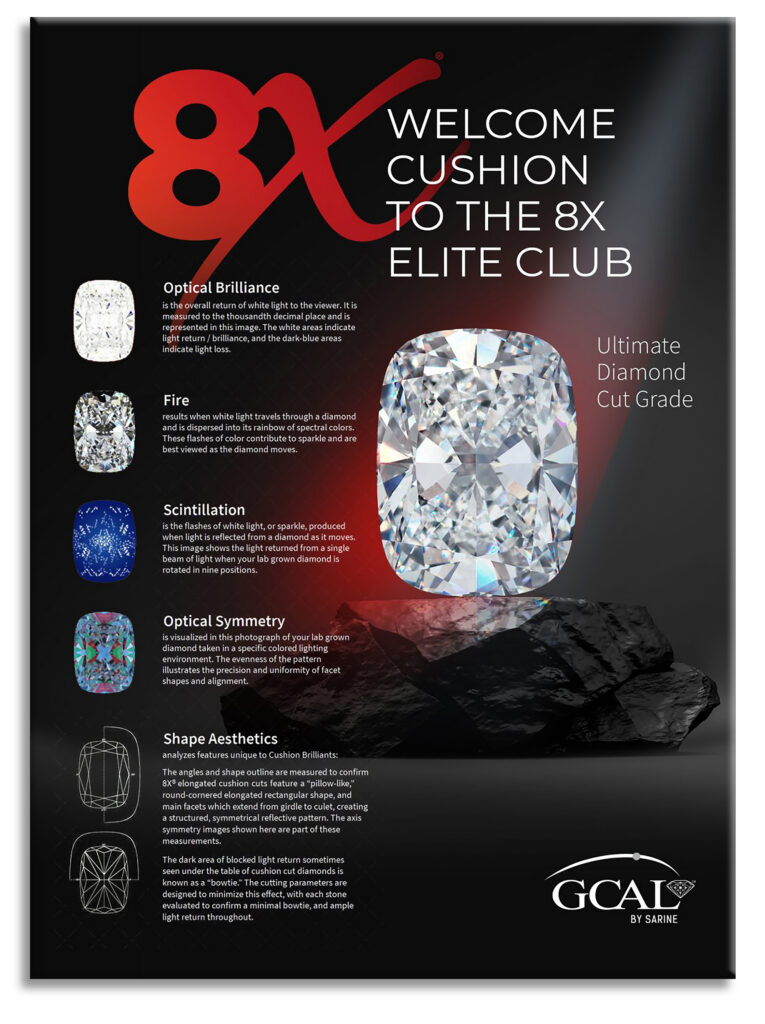
GCAL by Sarine recently expanded its 8X Ultimate Cut Grade program to include cushion-cut diamonds, joining Round Brilliant, Oval, Princess, Pear, Marquise, and Radiant shapes. The announcement adds one of the industry’s most popular fancy shapes to a program designed to identify diamonds that meet exceptionally strict standards for proportions, optical performance, symmetry, and overall appearance.
But the launch of an 8X Cushion grade also raises a broader question.
How much precision is enough?
And perhaps more importantly, what does that precision cost?
Gary Roskin
Roskin Gem News Report
Beyond polish and symmetry
Traditional grading of fancy-shaped diamonds has largely focused on polish and symmetry, with proportion measurements providing additional information about a stone’s overall design.
The challenge is that fancy shapes often vary dramatically in appearance, even when they share identical color, clarity, and carat weight grades.
A cushion cut with excellent light return may appear completely different from another cushion cut of the same size and quality that exhibits noticeable windowing or a strong bow-tie effect.
According to GCAL, its 8X system was developed to evaluate factors that extend beyond traditional grading metrics.
The program examines eight categories:
- Polish
- External Symmetry
- Proportions
- Optical Brilliance
- Fire
- Scintillation
- Optical Symmetry
- Shape Aesthetics
Together, those measurements are intended to provide a more complete picture of how a diamond actually performs when viewed by the consumer.
Not another “Excellent” grade
When discussing the development of 8X, GCAL President Angelo Palmieri repeatedly returned to a simple concept.
The program was never intended to become another broad category that large numbers of diamonds could easily achieve.
Instead, the goal was to identify only a very small group of diamonds manufactured to exceptionally tight standards.
“Most of the time when you see a cut grade announced, it’s a participation trophy,” Palmieri said. “Everything gets an Excellent.”
“8X was created to recognize only the very elite. We made a concerted decision at the outset that this was not going to be a participation trophy. This was going to be a cut grade for the true cut fanatics.”
This includes extremely narrow proportion ranges. It means evaluating not only measurements but also optical performance and visual appearance.
The objective is consistency.
Palmieri described the ideal 8X diamond as one that removes uncertainty from the buying process. Rather than forcing retailers and consumers to compare multiple diamonds searching for the best performer, the standard is intended to ensure that every qualifying stone reaches a similarly high level of visual performance.
For Palmieri, that philosophy became particularly evident during a recent retailer training session.
A retailer reviewing multiple 8X certificates remarked that the performance images all looked remarkably similar.
According to Palmieri, that was exactly the point.
“The images all look the same,” one retailer observed.
“That’s the idea,” Palmieri replied.
“The standard is created in a way that these stones should be cookie cutters—but in a good way. There should be very little room for variation in any of them.”
The goal is not simply to identify beautiful diamonds.
The goal is to create a standard so narrow that every qualifying diamond performs within an extremely limited range.
Why cushions are different
Among all major diamond shapes, cushion cuts may be one of the most difficult to standardize.
Unlike rounds, cushion cuts exist in numerous variations. Some are elongated. Others are square. Some feature large, chunky facets reminiscent of historical cutting styles. Others display the splintered reflections commonly associated with “crushed ice” cushions.
Attempting to create a single performance standard for all of those variations presents a significant challenge.
Palmieri describes the cushion category as the “Wild West” of diamond cutting.
“Cushion took the longest of any shape,” Palmieri explained. “It comes in so many different varieties and forms, and there’s no standardization.”
GCAL’s solution was not to accommodate every variation.
Instead, the laboratory chose to define a specific visual model.
The current 8X Cushion standard applies only to elongated cushion brilliants. Crushed-ice cushions do not qualify, nor do several other cushion variations commonly seen in the marketplace. The decision intentionally narrows the field, but it also allows the laboratory to create a more consistent visual standard.
Square cushions are expected to follow in the future, while antique-style cushions are also being considered for future development.
Behind the scenes: a digital cutting environment
Perhaps the most revealing part of our conversation involved what happens before a diamond ever reaches the grading laboratory.
Modern diamond manufacturing increasingly relies on sophisticated digital measurement systems capable of recording thousands of individual measurements.
Manufacturers pursuing 8X certification can submit those measurement files for analysis before formally submitting a diamond for grading.
According to Palmieri, GCAL first evaluates the stone’s proportions against the requirements of the 8X standard. Diamonds that satisfy those requirements move to additional analysis involving optical modeling and ray tracing.
The process allows manufacturers to identify promising candidates before the stones enter the laboratory.
Palmieri said the process is collaborative before formal submission, but independent once the diamond enters the lab.
“Before manufacturers officially submit a diamond for certification, we help them understand how to manufacture toward the 8X standard,” he said. “Once it enters the lab, it either meets the standard, or it doesn’t.”
In some cases, cutters can even determine which adjustments may be necessary to improve a stone’s chances of qualifying.
The approach highlights just how data-driven diamond manufacturing has become.
For many consumers, diamond cutting still evokes images of craftsmen working at polishing wheels. While that craftsmanship remains essential, today’s cutters increasingly work alongside advanced software, digital scanning systems, and optical modeling tools that allow performance to be predicted long before a finished diamond reaches a showcase.
The cost of perfection
One of the unavoidable realities of precision cutting is that perfection often comes at a price.
According to Palmieri, manufacturers evaluating the 8X standard have reported potential yield losses ranging from approximately 7% to 15% compared to more conventional cutting targets. The exact amount varies by shape and starting material, of course, but the underlying challenge remains the same.
For generations, diamond cutters have balanced two competing objectives.
The first is beauty.
The second is weight retention.
Ideally, a cutter wants both. In reality, improving one often means sacrificing some of the other.
A slightly different crown angle may preserve weight. A pavilion adjustment may increase yield. Small changes to facet placement can save valuable points that affect the final carat weight.
Those decisions are not necessarily wrong. In fact, they are often practical business decisions.
The challenge is that every compromise leaves a visible fingerprint somewhere within the finished diamond.
That reality helps explain why two diamonds with identical color, clarity, and carat weight grades can sometimes look surprisingly different when viewed side by side.
The philosophy behind 8X is that optical performance should take precedence over weight retention.
“It is an extraordinary standard to try to hit,” Palmieri said.
Rather than asking, “How much weight can be saved?” the process asks, “What would this diamond look like if performance were the primary goal?”
That approach does not necessarily make sense for every manufacturer or every market segment. In today’s diamond market, where pricing pressures remain significant, sacrificing additional rough weight can be a difficult economic decision.
Yet that tradeoff is also what gives the 8X concept much of its meaning.
The standard is not simply evaluating a finished diamond.
It is recognizing the manufacturing decisions made long before the stone reached the grading laboratory.
In that sense, an 8X diamond represents more than a grading result. It reflects a deliberate choice to prioritize optical performance over maximum yield.
A broader trend toward measurable performance
GCAL is not alone in exploring light-performance analysis.
Several grading laboratories now provide some form of optical-performance information, reflecting growing industry interest in measuring not only what a diamond is, but how it actually looks.
What distinguishes the 8X program is its attempt to combine those measurements with a highly restrictive set of manufacturing standards designed to identify only a small percentage of qualifying stones.
Whether that approach eventually becomes commonplace remains to be seen.
Palmieri believes the broader conversation around measurable light performance is still in its early stages.
“We’re not yet at the phase where you can’t buy a diamond without a lab report and a light-performance analysis,” he said. “But I think it’s heading that way.”
For now, the expansion of 8X into cushion cuts offers a glimpse into a larger industry trend.
As diamonds become increasingly difficult to differentiate based solely on traditional grading metrics, manufacturers, laboratories, and retailers continue searching for ways to quantify beauty itself.
That may be an impossible goal.
But with every new iteration of cut analysis, optical modeling, and performance grading, the industry moves one step closer.
And for GCAL, the newest cushion standard represents another attempt to answer one of diamond cutting’s oldest questions:
How close can a cutter come to perfection?
About GCAL by Sarine
GCAL by Sarine is an ISO/IEC 17025 accredited gemological laboratory known for its commitment to accuracy, transparency, and consumer protection. GCAL pioneered the industry’s money-backed grading guarantee and continues to lead in performance-based diamond grading, including the 8X Ultimate Cut Grade.