


You may be thinking: Didn’t we already cover tariffs?
Yes, we did. But…
So what’s changed?
Nothing dramatically overnight—but the Huffington Post and AGTA’s latest updates include several developments worthy of your attention, especially if your business depends on imported gemstones.
The U.S. Supreme Court
First, you may recall that Trump’s previous tariff program under IEEPA* was struck down by the U.S. Supreme Court on February 20, 2026.
*The Administration used IEEPA—the International Emergency Economic Powers Act of 1977—to justify certain tariffs by claiming trade-related conditions amounted to a national emergency. Critics argued the law was intended for sanctions during true emergencies, not broad tariff policy, and that tariff authority normally rests with Congress under more specific trade statutes.
Huffington Post, AGTA on refunds update
If you have been waiting for refunds, there is news.
The American Gem Trade Association (AGTA) reported that U.S. Customs and Border Protection was in the final stages of developing an online claims portal for prior IEEPA tariffs, expected to cover both finalized and unfinalized entries, including applicable interest.
The Huffington Post announced today, Monday April 20th, that the site is now up.
“As of 8 a.m. EST, refund requests can be submitted through the U.S. Customs and Border Protection by any entity that officially paid the tariffs imposed under President Donald Trump’s International Emergency Economic Powers Act.”
Of course, this will not include those of us indirectly affected by Trump’s tariffs.
“Refund requests are expected to be fulfilled within 60 to 90 days after a list of duties, submitted through the CBP’s program, is validated and accepted.” The report goes on, saying businesses that get refunds are not obligated to pass those proceeds on to their customers.
Not over just yet. The Trump administration offers up a new tariff instead.
In response to the ruling, the Trump Administration moved to another trade statute in order to continue imposing tariffs: Section 122 of the Trade Act of 1974.
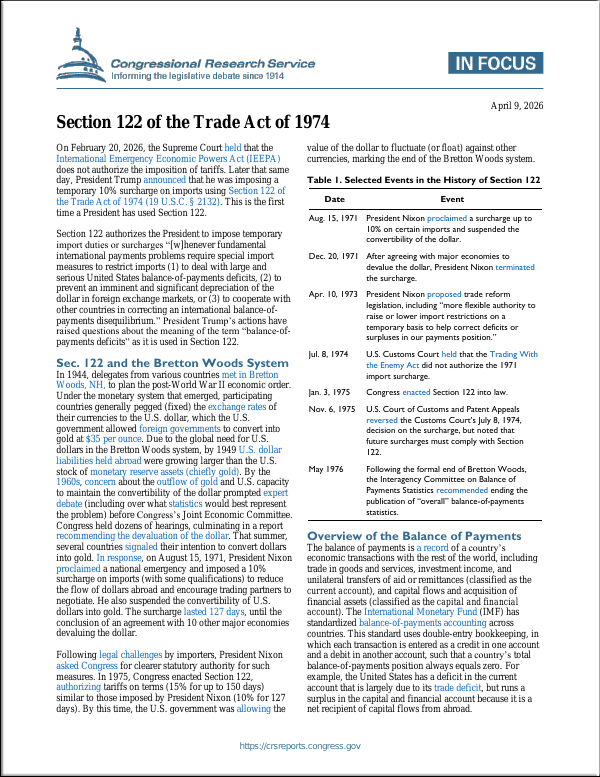
Section 122 of the Trade Act of 1974
“This is the first time a President has used Section 122.”
Section 122 allows a president to temporarily impose tariffs or import restrictions during serious balance-of-payments or international financial concerns. It was designed as a short-term emergency tool, and in the current case is being used as a broad global measure.
Key words: Temporarily. Short-term. And a broad Global measure.
10% Tariff
And that brings us to the current tariff: a 10% global import surcharge.
And how long does this one remain in effect?
As of now, it is scheduled to expire July 24, 2026, unless Congress extends it. Frankly, we would not suggest making business plans around a quick expiration.
Could the tariff rate increase?
Possibly.
There has been discussion of raising it to 15%, the statutory maximum under this law, although no such action has been taken—at least not yet.
Best bet: AGTA is still working on it
As you may recall, AGTA spent months working through earlier tariff frameworks that often required country-by-country relief efforts under Annex III.
Now, under the new Section 122 surcharge, AGTA now sees another path.
The proclamation includes exemptions listed under Annex II, including for natural resources that cannot be grown, mined, or produced in the United States.
AGTA argues that loose gemstones should qualify under that language.
To that end, AGTA has formally petitioned the Office of the United States Trade Representative (USTR) to ensure loose gemstones are properly included in the exemption.
But there’s more coming
AGTA also reports that Office of the United States Trade Representative (on behalf of the Trump Administration – gr) launched two Section 301 investigations in March.
Section 301 allows the U.S. government to investigate foreign trade practices considered discriminatory or inconsistent with U.S. trade rights—and to respond with tariffs or other restrictions.
The first investigation focuses on excess industrial capacity among 16 trading partners, including Thailand, India, Vietnam, and Japan.
The second reviews forced-labor prohibitions and enforcement involving 60 trading partners, including Thailand, India, Sri Lanka, and members of the European Union.
Both investigations are moving on an accelerated timeline and are expected to conclude before July.
The Trump Administration appears to be looking for more tariff revenue, so what follows these investigations could include new country-specific tariffs, product-specific tariffs, negotiated exemptions, or tougher import requirements.
That means July 24 may not be the end of tariff pressure—it could simply be the next transition point.
And yes, it’s still being challenged in court
A hearing was held April 10 before the U.S. Court of International Trade regarding the Trump Administration’s use of Section 122 to instate new tariffs. Plaintiffs are seeking to block the tariffs and obtain refunds of duties already paid.
So where does this leave the gem business?
Here is the practical summary:
- The 10% surcharge remains in effect
- July 24 is still a key date—but may not bring final relief
- Additional tariff pathways are already being explored by the Trump Administration
- Legal challenges are underway
- AGTA continues pressing for gemstone exemptions
There is no immediate resolution yet, and yes, these developments directly affect costs, sourcing decisions, and future planning for importers.
Tap here for AGTA’s full update for those who would like the complete report.