
Just when many in the gem trade thought they
finally understood the last round of U.S. tariffs…
the tariffs have changed again.
Gary Roskin
Roskin Gem News Report
Over the past couple of weeks, the American Gem Trade Association (AGTA) has issued multiple alerts covering new presidential proclamations, Section 301 investigations, Canadian imports, Brazilian gemstones, Russian sanctions, and multiple sections of U.S. trade law.
The result?
Déjà vu.
The same tariff questions… all over again.
The answers?
Okay, here’s where things stand.
The temporary tariff is gone. Now comes Section 301.
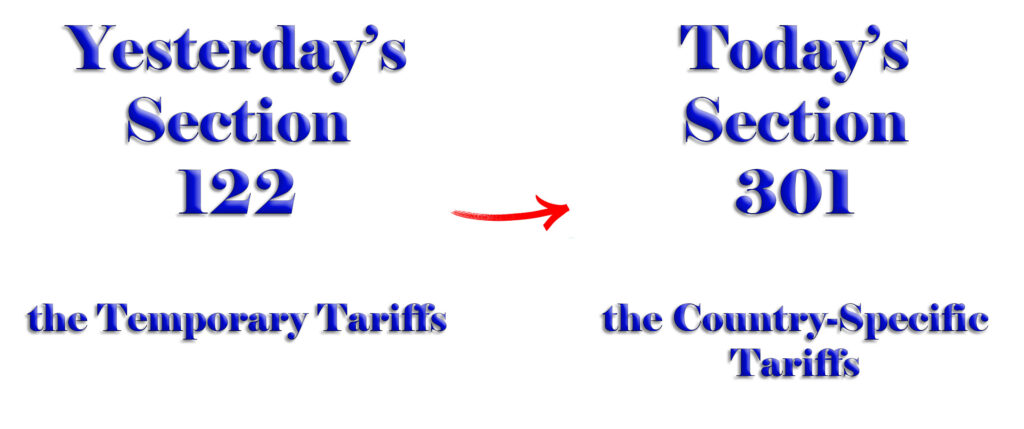
When the courts struck down the Administration’s IEEPA tariffs, the White House temporarily replaced them with a 10% global surcharge under Section 122 of the Trade Act.
That temporary tariff expired on July 24.
In its place, the Office of the United States Trade Representative (USTR) has now implemented country-specific tariffs under its Section 301 forced-labor investigations.
The Section 301 tariffs took effect Friday July 24, 2026
On July 23, the Office of the United States Trade Representative issued its final decision in its Section 301 investigation into forced-labor practices involving sixty countries.
The new tariffs took effect July 24.
Depending on the country, imports are now subject to a tariff of 10% or 12.5%. The 431-page notice also includes exemptions for certain products from certain countries.
And this is where the gem trade needs to pull out the loupe for a closer look.
Country Specific
According to AGTA’s preliminary review, loose colored gemstones, natural pearls, and gem-quality diamonds are exempt when imported from Cambodia, Indonesia, Malaysia, the European Union, Switzerland, and Taiwan.
But imports from several of the world’s most important gemstone cutting and trading centers are not exempt.
Loose gemstones imported from India and Sri Lanka are now subject to a 10% tariff. Those from Thailand and Vietnam face a 12.5% tariff.
China and Hong Kong are also subject to the new 12.5% tariff, in addition to previously existing Section 301 tariffs.
Meanwhile, important gemstone-producing countries including Kenya, Madagascar, Malawi, Mozambique, Tanzania, and Zambia were not among the sixty countries investigated and therefore are not subject to these new Section 301 tariffs.
In other words, whether a gemstone is exempt now depends on two things: what you’re importing and where it comes from.
The contradiction at the center of the exemptions
There is also a revealing irony here.
USTR says exemptions were granted, in part, for products that cannot be produced in sufficient quantities—or at reasonable prices—in the United States.
Loose colored gemstones, natural and cultured pearls, and gem-quality diamonds would appear to fit that description.
Yet instead of granting a universal exemption, the final determination exempts gemstones from some countries while continuing to impose tariffs on imports from many of the world’s principal cutting and trading centers.
It is that inconsistency that is the problem. For more than a year, AGTA has been working to address that inconsistency by asking that loose colored gemstones be moved from Annex III to Annex II.
Brazil is different
Brazil is already traveling on its own separate tariff track.
Beginning July 22, finished goods—polished loose colored gemstones—imported directly from Brazil became subject to a 25% tariff.
Brazilian rough gemstones, however, remain exempt. So much for encouraging in-country beneficiation.
Canada now enters the picture—in a big way
Another surprise came on July 20.
President Trump issued a proclamation imposing new 50% tariffs on nearly $20 billion worth of Canadian imports under Section 338 of the Tariff Act of 1930.
The tariffs are scheduled to take effect August 19 unless negotiations produce a different outcome.
The proclamation exempts certain products, including energy and critical minerals, but whether loose gemstones qualify for one of those exemptions remains unclear.
AGTA says it is seeking clarification from the Administration.

Russia: A Different Kind of Tariff
Not every proposed tariff now under discussion is intended to protect U.S. industries or reduce trade deficits.
Congress is also considering legislation designed to pressure countries that continue purchasing Russian oil and natural gas, with the goal of reducing the revenue Russia uses to finance its war against Ukraine.
The proposal would authorize tariffs of up to 100% on imports from those countries. India and China—both major centers for gemstone cutting and jewelry manufacturing—could be affected because of their continued purchases of Russian energy.
Unlike the Administration’s broader trade actions, this proposal is tied directly to the ongoing war in Ukraine and the international sanctions effort.
Whether the legislation ultimately becomes law remains uncertain.
So… what should importers expect?
Right now, the answer depends largely on where the gemstone was substantially transformed, not necessarily where it was mined.
Several different tariff programs are moving forward simultaneously, each using different legal authority, different countries, and different effective dates.
That means importers should expect more changes over the next several weeks rather than fewer.
AGTA’s Long-Term Goal Hasn’t Changed
While the latest tariff announcements may seem like yet another twist in an already complicated trade picture, AGTA’s strategy has remained remarkably consistent.
Its objective remains the same: secure a permanent exemption rather than fight country-by-country tariff battles whenever trade policy changes—by moving loose colored gemstones from Annex III to Annex II.
That effort continued even as this feature story was being finalized. On July 29, AGTA met with Deputy U.S. Trade Representative Ambassador Jeffrey Goettman, accompanied by Congressman Randy Weber (R-Texas), to continue pressing the industry’s case. AGTA described the meeting as encouraging and said it remains cautiously optimistic that a favorable resolution can be achieved.
AGTA has now been working toward that goal for well over a year. Whether it ultimately succeeds remains to be seen. Until then, keep your fingers crossed and your loupe handy.
◈

Want to help support AGTA’s efforts? Write to AGTA headquarters: info@agta.org.
Tap here to read the AGTA’s Tariff announcements.
Still with us? If you’re planning to dig into the AGTA announcements yourself, here’s a quick translation guide to help decode some of Washington’s favorite phrases.
Tariff Translation Guide
Because someone has to translate Washington, D.C., into plain American English.
| Washington Says… | It Means… |
|---|---|
| Trading partner | Country |
| Duties | Tariffs |
| Country of origin | Where the gemstone comes from |
| Entry | Import |
| Product-specific exemption | Some products are exempt |
| Non-industrial diamonds | Gem-quality diamonds |
| Applicable HTSUS classification | The type of gemstone being imported |
| Subject to additional duties | You’ll pay another tariff |
| Particular economies | Certain countries |