
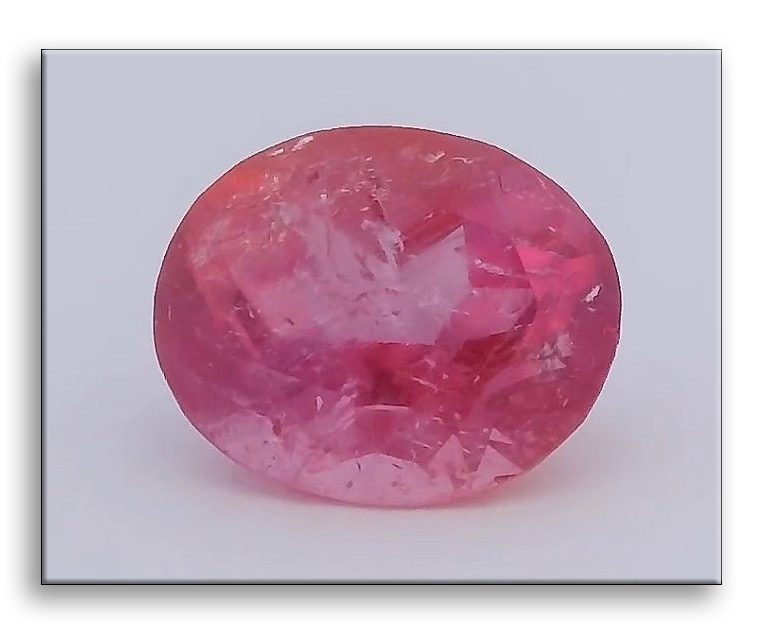
Discovered in Madagascar in the late 1990s, pezzottaite was initially mistaken for pink tourmaline or morganite (pink beryl) before laboratory testing revealed it to be something else entirely. Further analysis showed pezzottaite to be a rare, cesium-rich mineral belonging to the beryl group that had never before been identified.
Although it shares a common lineage with emerald and morganite, pezzottaite stands apart visually as well as structurally. In its best examples, its orangy-pink to purplish-pink hues can rival the beauty of fine morganite. At the same time, pezzottaite behaves differently in ways that matter to gemologists. It crystallizes in the trigonal system rather than the hexagonal system typical of beryl, a structural difference driven largely by its unusually high cesium content. That distinction is the reason pezzottaite presents such a clear set of identifying features—most notably its strong pleochroism, which becomes an important part of recognizing the material.
Get Out Your Dichroscope
Beryl (including pezzottaite) is a doubly refractive crystal, meaning that light entering the stone splits into two polarized rays traveling in slightly different directions and at slightly different speeds. As a result, the rays absorb light differently and—when viewed through a dichroscope—reveal two distinct colors, a phenomenon known as pleochroism.
Optically, pezzottaite behaves differently from the stones it was first confused with. Morganite, a pink variety of beryl, is only weakly pleochroic, typically showing subtle shifts between pale pink, peach, or near-colorless hues. In most cases, those differences are slight enough to have little impact on cutting or face-up appearance.
Pink tourmaline, by contrast, is strongly pleochroic, but the effect is usually expressed as variations in saturation—light pink versus darker pink—rather than a pronounced change in hue. Pezzottaite stands apart in showing stronger and more distinctive pleochroism, commonly displaying a clear difference between pink and purplish-pink in opposing crystallographic directions. That directional color difference is readily visible with a dichroscope and has real implications for cutting. Depending on orientation, a cutter can emphasize warmer, padparadscha-like peach hues or push the stone toward vivid, high-saturation pink, giving pezzottaite a broader visual range than many expect.
Supply & Demand
What ultimately sets pezzottaite apart in the market, however, is not just its color, chemistry, or optical properties, but its supply history. The material came from a single locality in Madagascar and was mined for only a brief period—less than three years. Commercial production effectively ended shortly after its discovery, and no sustained or economically meaningful deposits have followed. Nearly all pezzottaite available today traces back to that narrow window in time more than two decades ago.
Because pezzottaite entered the trade quickly—and then disappeared just as abruptly—it remains one of those gemstones that still feels “new,” even years after its discovery.
Tom Cushman in Madagascar
Tom Cushman, an established Idaho-based colored gemstone supplier, was already there. After managing a retail jewelry store in Chicago, he left retail behind in the early 1990s and from the advice of a local gemstone merchant, went directly to Madagascar, making his first trip in January 1991. From that point forward, he returned regularly—sometimes three, four, five times a year—buying gemstones straight from miners, establishing an office where they would come to him, and building long-term relationships in the country’s pegmatite regions well before Madagascar became a familiar name in the colored stone trade.
By the time pezzottaite showed up, Cushman was a known buyer, working day-to-day in the market.
Cushman saw it from the beginning. Miners began showing him unfamiliar pink stones, asking him what they were. “From the day it came out of the ground, they were showing me these pink stones.” Cushman watched carefully as it emerged in real time, buying it as it appeared, and navigating its identification, pricing, and early demand.
Rarity, Quality, and Reality
On quality and rarity, Cushman is blunt. Pezzottaite came from “one place, one time, 20 some years ago,” he said, and “what there is is all there is.” Inclusions are not the exception. “You expect it to be included,” he said. “It is far more included than emerald.”
As for the question, will they ever find any more, he noted reports of a very small, more recent pocket—within the last four or five years—but said the largest stones were “maybe three millimeters” in size. “There isn’t a one-carat stone in the lot,” he said, describing it as melee, and not a new supply of center stones.
“From the Time It Came Out of the Ground”
“When pezzottaite first started showing up in front of me, it wasn’t theoretical,” Cushman said. As a new mineral, identification was first left to the professional gem labs. But then it was up to Cushman and others in the field to know what to look for. As Cushman notes, “it was very easy to identify with a dichroscope. It’s got a purple half and a pink half… so easy….”
He bought what he could and rode the first wave of attention when pezzottaite became “the Stone of the Show” in Tucson. “It was hot, hot, hot,” recalled Cushman, and he sold a lot early on.
But then the market cooled. One cannot really predict this kind of event. There are colors that are always popular, and others that come and go in waves. That, Cushman said, is where the real lesson begins. When “nobody was selling,” he still had confidence in the stone’s beauty. He went back to the Malagasy and expatriate dealers who had bought pezzottaite when it was hot, and purchased as much of their inventory as he could. Cushman put it all in the vault, and left it there, waiting… for years.
After COVID, Cushman decided it was finally time to open the vault. “It’s been twenty years. Time to bring it back.”
Emerald Treatment
In that twenty-year pause, emerald treatments were becoming more accepted. One specific enhancement, Excel, caught Cushman’s attention, because it not only enhances better than any other enhancement (hiding fissures better, resists steam and heat, won’t leak out), but if someone is a collector and doesn’t want an enhanced pezzottaite, unlike other enhancements, this one can be professionally removed. Excel was first introduced to the trade by Arthur Groom, emerald expert in Ridgewood, New Jersey, and Fernando Garzon of the Clarity Enhancement Laboratory (CEL) in New York.
Cushman noted that interest picked up once some stones were Excel enhanced. The pezzottaite “treated really nicely,” making the stones more attractive. Once the stones were more attractive, “pezzottaite all of a sudden took off.”
As with any enhancement, full disclosure remains essential. Cushman is a member of the American Gem Trade Association (AGTA), where disclosure is a mandatory requirement of membership.
Color
Clarity may not be pezzottaite’s calling card, but color is where the stone truly distinguishes itself. Cushman describes a range running from what he calls “an incredible padparadscha” (pink-orange) through “screaming hot pink” to deep, “candy-apple pink.” That range, he explains, is directly tied to crystal orientation and cutting.
Pezzottaite typically shows distinct color zoning along different crystallographic directions. Cushman refers to an “AB” direction that tends to lean warmer—towards orange or peach—and a “C” direction that produces a deeper, more saturated pink. Face-up appearance depends almost entirely on how the stone is oriented and cut. A cutter can emphasize softer, padparadscha-like tones or push the material towards vivid, high-saturation pink, giving pezzottaite a broader visual range than many expect.
Limited Inventory
After the first couple of years, there was no longer any rough to buy. “All the rough was gone,” he said. Much of it absorbed into mineral collections—hand-size and fist-size crystals snapped up by collectors.
Wearability
From a practical standpoint, Cushman rates pezzottaite’s wearability at “a solid seven and a half.” With Excel treatment, he said, it becomes “a no-brainer” for normal wear and care—you can steam clean it and not damage the treatment, unlike every other emerald enhancement. “It won’t leak out. It’s not oil.”
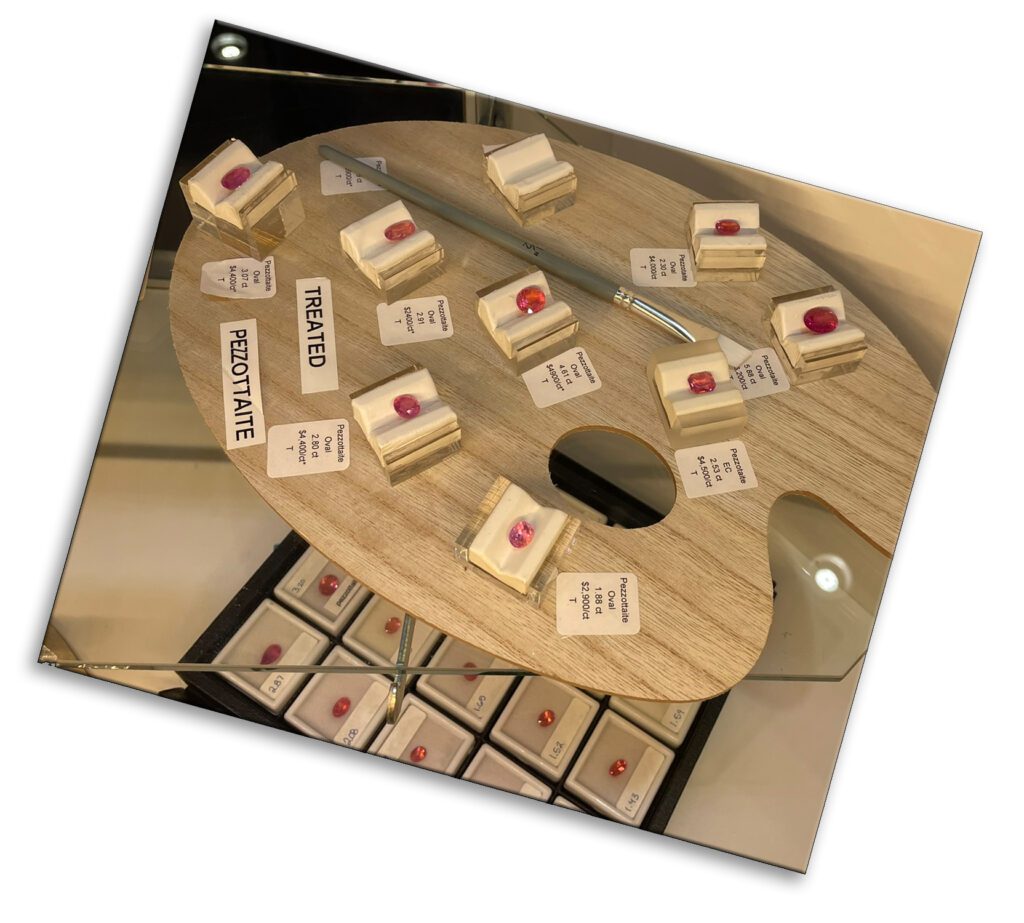
His current inventory runs to a few hundred stones, from cabochons and cat’s-eyes to one-plus-carat stones and “a mess of fours, fives, and sixes” that he considers ideal for rings.
Unique, Historic, and Pretty
For Cushman, pezzottaite sells itself to the right audience. His buyers aren’t chasing perfection; they’re looking for stones with beauty, real scarcity, and a clear backstory. Pezzottaite offers all of that. It’s visually striking, genuinely limited, and tied to a single, short-lived discovery. There’s no replacement material coming—no second act that we know of. As Cushman summed it up, “They’re certainly not making any more of it.”
Tap here to connect with Tom Cushman and learn more about Pezzottaite.