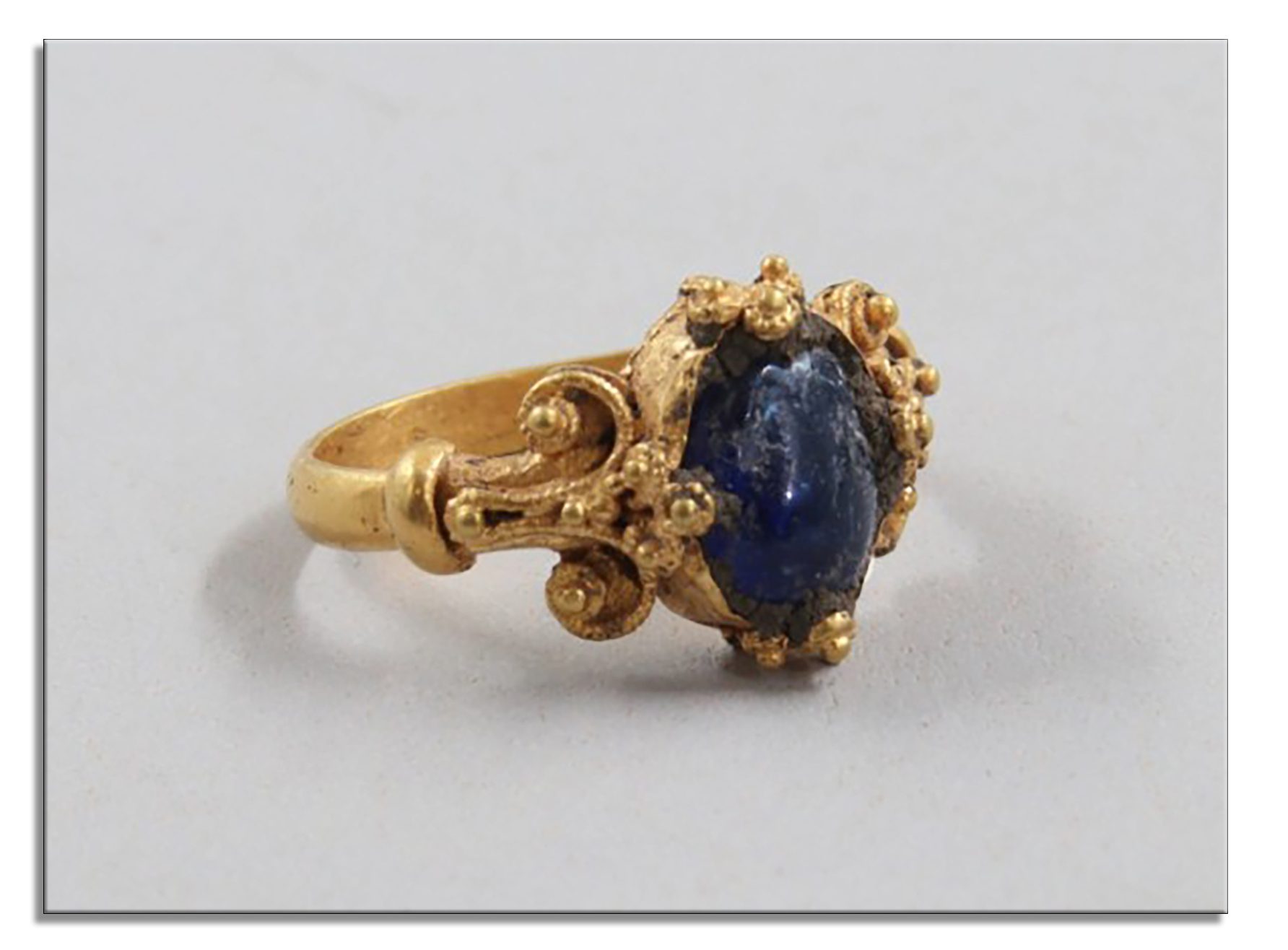


When this medieval gold ring first appeared in English-language news coverage earlier this month, it was already a really good story.
Three outlets — Archaeology Magazine, Medievalists.net, and Popular Science — all picked it up, each highlighting a slightly different angle. But reading the original Norwegian press release behind those stories adds a whole new layer — quite literally — and a much more human one.
The ring was found last summer, in 2025, in the middle of modern-day Tønsberg, one of Norway’s most important medieval towns. Archaeologist Linda Åsheim was working alone when she spotted it — a moment she later described as an “out-of-body experience.” Her first thought was, well, let’s just say, less than academic: “Shit — it’s gold!!”
Yes, it was.
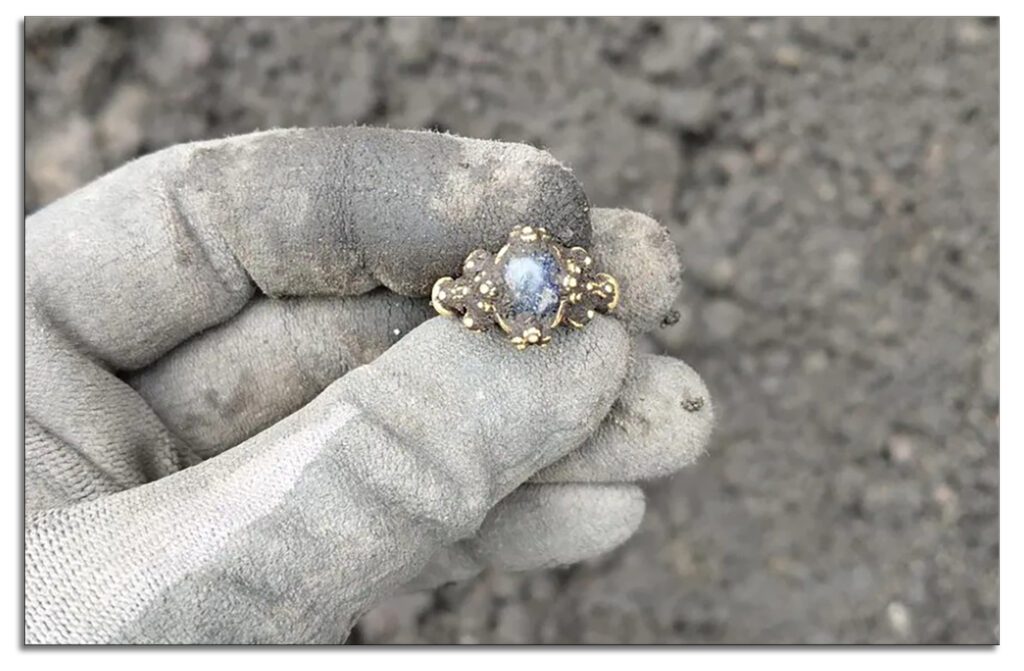
Photo by Linda Åsheim, archaeologist at the Norwegian Institute for Cultural Heritage Research (NIKU).
The ring had been sitting just about 7 centimeters down, less than 3 inches below the surface, recovered from a shallow soil layer associated with medieval cultivation, beneath the streets near the intersection of Storgaten and Prestegaten. The layer itself hasn’t been directly dated, but a spruce twig found just above it was radiocarbon dated to 1167–1269, firmly placing activity at the site in the Middle Ages.
That alone would make this a solid archaeological find. But what makes the ring exceptional is not just its age, but the quality of its workmanship.
Gold Work That Signals Status
This is not a simple gold band. The ring is richly decorated with filigree — fine gold wires twisted and soldered into intricate patterns — and granulation, where tiny gold beads are carefully attached to the spirals near the setting. These are labor-intensive techniques that require experience, precision, and time. And it’s worth remembering: this work was done by jewelry craftsmen operating squarely in the Middle Ages.
According to the project team, it has been 15 years since a gold ring was last found in Tønsberg, and even within Norway’s national artifact database — which lists 220 gold rings in total — only 63 date to the medieval period.
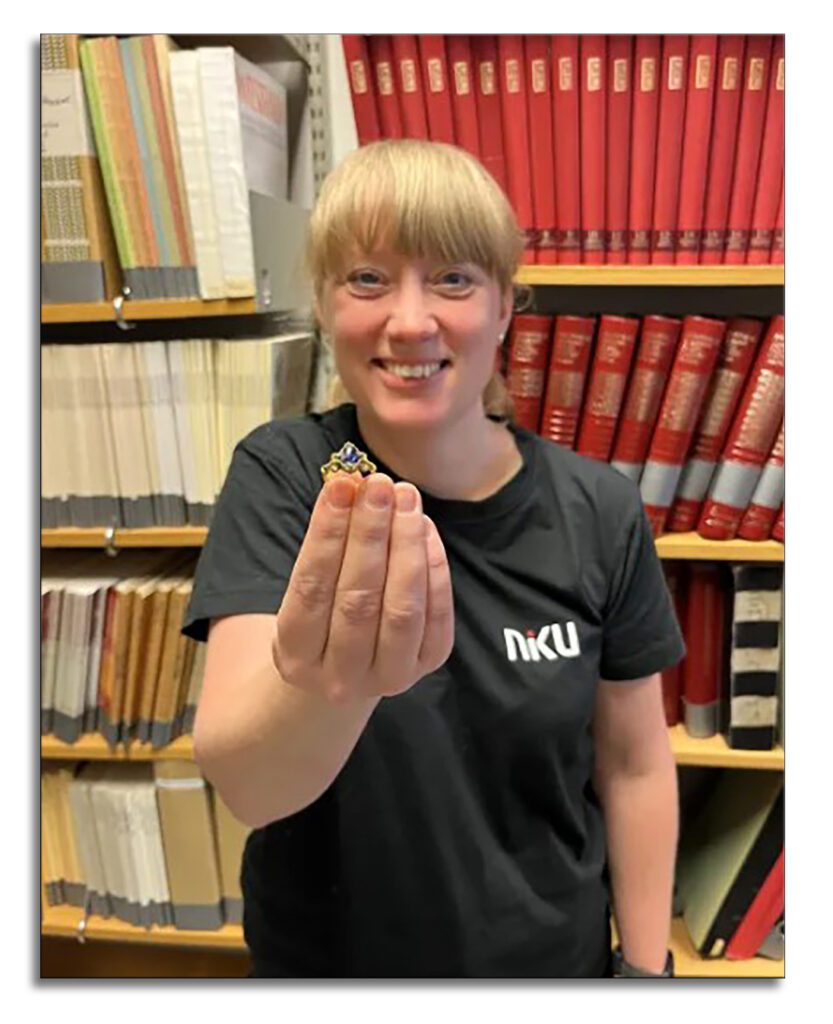
holding a medieval gold ring she found last summer, 2025.
Photo by Johanne Torheim, archaeologist at the Norwegian Institute for Cultural Heritage Research (NIKU)
As explained in the original Norwegian press release by Marianne Vedeler, a professor at the University of Oslo’s Museum of Cultural History who specializes in medieval and Viking-age material culture, the ring draws on older stylistic traditions. The spiral motifs resemble finger rings from the 9th and 10th centuries, while the combination of filigree and granulation reflects techniques that reached Norway from the Byzantine world, partly through Carolingian goldsmithing. Similar rings have been found in England and Denmark, though none match it exactly.
In other words, this ring sits at an intersection — of technique, influence, and time.
The Blue “Stone” at the Center
Then there’s the part we noticed immediately: the featured deep blue oval cabochon.
At a first quick glance, it may look like sapphire. But according to the specialists cited in the Norwegian release, the stone is “most likely glass,” deliberately colored blue to imitate a precious gem. According to the researchers at NIKU, Medieval craftsmen knew how to color glass using cobalt, and they understood how closely it could resemble sapphire when set into gold.
That choice is telling.
This is a ring made of gold, decorated with elite-level craftsmanship, and likely owned by someone of high social standing. The use of glass here doesn’t read as a substitute. It reads as intentional — chosen for its color, its symbolism, and the visual message it sent.
The press release even talks about how foil-backing was sometimes used to enhance the color of stones or glass in this time period, but there’s no evidence of that here.
In the Middle Ages, blue stones — especially sapphires — carried symbolic weight. They were believed to embody divine power, protect health, preserve chastity, and cool what medieval writers described as “inner heat.” Whether the wearer believed the stone was sapphire—or simply liked what it stood for—the message was clear: this ring was meant for someone important.
Who Wore It?
The ring is relatively small — estimated at EU size 50–55 (roughly U.S. size 5 to 7)— and archaeologists suggest it likely belonged to a woman. Combined with the gold, the decoration, and the setting, the conclusion is cautious but consistent: this ring belonged to someone from the upper levels of medieval society.
Tønsberg, after all, sat beneath the royal fortress of Tunsberghus, and kings, clergy, and elites passed through the town for centuries. Whether the ring was lost by accident or deliberately discarded, we’ll never know. What we do know is that it wasn’t ordinary.
Why This Ring Matters
For those of us in the gem and jewelry trade, this ring is a quiet reminder that materials alone don’t tell the full story. Precious metal, skilled craftsmanship, visual symbolism, and cultural meaning all mattered — sometimes more than whether a stone is “natural.”
The Tønsberg ring doesn’t challenge our understanding of historical jewelry. It shows that a ring didn’t need a natural sapphire to matter.
Sometimes, a blue piece of glass says enough.
Tap here to read the original feature story from NIKU, in Norwegian, of course.