

Each autumn, Gem-A receives submissions for this contest, not just from Gem-A students, alumni and members, but from colleagues and peers around the world. These images showcase the stunning world of gem photography as seen through the eyes of professional and amateur gemmologists. This 2025 competition focused on the landscapes and inner worlds of gemstones.
As part of the rules, all entrants must send only their best photomicrographs taken in 2025.
As in previous years, the first-prize winner will receive a one-year membership to the Association and a voucher to Gem-A Instruments; their photo will also grace the cover of the Winter 2025 issue of Gems&Jewellery.
This year’s contest also includes a People’s Choice Award, based on the number of votes an image received from the general public on Facebook. The image that receives the most votes will receive a prize alongside the first-place winner and two runners-up.
Congratulations to all – these are exceptional photos and you should all be very proud of your work!
[all images provided to us courtesy of the Gem-A]
2025 People’s Choice Award Winner

Giovanni Pace has been crowned this year’s winner of our Facebook vote for his incredible photomicrograph depicting a pyrite inclusion within a 14.35-carat hyaline quartz cabochon. The material hails from the state of Bahia, Brazil.
His photomicrograph was obtained from a stack of 18 photographs at 90x magnification (1.60 mm field of view), acquired under darkfield illumination with fibre optics and polarised light. To enhance the microscopic details, a light-blue filter was positioned between the darkfield light source and the specimen, and was subsequently removed via digital image processing in Photoshop.
Giovanni will now receive a £50 voucher redeemable at Gem-A Instruments. His photomicrograph will also be featured in the Winter 2025 edition of Gems&Jewellery magazine.
Fifth Place

Well done to Randy Lightfoot for capturing such an otherworldly scene in this 11.82 carat boulder opal using oblique fibre-optic light (field of view ~2.50 mm).
One of this year’s judges, Sammantha Maclachlan FGA DGA, comments: “Randy Lightfoot’s image beautifully captures the play-of-colour so often found in this material, with vibrant flashes that draw the eye and invite closer inspection. The use of stacking is particularly effective, allowing us to peer deep into the opal and appreciate the layered complexity and internal structure that give the stone its unique visual character.”
To achieve this image, Randy used a Sony A6600 mated to one of the ocular ports of a Leica S7E and then used HelicoFocus to stack 27 frames. The final stacked photo was edited in Adobe Lightroom on an iPhone.
The only parameters adjusted in this photo were exposure, contrast, highlights, noise reduction, clarity, and dehazing. Colour was not influenced, and there was no cropping or scaling. Dust particles were also cleaned up during the editing process.
Fourth Place

“The Penguin.” Negative crystals, with an oil and gas bubble that moves when tilted, are seen in a quartz from Pakistan. An Olimpus SZ6045 microscope was used, with side-led lighting. The scene was captured with a Canon EOS 600D; stacking made using Helicon Focus 7. The image editing (white balance, crop) was performed using Adobe Photoshop 2024. Photo by Dmitry Petrochenkov, field of view 4 mm.
Third Place

Dumortierite crystals in quartzite captured with a Leica S9D and Canon EOS RP under darkfield and fibre-optic illumination, paired with crossed polarisers. This image was focus stacked, with colour refinement in Lightroom.
“Dumortierite, a borosilicate mineral commonly occurring as blue fibrous aggregates within quartzite, typically exhibits a uniform blue appearance under standard illumination. When examined under crossed polarisers, however, the inclusion displays distinct and vivid interference colours, revealing its anisotropic optical behaviour.” Photo by Keith Chow, field of view 3.5 mm.
Second Place

“The Little Fish” – A fully melted crystal in a beryllium-treated natural sapphire. “A friend of mine, just back from Thailand, showed me a parcel of beryllium-treated sapphires he had bought in a market in Chanthaburi. Modest stones, mostly yellow and orange, but a small bluish one caught my attention — I immediately noticed some inclusions under the table. Seeing my interest, he told me I could keep the stone, and after thanking him I got to work photographing the many inclusions inside. One inclusion in particular stood out: a crystal melted by the extreme heat used in the treatment. The material that had flowed into a fracture had taken on almost tree-like shapes. Within that blue setting, the inclusion looked almost like a tiny fish swimming in the water. It took many attempts to get the perfect shot, but I finally did, created from a stack of 183 images.” Equipment used: Canon EOS R7; Amscope 10x + extension tubes; Affinity Photo; Topaz Sharpen AI. Photo editing/manipulation: InPainting used to remove some crystals. Lighting: Sewing machine LED lights AC-110-240v 50/60Hz 1W. Diffusers: White plastic cups. Photo by Francesco Protopappas, field of view 1.2 mm.
And the Winner Is …
Gem-A Announces Photographer of the Year!

FIRST PLACE!
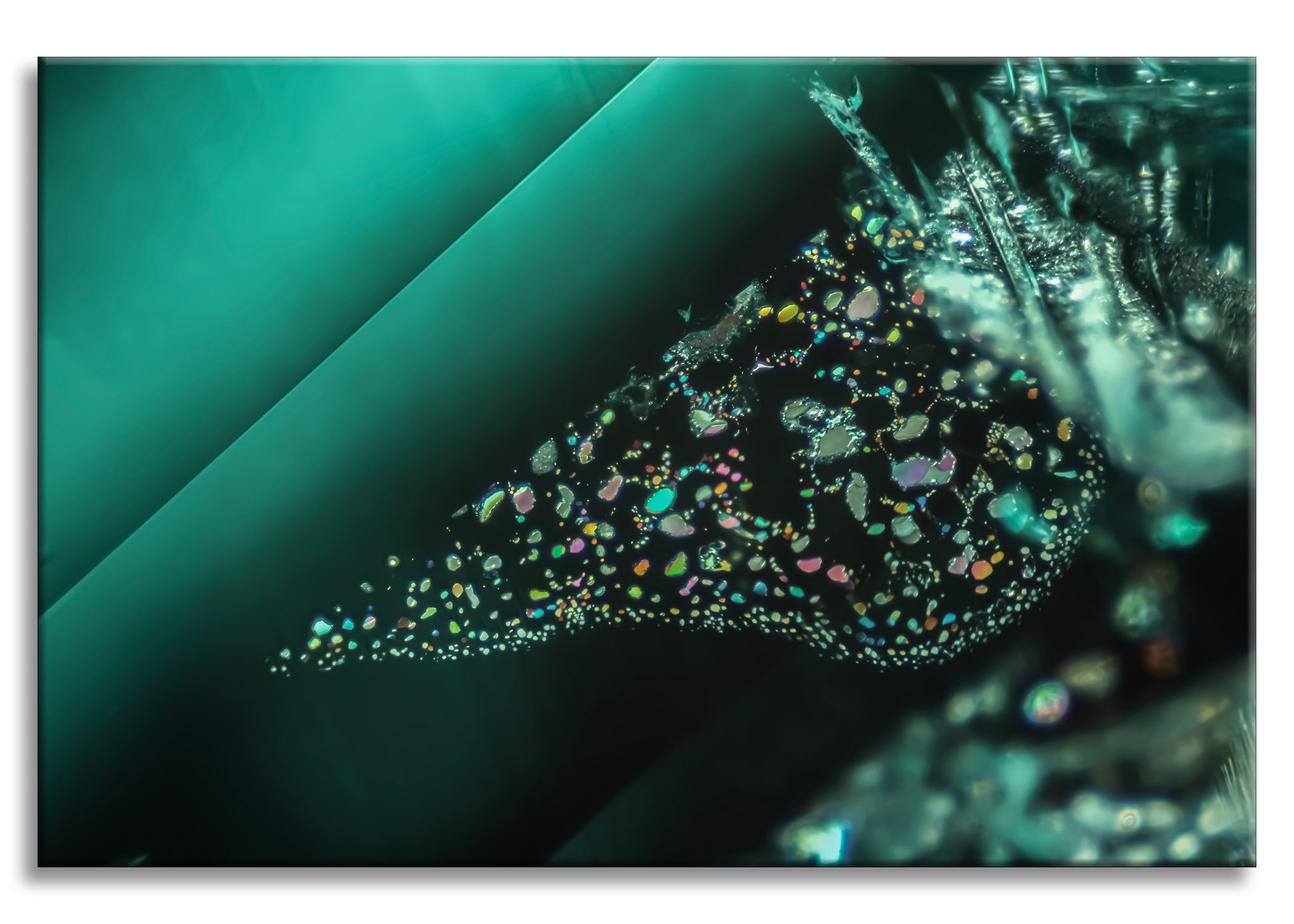
Congratulations to Keith Chow for his photo: Thin film-like fluid inclusions in a Russian emerald.
The focus-stacked image was captured with a Leica S9D and Canon EOS RP under darkfield and fibre-optic illumination, with polarisers applied.
“Thin film-like fluid inclusions are characteristic of Russian emeralds and are frequently observed along specific crystallographic orientations. When viewed along the c-axis with appropriate illumination, these films produce intense interference colours, creating a rainbow-like optical effect that reflects their variable thickness and compositional interfaces.”
Photo by Keith Chow, field of view 3.5 mm.
Tap here to learn more about the competition and how to enter next time!