
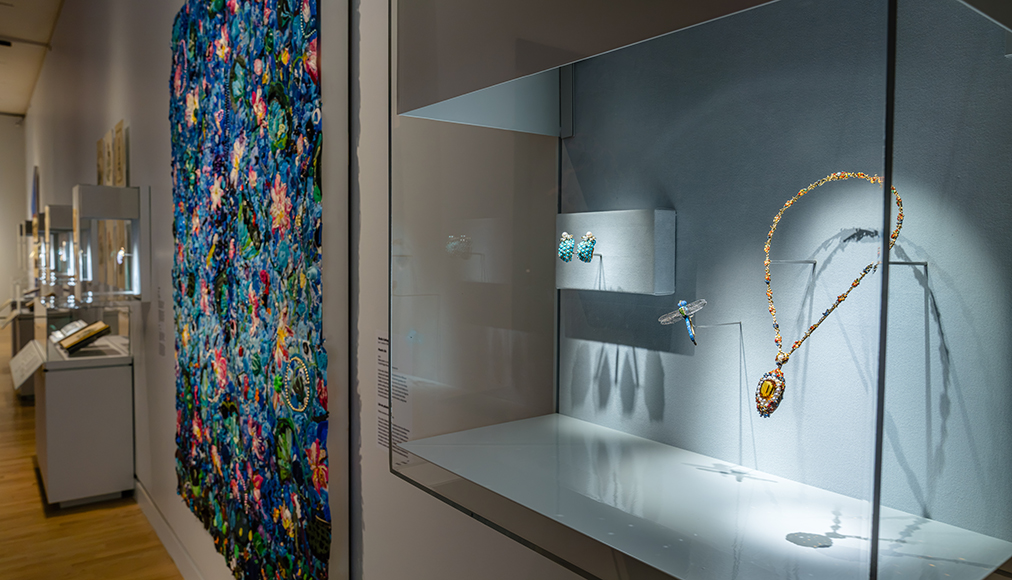


From an Arkansas diamond and jeweled orchids,
to American gemstones and the women behind some of Tiffany’s celebrated designs,
Crystal Bridges Museum of American Art explores nearly a century of creativity inspired by the natural world.
An extraordinary collection of Tiffany & Co. jewels, historically important American gemstones, paintings, mineral specimens, and decorative arts has come together at the Crystal Bridges Museum of American Art in Bentonville, Arkansas, for Nature Adorned: The Artistry of Tiffany & Co. and the American Imagination.
On view now through March 29, 2027, the exhibition combines rarely seen treasures from The Tiffany Archives, dating from 1885 to 1987, with works from the museum’s collection.
This is more than an exhibition of Tiffany jewels, although the jewels themselves are extraordinary. By displaying jewelry alongside paintings, sculptures, stained-glass windows, lamps, and natural mineral specimens, Crystal Bridges shows how the same flowers, landscapes, colors, and natural forms have inspired American artists and jewelry designers for generations.
And for gemologists, there’s another story: Tiffany’s historic role in bringing American gemstones into fine jewelry.
America’s Gemstones Find a Home at Tiffany
During the late nineteenth and early twentieth centuries, Tiffany & Co. became an important champion of gemstones discovered in the United States.
With Dr. George Frederick Kunz as Tiffany’s first chief gemologist, the company championed American gemstones, including tourmalines from Maine, sapphires from Montana, emeralds from North Carolina, diamonds from Arkansas, and tourmalines and kunzite from Southern California.
These “local” gems were more than simply alternatives to “traditional international sources.” They became part of a distinctly American approach to jewelry design, combining the country’s mineral wealth with the creativity of Tiffany’s designers and bench jewelers.
And speaking of “local,” with the Crystal Bridges museum residing in Arkansas, you can’t get more local than one of the exhibit’s most significant objects.
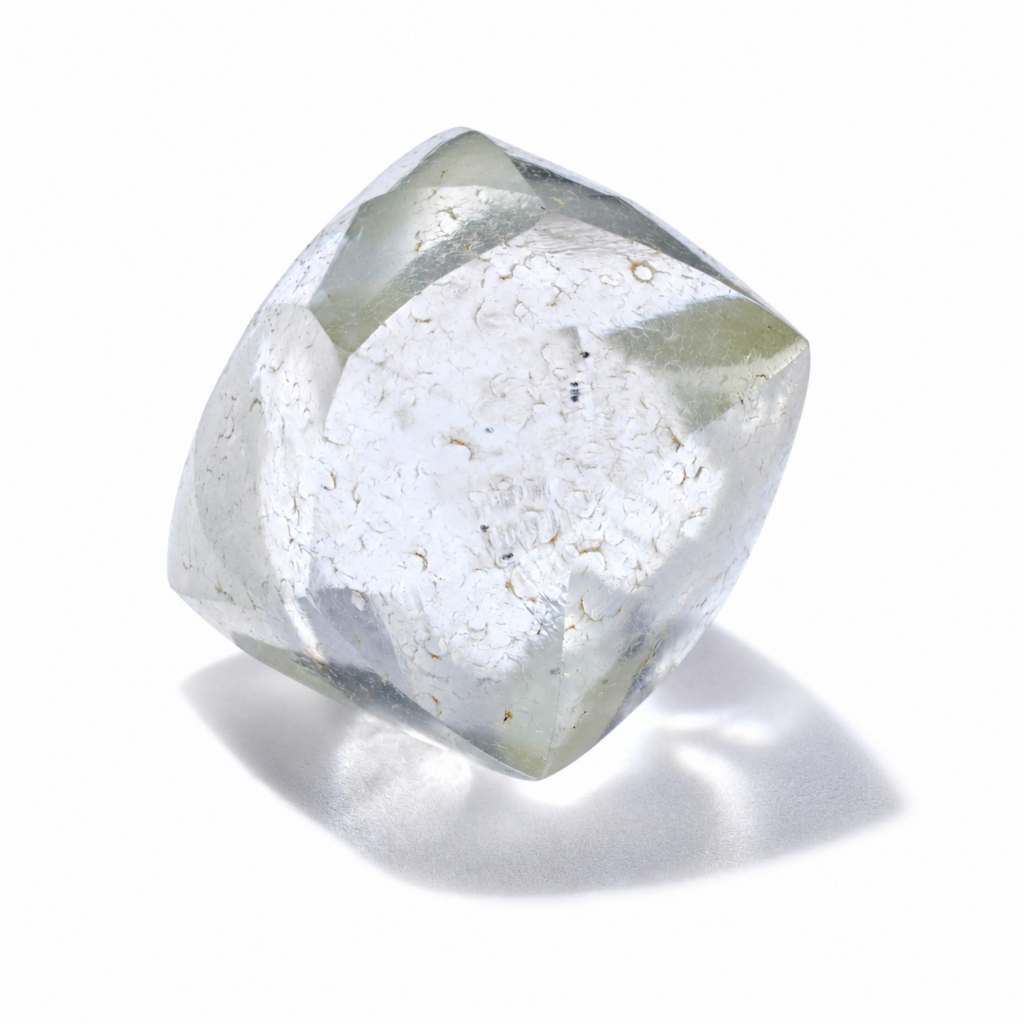
Diamond Notes: rough dodecahedral diamond crystal, very light yellow body color
5.0 x 2.1 x 1.7 cm
Tiffany & Co. Archives
An Important Rough Diamond Returns to Arkansas
Among the treasures from the Tiffany Archives on display is the Arkansas Diamond, discovered in 1926 and acquired by Tiffany & Co. in 1946.
The 27.21-carat rough diamond, a dodecahedron with “a very light yellow body color,” is a reminder that Arkansas is home to a diamond mine – now a state park.
Crater of Diamonds State Park near Murfreesboro is just a four hour drive from Bentonville, where, for approximately $15, visitors can search for diamonds in the volcanic deposit. Yes, you can keep anything you find. And if you think you found a diamond, they will even help identify it for you.
This diamond deposit has produced some of the country’s most celebrated discoveries, including the Uncle Sam Diamond, discovered in 1924, just two years before the Arkansas Diamond. Originally weighing 40.23 carats, the rough diamond was fashioned into a beautiful 12.42-carat emerald-cut, and can be seen in the Smithsonian Institution’s National Gem Collection in Washington, D.C.
Although the Uncle Sam Diamond is not part of the Nature Adorned exhibition, its history provides that mystical connection to Tiffany’s Arkansas Diamond that is on display.
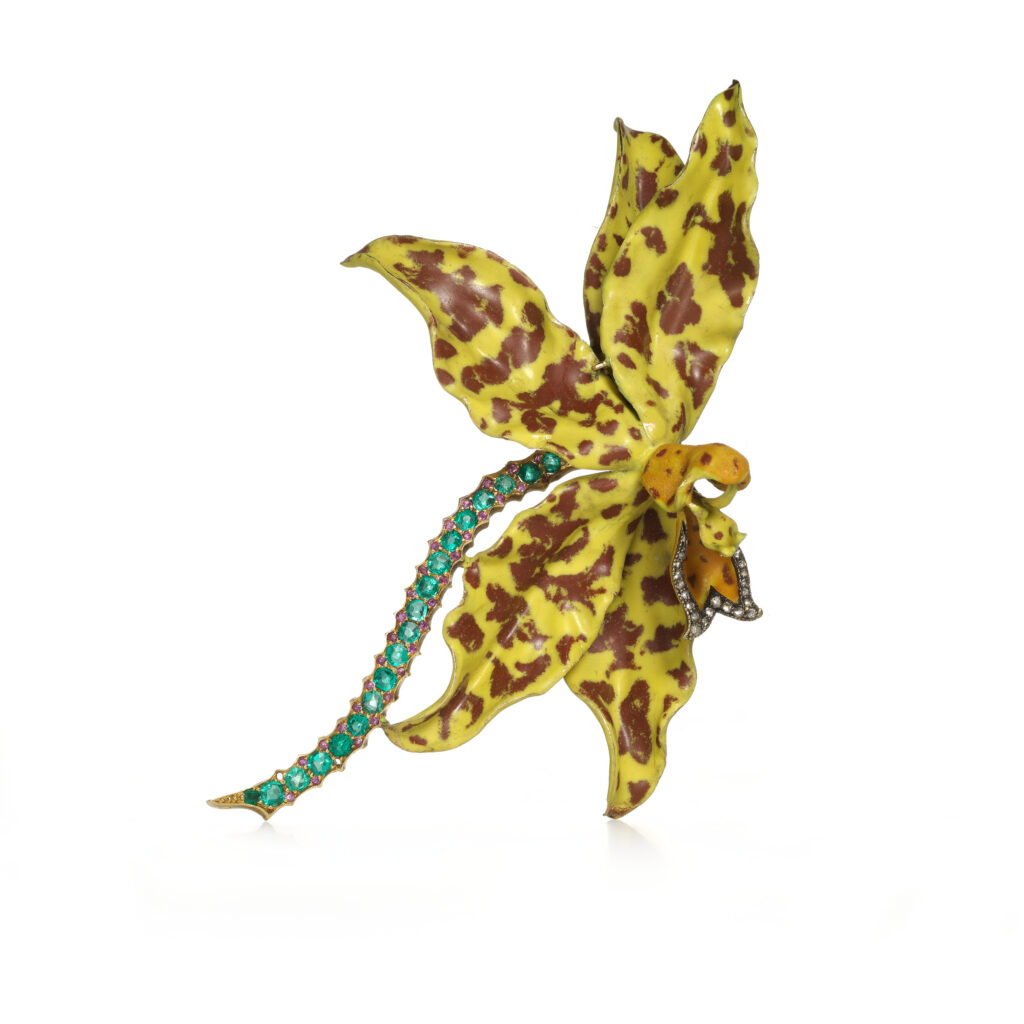
Tiger Orchid Brooch, 1889
gold, sterling silver, diamond, emerald, pink sapphire, enamel,
7.5 x 5 x 2.2 cm
Tiffany & Co. Archives
Jeweled Orchids and Painted Flowers
Nature has inspired artists for centuries, but few nineteenth-century American jewelry artists interpreted flowers quite like George Paulding Farnham.
Farnham joined Tiffany & Co. in 1885 and became one of the company’s most celebrated jewelry designers, earning international recognition for his imaginative designs, particularly these, his extraordinary jeweled orchids.
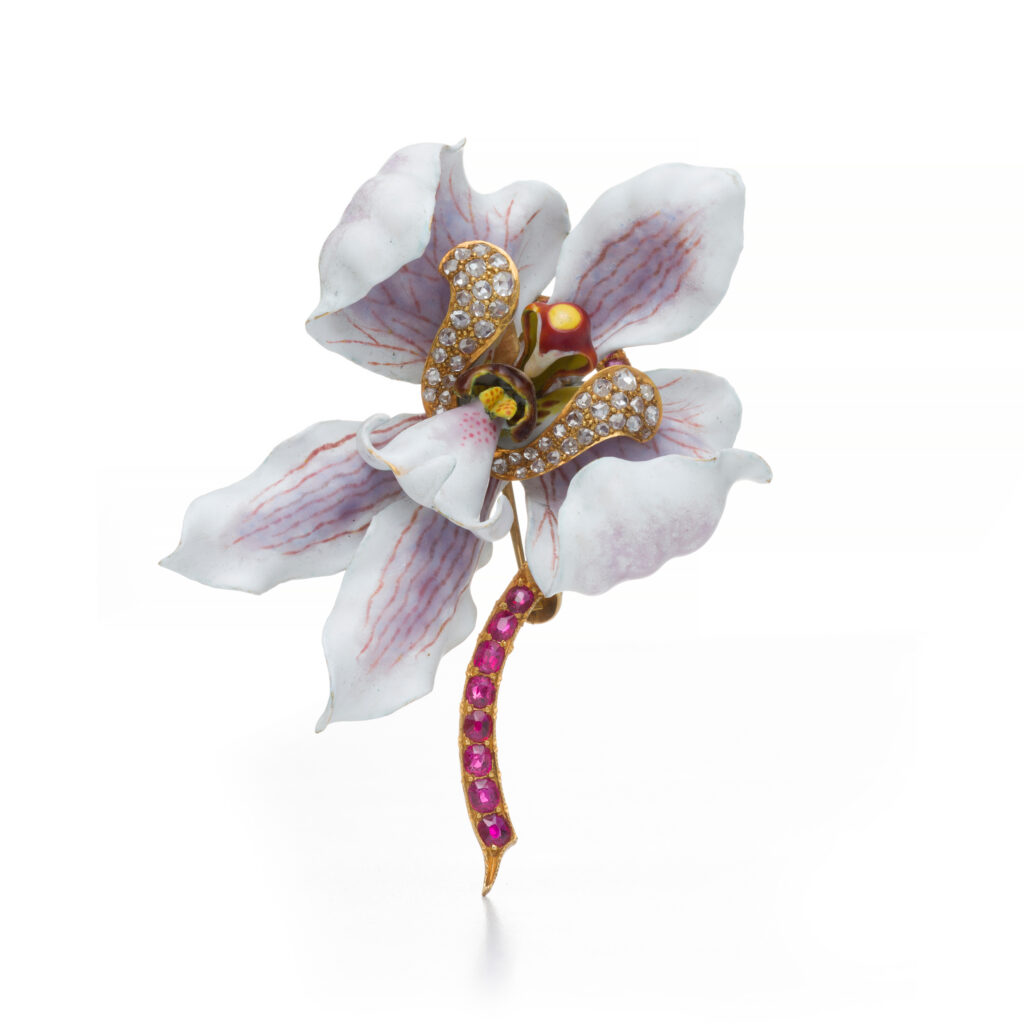
Brooch, 1889-1893
Gold, diamonds, rubies, enamel
3 1/8 in. x 2 3/8 in.
Tiffany & Co. Archives
Two of his extraordinary orchid brooches, created for Tiffany & Co. between 1889 and 1893, are amongst the exhibition’s highlights.
The one seen here combines gold, diamonds, a stem of rubies, and enamel. The other, the Tiger Orchid, features gold, sterling silver, diamonds, a stem of emeralds, pink sapphires, and enamel.
Both demonstrate Farnham’s remarkable attention to nature’s details, creating wearable art with gold, silver, enamel, and gemstones.
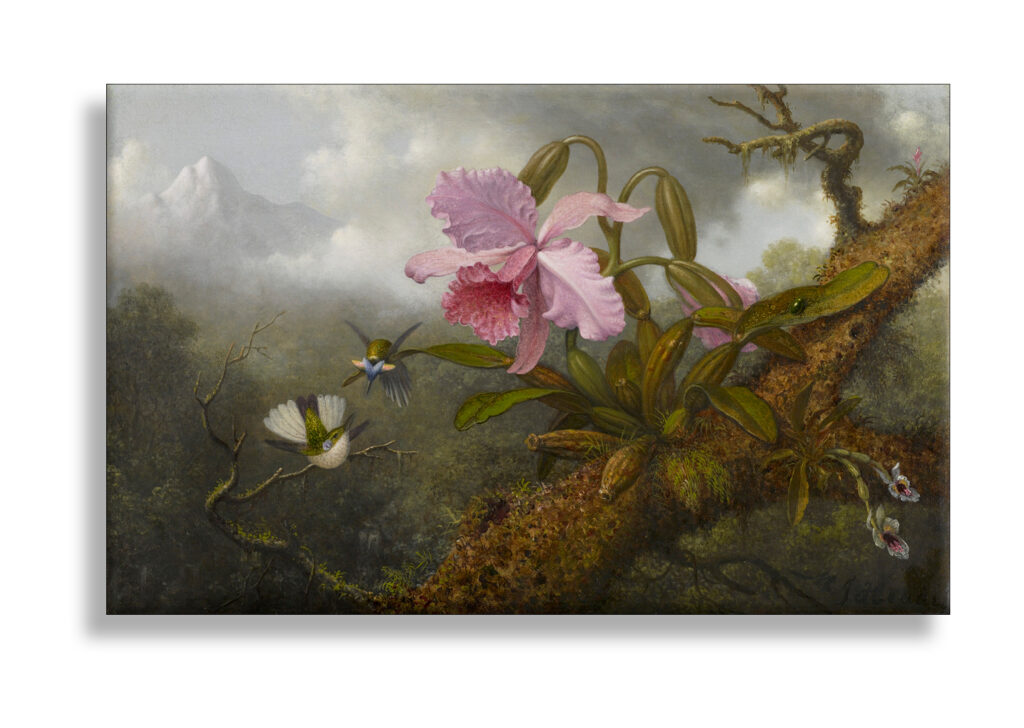
Oil on canvas 24 in. x 31 1/2 in. x 4 in.
Crystal Bridges Museum of American Art, Bentonville, Arkansas, 2010.67.
Photography by Amon Carter Museum of American Art.
The Crystal Bridges Museum places these jewels in visual conversation with paintings by Martin Johnson Heade, a 19th century American painter who focused on landscapes, especially orchids.
Amongst the paintings on display is Heade’s Cattleya Orchid, Two Hummingbirds and a Beetle, painted between approximately 1875 and 1890.
Seen together, the paintings and jeweled brooches offer visitors a rare opportunity to appreciate how different artists interpret the same subject, creating extraordinary works of art in their respective mediums.
“Nature Adorned: The Artistry of Tiffany & Co. and the American Imagination offers
a remarkable opportunity to celebrate Tiffany’s rich heritage through a distinctly American lens.”
Victoria Reynolds
Chief Gemologist and Vice President of High Jewelry
Diamond and Gemstone Acquisition,
Tiffany & Co.
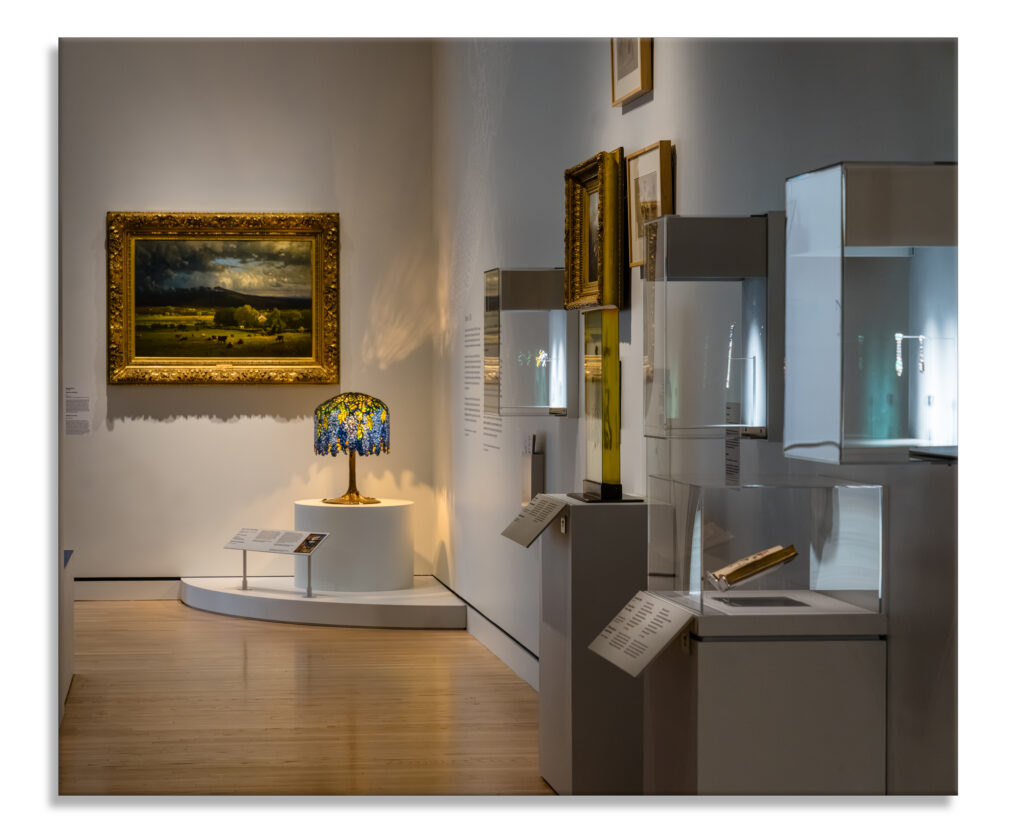
Clara Driscoll Wisteria table lamp, ca. 1905-1906
Leaded glass and bronze
27 in. high, 18 in. shade diameter (68.6 × 45.7 cm)
Crystal Bridges Museum of American Art, Bentonville, Arkansas,
Gift of the Benedict Silverman Collection, 2021.16
The Women Behind Tiffany’s Artistry
While names such as George Paulding Farnham and Jean Schlumberger are familiar to jewelry historians, many of the talented women who contributed to Tiffany’s artistic legacy have received considerably less recognition.
The women associated with Tiffany Studios, often referred to as the “Tiffany Girls,” played important roles in the creation of stained glass, lamps, decorative objects, and other works. Women also made significant contributions to Tiffany’s jewelry designs under the direction of Louis Comfort Tiffany.
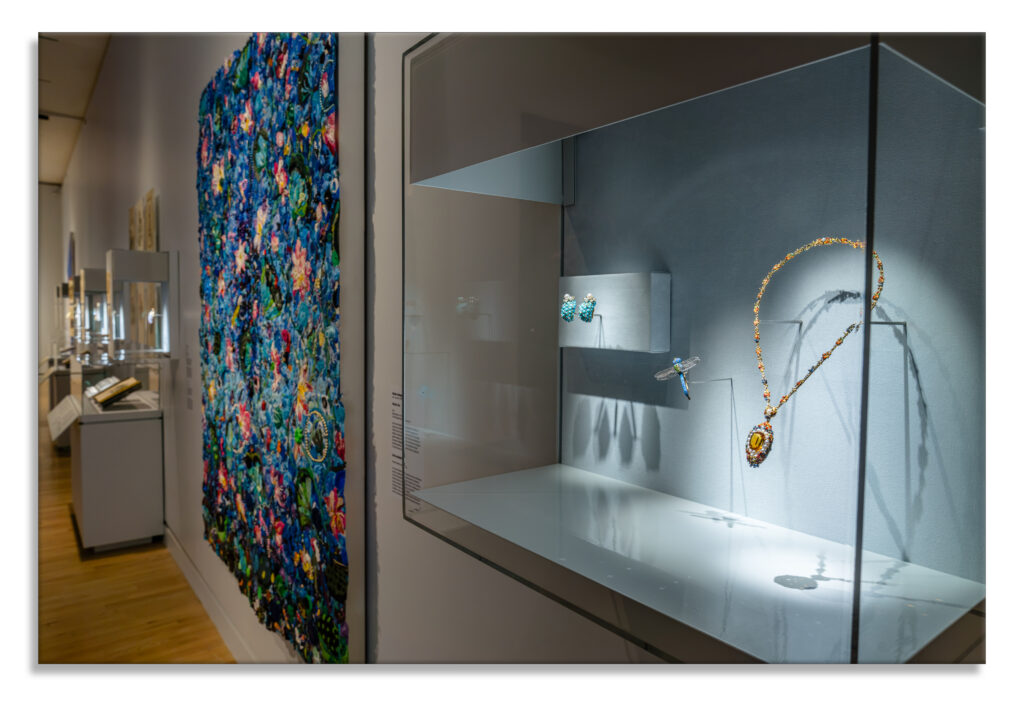
Dragonfly Brooch, 1907–1914. Gold, platinum, black opal, and demantoid garnet.
Right: Meta Overbeck, under the direction of Louis Comfort Tiffany for Tiffany & Co.
Necklace, 1918–1920. Gold, citrine, pearls, and enamel. The central citrine is accented by pearls.
Several of these designers are represented in Nature Adorned.
Clara Driscoll, who directed the Women’s Glass Cutting Department at Tiffany Studios, was responsible for some of the firm’s most celebrated lamp designs.
Her Wisteria Table Lamp (above), dating from approximately 1905–1906, is included in the exhibition. Its cascading blossoms, rendered in richly colored leaded glass, transform the familiar flowering vine into an extraordinary decorative object.
For decades, much of the work of Driscoll and her female colleagues was credited to Tiffany Studios, with little recognition given to the women who actually designed and created these pieces. The discovery of Driscoll’s correspondence helped historians identify her contributions, including designs for some of Tiffany’s most celebrated lamps.
Another important contributor was Agnes F. Northrop, whose landscape and botanical designs helped define Tiffany Studios’ stained-glass artistry.
Crystal Bridges’ permanent collection includes the monumental Mountain Landscape (Root Memorial Window), dating to 1917 and attributed to Northrop. Standing more than nine feet tall, the window depicts a waterfall surrounded by lush foliage, demonstrating how Tiffany Studios translated the natural landscape into compositions of glass and light.
The contributions of women to Tiffany jewelry are equally worthy of recognition.
Julia Munson, who worked under the direction of Louis Comfort Tiffany, is represented in the exhibition by a gold bracelet dating from 1907 to 1914, set with 35 Montana sapphires in round, oval, and antique cushion cuts.
Another of her designs, a dragonfly brooch from the same period, combines gold, platinum, black opal, and demantoid garnet.
Meta Overbeck, also working under Louis Comfort Tiffany, is represented by a remarkable necklace dating from 1922 to 1923, incorporating gold, enamel, Montana sapphires, emeralds, colored diamonds, and orange zircons. The exhibition documentation estimates the weight of the central Montana sapphire at approximately 39.31 carats.
Another Overbeck necklace, dating from 1918 to 1920, combines gold, citrine, pearls, and enamel.
These pieces are especially significant in the context of the exhibition. They demonstrate not only the artistry of women working within the Tiffany organization, but also their role in transforming American gemstones into distinctive jewelry designs.
Although the term “Tiffany Girls” is most closely associated with the women of Tiffany Studios’ glassmaking operations, the contributions of Munson and Overbeck deserve recognition alongside those of Driscoll and Northrop.
Their work was part of Tiffany’s artistic identity, even when the company’s name received most (if not all) of the credit.
American Gemstones in Historic Tiffany Jewelry
The exhibition also includes a selection of late nineteenth-century Tiffany jewelry featuring colorful gemstone combinations.
A necklace dating from 1885 to 1895 combines 18-karat gold, platinum, amethyst, citrine, diamonds, and tourmaline.
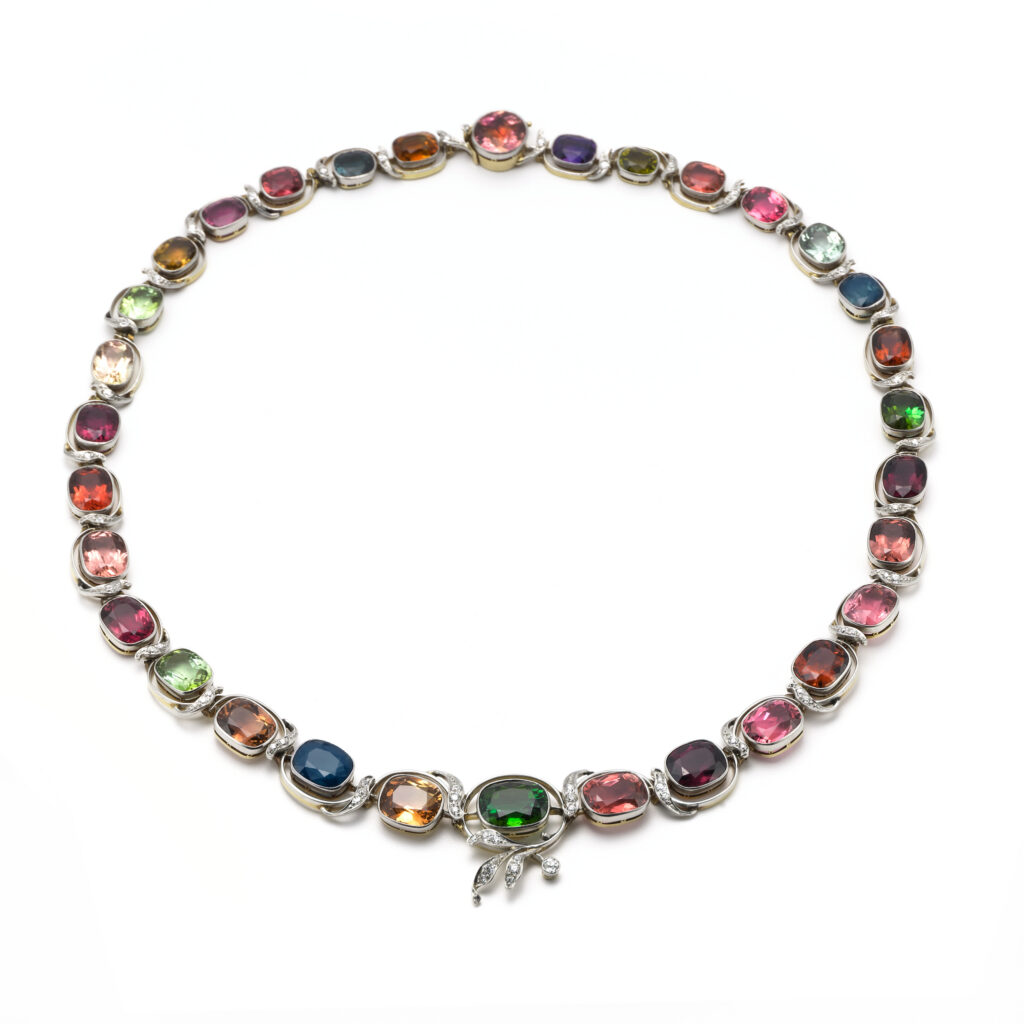
Necklace, 1885-1895
18kt gold, amethyst, citrine, diamond, tourmaline, platinum
7 in. x 2 1/16 in. x 1/4 in.
Tiffany & Co. Archives
Another necklace, attributed to George Paulding Farnham and dating from approximately 1890 to 1912, features watermelon tourmalines and pearls.
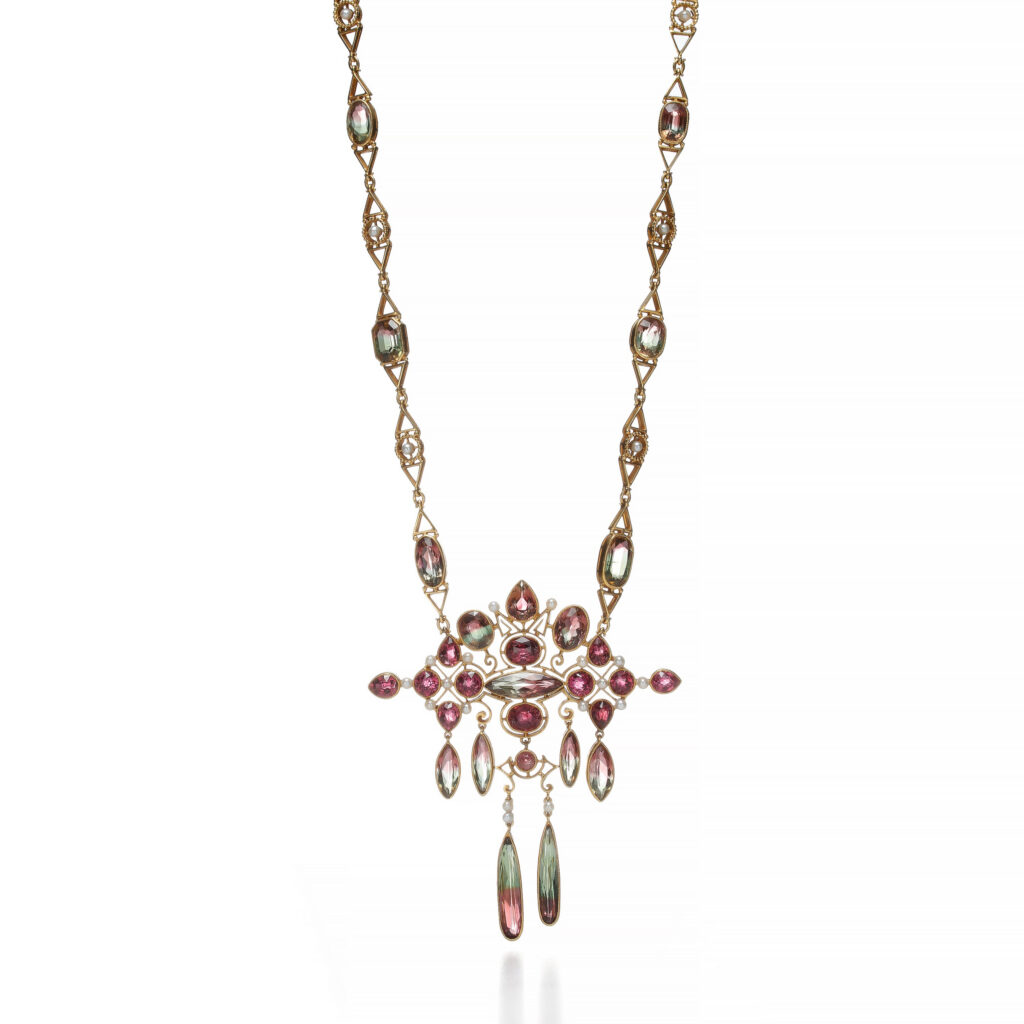
Necklace, 1890-1912
Watermelon tourmalines, pearls
8 7/16 in. x 1 7/8 in. x 1/4 in.
Tiffany & Co. Archives
These jewels reflect Tiffany’s willingness to incorporate colored gemstones into designs that celebrated their natural colors and distinctive characteristics.
Other objects in the exhibition include a 13.14-carat Carolina emerald, discovered in 1970 and acquired by Tiffany in 1971, and a 1906 gold pendant set with kunzite and diamond.
Together, they offer a glimpse into Tiffany’s long relationship with American gems.
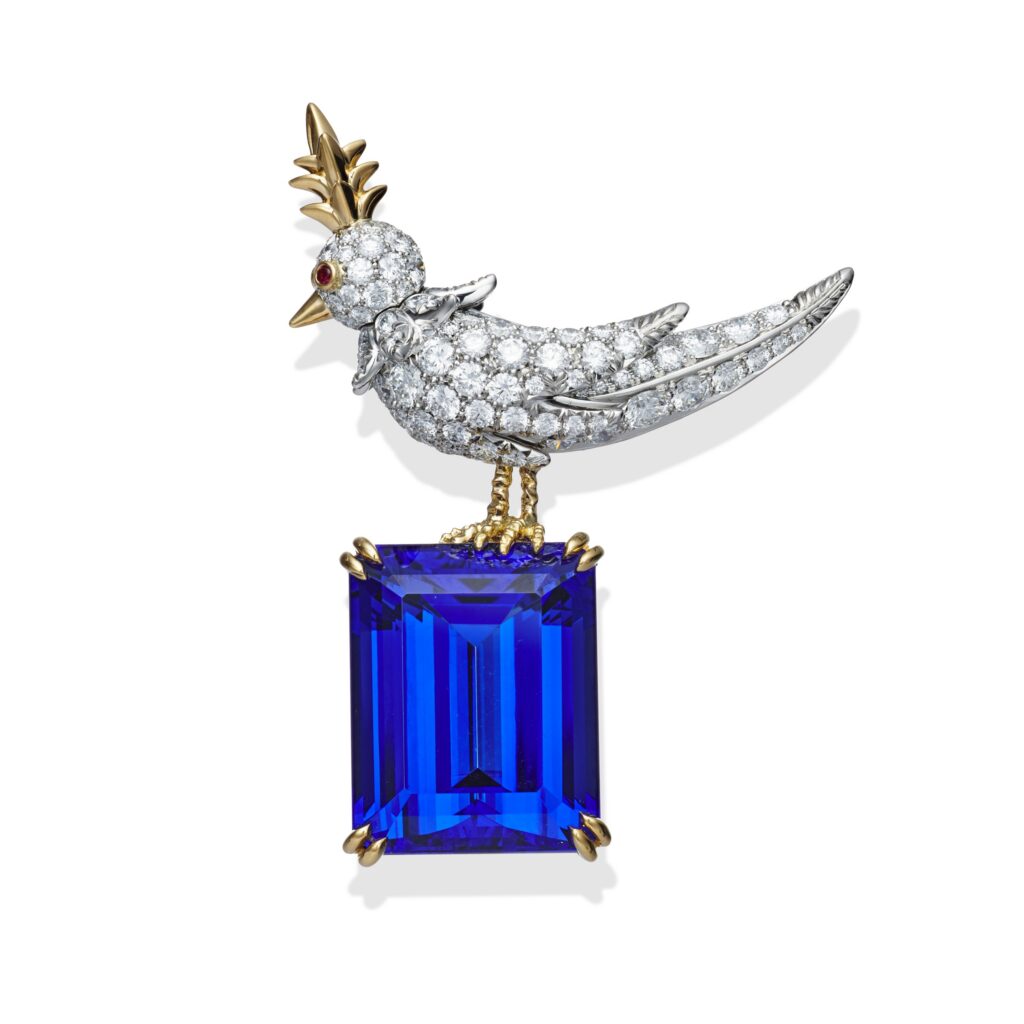
Bird on a Rock Brooch, 1965
Gold, tanzanite, diamond, ruby
1 13/16 in. x 1 5/16 in. x 1/2 in.
Tiffany & Co. Archives
Schlumberger: Nature Reimagined
The exhibition’s nature path continues into the twentieth century with the work of Jean Schlumberger. His celebrated Bird on a Rock brooch, dating from 1965, features gold, tanzanite, diamonds, and ruby.
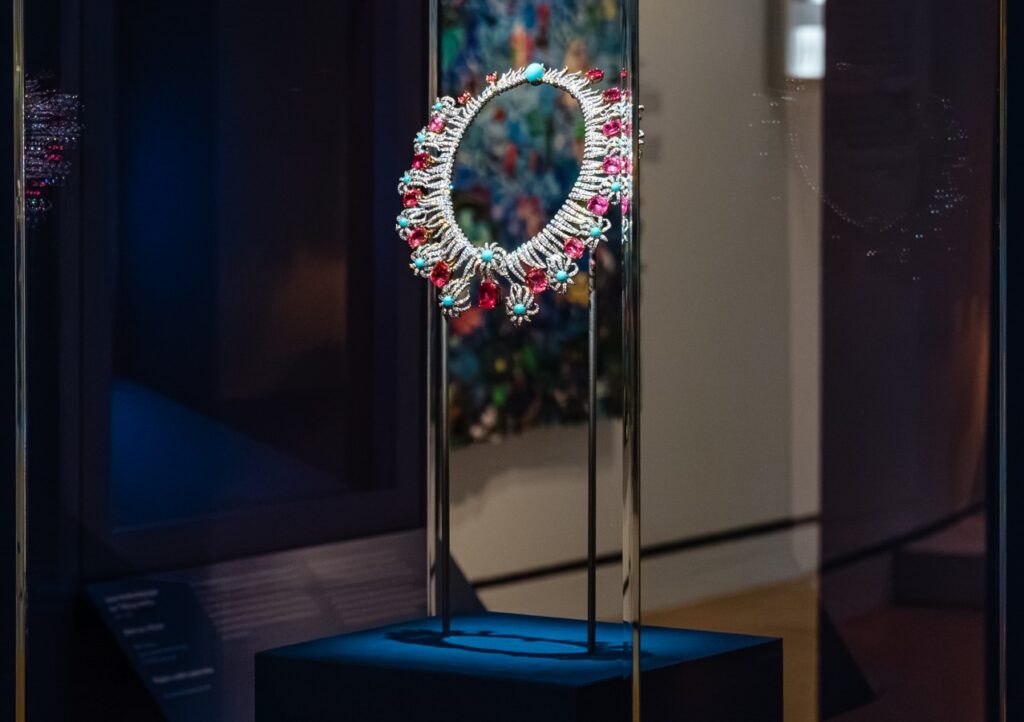
Another extraordinary creation, the Hedges and Flowers Necklace, dating from 1978 to 1987, combines gold, platinum, diamonds, rubellite tourmaline, and turquoise.
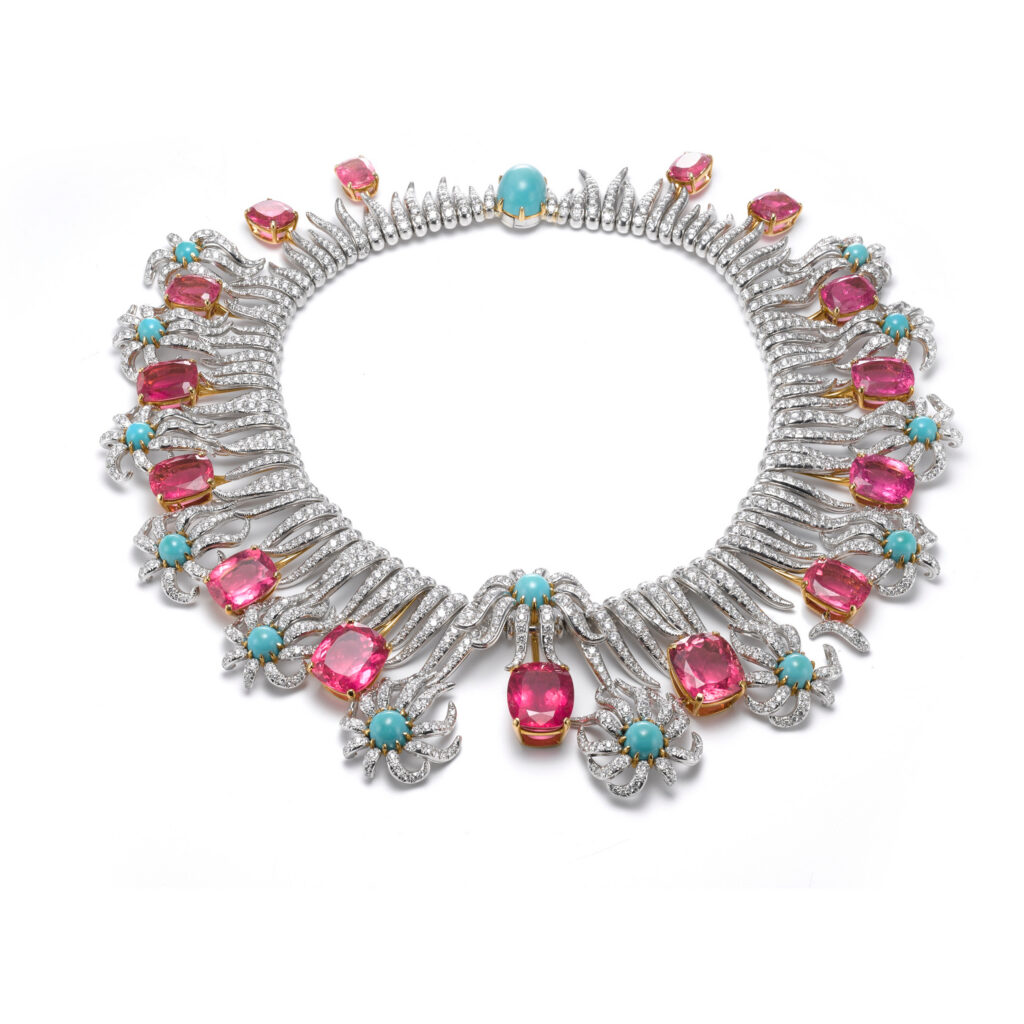
Hedges and Flowers Necklace, 1978-1987
Gold, platinum, diamond, rubellite tourmaline, turquoise
7 1/16 in. x 6 15/16 in. x 1/2 in.
Tiffany & Co Archives.
Jewelry as American Art
Perhaps the most interesting achievement of Nature Adorned is the way it places jewelry within the broader story of American artistic creativity.
A diamond crystal becomes a reminder of the nation’s geological history. An orchid brooch shares the gallery with a botanical painting. A stained-glass lamp reveals the work of a pioneering woman designer. And a colorful gemstone necklace demonstrates how natural materials can become expressions of artistic imagination.
For Tiffany & Co., the natural world has long provided both the materials and the inspiration.
For the Crystal Bridges museum, those connections offer a way to explore nearly a century of jewelry and decorative arts alongside American paintings and sculpture, and the artists who created these works.
Nature Adorned: The Artistry of Tiffany & Co. and the American Imagination is on view at the Crystal Bridges Museum of American Art in Bentonville, Arkansas, through March 29, 2027. Admission is free.
Tap here for more information about the Crystal Bridges Museum and the Nature Adorned exhibition