

by Emily “D.D.” Frontiere –
Contributing Editor –
for the Roskin Gem News Report –
The modern world is characterized by rapidly evolving technology. Regardless of personal opinions, continuously advancing technology is inexorably interwoven into our lives, and the world of gemology is no exception. At the 2026 AGA conference in Tucson, Dr. Aaron Palke spoke about the necessity for cutting-edge testing laboratories like the GIA to have specialized equipment at their disposal.
A New Age Requires New Tools!
Dr. Palke began with an explanation of why traditional tools, including microscopes, refractometers, polariscopes, and spectroscopes are no longer sufficient to evaluate and examine gems. In total, he points to three categories that may require advanced testing: treatments, natural-versus-synthetic determination, and origin determination.
As our understanding of gemology has grown, he said, so too have treatments and production methods of synthetics. Existing treatment methods are refined and leave behind less evidence indicating their use. Moreover, entirely new treatments are developed which are invisible to traditional machines. Similarly, gemstone synthetics, notably diamonds with millions of carats grown each year, have become identifiable only by specialized scanners. Lastly, the ability to determine geographic origin is extremely important for research purposes and gemstones whose value is linked with place of their growth.
To illustrate the co-evolution of treatments, synthetics, with testing technology, Dr. Palke referenced the early years of, what he calls, “modern gemology,” beginning around the year 1950. Prior to this date, gemologists needed just the basic tools listed above. This all changed thanks to the contributions of famed scientist Jim Shigley, who Dr. Palke credits as being one of the founders of modern gemology despite not being a gemologist himself.
A pivotal moment occurred when Dr. Shigley put rubies in an X-ray fluorescence spectrometer to reveal exactly which elements were present. The results of such analysis showed that natural gems contained gallium, while synthetics did not. This experiment proved the value of advanced testing in gemology, and similar investigations were subsequently performed on pearls. The rest, as they say, is history.
Fast-forwarding to today, Dr. Palke explained how there are some gems with complex histories that must be examined with multiple machines to achieve a complete understanding of their nature. He used an example of an orange stone that came to GIA with inclusions and evidence of melt. X-ray showed aluminum, chromium, iron, and gallium. Had analysis stopped here, the gem would have been labeled corundum. However, laser-ablation with a mass spectrometer showed beryllium, leading to the conclusion that the stone was a beryllium-treated corundum. Thus, while these machines are expensive to develop, obtain, and operate, they are absolutely necessary to detect equally advanced treatments.
Most Gems Don’t Need Extra Attention
Due to the extra time and expense associated with advanced testing, Dr. Palke stressed that most gems submitted to GIA for grading and origin reports never come near his lab. To illustrate the various types of analysis that can be performed at GIA, Dr. Palke presented four case studies that become progressively more complicated.
Case Study #1: The Ideal Path
The “ideal” pathway Dr. Palke explored first has only a few steps. When a gem arrives at the lab, it undergoes an intake process which records various identifying features like weight and dimensions, and it receives an internal tracking number. Then, a gemologist performs a basic microscopic analysis and takes an RI reading. The particular stone Dr. Palke referenced had an RI consistent with corundum and contained large, intact crystal inclusions characteristic of Sri Lankan origin. With no confusing observations, a report was generated identifying the gem as a natural untreated sapphire from Sri Lanka.
Case Study #2: Contextual Knowledge is Necessary
Precheck identified this gem as pink corundum and noted clusters of zircon crystals which did not show signs of heat treatment. This indicated that the stone was likely Madagascan. However, the gemologist knew that it has been established that Madagascan pink corundum can be treated with low heat that does not affect inclusions. This prompted the grader to send the stone for more testing. FTIR spectroscopy revealed multiple peaks associated with heating. With all questions answered, the stone was issued a report stating it was a heat-treated Madagascan pink sapphire.
Case Study #3: Sometimes You Have to Study More Than Just the Gemstone
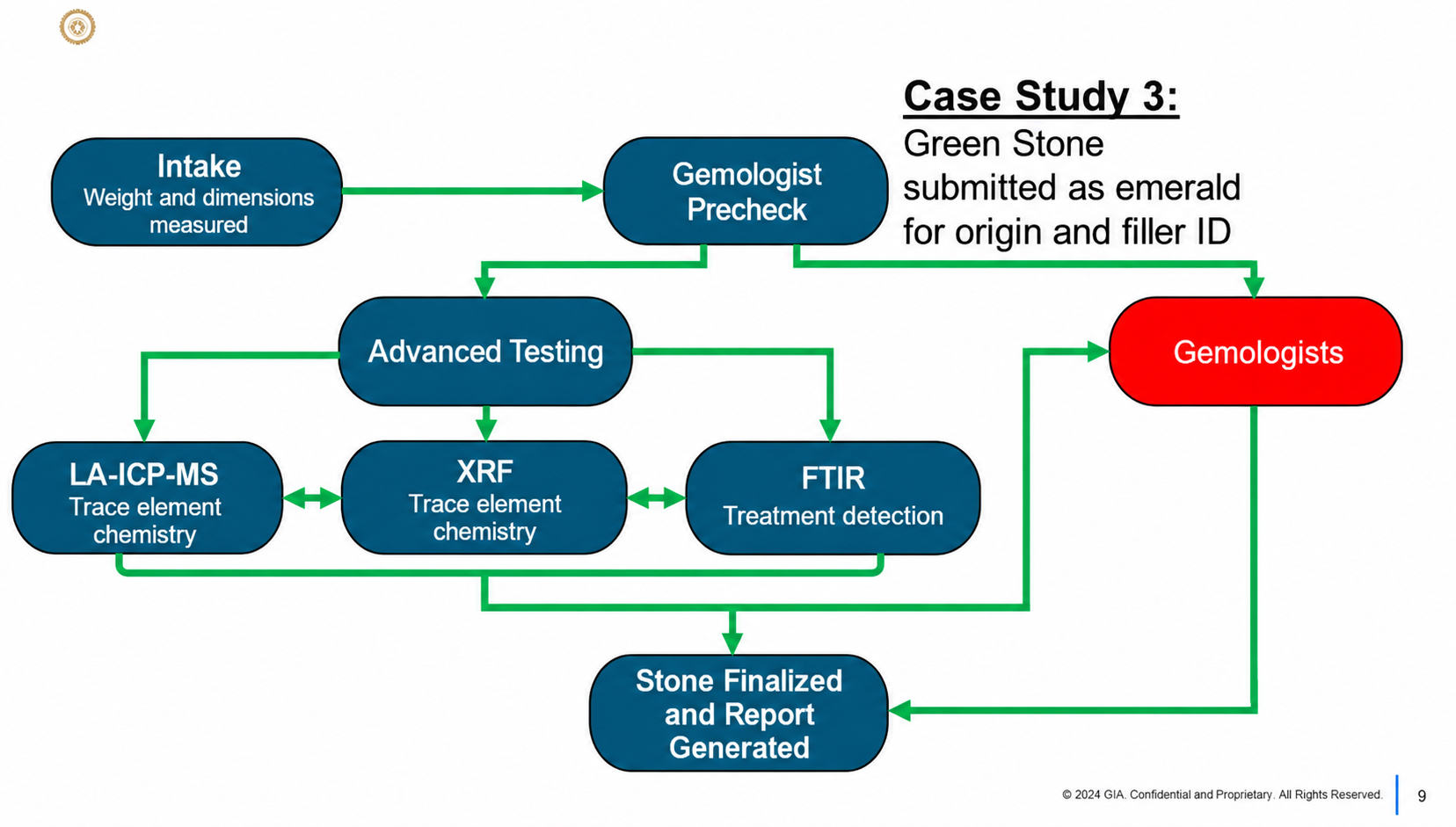
The third example was a green stone submitted as an emerald and the owner wanted to identify the type of filler that was used for fracture filling. Identifying filler, Dr. Palke explained, certainly requires advanced testing. The precheck showed three-phase inclusions, indicating a possible origin of either Colombia or Afghanistan. Typically, XRF data showing aluminum and iron would be able to make this determination, but this stone plotted out of standard, so LA-ICP-MS was done to look for iron and rubidium. With so many steps, Dr. Palke shared images that help explain each step.
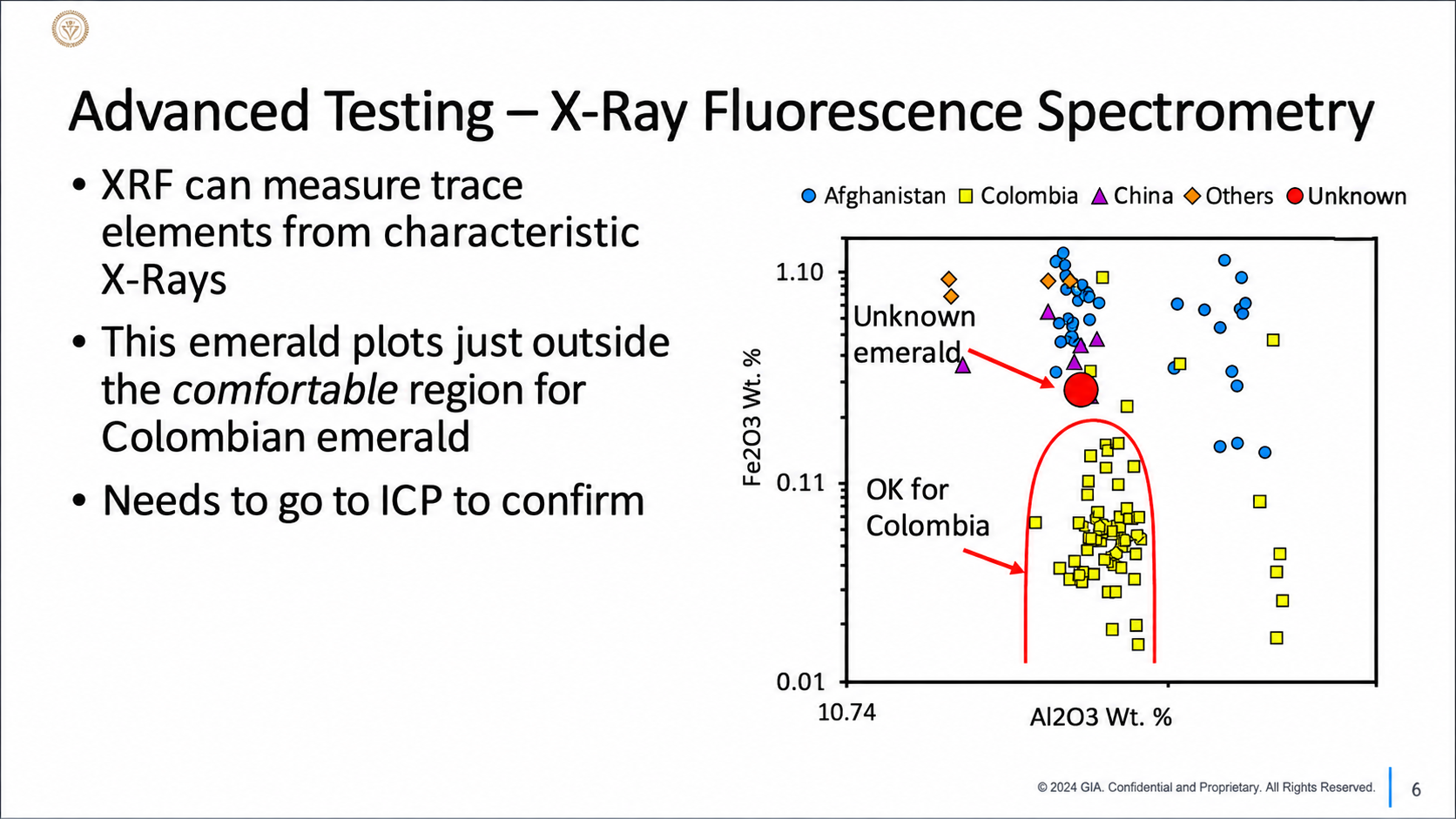
This XRF plot shows that the emerald reading shown as a red dot falls outside the “comfortable region” associated with Colombian origin. Image by Dr. Aaron Palke.
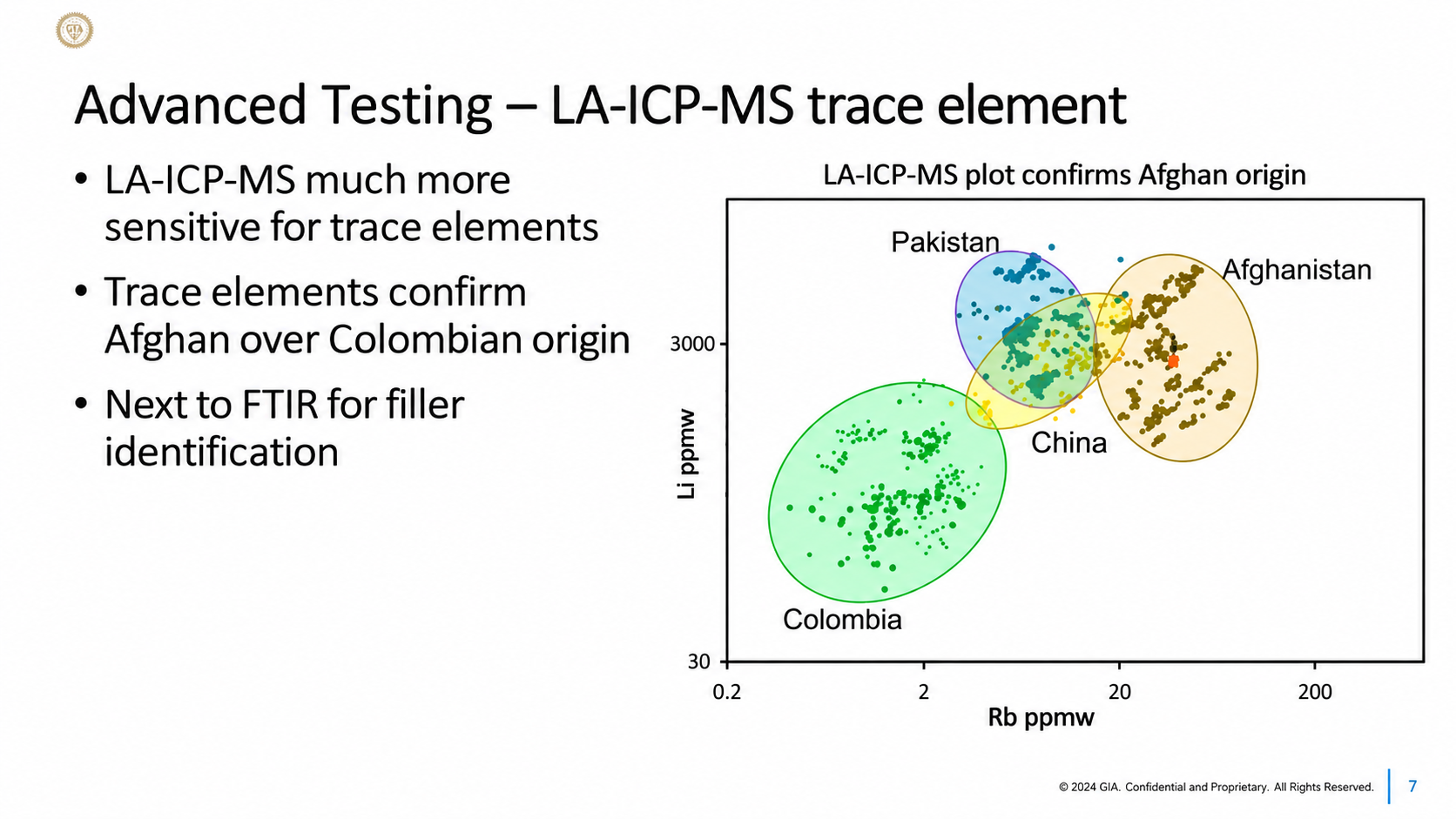
Further analysis of trace elements in the sample confirms Afghan origin rather than Colombian. Image by Dr. Aaron Palke.
With origin established, the final question was about the filler. FTIR measures defects in minerals and organics and the peaks from this stone indicated a modern resin or epoxy. Readings at 3032nm and 3060nm meant it was a type B filler.
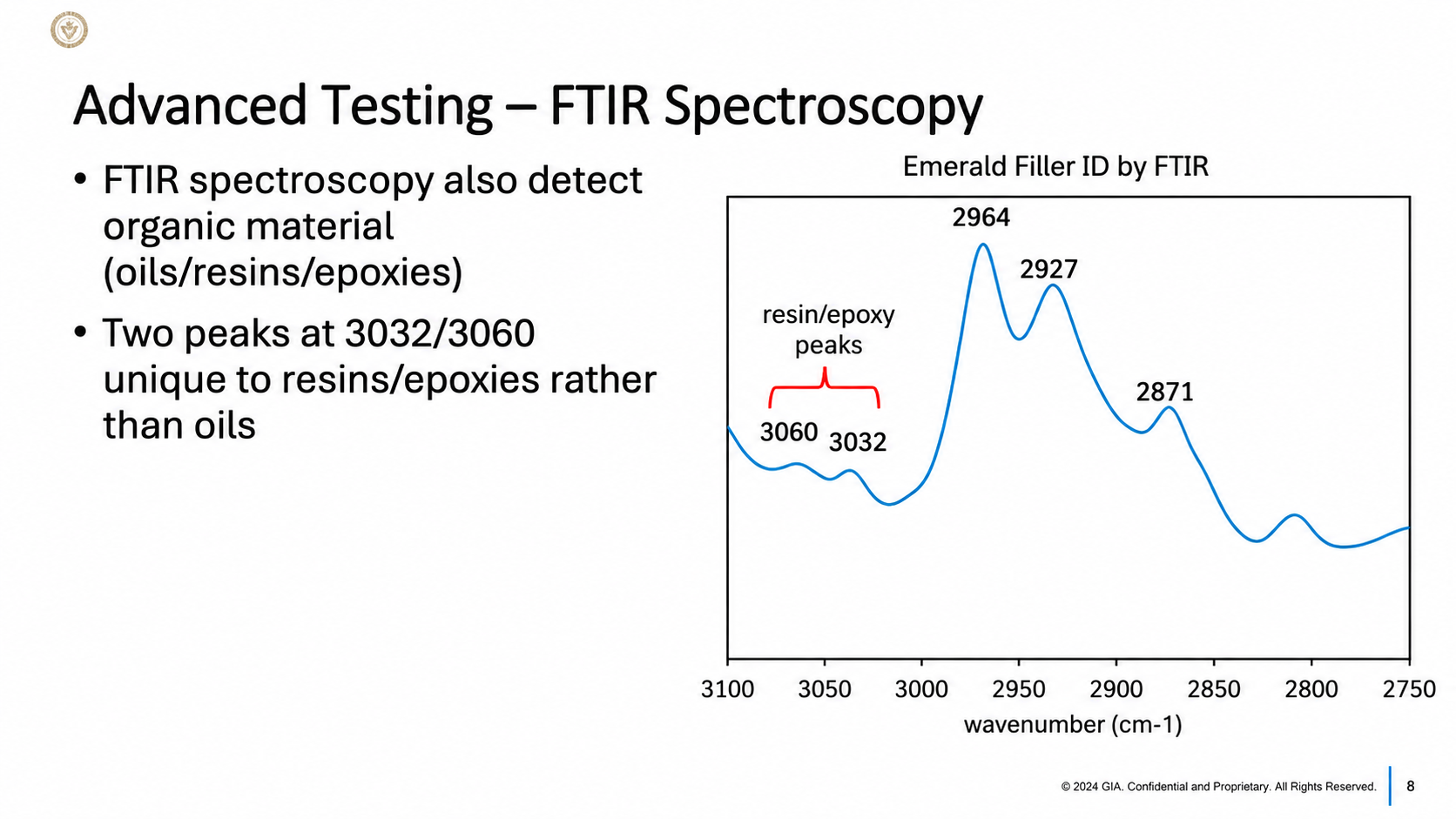
Two clear peaks confirm type B resin/epoxy filler. Image by Dr. Aaron Palke.
Thus, this emerald required three separate advanced testing methods to determine both its origin and the nature of the filling before being sent to a gemologist to create a final report.
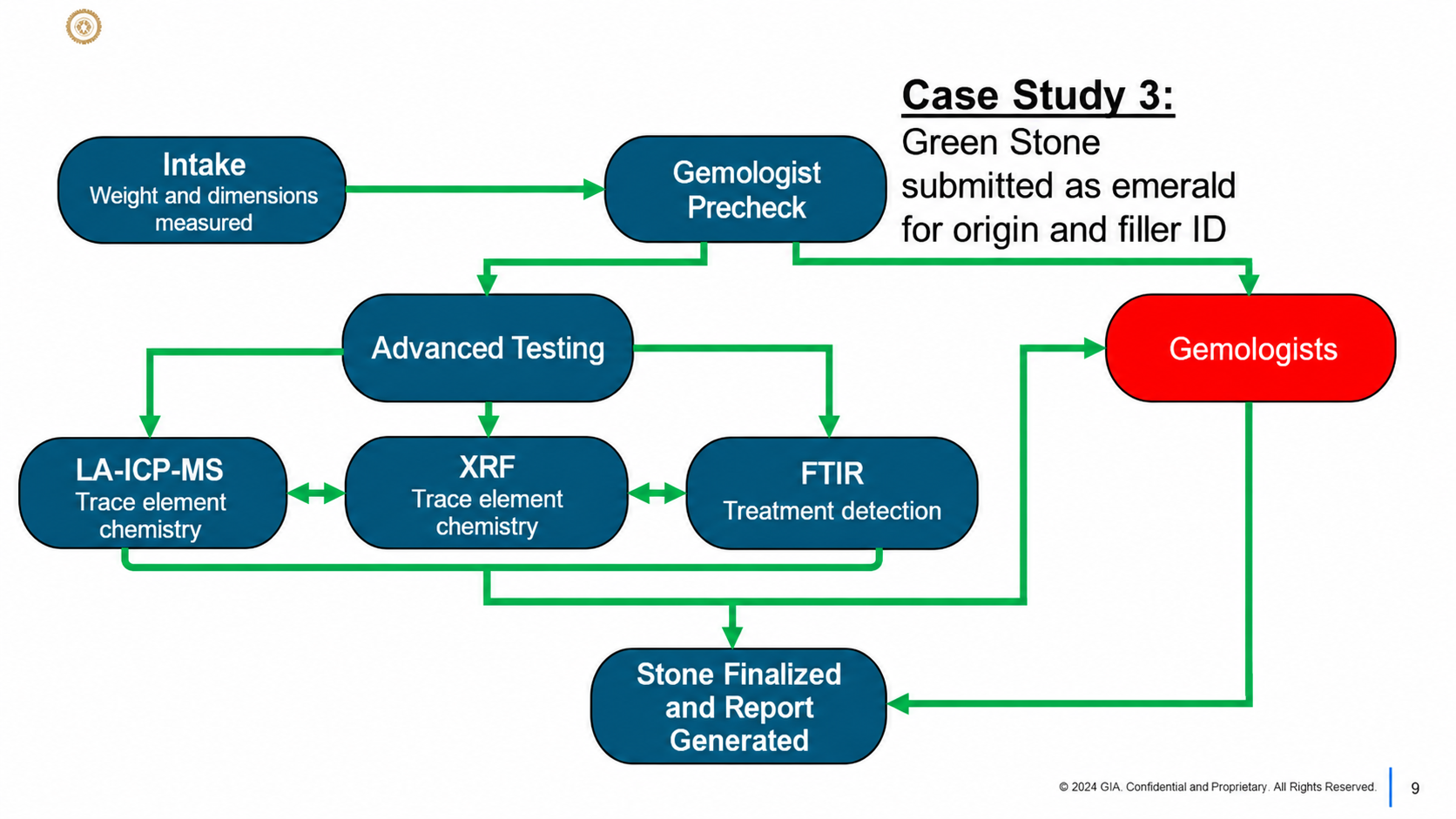
Completing this long pathway took quite a bit of time. Image by Dr. Aaron Palke.
Case Study #4: There Are Circumstances Where GIA Will Not Issue a Report
Finally, Dr. Palke presented a case which demonstrates the limits of current testing technology. A stone was submitted as a sapphire and the precheck analysis showed strange silk inclusions that were broken as well as discoid fractures indicating high-temperature heat treatment. FTIR analysis showed definite beryllium peaks and ICP analysis gave consistent results confirming beryllium diffusion had been performed. GIA will not issue an origin report for beryllium-diffused sapphire as the treatment makes origin determination impossible.
Don’t Throw Away Those Fundamental Tools!
To wrap up his talk, Dr. Palke spoke to what practicing gemologists can accomplish with the standard instruments they trained on. Independent gemologists, like the gemologists at GIA, can most often identify the type of gemstone with confidence. Treatments like high-temperature heating and clarity enhancements are often apparent. Depending on the gemstone type, inclusions might indicate origin.
Things that cannot be determined include beryllium diffusion, heated spinel, low-temperature heating, some synthetics, and clarity enhancement identification. If any of these are suspected or if clients ask about them, stones must be sent to a lab.
Technology Will Keep Advancing
In conclusion, Dr. Palke said that new discoveries like novel synthetics and treatments will continue to require technological innovation and progress. With regards to origin determination, ongoing research is required as materials from new sources are made available on the market. Thus, he states that advanced testing equipment is an integral part of the modern gemology landscape and automation continues to play a role. What is most important for practical gemologists is knowing when to send something to the lab.
Ask an Expert (Human)!
The audience had many questions for Dr. Palke spanning multiple topics, many of which inquired about procedural practices both at the GIA lab and regarding the proper use of some of the advanced machinery. The final question was about the use of AI and its future role in gemology. Dr. Palke said that this is an exciting field, but was careful to stress that he believes that human gemologists will always be needed to interpret nuances.
About the Author:
Emily “D.D.” Frontiere is a gemologist, gems and jewelry appraiser, and freelance writer based in Santa Fe, New Mexico. You can read more of her work here as well as work published by the International Gem Society. ddfrontiere@gmail.com.